

Episode 6: The Pros and Cons of Wisdom
Ancient Egypt produced a great deal of proverbs and wisdom literature. Some of it even slipped into the bible. But how wise is wisdom literature?
| Read Transcription | References and Notes |
| Episode Quiz | Episode Song |
| Episode on Spotify | Episode on Apple Podcasts |
| Previous Show | Next Show |
Ancient Near Eastern Wisdom Literature
Hello, and welcome to Literature and History. Episode 6: The Pros and Cons of Wisdom. In this episode, our final program before turning toward the archaic Greek period, we’re going to explore some of the earliest remnants of a genre writing called “wisdom literature.” We will first consider one of the very oldest literary texts on earth, the “Instructions of Shuruppak,” a Sumerian text from roughly the 2500s BCE, and we’ll then move on to read some Akkadian wisdom literature from a thousand years later, and then finally, two pieces of ancient Egyptian wisdom literature from later still – their names are “The Instructions of Amenemope,” and “The Instructions of ‘Onchsheshonqy.” All told, this episode will feature four different ancient near eastern and Egyptian works that we might call “proverbs lists,” spanning about 2500 years. And whoever you are, and wherever you are, you have already read all four of them.I don’t quite mean that literally. I don’t imagine you have a battered, 1,000-page anthology of Akkadian literature on your bookshelf, nor similar collections of writings from ancient Sumer and Egypt. It’s just that wisdom literature is such a ubiquitous genre of writing, and the lessons that it offers are so relatively consistent throughout the ages, that what you’re going to hear in this episode will feel quite familiar in spite of the exotic sounding names and far off dates of the four texts involved. So let’s start with a definition of “wisdom literature,” beginning with “wisdom” itself.
In literary history and beyond, wisdom has generally been understood as a mental quality most common to those with age and experience. It is worldly familiarity with civilizational customs and practices acquired through long experience, rather than book learning or spontaneous revelation. You can study calculus, physics, violin, sculpture, or gymnastics while very young. Wisdom, however, comes not from youthful ingenuity and industriousness, and not through the acquisition of specialized skills and knowledge, but instead through the general empirical intake of life itself – through travel, meeting many people, weathering some ups and downs, and a great deal of learning all the way.
What Is Wisdom Literature?
To move on to a definition of “wisdom literature,” then, narrowly speaking, wisdom literature is an ancient near eastern genre of writing that offers lessons about life, virtue, how to succeed, what to do, what to avoid, and that kind of thing. A large slab of the Bible is often understood as wisdom literature – that stretch of text that in all canons includes Job, Psalms, Proverbs, and Ecclesiastes, and in some canons, also includes the Wisdom of Solomon and Book of Sirach. The Biblical book of Proverbs, in particular, is likely the most famous extant piece of wisdom literature – Proverbs is a long list of short teachings on how to live well and be a good person. The Book of Proverbs tells you, “A fool takes no pleasure in understanding / but only in expressing personal opinion” (Prov 18:2), and “Those with good sense are slow to anger, / and it is their glory to overlook an offense” (19:11).1 That is wisdom literature, and what it sounds like – it’s generally pithy advice for life. And whether it’s in the Bible, or in Egyptian hieratic script, or Akkadian or Sumerian cuneiform, or Greek or Latin, ancient wisdom literature often gives pretty similar advice from time to time and place to place.It generally counsels you to err on the side of caution, to be moderate rather than extravagant, to be realistic and not prideful, to be pious toward the gods, to listen more than you talk, to be kind to the powerless, and to adopt various commonsensical behaviors related to various ancient industries like farming, horticulture, animal husbandry, and trade. Ancient near eastern wisdom literature’s advice ranges from timelessly profound to weird and incomprehensible, and everything in between. In general, the genre adopts a gently conservative attitude, valuing the received customs of the ages and inculcating the values of prudence and discretion more than encouraging innovation and pioneering one’s own path.

Champollion’s table of Greek, Demotic, and Hieroglyphic, produced in the early 1820s. In this image, we see, concisely, what the Rosetta stone enabled – a window into a world 4,000 years before our own.
However, wisdom literature can also be pretty dull, and pretty nasty, too. Human civilizations have very different values from one another, and so in some cases, what one civilization holds as timeless wisdom can be quite unappealing to a different civilization. The scribes of bygone Mesopotamia and Egypt who set down the texts that have come down to us assumed slavery to be a natural social institution, and they wrote and copied so many casually misogynistic statements that what they left behind makes for strange read – sometimes pretty profound, and at other times, so incongruent with modern values that they make us wince. However, as I said in the first episode of this podcast, literature is a search for familiarity and for differences. Over the remainder of this episode, we’ll explore how the great civilizations of the Fertile Crescent thought about what it was to be wise, and how what they perceived as wisdom compares to what we understand as wisdom.
So let’s begin with an exceedingly old chunk of wisdom literature – literally a chunk of baked clay tablet, in this case, generally dated to about 2,500 BCE and found around 100 miles southeast of Baghdad down the Tigris-Euphrates floodplain. This text, called “The Instructions of Shuruppak,” will begin to show us the many ways that, as the title of this episode is intended to convey, the wisdom of any age has its pros and cons. [music]
The Bronze Age Intelligentsia: A Metropolitan Class
Our first text is once again from ancient Sumer, and it’s called “The Instructions of Shuruppak.” Put briefly, in “The Instructions of Shuruppak,” a legendary king offers a long list of bite sized morsels of advice to his son – do this and not that, do that and not this, and so on. It’s a short text – about 2,700 words long, or five single-spaced pages. But as far as 4,500-year-old cuneiform goes, “The Instructions of Shuruppak” are in pretty good shape – a lot of it has been readable and translatable. This very old Sumerian text is written in a form very common to ancient near eastern wisdom literature. In the genre, a father often offers advice to a son – often the father and son are a king and prince – or a sage offers advice to a student. Structurally, the advice in wisdom literature, as is the case in the biblical Book of Proverbs, isn’t organized into categories. Instead, it’s once again piecemeal – a series of succinct sayings that change from topic to topic as you proceed forward.Before we listen to the Sumerian King Shuruppak give advice to his son, Ziusudra, let’s get a setting in our minds. When most of us picture ancient Sumer, I think we picture a dry, foreboding place where people were eking out a hardscrabble existence and occasionally chiseling cryptic things into stone. This is inaccurate. Much of what we know about Sumer comes from its writing, and that writing was impressed into damp clay, and that clay came from the vast, fertile wetlands of the Tigris-Euphrates floodplain. Sumer, in 2500 BCE, was a populous, lush, diverse civilization, teeming with all sorts of people and enterprises. The text we’re about to look at alleges to be the words of a king named Shuruppak, but Shuruppak was also a place. During what scholars call the Fara period, the city of Shuruppak was a large town at the heart of urban Sumerian civilization, having all the niceties of Sumerian society at that time – a scribal school, temple, palace, public squares, a canal network, and various public and private businesses that enriched a small aristocratic class.

The Standard of Ur, a set of decorative panels for a box dated to the mid 2500s BCE, the same period of “The Instructions of Shuruppak.”
I know we’ve discussed Sumer before in our podcast, but when we plunge back into the 2000s BCE, it’s always important to remember that the major civilizations of the period were not neolithic outposts, but instead sprawling, metropolitan affairs that were far more similar to modern society than most of us realize. All four of the wisdom literature texts we’ll consider in the remainder of this show were likely produced in urban, riparian civilizations, in which you could walk down a street and see hundreds and in cases thousands of people, and where there were taverns, performance venues, bazaars, workshops, mills, wholesalers, brothels, schools, and moreover all walks of life, from the ultra-rich nobility nibbling delectables on the upper tiers of palaces down to slaves sweating with shovels to build dikes and clean up after any given season’s flood. While Sumerian society, along with later ancient near eastern societies, was complex and had many different strata, those who produced and consumed written material, were fewer in number, and less diverse.
Throughout all of the premodern period, oral literature, sung by bards, was open for business for anyone who wanted to listen. Written literature, however, was far more rarefied, and when we come to a block of cuneiform like “The Instructions of Shuruppak,” in all likelihood we’re looking at a text that was produced for, and by, a wealthy class. Scribal schools cost money, whether in ancient Sumer, Babylon, or Egypt, and while scribes were a sort of white-collar secretarial class, their employers were people of considerable means. As a result of its origins, then, all of the wisdom literature that survives from the ancient world has a tacit class bias – an assumption that readers, while they might not be swimming in silver, are at least of a certain income level, and also, that readers are male. This bias doesn’t make ancient near eastern wisdom literature bad, or anything – it’s not all about selecting the right caviar, or how to build a palace out of palaces, or something like that. It’s just that ancient near eastern wisdom literature wasn’t something that a laborer was going to read at home after working at the brick kiln all day. This was something that, perhaps on the upper balcony of an aristocratic home, a scribe might read aloud to a father and son as they looked out over the city, listened to an evening breeze in the palm fronds, and enjoyed ancient riverine civilization’s beverage of choice – beer.
And speaking of beer, it is time for you to hear the first, and most ancient morsel of ethical philosophy that you’ll hear in Literature and History. To jump right into the 4,500-year-old “Instructions of Shuruppak,” the about halfway through, a maxim advises the reader, “You should not pass judgment when you drink beer.”4 It’s mildly funny and a perfectly decent piece of advice, reminding us that some parts of human life are pretty steady through the ages. Don’t judge people or make consequential decisions when you have a blood alcohol level. Wisdom not for an age, but for all time. Beer, as we learned in previous episodes, was a big part of Sumerian culture and even theology, but of course, the “The Instructions of Shuruppak” are about far more than beer.
“The Instructions of Shuruppak” in Detail
Let me take you through the “Instructions of Shuruppak” now, topic by topic. I’ll make two notes ahead of time. The first is that quotes from this text will come from the from the ETCSL, or Electronic Text Corpus of Sumerian Literature translation, free to all and published by Oxford University Press. The second point I wanted to make is that although some different versions of this text survive, the cuneiform is so old and in places so obscure that translating it, even by trained specialists, is a tricky affair. Thus, I’ve picked passages to quote whose meaning is reasonably certain.
The Sumerian Ram in a Thicket sculpture from the Royal Graves at Ur, dating from around 2600-2400 BCE, around the time of “The Instructions of Shuruppak.” Photo by Jack1956.
While ancient near eastern wisdom literature offers judicious sounding advice on when to speak and not speak, and tells us to keep our money and reputations under close guard, the genre also often gives counsel so obvious that it’s almost funny. “The Instructions of Shuruppak” tell us, “You should not place your house next to a public square: there is always a crowd. . .there” (18). It’s sensible advice, but most of us can understand that there are crowds in public squares. A moment later, the text advises us, “My son. . .you should not cut yourself with an axe” (31). Though this is doubtless good advice in our axe-filled world, it seems like a rather odd thing to actually set down for posterity. Along these same lines, “The Instructions of Shuruppak” warns its listener, “You should not play around with a married young woman: the slander could be serious. . .you should not sit alone in a chamber with a married woman” (33-4). Again, it’s perfectly decent advice, and surely there’s some ancient Sumerian cultural subtext that’s lost in translation, but understanding the basics of monogamous relationships really isn’t so hard to do. In summation, ancient near eastern wisdom literature, from the very beginning of what survives of it, sometimes offers weirdly obvious lessons.
So far, we’ve seen “The Instructions of Shuruppak” provide advice that’s generic, but solid, on watching what you say and being prudent about your associations. And we’ve seen “The Instructions of Shuruppak” present self-evident truisms that don’t seem like they really needed to be set down. The 4,500-year-old Sumerian text, in addition to these first two categories of instructions, also has plenty of cryptic statements that do not make any sense to us, but that, we can presume, would have made sense to ancient Sumerians. For instance, early in the cuneiform tablet, readers are instructed, “You should not sink your hand into blood” (40). I don’t think many of us are tempted to sink our hands into blood today, but just in case that’s a thing that people do in your area, Sumerians during the Fara period found it disagreeable. Toward the end of the tablet, a line cautions us, “You should not throw a lump of earth into the money chest. . .otherwise you will give birth to a son” (247). That one sounds very strange. Equally strange is pair of cuneiform lines that the ECTSL translates as “Let us run in circles. . .saying: ‘Oh, my foot, oh, my neck!’ Let us with united forces. . .make the mighty bow!” It’s hard to determine what this might have meant thousands of years ago, but today, it sounds like gibberish.
So far, then, we’ve learned that very ancient wisdom literature can indeed sound quite wise, and that sometimes it tells us obvious stuff, and that sometimes it’s so rooted in old metaphors and superstitions that we can’t make any sense of it. In addition to all of this, ancient near eastern wisdom literature, as universal as it generally intends to be, always bears the ideological fingerprint of the culture that produced it. As an example, several lines in “Instructions of Shuruppak” discuss the mountains. To the Sumerian gentility, living comfortably down in the cities of the Tigris-Euphrates floodplain, the mountains in question were the Zagros mountains. The Zagros range, today, forms the eastern boundary of Iraq, and back in 2,500 BCE, to Sumerians, the eastern mountains, foothills, and highlands were a threatening border zone, beyond which were other cultures, chief among them the Elamites. “The Instructions of Shuruppak,” at one point, tell us, “On the unfamiliar way at the edge of the mountains, the gods of the mountains are man-eaters. They do not build houses there as men do; they do not build cities there as men do” (267-71). It sounds pretty scary. So, too, does “The need for food. . .brings traitors and foreigners, since the need for food brings down. . .people from the mountains” (178-80). In both of these cases, if we didn’t know we were reading Sumerian wisdom literature, we’d be a little bit puzzled. But literate Sumerians were generally flatland folks who paddled between parties on canal boats, and to them, the eastern highlands were an ominous place, and so they left behind adages that mountains and hill-dwellers were best avoided.
Wisdom literature, as we’ve seen so far, can be wise, it can state the obvious, it can be unintelligible, and it can tell us things about the culture that produced it. There’s another general truism about wisdom literature that we also learn right away from the oldest extant piece of it – the “Instructions of Shuruppak” that we’ve just been discussing. And that is that the ancient Sumerians, Babylonians, Egyptians, Jews, Greeks, and Romans who enjoyed wisdom literature were most often people who had money. Written literature, always in antiquity, was the domain of the privileged few. A great big crowd might gather around to hear a bard sing about Gilgamesh, or the saga of Isis and Osiris, or Odysseus. But wisdom literature, being non-narrative lists of maxims and truisms, isn’t really blockbuster material in the same way that Heracles punching hydras is. In a Christian Bible, Proverbs is nice, but people don’t know it as well as they do the Gospels or the narrative portions of Genesis, because and it’s easier for us to latch onto stories with characters than long sequences of impressive-sounding dictums.

One the numerous statues of Gudea of Lagash (c.2120 BCE), the monarch who commissioned the famous Cylinders of Gudea.
Although antiquity sometimes surprises us, ancient Sumer and the civilizations that descended from it were patriarchal, slaveholding societies, and the wisdom literature that they left behind of course reflects the values of such societies. But again, while ancient near eastern literature can seem long ago and far away, a lot of it does offer commonplace truisms that we’re still passing around today. And even the very earliest piece of it, “The Instructions of Shuruppak,” is far more closely connected to the cultural world that you know than you may realize.
There’s something I didn’t tell you about “The Instructions of Shuruppak,” which has to do with the king and the prince whose names occur at the beginning of the text. Earth’s earliest known philosophical document opens with the following words: “In those days, in those far remote days, in those nights, in those faraway nights. . .[Shuruppak], the wise one. . .gave instructions to his son [Ziusudra].” Ziusudra was not some random prince. Ziusudra, as you may remember from an earlier episode, was the hero of the Sumerian flood story called the Eridu Genesis, the earliest extant version of the ancient Mesopotamian flood myth. In the Eridu Genesis, a wrathful god decides to destroy humanity with a flood, and a beneficent god elects to keep us alive, encouraging a pious mortal named Ziusudra to build a boat and fill it with pairs of living creatures. Ziusudra survives the flood, and a new covenant between humanity and the gods is passed, and that’s the end. Ziusudra, then, the recipient of all of the advice in “The Instructions of Shuruppak,” was the earlier version of the Akkadian hero Atrahasis, who was an earlier version of the Biblical Noah, reminding us some of the Bible’s most famous stories share some of the cultural DNA of ancient Sumerian and Akkadian literature. [music]
Akkadian Wisdom Literature
So, now that we’ve had an introduction to wisdom literature and gone through “The Instructions of Shuruppak,” let’s go deeper into the Bronze Age, and into the world of Akkadian language literature. Akkadian cuneiform, as a reminder, was the international language of the ancient near east for almost 2,000 years, with the first Archaic Akkadian inscriptions extant around 2300 BCE, and the latest, around 100 BCE, although the language’s apex stretched from about 1850-1000 BCE.5 Akkadian came after Sumerian, although Akkadian intellectuals, following the decline of Sumerian civilization around 2000 BCE, kept writing and speaking Sumerian in much the way that medieval Europeans used Latin as a storied literary language ages after the fall of Rome. Akkadian language and culture, as a result, were thoroughly steeped in the literature and religion of ancient Sumer.I’m going to read you some quotes from a handful of wisdom literature texts from the mature period of Akkadian cuneiform, so our timeframe over the next few minutes is going to be about 1500-1000 BCE. Quotes will come from editor Benjamin Foster’s gigantic anthology of Akkadian literature, Before the Muses, published by CDL Press in 2005, which gathers a number of different Akkadian language wisdom literature texts into one section. To begin, just because I want to emphasize that ancient near eastern wisdom literature really is worth reading, and that its profundity sneaks up on you, let’s hear some Bronze Age Akkadian maxims that are, in my opinion, actually pretty wise.
Perhaps the most appropriate quote for this entire episode is the statement, “The life of yesterday was repeated today.”6 The statement brings to mind the world-weary opening of the biblical Ecclesiastes: “there is nothing new under the sun” (Ecc 1:9).7 The Akkadian version of the adage, however, “The life of yesterday was repeated today,” nicely points to the repetitious, cyclical nature of individual experience. We do a lot of the same stuff from day to day. Maybe that’s why a lot of wisdom literature still rings true even though it’s thousands of years old. Another similar Akkadian adage is, “You went and plundered the enemy territory, / The enemy came and plundered your territory” (428). Here, some old sage reminds us that harsh deeds come back to us, and another says, “Be fair to your enemy, / Let your mood be cheerful to your opponent. / Be it your ill-wisher, tre[at him generous]ly” (413). These proverbs are sound advice. Be a decent person, even to those who antagonize you; if you do something mean, you’ll get comeuppance for it; and everything that’s happened to you has happened before. And in a final Akkadian proverb that I think is quite insightful, another late Bronze Age hunk of cuneiform warns us, “When you commit a crime (out of weakness), / The [river] will bear (it) away. / When you commit a crime (from a position of power), / Heaven itself will forsake you” (428). Though wisdom literature does generally have an upper class bias, at the same time, Mesopotamians understood that poverty and hunger cause crimes of necessity, whereas the recreational cruelties of the wealthy are far severer transgressions.
While Akkadian wisdom literature has some genuine zingers like the ones I just quoted, it also contains a great deal of wisdom literature’s greatest hits. One text says, “Hold your tongue, watch what you say. / A man’s pride: the great value on your lips. . .Speak nothing slanderous, no untrue report. / The frivolous person is of no account” (412). A great deal of wisdom literature essentially tells you to be prudent and watch your mouth, as you just heard there. Another common theme is to keep your head down and avoid conflict, as in the Akkadian saying, “When confronted with a dispute, avoid it, pay no heed. / If it is a dispute with you, put out the flame, / A dispute is a wide-open ambush” (412). Another still is to be moderate in your appetites, as in the rather unimpeachable, “do not frequent public houses, / [Excessive drinking, gluttony] bloat the body” (416-417). In ancient Babylon just as much as today, people knew that tons of beer wasn’t great for you.
Akkadian wisdom literature, like all ancient near eastern wisdom literature, assumes the listener to be male and wealthy. One Akkadian text warns against letting a sex slave have too much control of one’s household (413), and another says, “Man is the shadow of god, and the slave the shadow of man” (434). Another surviving adage tells its listener, “Do not open your heart (too much) to a woman you care for, / Seal it up, however much she cuddles. . .[you]” (418). While this is some of the worst relationship advice in history, women are frequently portrayed as untrustworthy blabbermouths or seductresses in ancient near eastern wisdom literature. A lovelorn man in the Biblical Book of Proverbs is likened to “an ox to the slaughter. . .like a bird rushing into a snare, not knowing that it will cost him his life” (Prov 7:22,3).
However, although ancient near eastern wisdom literature is frequently misogynistic and classist, it can be quite the opposite, as well. A common idea in the genre is the necessity of giving to the poor, as in this Akkadian proverb:
Do not despise the miserable. . .
Do not wrinkle up your nose haughtily at them.
One’s god will be angry with him for that. . .
Give food to eat, beer to drink,
Present what is asked for, provide for and honor.
One’s god will be happy with him for that. . .
Do good deeds and be helpful all the days of your life. (413)
That is, again, an Akkadian language saying from some time between 1500 and 1000 BCE, and it shows that wisdom literature can and often does inculcate the moral necessity of charity just as much as it generally accepts slavery as a natural social institution. And ancient near eastern wisdom literature, can also, from time to time, be surprisingly feminist. Here’s one for the ages. A speaker in an Akkadian proverb – one I can only assume is a woman – proclaims, “My vagina is fine, (though) some of my folks / consider me a has-been; / It’s all fine, and I still (need to) wear a tampon” (427). The word “tampon” there is not a literal translation from the Akkadian, of course, but the meaning of the statement is clear – I’m fine, I’m a bit older, but my vagina is doing great. That – what we might call body positive – quote isn’t something we would find in the Bible. But to be fair to the Bible, although the Book of Proverbs has a couple of derogatory swipes at women, it also personifies wisdom itself as a woman, calling out proudly in streets and squares to enlighten people with her teachings, bellowing, “How long, O simple ones, will you love being simple? / How long will scoffers delight in their scoffing / and fools hate knowledge?” (Prov: 1:22-3).
So to wrap up the Akkadian portion of this program, it’s important to understand that even by, say, 1200 BCE, wisdom literature was already an old genre, with some fundamentally bourgeois values, but that it was also flexible. By the time of the Bronze Age Collapse, wisdom literature texts were cautioning readers to be conservative and cagey, but also, generous and honest; they were leery of illicit relationships with women, but also sometimes quite positive about women; they reveal casual prejudices against slaves and the poor, but they also reveal casual prejudices against the rich. Reading what survives of ancient near eastern wisdom literature in Sumerian and Akkadian anthologies, we see a sprawling genre that spanned thousands of years, in which one proverb is dull, the next culturally incomprehensible, the next deeply insightful, and the one after that dull again. As assorted as it is, Sumerian and Akkadian wisdom literature is really, once again, earth’s earliest surviving ethical philosophy, a grab bag of truisms that provides in punchiness what it lacks in sustained argument.
Now that we’ve had a good, long introduction to what wisdom literature its, and learned about its diversity and its deep, old roots in Mesopotamia, let’s head back to ancient Egypt. We’ve considered the ancient Egyptian Book of the Dead, and we’ve read some ancient Egyptian fiction, too. In addition to theology and fiction, though, Bronze and Iron Age Egyptians loved wisdom literature just as much as their neighbors, and the lands of the Nile left behind some pretty canonical wisdom literature texts that are fixtures of Egyptology courses today. So, let’s take a look at the two most famous pieces of wisdom literature from Egypt, and see what they have in common with what we’ve seen so far, and how they’re different, too. [music]
The Ancient Egyptian “Instructions of Amenemope”
The final two texts we’ll look at in this program are very straightforward. Although they were produced in different times in Ancient Egyptian history – one during the late New Kingdom near Abydos, in central Egypt, around 1100, and the next a thousand years later in nearby Akhim, the stories are structurally and thematically very closely knit. Each narrative inculcates values common to wisdom literature that we’ve already heard: think before you speak, be honest in your dealings with others, be kind to the disenfranchised, avoid fools and keep company with the wise, etc. The first story is about twenty pages long, and the second about thirty. In fact, the only tough thing about these narratives is that their titles include exotic and unfamiliar Ancient Egyptian names. “The Instructions of Amenemope” is the title of the first, and “The Instructions of ‘Onchsheshonqy” the title of the second. If you forget the chronology of these two narratives, just remember that Amenemope, the one set down around 1100 BCE, came before ‘Onchsheshonqy, the one set down around 100 BCE, just as A comes before O.Let’s hear some samples of what Ancient Egypt’s wisdom literature sounds like, beginning with “The Instructions of Amenemope,” a document in which a wise sage and scribe gives advice to his son. “The Instructions of Amenemope” dates from the fall of the New Kingdom, some time around 1100 BCE, making it the youngest text we’re looking at in this program thus far. All of the quotes from ancient Egyptian wisdom literature in the remainder of this program will come from an anthology called The Literature of Ancient Egypt, edited by William Kelly Simpson and published by Yale University Press. I’m going to read about a page and a half of the seventeen pages that make up the main narrative of “The Instructions of Amenemope.” So far, you’ve heard wisdom literature in bits and pieces, but I think a longer excerpt will help you walk away from this episode with a good general idea of what wisdom literature is, and what it’s actually like to read the genre for yourself.
So here’s the opening of “The Instructions of Amenemope,” or what we might call the epigram. The whole thing begins with the words:
[This is] [t]he beginning of the instruction about life,
The guide for well-being. . .
[It will] set one straight on the paths of life,
And make him prosper on earth. . .
save him from the talk of others, . . .
[and make him] one who is respected in the speech of men. . .
You will discover my words to be a treasure house of life,
And your body will flourish upon earth.8
And following that preface, the advice begins in earnest.
Beware of stealing from a miserable man
And of raging against the cripple.
Do not stretch out your hand to strike an old man,
Nor snip at the words of an elder.
Don’t let yourself be [set] on fraudulent business,
Nor desire the carrying out of it;. . .(226)
Do not get into a quarrel with the argumentative man
Nor incite him with words;
Proceed cautiously before an opponent,
And give way to an adversary;
Sleep on it before speaking,
For a storm come forth like fire in hay is
The hot-headed man in his appointed time. . .(227)
Do not take by violence the shares of the temple,
Do not be grasping, and you will find abundance;
Do not take away a temple servant
In order to do something profitable for another man.
Adhere to the silent man, you will find life,
And your body shall flourish upon earth.
Do not displace the surveyor’s marker on the boundaries of the arable land,
Nor alter the position of the measuring line;
Do not be covetous for a single cubit of land,
Nor encroach upon the boundaries of a widow. (228)
If you spend your life with these things in your heart,
Your children shall observe them. (227)
And again, those were some of the opening maxims from “The Instructions of Amenemope,” an Egyptian text from around 1100 BCE.
The contents of “The Instructions of Amenemope” are pretty well represented in what you just heard. In the order of the excerpt above, the text teaches Amenemope’s son to be kind toward the disenfranchised, to be honest in business, to avoid overly combative people, to think before opening his mouth, not to steal from religious institutions, (again) to think before opening his mouth, not to tamper with legally ordained boundary markers, and then (again) to be kind toward the disenfranchised.
Overall, “The Instructions of Amenemope,” like its Sumerian and Akkadian predecessors, presents a coherent ethical system characterized by caution, conservatism, and a related respect for the existing socioeconomic order. You could open almost any piece of wisdom literature alongside Amenemope’s instructions – say Proverbs in the Bible or Ben Franklin’s Poor Richard’s Almanac, copy and paste some statements back and forth, and, for the most part, not know the difference.
“The Instructions of Amenemope” and the Biblical Book of Proverbs
Of all the wisdom literature we’ve looked at so far in this show, “The Instructions of Amenemope” is probably the most famous text. This is because “The Instructions of Amenemope” has very close parallels to the Biblical Book of Proverbs. For good or for ill, if something Sumerian, Akkadian, or ancient Egyptian sounds like it might have influenced the Bible, people tend to pay a bit more attention to it, and to hypothesize about how ancient Hebrew scribes might have borrowed from the older civilizations around them. The idea that parts of the Bible might have been adapted or plagiarized from earlier sources, of course, ruffles feathers in some circles. Nonetheless, a coolheaded and commonsensical approach to Biblical borrowings shows that while many ideas in the Old Testament were pervasive in Mesopotamia and ancient Egypt before the Bible was written, there’s very little in the Tanakh that actually looks copied and pasted from elsewhere. So let’s take a moment and hear some of the closer parallels between the Biblical Book of Proverbs and the “The Instructions of Amenemope.” Just to be very clear, by the way, “The Instructions of Amenemope” are again generally dated to roughly 1100 BCE, whereas Proverbs is a younger text, and was probably cobbled together from many different sources over the next millennium.In my own notes, I have a big table of parallels between Amenemope and Proverbs, but a podcast isn’t a great to go through such granular details, so again, let’s just look at the closest parallels. First, Amenemope says, “Beware of stealing from a miserable man / And of raging against the cripple” (226). Proverbs says, “Do not rob the poor because they are poor, / or crush the afflicted at the gate” (22:22). That’s a pretty close parallel. Amenemope says, “Do not deal with the intemperate man” (234), and Proverbs, “Make no friends with those given to anger” (22:24). Amenemope says, “Do not pour out your words to others” (239), and Proverbs, “Do not speak in the hearing of a fool” (23:9). And a final fairly close parallel can be observed on the transience of wealth. Amenemope says that riches “will make themselves wings like geese, / And fly up to the sky,” just as Proverbs says that money “suddenly. . .takes wings to itself, flying like an eagle toward heaven” (23:5). There are more parallels than these, but again, this is dense stuff to go through in a podcast episode, so let’s zoom out and consider what these parallels can teach us.
There are definitely some comparable maxims to be found in “The Instructions of Amenemope” and the Biblical Book of Proverbs. Rather than leading us to conclude that Jewish folks copied the work of Egyptian folks, though, the parallels between Amenemope and Proverbs should remind us of something very obvious. The ancient near east, from Sumer in 2500 BCE down to Jerusalem in 500 BCE after the Babylonian Captivity, was a culturally interconnected place. The Fertile Crescent, during the Bronze Age and Iron Age, was full of all kinds of cultural borrowings. Of course Mesopotamians and ancient Israelites told similar flood stories. Of course ancient Mesopotamians and Egyptians and Israelites shared similar proverbs. Wisdom literature, in particular, isn’t about originality, it’s about understanding how to use the lessons and discernment of those who have come before. If, then, the Book of Proverbs does borrow from older ancient near eastern wisdom literature, which it probably does to some extent, that borrowing is to be expected for the genre. [music]
“The Instructions of ‘Onchsheshonqy”
Now that we have a good all-around sense of wisdom literature, including some ancient Egyptian wisdom literature, let’s turn to our final text. This final text is called “The Instructions of ‘Onchsheshonqy,” and it is the youngest, and final ancient Egyptian text we’ll look at in the main sequence of Literature and History. In it, a prominent priest named ‘Onchsheshonqy offers instructions to his son. “The Instructions of ‘Onchsheshonqy” was likely set down during the final three centuries BCE – with proverbs lists, dating is especially difficult because the proverbs themselves come from many different periods. This is a very late text, and as we’ll see in a moment, it likely reflects some of the changes sweeping through the lands of the Nile in the final few centuries BCE.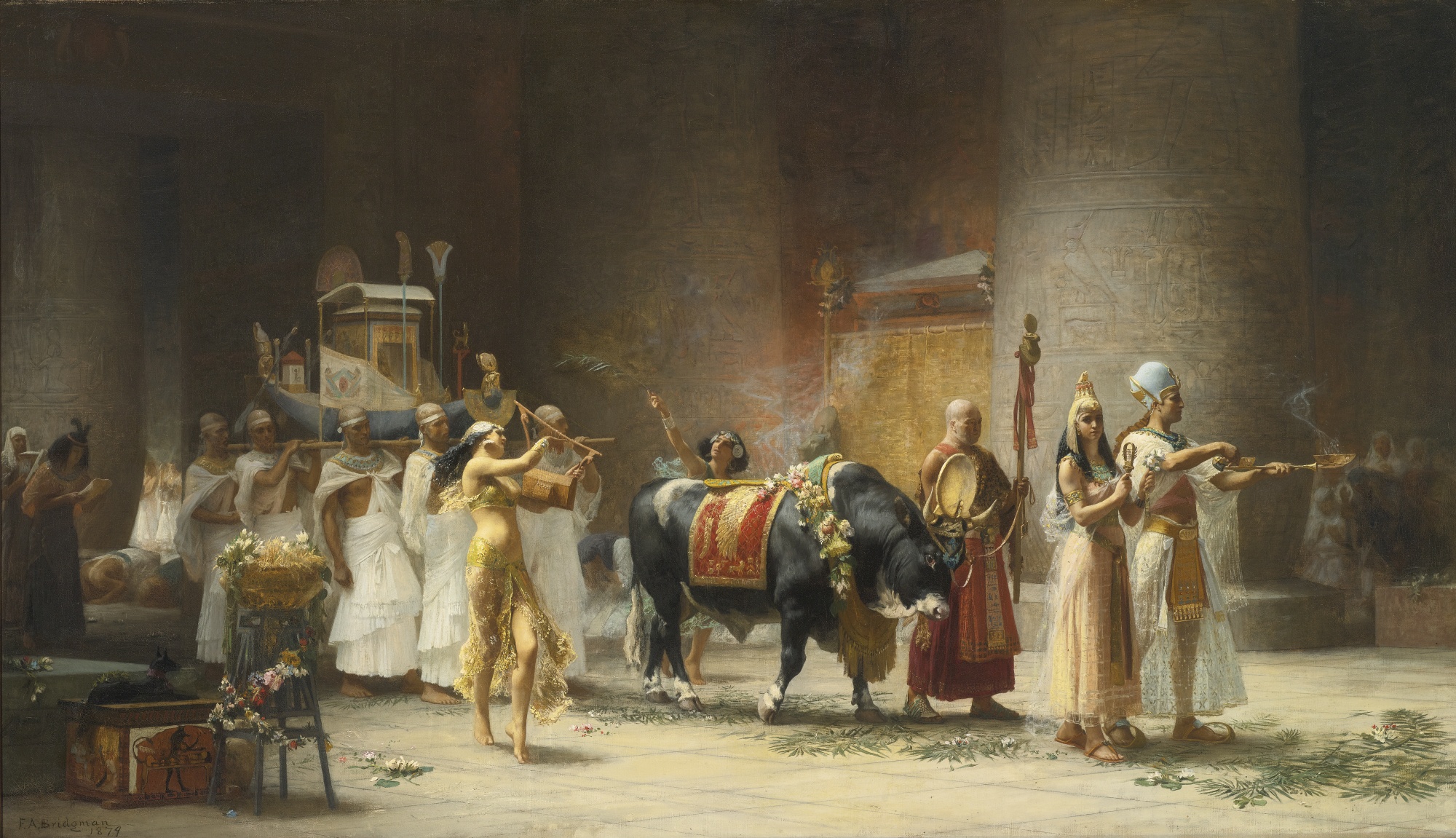
Frederick Arthur Bridgman’s The Procession of the Bull Apis (1879). The bull was understood as a living embodiment of Ptah (later Osiris).
As with so many ancient near eastern proverbs lists, “The Instructions of ‘Onchsheshonqy” has some stuff that sounds familiar. For instance, ‘Onchsheshonqy tells the listener, “Do not do evil to a man so as to cause that another do it to you” (511). That sounds a bit like the Golden Rule of the Book of Luke, just as it sounds like the old Akkadian adage we heard earlier, “You went and plundered the enemy territory, / The enemy came and plundered your territory,” essentially, what goes around comes around. Just as “The Instructions of ‘Onchsheshonqy” has proverbs that are pretty timeless, the text contains a handful of amusingly incomprehensible morsels of advice, as well. The text warns us, “Do not give a weary look toward the door bolt” (516). I don’t know what to make of that. Another curious one is, “If you are powerful, throw your documents into the river. If you are weak, throw them also” (517). That’s another very late Egyptian proverb that’s just hard to make sense of. As with other wisdom literature texts we’ve read in our show, there are proverbs in “The Instructions of ‘Onchsheshonqy” that are so obvious that they’re inadvertently funny, like, “A man who looks in front of himself does not stumble and fall” (513). While this is doubtless true, it is perhaps a proverb more pertinent to toddlers than anyone else. In short, “The Instructions of ‘Oncheshonqy” contains the usual slurry of profundity mixed together with incomprehensibility mixed together with the readily apparent.
It is very important to understand ancient near eastern wisdom literature as a long and interconnected genre in which texts from centuries apart have many shared features. But since we’ve been discussing ancient Egypt for the past few episodes, let’s consider the aspects of “The Instructions of ‘Onchsheshonqy” and before it “The Instructions of Amenemope” that are more distinctly Ancient Egyptian in origin. One of the most prominent aspects of these two texts is a pervasive sense that you should not strive beyond your station. Ancient Egypt’s wisdom literature is thoroughly filled with proverbs and maxims on how to best position oneself within the social pyramid, to use an appropriate word. The general sense in “Amenemope” and “‘Onchshesonqy” is that the wise know their place, and only fools try to climb the social ladder. More than, say, Hesiod’s Works and Days or Biblical books like Proverbs, Sirach, and the Wisdom of Solomon, all produced around the same time, the scribes of Ancient Egypt believed it was important for young people to understand their country’s rigid pecking order.
Let’s look at some examples, drawn from both the 1100 BCE “Instructions of Amenemope” and the “Instructions of ‘Onchsheshonqy” from about a thousand years later – examples that, again, show the texts’ preoccupation with social hierarchy. This is again the Simpson translation, published by Yale University Press in 2003. Here they are.
When you are too free before your superior,
Then you are in bad favor with your subordinates. (233)
Do not sit in the beer hall
Nor join someone greater than you,
Whether he be low or high in his station.
An old man or a youth
But take as a friend for yourself someone compatible. . .
When you see someone greater than you outside,
Follow him, respect (him). (242)
Do not act overly familiar with the one who is greater than you. (506)
Do not go off after being beaten, lest your punishment be doubled. . .(506)
Do not eat a meal in the presence of a magistrate,
Nor set to speaking first.
There is no one who insults his superior who is not himself the one insulted. (521)
If you are about to say something before your master, count on your hand up to ten. (523)
Learn the manner of sending word to the palace.
Learn the manner of sitting in the presence of Pharaoh.
Learn the ways of heaven.
Learn the ways of earth. (526)
So collectively, these maxims that I just read teach obedience, reverence toward authority, and complacency within the social hierarchy. These ideas are unavoidable within Egypt’s unique brand of wisdom literature. The social posturing encouraged by the above maxims might simply be evidence of scribes paying deference toward their own employers and masters. But it is more likely that these admonitions to bow down before authority did constitute practical advice during the ruthlessly autocratic 31 dynasties of Egypt, and the chaotic periods that punctuated them.
It’s little surprise that ancient Egypt’s wisdom literature sounds Egyptian. Just as the Biblical Book of Proverbs tenaciously drives home the worship of Yahweh, or Thoreau’s Walden articulates rugged New England transcendentalism, Egypt’s wisdom literature also demonstrates that what constitutes wisdom varies somewhat from culture to culture. But Egypt’s wisdom literature reveals more than simply a cultural preoccupation with social hierarchy. “The Instructions of ‘Onchsheshonqy,” in particular, bears the marks of the period that produced it – the bloody and chaotic sunset of Ancient Egypt’s history.
Signs of Crisis in “The Instructions of ‘Onchsheshonqy”
By 100 BCE, Egypt was not the solitary autocracy that had built the great pyramid in the 2500s, nor the great imperial power it had been in the 1270s under Ramesses II. A series of foreign peoples had conquered the country – Hyksos from the north, then Libyans from the west, then Kushites form the south, and then Persians from the east. In 304 BCE, Egypt became subject to the Macedonians under the descendants Alexander the Great. By the 200s, the Ptolemaic Greek dynasty of foreign rulers in Egypt was rotting at the core. Incest, betrayal and murder plagued the ruling regime, and in the south, armed rebellions, peasant revolts, and banditry disrupted the production of goods and the flow of commerce. The Rosetta Stone, which was issued in 196 BCE to commemorate the coronation of Ptolemy V and his victory over native Egyptian rebels, has Egyptian hieroglyphs at the top, Demotic, or administrative and legal Egyptian, in the middle, and Greek at the bottom. A royal decree, the Rosetta Stone was Ptolemy V’s attempt to institute a lasting Greco-Egyptian government, with the Greeks in charge, effectively as pharaohs. But Ptolemy V was captaining a leaky ship. The Egyptian pharaohs of old had once been thought of as divine, but the embattled rulers who made up the late Ptolemaic dynasty hardly encouraged reverence or worship. They were not Egyptians – they were sacrilegious outsiders who brought neither stability nor imperial conquests. The Rosetta Stone, while it’s been priceless to modern linguists, was in its own time the symbol of a failed attempt at political consolidation.So Egypt was falling to pieces by 100 BCE. Its successive conquerors over the past thousand years had all sought control of the mineral rich lands of Nile, envisioning Egypt’s legendary stores of gold, grain, and grazing lands. In the time that ‘Onchsheshonqy was set to papyrus, though, a conqueror had risen who would totally annex Egypt, and turn it into a breadbasket for a long time. This conqueror would not wield a Greek hoplite spear, but instead a Roman gladius. The Roman Republic had spent over a century tightening its grip over Egypt’s satellite lands. The final collapse of Egypt, a story that involves some of the most famous people in ancient history, took place in the summer of 31 BE. Queen Cleopatra, born to Ptolemy XII in 69 BCE, had tried to maintain Egypt’s relative independence through her unions with first Julius Caesar and then Mark Antony. And when she died in on August 12, 31 BCE, Egypt lost its sovereignty – not to regain again it again for nearly two thousand years.
It’s difficult to imagine the cultural trauma involved when a three-thousand-year-old civilization is battered by a series of increasingly rapid conquests. Everything the Ancient Egyptians knew – their religion, their economy, the languages spoken in their country, the trade networks – were rearranged or threatened sequentially during the first millennium BCE. Perhaps the most emblematic way to explain what happened to them with the death of Cleopatra is a famous anecdote about their geography. The Nile flows northward, and Egyptian maps put the source of the Nile to the north. Thus, rotate a map of North Africa and the Levant a hundred and eighty degrees, so that south is north, and you have the way that Egyptians viewed the world for thousands of years. When the first Roman emperor Augustus demoted Egypt to a province of the new Roman Empire, the world of the Egyptians was literally turned upside down.
So let’s get back to “The Instructions of ‘Onchsheshonqy,” a text written during some dark years of ancient Egyptian history. The instructions, overall, seem surprisingly immune to stricken lamentations about the end of the world. Instead, ‘Onchsheshonqy plods imperturbably onward, offering his counsel. I should note that the frame narrative is supposed to take place during an earlier period of ancient tEgyptian history – the 500s BCE, and so maybe we shouldn’t expect ‘Onchsheshonqy to say anything about the apocalypse of the first century BCE. But still, even though “The Instructions of ‘Onchsheshonqy” are set during an earlier period, and even though the piece is supposed to disclose timeless wisdom unto its recipient, the text still shows some evidence of the chaos and trauma of Egypt’s final century. Let’s look at some examples.
The first is a series of five hopeful statements that wish desperately for a coherent social structure. The statements are unique within the “‘Onchsheshonqy,” because they are not instructions or proverbs, but instead, lamentations. They are:
[If only] the son were more honored than his father!
[If only] it were the master’s son who became master!
[If only] the moon succeed the sun, without failing to appear!. . .
[If only] I knew my neighbor, that I might give to him my property!
[If only] I knew my brother, that I might open my heart to him! (510)
The speaker of these lines from “The Instructions of ‘Onchsheshonqy” is alone in a world with no family or friends, where the celestial orbs, long the paramount emblems of Ancient Egyptian worship, are failing to function. Let’s look at another section.
This next portion of “The Instructions of ‘Onchsheshonqy” is simple. ‘Onchsheshonqy considers the cataclysmic changes taking place, and concludes that these changes are the result of the wrath of their principal deity.
If [God] is angry at a land, its ruler will abandon the law.
If [God] is angry at a land, he will cause the laws to cease within it.
If [God] is angry at a land, he will cause purity to cease within it. . .
If [God] is angry at a land, he will elevate its humble men, and he will humble its great men.
If [God] is angry at a land, he will cause the fools to be rulers of the educated. . .
If [God] is angry at a land, he will make its bureaucrat to be the authority over it.
If [God] is angry at a land, he will make its washerman to be chief of police. (504)
So in that portion of the “Instructions of ‘Onsheshonqy,” you can see Onsheshonqy trying to understand the social order of first century BCE Egypt. The topsy-turvy rearrangement of the social order we glimpse here is the vision of an educated Egyptian scribe, familiar with his country’s customs and culture, and can only imagine that Egypt’s decline is the result of God’s anger. [music]
Ancient Egyptian Wisdom Literature in Hindsight
“The Instructions of ‘Onsheshonqy” suggests an overall melancholy and retrospection in the twilight of ancient Egypt’s 3,000 years as an autonomous political unit. The text, as we’ve seen, inculcates traditionalism, wanting various social classes to know their place in the divine order, and its moments of gloominess seem to come from a sense that this oldorder is all falling apart. As we come to the end of our short sequence on ancient Egypt, though, with the scent of ancient Judah, Greece, and Rome on the wind, I actually want to close with some words of respect and esteem for the indigenous civilization of the Nile.Egypt, during the remoter periods of antiquity, was fated by geography to be a great civilization. A vast, fertile wetland in the middle of a greater global region that did not have the resources to support large neighboring populations, Egypt had everything – food, fresh water, Mediterranean and Red Sea ports, and waterborne access to trans-Eurasian and African trade. Isolated and yet rife with natural plenty, ancient Egypt thrived for thousands of years, its citizens going up and down a river and through a delta where every embankment and islet held reminders of the incredibly ancient past. I think that if you were an indigenous Egyptian, living during the Ptolemaic period in the wake of foreign kings from Persia and Greece, the tangible evidence of your own country’s demonstrable antiquity all around you would have been heartening.

Henry David Thoreau (1817-1862), one of America’s more prominent producers of modern wisdom literature. Up to the present day, following the appealing optimism of American transcendentalism, our wisdom literature tends to prize the limitless capacity of the individual, though this romantic period preoccupation was not shared by the wisdom literature of antiquity.
Thus, when we see the “Instructions of ‘Oncheshonqy” in, say, 100 BCE, warning “Do not act overly familiar with the one who is greater than you” (506), it’s easy to scoff. Up to the very end, it seems, the ancient Egyptian scribal class believed in kowtowing to their betters, even as Greeks and Romans up north experimented with different forms of government. But again, ancient Egypt had always been monarchical, and its bygone sister civilizations, Sumer, Babylon, and Assyria, had also been monarchical, and this was the social order that they knew. The American motivational author Jack Canfield wrote in an often-quoted passage of Chicken Soup for the Soul, “Don’t let anyone steal your dreams. Follow your heart, no matter what.”9 Other, similar lines in the 1993 collection include, “People who say it cannot be done should not interrupt those who are doing it,”10 and “Don’t worry about failure. Worry about the chances you miss when you don’t even try.”11 These sound nice. I like inspirational quotes, too. But ancient Egyptian proverbs are a bit humbler, and more hardheaded. The Amenemopes, and ‘Oncheshonqys, like the Akkadians and Sumerians who lived long before them, understood that we are born into complex, stratified civilizations, and that it is wiser to chart a realistic course within these civilizations than to imagine that every single one of us is going to get a Great Pyramid some day. [music]
Moving on to the Iron Age from Bronze Age Literature
So that was the story of 3,000 years of ancient near eastern wisdom literature, including the earliest proverbs. Taken all together, wisdom literature’s instructions tend to counsel temperance, honesty, caution, self-restraint, stoicism and silence over heedless self-indulgence, lying and cheating, and unrestrained talkativeness. Always, they bear the fingerprints of the cultures that set them down, but also, always, they offer universal counsel pertinent to any place and time. We will have oodles more to come from the genre – in fact the very next program in our show will cover another piece of wisdom literature, this one by the Archaic Greek writer Hesiod. Everything that we learned in this show will apply to future wisdom literature texts, from Hesiod, to various books of the Bible, to ancient Greek and Roman philosophy, and beyond.Wisdom literature, today, survives in complex, nonlinear instructive texts, in which stories and maxims are woven around one another. Both during antiquity as well as today, it was what we might call a B-list genre, always taking second fiddle to exciting narrative epics, creation stories, and works of history. At the same time, though, in studying wisdom literature, we get the astounding experience of learning, page after page, how much human civilization has changed over thousands of years, and how much it’s remained essentially the same.
In our podcast, we’re about to move forward from the obscurer centuries of the Bronze Age, and into the most famous books of the ancient world – the Iliad, the Odyssey, and the Bible. Before we do that, however, let’s pause for a moment, and consider what we’ve learned so far.
Histories of European literature have frequently begun with ancient Greece and the Bible. That’s okay. We do have to start somewhere. It’s just that that somewhere should be Sumer and the Old Kingdom of ancient Egypt, where written literature actually began. The Homeric epics came together between 725 and 625 BCE, and most of the Old Testament was produced between about 700 and 400 BCE. By this time, a lot of written texts existed which still survive to this day. As I’ve written the first few episodes of this podcast, again and again I’ve made use of two anthologies of Sumerian literature, an omnibus anthology of Akkadian literature, one of ancient Egyptian literature, and one of Hittite literature, and some others besides these. These texts were all published after the turn of the present century, and together they teach us that the Iliad, Odyssey, and the Tanakh were not written in some mysterious, misty, remote past, but instead during a bustling few centuries with well-established scribal and literary traditions – traditions that had already produced the Enuma Elish, Atrahasis, and the Epic of Gilgamesh in Mesopotamia, and The Book of the Dead, “The Shipwrecked Sailor,” “The Eloquent Peasant,” “Prince Hordedef’s Tale,” “The Instructions of Amenemope,” and “The Instructions of ‘Onchsheshonqy” in ancient Egypt, and hundreds of other surviving written poems, love songs, hymns, temple dedications, epics, short stories, and more.
The ideology and culture of the Iron Age Fertile Crescent was connected. By the time the Homeric epics and Old Testament were written, Akkadian cuneiform had been an international language in the ancient near east for a thousand years. No wonder, about a thousand years after the heyday of Sumer, an Akkadian sage wrote, “The life of yesterday was repeated today.” No wonder, a thousand years after that, a Persian-period Hebrew sage wrote, “there is nothing new under the sun.” As we learned back in Episode 1, the first rule of studying antiquity is that everything is always older and more interconnected than you think.
We also learned a second rule for studying antiquity in Episode 1, and that was that it’s generally a mistake to try and pinpoint the origins of things. Ancient Egypt generally seems to lie at the headwaters of a lot of ideas that would pervade later religion and philosophy. The Book of the Dead shows us a bipartite afterlife in which deeds on earth lead to either exaltation or suffering in the hereafter. Somewhat connectedly, ancient Egyptian ideology also has a notion of universal order – the ma’at, underlying all things, a theory that sounds like Greek stoic theology, and more obviously, a bit like monotheism. But did ancient Egyptians “invent” the idea of a binary afterlife, or a universal order undergirding all reality? I doubt it. When Sumerian proverbs from the 2000s BCE sound pretty similar to Akkadian proverbs from the 1000s BCE, which sound pretty similar to Hebrew proverbs of the 500s, which sound pretty similar to Egyptian proverbs of the 100s, it’s pretty clear that some ideas are just things that humans are going to come up with. I think as more ancient near eastern writings are discovered and translated, although we’ll surely find some odd, kooky stuff, in the main, we’ll continue to learn the commonsensical lesson that Mesopotamia, Egypt, and Canaan in between them, from 3000 BCE up to the Common Era, was a big, fat, interconnected cultural system. And if you happen to hop off of Literature and History after this episode, I hope you’ll go forth remembering the main lessons that we learned from the Bronze Age – that ancient Israel, and ancient Greece had some much older brothers and sisters, and that they’re well worth knowing about, too.
Speaking of those older brothers and sisters, I’ve covered ancient Egypt pretty quickly. Because of the relative shortage of literary texts to have come from Ancient Egypt, I’ve zipped through its three millennia of history, making occasional references to the Old, Middle, and New Kingdoms, and various pharaohs, but never offering the history of ancient Egypt as a connected story. If you are interested in a deep dive into ancient Egypt, though, there’s a podcast quite similar to this one called “The History of Egypt.” In it, host Dominic Perry, a trained Egyptologist, over the course of hundreds of episodes, takes you through the sprawling centuries of Egypt’s early history. Once you listen to it, you’ll have a reference point for all other events in the ancient world, because Egypt, up until 31 BCE, at least, definitely proved built to last. There’s a link to Dominic Perry’s “History of Egypt” in the notes of this episode in your podcasting app.
Well, folks, it’s time for Literature and History to move northwest from the Nile Delta. We have learned about a number of ancient Mesopotamia’s most famous surviving stories. And we’ve talked about some of the heavy hitters of ancient Egypt. Now, I’d like to offer you a nice, long, free eight-episode introduction to the two most important early figures in Ancient Greek literature, and these, as any classicist will tell you, are Hesiod and Homer. Next time, we’re going to talk about a grumpy, cynical, wonderful archaic-period Greek writer named Hesiod. Hesiod’s Works and Days, done some time in the late 700s BCE, is part farmer’s almanac, part mythological narrative, part angry rant, and all, from end to end, as entertaining as it was influential. More generally, Hesiod’s Works and Days, and his Theogony, side by side with Homer’s Iliad and Odyssey are works that mark a moment at which the ancient Aegean world was beginning to adopt phonetic alphabets – when city states were beginning to emerge and thrive after a few centuries of tumultuous history that followed the Bronze Age Collapse. Thanks for listening to Literature and History, and I’ve got a song coming up if you want to hear it. If not, Hesiod and I will see you next time!
Still here? Alright, well, here goes. I got to thinking about all the misogynistic stuff in the wisdom literature of the ancient world. You find it in the texts of Ancient Egypt, and the Book of Proverbs, and many of the Prophetic Books of the Old Testament. I’m not singling out the Bible – you find this misogynistic stuff all over Greco-Roman literature – from the poet Semonides’ demeaning catalog of the different types of women in the 600s BCE down to casually anti-feminist proclamations in Roman elegists like Propertius, Tibullus and Ovid – I mean the ancient world set down some really dismissive stuff about women. Of course, these writers were products of different cultures than ours – it goes without saying – but nonetheless when we read them, I think we’re surprised to see such consistent and casual misogyny all over these books. And then I got to thinking, what if I were in a bar with the Egyptian, and Hebrew, and Greek and Roman authors who wrote these texts? A distinct possibility, right? Like a piano bar, a loungy kind of place. I decided that what I would do would be to sing them this song. This one’s called “Could We Please Down the Misogyny.” I hope you like it, and I’ll see you next time.
References
2.^ “Words to the Wise” (131). Printed in Foster, Benjamin R. ed. Before the Muses: An Anthology of Akkadian Literature. CDL Press, 2005, p. 414.
3.^ Schlatter, John W. “I Am a Teacher.” Printed in Canfield, Jack, and Hansen, Mark Victor. Chicken Soup for the Soul. Chicken Soup for the Soul, 2012, p. 127.
4.^ “Instructions of Shuruppak” (126). https://etcsl.orinst.ox.ac.uk/section5/tr561.htm. Further quotes from the text in the ETCSL translation will be noted with line numbers in this episode transcription.
5.^ See Foster (2005), pp. 2-4.
7.^ Coogan et. al. (2001), p. 945.
8.^ Printed in Simpson, William Kelly. The Literature of Ancient Egypt. Edited and with an Introduction by William Kelly Simpson. Yale University Press, 2003, pp. 224, 226.
9.^ Canfield, Jack. “Follow Your Dream.” Printed in Canfield, Jack, and Hansen, Mark Victor. Chicken Soup for the Soul. Chicken Soup for the Soul, 2012, p. 186.
10.^ Message published in the Wall Street Journal by the United Technologies Corporation, 1981. Printed in Canfield, Jack, and Hansen, Mark Victor. Chicken Soup for the Soul. Chicken Soup for the Soul, 2012, p. 212.
11.^ Printed in Canfield, Jack, and Hansen, Mark Victor. Chicken Soup for the Soul. Chicken Soup for the Soul, 2012, p. 131.