
Episode 3: He Who Saw the Deep
The Epic of Gilgamesh, composed 3,000-5,000 years ago, and first translated in the 1860s and 70s, was one of the greatest literary discoveries of all time.
| Read Transcription | References and Notes |
| Episode Quiz | Episode Song |
| Episode on Spotify | Episode on Apple Podcasts |
| Previous Show | Next Show |
Photo Credit for Mask of Sargon Statue: Hans Ollermann

The History and Full Story of the Epic of Gilgamesh
Hello, and welcome to Literature and History. Episode 3: He Who Saw the Deep. In this show, we will read the Epic of Gilgamesh – the very ancient story of a hero who vied with deities and monsters, traveled to the ends of the earth, and explored the outermost limitations of what it means to be a human. With action, adventure, sex, violence, friendship, loss, and triumph, the story of Gilgamesh has been with us in some form or other for more than four thousand years, its oldest remnants still surviving in Sumerian cuneiform fragments from the late 2000s BCE. Gilgamesh, after all, among all of the famous things that he allegedly did, was a legendary Sumerian king, and he ruled over the city of Sumerian city Uruk, the remains of which, today, are about 150 miles southeast of Baghdad.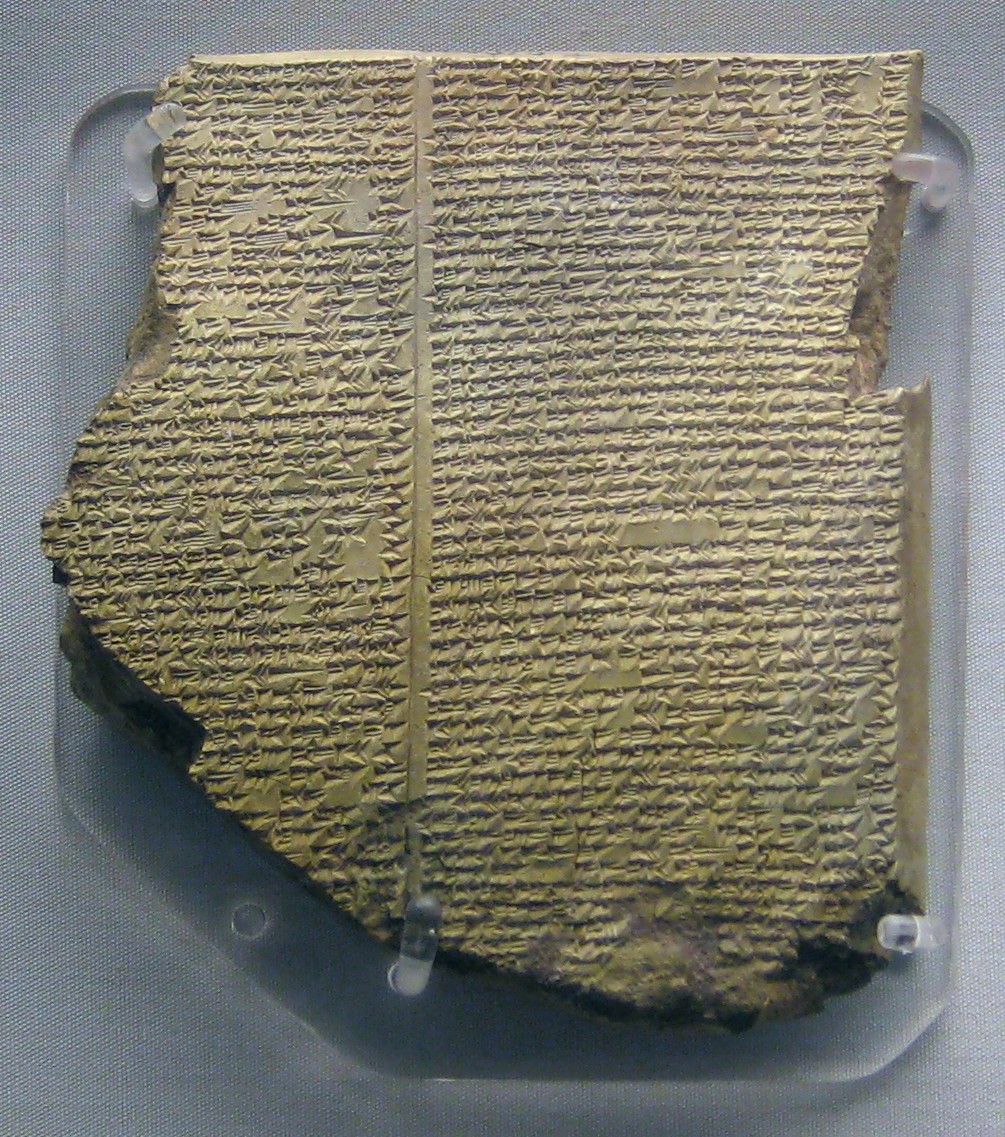
The famous flood tablet that concludes the Epic of Gilgamesh, including the flood story of the immortal sage Uta-napishti.
From the beginning of its reemergence into modern history, Epic of Gilgamesh has become as famous as it is for a couple of different reasons. First, as we’ll soon see, it’s a tremendous story, told with literary panache, and it has something for everyone. The saga of a hero who seems like he could have been Odysseus’s Iraqi grandfather, the Epic of Gilgamesh, as it went into recirculation in the late 1800s, also looked like other epics from the ancient world. Gilgamesh proved that a human civilization whose storytelling was as marvelous and sophisticated as any civilization’s had thrived long before the earliest books of the Old Testament were set down. And speaking of the Bible, the other reason that the Epic of Gilgamesh had such a major and immediate impact is it also contains, in its eleventh tablet, one of the three surviving versions of the Mesopotamian flood myth, which we discussed last time. The Babylonian Atrahasis, which we looked at in the previous program, is a longer and older version of the Mesopotamian flood myth. However, the Atrahasis wasn’t translated into English at length until 1965.1 Thus, the Gilgamesh flood tablet, translated in 1876, was the first time that a long, connected narrative that sounds a lot like the Biblical flood story, and is older than the Biblical flood story, began circulating among the general public. Thus, Gilgamesh’s story, as the 1800s drew to an end, was both a whopper of epic, as well as the first big slab of edgy, inarguable evidence that not everything in the Old Testament is entirely original.
Now, there is a lot of history behind the Epic of Gilgamesh, both modern history about how it resurfaced in the nineteenth century, as well as ancient history, concerning the Sumerian, Babylonian, and Assyrian civilizations that shared legends about Gilgamesh and passed them down to us today. Assuming that you’re new to this very old story, though, I think we should begin by learning about who Gilgamesh was, and why he became such a fixture of Mesopotamian storytelling during the Bronze Age. [music]
Who Was Gilgamesh?
Sometimes in history, real kings like to have myths made up about them. In antiquity, these myths often took the forms of origin stories about ancestors. If you were an ancient near eastern king, or a Mediterranean queen, and you had bards working in your court, you might pay these bards to connect your modern dynasty to myths and legends shared by your culture. The Roman emperor Augustus did this in the 20s BCE, when the poet Virgil wrote the Aeneid. The Aeneid is a titanic work of literature, but one of the historical reasons for its inception was that powerful, rich Augustus wanted his legacy to be connected to that of Aeneas, the great Trojan hero associated with the founding of Rome. Never mind the fact that the association was silly, and that Aeneas’ story was a myth. For Augustus, the connection between his reign and that of a musclebound mythological hero was good propaganda.Long, long before Augustus and the Roman empire, in the southeast of modern-day Iraq, ancient Sumer controlled the lower Tigris-Euphrates floodplain for much of the 2000s BCE. The centuries between 3000 and 2000 BCE were a bumpy ride for the Sumerians, but they ended the millennium on a high note. Between about 2100 and 2000 BCE, a very powerful, talented dynasty of Sumerian kings ruled from the city of Ur. This dynasty is known today as the Third Dynasty of Ur, and under its rule, during a period of prosperity and cultural productivity, it produced a lot of the Sumerian literature that has come down to us. Beneath the kings of the Third Dynasty of Ur, from 2100-2000 BCE, Sumer prospered, and Sumerians were busy setting down all sorts of writing onto clay tablets. Let’s learn what this Third Dynasty of Ur, which flourished between 2100 and 2000 BCE, has to do with the mythological Gilgamesh, king of Uruk.

A copper alloy head of a Sumerian ruler from around 2300-2000 BCE.
Later Sumerian kings, like Ur-Nammu and his son Shulgi, wanted to be associated with the old, awe-inspiring kings of Uruk. And during their reigns, myths and legends were recorded in Sumerian cuneiform that told of the deeds of these bygone kings. In fact, Sumerian epics older than that of Gilgamesh survive today that tell the story of Gilgamesh’s father, Lugalbanda, and also, Gilgamesh’s predecessor on the throne, Enmerkar, generally held to be the first king of Uruk. To sum up, then, back during the century between 2100 and 2000 BCE, Sumerians imagined the great kings of yesteryear – the monarchs who had founded Uruk, cordoned it off from dangerous foes to the east, and paved the way for the efflorescence of Sumerian culture and civilization that was taking place at the end of the 2000s BCE. Gilgamesh was one of those legendary kings – part of a mythical lineage like that of King Arthur. Born into royalty as the son of king Lugalbanda before him, Gilgamesh, in the Sumerian epic tradition, was a hero who came from a heroic dynasty.
Sumerian civilization went into a slow decline after about 2000 BCE. Other Sumerian epic heroes – the aforementioned Enmerkar and Lugalbanda, largely faded into memory. But even as other civilizations took the mantle of Mesopotamian leadership, stories about Gilgamesh remained in circulation. As the Sumerian language faded from popular use after 2000 BCE, it was slowly replaced by Akkadian as the main parent language of Mesopotamia. Although residents of the later Mesopotamian civilization of Babylon spoke Akkadian, or the Babylonian dialect of Akkadian, Sumerian stuck around for several hundred years. Sumerian was, for a long time in the Bronze Age, like Latin during the European Middle Ages, a language of literature and learning, and bright young Babylonian kids growing up and going to scribal school in the 1800s, and 1700s, and 1600s BCE, learned Sumerian as part of their education. They often learned Sumerian, in fact, through copying other texts, and these texts included stories about Gilgamesh. As Sumerian culture fell increasingly into twilight, then, generations of Akkadian speakers still knew some of the old stories about Gilgamesh. There was a story about how Gilgamesh and his companion Enkidu fought a giant. In another story, Gilgamesh wrestled a gigantic bull. There were sad tales about the deaths of Gilgamesh and Enkidu. These short stories, even though Sumerian history was quickly becoming a distant memory, kept Sumer alive in the figure of one of its heroes. And as time passed, and 2000 BCE gave way to 1000 BCE, more and more stories began to orbit the legendary king Gilgamesh of Uruk.
The 12-tablet Standard Babylonian Version of the epic that I mentioned earlier was written long after the fall of Sumer – some time between 1300 and 1000 BCE, in the Akkadian language. In antiquity, this long version was attributed to a compiler named Sin-leqi-unnini, and indeed, it’s possible that a single author took a number of disparate songs and oral legends, together with extant cuneiform documents, and wove it all together into a connected narrative. The Standard Babylonian Version of the Epic of Gilgamesh has a consistently high level of artistry, together with many word-for-word ties to earlier Sumerian manuscripts, and so it’s possible that some Akkadian-language Homer really did wrangle the epic together toward the end of the Bronze Age. And speaking of the Bronze Age, even though the Standard Babylonian Version that we now possess of the Epic of Gilgamesh was likely compiled back between 1300 and 1000 BCE, the physical manuscript of the Standard Babylonian Version that we’re about to read was probably pressed into clay a long while after this.

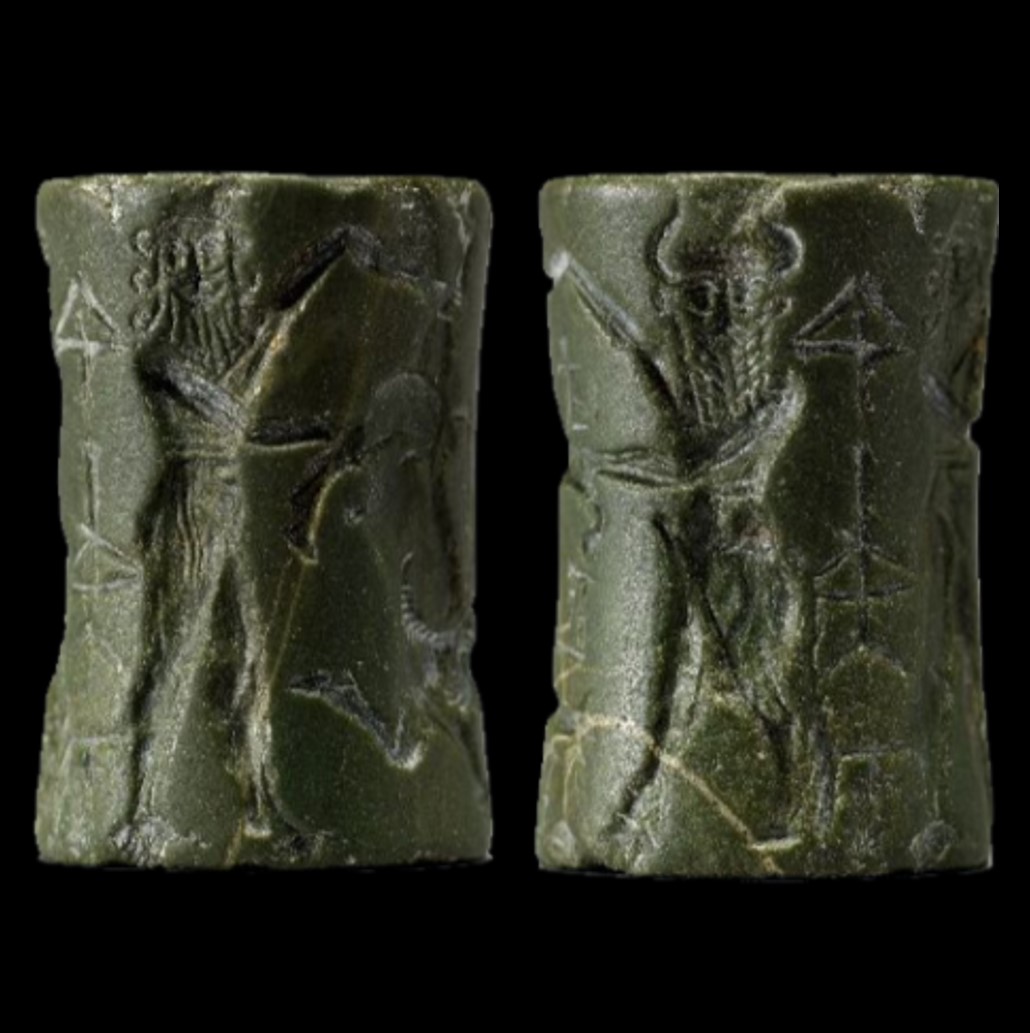
Enkidu fighting an lion in a cylinder seal impression.
So, that’s a quick rundown on the history behind the Epic of Gilgamesh. If you’re just here to listen to the tale of Gilgamesh kicking ass and having great adventures, we’re almost there. But before we go on, let’s review what we’ve learned so far. Gilgamesh was an old, old hero, and the earliest surviving stories about him have roots in the late 2000s BCE. As the 2000s passed into the 1000s, tales about Gilgamesh grew and grew. Akkadian scribes copied Sumerian legends about Gilgamesh, and they added new ones, and the hero’s saga snowballed into a longer and longer story that spanned cultures and centuries. Some time between 1300 and 1000 BCE, a Babylonian writer set down the 3,000-line version of the Epic of Gilgamesh that’s famous across the world today. This version of the epic, a wheelbarrow of cuneiform, spread variously among Mesopotamian centers of learning for another 500 years, until the Neo-Assyrian King Ashurbanipal had it copied for himself and for posterity. Ashurbanipal’s library was destroyed in 612 BCE by a confederation of forces opposed to the Neo-Assyrians, but it’s hard to burn clay tablets. In fact, fire from city sackings just tends to make them harder and more durable, and so, the Epic of Gilgamesh, at the end of the 600s, sunk under a blanket of ash and rubble, where it slept for the next 2500 years.
I wanted to tell you the story the Epic of Gilgamesh before reading the epic itself because it’s actually a very special story. Sumerians started it, Babylonians developed and wrote it, and Assyrians copied and preserved it. A lot of ancient works of literature are like this – the Bible, the Homeric epics – these are texts that were produced by generations, in which, to some extent, the fittest parts and the finest passages survived, and everything else fell prey to time. Because it had such a long gestation period, and because so many people and different cultures ultimately had a hand in writing and preserving it, Gilgamesh’s saga is a pan-Mesopotamian tale, filled with rich, folkloric episodes that are as entrancing to us today as they were to audiences back in the Bronze Age. There is no simple origin or authorship story for the Epic of Gilgamesh – I can’t tell you that Sam the Sumerian wrote it in 2125 BCE, or that Allison the Akkadian wrote it in 1612 BCE, or something like that. What I can tell you is that this work of literature was dozens of generations in the making, and that it shows. If there were once tiresome or derivative parts of the Epic of Gilgamesh, they’ve been stripped away, and what remains is 3000 lines of the finest storytelling of the Bronze Age.
So, now that you know the complicated but necessary background for this wonderful story, let’s hear the tale. I’ll be quoting from a number of versions of the epic in the remainder of this program, but unless otherwise noted, quotations will come from the Andrew George translation, published by Penguin Classics in 2003.
The Akkadian title of the Standard Babylonian Version of this epic is “sha naqba imuru.” This title is translated today as “He who saw the deep,” the title of this episode, and the very first line of the standard version of the Epic of Gilgamesh. The “he” in question is the valiant Gilgamesh, the protagonist of the story. But what is this “deep” that he sees, and why is it so important that it belongs in the very first line? It’s time to open up the book, and find out. [music]
The Opening of The Epic of Gilgamesh
The 3,000-year-old Epic of Gilgamesh begins with these words in the Penguin George translation:He who saw the Deep, the country’s foundation,
[who] knew. . ., was wise in all matters!. . .
He. . .[learnt] of everything the sum of wisdom.
He saw what was secret, discovered what was hidden,
he brought back a tale of before the [flood].
He came a far road, was weary, found peace,
and set all his labours on a tablet of stone. (1.1-10)3
Gilgamesh was the king of Uruk. Under Gilgamesh’s reign, the ramparts of Uruk soared into the sky with fine brickwork, and the city was a square mile in size. Adjacent to it was a fine grove of date palms, and a gigantic temple to the city’s patron goddess.
The text describes him as “tall, magnificent and terrible” (1.37). A warrior king, Gilgamesh fought in the front ranks or supported from the rear guard, as needed. His father Lugalbanda had been a hero, too, wedded to the goddess Ninsun, whom we’ll meet a bit later in the story. Precisely two-thirds god, according to the cuneiform, Gilgamesh had a beard and hair thick as barely, and as soon as he grew to adulthood, he was perfectly handsome.
Gilgamesh was also, both by our standards and by those of ancient Babylon, not a good person. To young men, he was a bully, as the first tablet of the story tells it, “The young men of Uruk he harries without warrant, / Gilgamesh lets no son go free to his father” (1.67-8). But to the young women of Uruk, King Gilgamesh was far worse. The women of the city complained to their goddesses, lamenting that “[Though powerful, pre-eminent,] expert [and mighty,] / [Gilgamesh] lets [no] girl go free to [her bridegroom]” (1.75-6). Gilgamesh, in other words, forced the young women of his city sleep with him before they consummated their marriages with their husbands.4 Gilgamesh, then, as the epic begins, is a powerful, magnificent, but also tyrannical and cruel king. And, the first tablet of the Standard Babylonian version tells us, Gilgamesh was getting worse and worse. The reports of Gilgamesh’s brutality toward his own subjects soon reached the gods due to the earnest prayers of the men and women of Uruk.
The gods convened, and discussed what to do. The deities decided that what Gilgamesh needed was a rival who could put him in his place. They asked a mother goddess to create this rival, and so, throwing a dollop of clay into the wilderness, she did. And in this fashion, the second main character of the Epic of Gilgamesh enters the story. [music]
The Epic of Gilgamesh Introduces Enkidu
The Epic of Gilgamesh’s second hero is called Enkidu. And to quote the Electronic Babylonian Library translation this time,In the wild. . .Enkidu, the hero,
an offspring of silence, [was] knit strong. . .
All his body is matted with hair,
he is adorned with tresses like a woman:
the locks of his hair grow. . .thickly
he knows not at all a people nor even a country. . .
feeding on grass with the very gazelles.
Jostling at the water-hole with the herd,
he enjoyed the water with the animals. (1.101-110)5
This is quite a memorable portrait. To counter the cruel, metropolitan Gilgamesh, the gods created an innocent man embedded in nature, an Esau to Gilgamesh’s Jacob. Enkidu might have lived in the wilds for a long time, the companion of grazing animals, content to never know anything about Uruk or its ruthless king. But one day, Enkidu was grazing at the watering hole, and a young trapper saw him there. The young trapper kept seeing Enkidu there, and eventually, the young man told his father about the strange wild man who ran with the gazelles. Enkidu wasn’t just strange, the young trapper explained. He was huge, and looked dangerous. And he had been sabotaging the trapper’s attempts to snare animals, and setting free animals that the trapper had caught.
And so the trapper’s father told the young man to go and seek the counsel of Gilgamesh in the city of Uruk. And as it turned out, both the trapper’s father, and King Gilgamesh himself offered the troubled young man the same advice. The young man needed to find a beautiful woman whose name is most often translated as “Shamhat the harlot” (1.67). Then, this “Shamhat the harlot” would wait by the watering pool for Enkidu to arrive and start drinking water with his herd. When Enkidu arrived, Shamhat would take off all of her clothes, and seduce Enkidu, and afterward, Enkidu’s herds would abandon him, and the young trapper’s problem would be solved.
A 4000-Year-Old Sex Scene and Its Aftermath
The plan was put into action. The young trapper found Shamhat, and he gave her the instructions that Gilgamesh had recommended. We are not told how Shamhat felt about having sex with a presumably very smelly wild man, but, being a professional in her trade, she did what she had been asked. I’m now going to read you a three-thousand-plus-year-old sex scene that’s somewhat graphic, so, with respect to all listeners, you can fast forward about ninety seconds and skip it if you need to for any reason. The EBL translation tells us that Shamhat saw Enkidu at the watering hole, and:[Shamhat] let loose her skirts,
she bared her sex and he took in her charms.
She showed no fear, she took in his scent:
she spread her clothing and he lay upon her.
She treated the man to the work of a woman,
vhis ‘love’ caressed and embraced her.
For six days and seven nights Enkidu, erect, did couple with [Shamhat].
After he was sated with her delights,
he turned his face toward his herd.
The gazelles saw Enkidu and they started running,
the animals of the wild moved away from his person.
Enkidu had defiled his body so pure,
his legs stood still, though his herd was on the move.
Enkidu was diminished, his running was not as before,
But he had reason, he [was] wide of understanding. (1.186-200)
To pause for just a moment, here, one of the reasons why Mesopotamian literature is so fascinating is because it can be so strange and familiar at the same time. On one hand, here, we have a truly bizarre erotic sequence of a very unflappable sex worker consenting to a marathon coital session with a hairy man adjacent to a herd of gazelles. That’s pretty odd stuff. On the other hand, though, the themes are familiar. An innocent man in a state of nature sins with a woman, and with this sin comes reason, and he is no longer the unblemished person that he was before.

An Uruk period (c. 3200 BCE) cylinder seal impression of a king and priest feeding a herd of animals. It’s impossible to overstate how much Mesopotamian life was tied to agriculture and animal husbandry.
Shamhat had some more information for Enkidu. Shamhat had heard, she said, of prophetic dreams that Gilgamesh had experienced and shared with Gilgamesh’s mother. Gilgamesh had dreamt of a rock falling from the sky that he’d been unable to lift. Gilgamesh’s mother had told him that this rock was an omen of a powerful friend Gilgamesh would make, a friend whose “strength is as mighty as a rock from the sky. / Like a wife you’ll love him, caress and embrace him, / he will be mighty, and often will save you” (1.270-2). Gilgamesh told his divine mother of a similar dream, this second dream about an ax, and Gilgamesh’s mother confirmed that this ax-dream also showed him a portent of the friend that he’d soon make.
Thus, the beautiful Shamhat told Enkidu that there had been some omens of Enkidu’s pending arrival in Uruk, and so the time had come for the wild man to come to the big city. Shamhat and Enkidu didn’t leave just yet, though. As the closing lines of the first tablet tell us, “[After] Shamhat had told Enkidu the dreams of Gilgamesh, / the two of them together [began making] love” (1.299-300). And that’s the end of the first tablet. [music]
Enkidu Journeys to Uruk
And so off Enkidu and Shamhat went, leaving the wilderness where he had dwelt in order to travel toward Uruk. Shamhat, along the way, assured the valiant Enkidu that he would find his proper place in the city. The couple came from the hinterlands into the periphery of Sumer, and the first outpost of civilization they reached was a shepherds’ camp. There, the sheepherders made a striking observation. Enkidu, they said, looked like Gilgamesh. He was, they said, “tall in stature, proud as a battlement” (2.40-1). And just as Enkidu had recently lost his virginity, in the shepherds’ camp, he experienced another of the allures of human civilization. The sheepherders gave the wild man bread, and ale, and as he drank, “His mood became free, he started to sing, / his heart grew merry, his face lit up” (2.P.104-5).Enkidu, there in the shepherd’s camp, finally got his shaggy hair trimmed, and he put on clothing. As Enkidu was enjoying another liaison with his lover Shamhat, he saw a traveler passing by the shepherd’s camp. This traveler was headed to a wedding in Gilgamesh’s city of Uruk. And the traveler told them of what would likely happen at the wedding in Uruk. Gilgamesh, said the traveler, forced new brides to have sex with him before sleeping with their husbands. The traveler said, “[Gilgamesh] will couple with the wife-to-be, / he first of all, the bridegroom after” (2.P.159-60). The news made Enkidu furious. Without further delay, Enkidu and Shamhat left the shepherds’ camp and they went the rest of the way to Uruk.
Enkidu, evidently angrier than he was dazzled with the big city, proceeded directly to Uruk’s town square. The citizenry of Uruk marveled at his stature, finding him equal to Gilgamesh. The cruel king of Uruk was just on the verge of forcing one of the brides of the city to copulate with him, as he was accustomed to doing. There is some damage to Tablet 2 of the story, and what would have probably been a very dramatic leadup to the confrontation between Gilgamesh and Enkidu. What survives of confrontation between Gilgamesh and Enkidu, and thus the first battle in the epic, is as follows, in the Oxford Stephanie Dalley translation:
[Enkidu stood] in the street of Uruk. . .
He barred the way [of Gilgamesh]
The country of Uruk was standing around him,
The country gathered together over him. . .
The bed was laid at night for [the new bride]. . .
Enkidu blocked [Gilgamesh’s] access at the door of the father-in-law’s house,
He would not allow Gilgamesh to enter.
They grappled at the door of the father-in-law’s house,
Wrestled in the street, in the public square.
Doorframes shook, walls quaked. (2.103-17)6
And after their great fight in Uruk, after making the walls of the city quake with their combat, Gilgamesh and Enkidu took measure of one another. In a 3,000-year-old plot twist, rather than fighting further, the two men decided that they would be friends. The men kissed. Gilgamesh introduced Enkidu to his mother, the goddess Ninsun. Ninsun observed that shaggy Enkidu had no brother, and overhearing the remark, the wild man felt saddened and drained.
Then, though the text is somewhat ambiguous as to why, Gilgamesh proposed a quest. Perhaps he wanted to cheer his new friend up. Perhaps, knowing that he had now had a comrade of equal strength, his ambition had risen in scope. For whatever reason, Gilgamesh said that it was time for the two men to leave Uruk, and pursue glory and danger.
There was a monster, Gilgamesh explained, named Humbaba. Humbaba lived in a forest of cedar trees, and the two heroes would go directly into the monster’s lair, and terrify him. Enkidu was hesitant. Enkidu knew Humbaba, he said. When wandering with his herds in former days, the wild man had skirted the edge of the deep cedar forest that stretched for miles and miles in all directions. Humbaba was a giant, Enkidu said. His voice was like the flood, his words scorched, and his exhalations were poison. No one could face Humbaba and live. But Gilgamesh was undaunted. Gilgamesh said that he, at least, would go and face Humbaba.
Enkidu remonstrated. The gods had made Humbaba to protect the cedar trees from humans. No one went into the deep cedar forest. The giant monster that guarded it could hear twigs and the rustling of leaves from miles and miles away. The gods themselves were afraid of Humbaba. But Gilgamesh was still undaunted. He told his new friend that Enkidu was being overcautious. Gilgamesh said, “As for man, [his days] are numbered, / whatever he may do, it is but wind” (2.234-5). More than emphasizing the ultimate shortness of life, Gilgamesh told Enkidu that Enkidu shouldn’t doubt himself. Gilgamesh said that lions were afraid of Enkidu – that he had grown up in the wilderness and had proved himself in combat.
Enkidu was finally convinced. The two heroes went to the forges of Uruk, where they each had a hatchet, and an ax made for them, and then fine daggers. And then, armed to the teeth, Gilgamesh called an assembly in the city of Uruk. The king broadcast his plan. He would go to the forest of cedar, Gilgamesh proclaimed, to face the great monster Humbaba. He would march into the unknown and clash with an ancient power. He asked for the blessing of the young warriors of Uruk, and said that he hoped to return and celebrate the city’s festivals.
But Enkidu was still reluctant. Enkidu also gave a speech, telling the assembly at Uruk to tell Gilgamesh not to go through with his crackbrained scheme. Humbaba was death itself. If anyone even went into the forest of cedars, said Enkidu, they would be paralyzed with terror. And hearing the discordance between Gilgamesh and Enkidu, the elders of Uruk found Enkidu’s prudent counsel more persuasive. They said, “You are young, Gilgamesh, borne along by emotion, / all that you talk of you don’t understand” (2.289-90). And Gilgamesh, suddenly, seemed to hesitate. Some further cuneiform on Tablet 2 is missing here, but that’s the end of Tablet 2. [music]
The Heroes Depart from Uruk
In spite of the war counsel, and the apprehension of Enkidu and Gilgamesh toward going to fight Humbaba, the two heroes eventually decided to go through with the quest. The elders of Uruk prayed that Gilgamesh would make it back. They advised the pair to let Enkidu lead the way, because Enkidu knew the wild country from his youth there. With the counsel of the elders complete, Gilgamesh and Enkidu then went to speak with Gilgamesh’s mother, the goddess Ninsun. Gilgamesh stood before his mother and expressed awareness of the enormity of the task that he’d taken on himself, admitting, “I shall face a battle I know not, / I shall ride a road I know not” (3.26-7).Gilgamesh’s mother was also apprehensive. She listened, but said nothing, and then went into the temple and bathed. Ninsun dressed herself in her finest attire and then went up to the roof of her dwelling to burn incense to the great sun god Shamash. She asked Shamash, the sun god and god of justice, “Why did you afflict my son Gilgamesh with so restless a spirit?” (3.46). This initial inquiry led into a long and formal prayer. She praised the sun god for opening the gates of day, and hoped that when the time for the combat came, the winds themselves would help her son defeat his great foe. With her prayer complete, Gilgamesh’s mother Ninsun then went to Enkidu. She scribed sacred symbols on Enkidu’s neck, and she declared that the wild man was now her son, too, and the brother of Gilgamesh.
Then the two heroes, still in Uruk on the verge of leave taking, performed their own rituals to grant them good fortune on their quest. Gilgamesh gave instructions for the rule of Uruk in his absence, and after more well-wishing, more counsel for conduct during the difficult trials ahead, earnest blessings, and foreboding warnings about the difficult and dangerous nature of their enterprise, Gilgamesh and Enkidu left Uruk, taking us from the somewhat damaged Tablet 3 to Tablet 4, which will tell us of Gilgamesh and Enkidu’s journey to the giant, dark forest where the monster Humbaba awaited them.
And just to offer some geographical background, by the way, when ancient Akkadian speakers wrote about a “forest of cedars,” it’s generally understood that they were referencing an area in present-day Lebanon. Lebanon, then as now a rugged, beautiful part of the Levant, home to a range called the Mount Lebanon range, where cedar forests have flourished since before humanity ever showed up on earth. The Epic of Gilgamesh references Mount Lebanon (4.3), or Jabal Lubnan in Arabic, and so if we’re talking exact modern distances, Gilgamesh and Enkidu would have traveled about six hundred miles northwest from Uruk, in the southeast of present-day Iraq, up through the Syrian desert and then into the more temperate and resource-rich highlands of what’s today Lebanon. We’re reading a fairytale, obviously, so putting geographical pins on the map is a little bit silly, but, if you’re a modern day Iraqi, Jordanian, Syrian, or Lebanese person, you can take pride in the fact that Gilgamesh and Enkidu’s giant sandals, according to legend, at least, once passed over your country’s soil. [music]
Gilgamesh’s Dreams and the Long Road to the Cedar Forest
In spite of all the blessings and well-wishing, the two heroes, now on the road together, found themselves deeply unsettled. Their road was long – a month and a half, the text tells us (5.3) – and they had plenty of time for doubt and second-guessing. Gilgamesh wanted to consult his dreams, hoping for favorable or unfavorable signs therein. The two men underwent special rites before Gilgamesh slept, Tablet 4 of the Epic of Gilgamesh, the one we’re currently reading, concerns itself with five different dreams that Gilgamesh had on the way to fight Humbaba.First, Gilgamesh dreamt of a mountain that fell. Enkidu said that the dream foretold the fall of the ogre Humbaba. Then, Gilgamesh dreamt of a mountain again, and of a handsome man pulling him out from beneath the mountain. Once again, Enkidu interpreted the dream as favorable to their success in their perilous mission. And for a third time, Gilgamesh and Enkidu set up camp during their long westward march, preparing their sleeping place such that Gilgamesh would have more dreams. And dream he did. Gilgamesh’s third dream was of pure calamity. He dreamt of a day falling into night lit only with lightning and fire, until death and cinders rained down everywhere. When Gilgamesh awoke, the hero, panicked, asked Enkidu about this third dream. Enkidu, once again, was calm. Enkidu said all of Gilgamesh’s dreams had only been full of favorable signs. Gilgamesh had seen his father, said Enkidu, the Sumerian hero Lugalbanda, and the fire and cinders that Gilgamesh had seen were only portents of the fighting that the two heroes would soon face.
In Gilgamesh’s fourth dream, he saw the Anzu, or Thunderbird, one of the most famous creatures in Mesopotamian mythology. The Thunderbird, associated with the coming of spring storms in ancient Sumer, had been befriended by Gilgamesh’s father, Lugalbanda, in a separate myth cycle, and Enkidu told Gilgamesh that his dream about the thunderbird was nothing to worry about. And in Gilgamesh’s final dream en route to fighting Humbaba, the hero dreamt he was wrestling a wild bull, and worried that this was an omen of the overwhelming force they’d face in the battle to come. But for a fifth time, Enkidu corrected him. The wild bull, said Enkidu, was the sun god Shamash, who would help them in their perilous fight, and Gilgamesh’s father, Lugalbanda, would also watch over him in the mayhem to come.
Finally, the dreams were over. The two heroes were close, now, to the edge of the dark forest. And although Gilgamesh had initially urged Enkidu to undertake the quest, it was now Gilgamesh who faltered. First Enkidu urged Gilgamesh, once more, to have courage. Then, the sun god Shamash called down to them. They needed to strike sooner, rather than later, the sun god proclaimed. Both warriors, now, felt a tremor of fear at what was about to happen. And after a moment, it was Gilgamesh who urged Enkidu once more. Gilgamesh said they’d made the journey. They’d crossed the mountains. Enkidu could handle himself. And finally, the time for talking and reassurances ended. The two heroes stood on the verge of the forest. It was time to fight.
The fourth tablet of the Standard Babylonian Version of the Epic of Gilgamesh ends there. To pause for just a moment, the entire story we’ve heard so far has led up to the climactic scene of the two warriors standing on the fringes of Humbaba’s woodland. A great deal of rising action has gone into leading up to the fight with Humbaba – the fight is about to happen in Tablet 5, though it’s initially mentioned in Tablet 2. There is a considerable amount of literary skill that goes into foregrounding this major moment in the epic, and the long leadup to the battle helps both humanize the heroes Gilgamesh and Enkidu, as well as showing their young friendship taking place as both warriors take turns comforting one another. So, let’s move on to the next part, the battle with Humbaba, an episode that was one of the older parts of the Epic of Gilgamesh, and a favorite for Akkadian scribal schools in which young students copied famous literary texts in order to practice writing cuneiform. [music]
The Battle with Humbaba
The cedar forest loomed in front of the two adventurers, the aroma of the trees abundant, and the whole scene deceptively peaceful. Through a straight track in the woods, they could see Mount Lebanon in the distance. The heroes went into the forest. Once beneath the canopy, although there is some damage to the original texts, it seems that they second guessed their dangerous venture yet again. But at last, they found themselves face to face with the monster Humbaba, and by that time, it was too late to deliberate any further.Humbaba was not happy to see them. The monster, in his rumbling, fiery voice, said, in the Oxford Dalley translation:
The fool Gilgamesh (and (?)) the brutish man ought to ask themselves, why have you come to see me?
Your [friend] Enkidu is a small fry who does not know his own father!
You are so very small that I regard you as I do a turtle or a tortoise.
Which does not suck its mother’s milk, so I do not approach you.
[Even if I] were to kill (?) you, would I satisfy my stomach?
[Why, ], Gilgamesh, have you let (him reach me. . .
So I shall bite [through your] windpipe and neck, Gilgamesh,
And leave [your body] for birds of the forest, roaring (lions), birds of prey and scavengers. (5.86-94)
Humbaba, obviously, was not a friendly forest giant, and his threats terrified Gilgamesh. Enkidu, however, urged his friend to have courage, and, having no choice, Gilgamesh threw himself into combat. The heroes dug their feet into the turf and fought the giant. Humbaba fought back. The ground shook, and the mountains cracked. The white clouds above glowered into black, and began to pour dark rain.

A basalt relief from the Neo-Hittite period of Syria (900s BCE) of two warriors fighting a monster – possibly the Epic of Gilgamesh‘s scene of Gilgamesh and Enkidu fighting Humbaba.
Humbaba railed against his assailants. He cursed them, growling, “May the pair of them not grow old, / besides Gilgamesh his friend, none shall bury Enkidu” (5.256). The Standard Babylonian version of the epic tells us tersely that Gilgamesh then stabbed Humbaba in the neck and Enkidu pulled out his lungs, after which rain poured down from the high peaks around them. An older version of the same story survives, which emphasizes the completeness of Humbaba’s destruction. In this older version, Gilgamesh slew Humbaba with a blow to the neck, and a general earthquake rocked the trees and peaks all around them, and then Gilgamesh began to destroy the forest itself, with Enkidu taking the timber.
With the monster Humbaba thus extremely dead, the two heroes, after perhaps exchanging an ancient Sumerian version of a high five, discussed what was next. They talked about what they could build with all of the cedar they now had. Within the forest’s depths there was a secret temple, and at this temple the heroes proclaimed that they would use some of the cedar to build the high Sumerian god Enlil a mighty temple door. And so, the heroes prepared to return to Uruk, loading a raft with a great deal of Lebanese cedar, and also, the severed head of the monster Humbaba, whom they had defeated. Thus ends the climactic fifth tablet of the Standard Babylonian Version of the Epic of Gilgamesh, and just as a reminder, there are twelve total, so we’re almost halfway through. [music]
The Heroes Return to Uruk and Ishtar Courts Gilgamesh
Gilgamesh and Enkidu returned to Uruk as heroes, having defeated the menacing monster Humbaba in the distant west. Gilgamesh, who had already been a king of a powerful city, rose to even greater esteem, and soon, the gods themselves began to notice. Specifically, the goddess Ishtar noticed Gilgamesh’s heroic stature, and his beauty, and she made him a proposition. Ishtar approached Gilgamesh, and she told him, “Grant me your fruits, O grant me! / Be you my husband and I your wife!” (6.8-9).
A Sumerian seal of Inanna (Ishtar) from about 2350-2150. Ready for war and not adverse to showing a leg, Inanna is one of the most singular and distinctive figures in Bronze Age literature and theology.
Heroes in ancient epics sometimes had liaisons with goddesses. Just as Odysseus shacks up with the divine Calypso and Circe in the Odyssey, and Anchises goes to bed with Aphrodite in the Homeric Hymn to Aphrodite, Gilgamesh’s father Lugalbanda was married to the goddess Ninsun, who’s a minor character in the Epic of Gilgamesh. Beyond fiction, ancient Sumerian kings were sometimes understood as being married to goddesses of cities, though the marriages were probably understood as metaphorical in nature, Thus, when Ishtar approaches Gilgamesh with a proposition of marriage, in the Epic of Gilgamesh, the goddess of Uruk is proposing a liaison which would have been ordinary sounding within the traditions of bygone Mesopotamian traditions. Sometimes, the kings of Sumer and Babylon had to hook up with goddesses. It was a rough life.
To return to Tablet 6 of the Epic of Gilgamesh, Ishtar told Gilgamesh of all the things he would get if he consented to marriage with her – a fine chariot, driven by lions and giant mules; the adulation of other kings and nobles, who would bring him the freshest produce in the land; mighty oxen to plow his fields, and great fecundity in his goats and sheep, such that his herds would double and triple. Ishtar’s entreaty offered Gilgamesh power and plentitude as great as any bygone Mesopotamian king could have hoped for. But Gilgamesh was not interested.
In a long speech filled with Bronze Age metaphors that are a little tricky to understand, Gilgamesh essentially told the volatile goddess that he knew how she worked. Her lovers generally ended up worse for the wear. He said she was like a stone that appeared firm, but that would actually make a wall collapse – that she was like a shoe that, once put on, would cut someone’s foot. And he listed some of Ishtar’s romantic misadventures as justification for his reluctance, the gist of the speech being that everyone whom Ishtar loved ended up dead, maimed, or otherwise disadvantaged. It was quite a strong speech, revealing a thorough knowledge of Ishtar’s checkered past and her admittedly alarming habit of harming her many lovers. After hearing Gilgamesh’s rejection speech, Ishtar began fuming and crying, all at once.
Ishtar Seeks Revenge
She hurried to speak to her mighty father, the deity of the sky, Anu, and told Anu that the mortal hero Gilgamesh had slandered her. Anu pushed back, telling her that she’d provoked Gilgamesh. Ishtar said she wanted to borrow a monster. This monster was called the Bull of Heaven – basically, as we’ll see in a moment, a very large bull. With the Bull of Heaven, said Ishtar, she’d punish Gilgamesh for his disrespect. And though Ishtar only has a minor role in the Epic of Gilgamesh, I want to read you what she said next to her father Anu, just to give you an idea of what an awesome character she is. She said, in the Penguin George translation,Father, give me, please, the Bull of Heaven,
so in his dwelling I may slay Gilgamesh!
If you do not give me the Bull of Heaven,
I shall smash [the gates of the Netherworld, right down] to its dwelling,
to the world below I shall grant [freedom,]
I shall bring up the dead to consume the living,
I shall make the dead outnumber the living. (6.95-100)
In other words, Ishtar says, “Please, dad, can I borrow the bull – otherwise I will rip open the netherworld and unleash hell on earth?” It’s a very Ishtar line, and in the most important episode of the earlier Sumerian epic dealing with Ishtar, she strips naked and goes down to the underworld to get her husband back from the dead, so she already had some experience with harrowing the realm of the departed.

Gilgamesh fighting the Bull of Heaven in a carving dated to the reign of the Sumerian king Naram-Sin (c. 2255-2219 BCE).
Enkidu and Gilgamesh were temporarily stunned. They’d come back to Uruk, grandstanding as heroes, and now all of a sudden, a gigantic monster was marauding their home territory. But Enkidu knew all about hoofed mammals. Enkidu had a plan. Enkidu said he’d seize the animal’s tail, and then put his leg onto its back leg, causing it to lose its balance. Then Gilgamesh could stab it on top of the head. The heroes, wasting no time, put their plan into action, with the Bull of Heaven unable to fight against the combined might of the two heroes. They cut out its heart and offered the heart to the sun god Shamash. Gilgamesh removed the giant horns of the Bull of Heaven, and afterward, the horns adorned his bedchamber.
The goddess Ishtar was heartsick at her failure, and mourned the death of the Bull of Heaven. Enkidu heard the goddess crying. And rather cruelly, Enkidu tore a section of the Bull of Heaven off and flung it at the goddess, telling her, “Had I caught you too, I’d have treated you likewise” (6.155). The goddess did not immediately chasten Enkidu for the wild man’s malicious threat. Instead, she gave the Bull of Heaven fitting burial rites. And here, with Gilgamesh and Enkidu ascendant, and Ishtar scorned and threatened, the sixth tablet ends, and the seventh begins. [music]
The Decline of Enkidu
As we reach the halfway point of the Epic of Gilgamesh, Gilgamesh and Enkidu have risen to peerless heights among mortals. With Shamash’s help, they had defeated Humbaba. And all by themselves, they had bested the Bull of Heaven. Their victories were so complete, in fact, and Enkidu’s disparagement of Ishtar had been so pronounced, that the gods of Mesopotamia took note. In a dream, Enkidu had seen the counsel of the gods.The dream has been lost from the Standard Babylonian Version of the Epic of Gilgamesh, but from an ancient paraphrase of it, Enkidu’s dream seems like it was once quite an important part of the story. In Enkidu’s dream, the highest gods of Mesopotamia met and debated about what would happen to Enkidu. The mighty deity Enlil was angry at Shamash for supporting Gilgamesh and Enkidu’s rise to power, and Enlil decided that it was time for Enkidu to die.
Enkidu awakened from his dream in tears of despair. Enkidu knew about dreams, and did not doubt that they foretold what would soon be. He told Gilgamesh that his end was coming. He’d never see his friend again. He’d go down to the underworld, as everyone eventually did, only before his time. Enkidu looked at a fine door that he had wrought from the tallest cedar of Lebanon, an emblem of his brief glory days. Enkidu, delirious with grief, fixated on the door, and what would eventually happen to it, listening to his own maundering words, which only deepened his sadness.
Gilgamesh tried to comfort his friend. It had just been a dream, said Gilgamesh. Gilgamesh vowed to pray to the high gods, and fashion a statue for them. But Enkidu was convinced that his fate was sealed. The gods didn’t change their minds, Enkidu said.
Still, Enkidu didn’t want to die. The day fell into night, and the next morning, Enkidu watched the sun rise, crying in the first rays of dawn and asking the sun god Shamash to spare him. Enkidu cursed the trapper who had brought the harlot Shamhat to him. He cursed Shamhat, who had encouraged him to come to Uruk. She had taken his innocence and sealed his fate, he said, and he wished her a hard road ahead.
The morning rose, and Enkidu found that the sun god Shamash had heard his words. The god told Enkidu that he should curse the harlot Shamhat. Shamhat had been kind to him. The god Shamash said that Enkidu would be honored in death, and have a fine place in the underworld. This counsel did little to comfort Enkidu. He fixated on Shamhat once again for sealing his fate.
Later, in a conversation with Gilgamesh, the doomed Enkidu described another vision he had had of his end. This is an interesting moment of the epic, because it gives us a glimpse of what Mesopotamians thought of when they thought of the afterlife. Enkidu said that in his dream, he had seen a grim, fierce man who then escorted him to the netherworld. As Enkidu puts it in the EBL translation,
[He struck] me, he turned me into a dove.
[He bound] my arms like (the wings of) a bird,
to lead me captive to the house of darkness, the seat of Irkalla:
to the house which those who enter cannot leave,
on the journey whose way cannot be retraced;
to the house whose residents are deprived of light,
where dust is their sustenance, their food clay.
They are clad like birds in coats of feathers,
and they cannot see light (but) dwell in darkness.
On the door. . .on the House [(of Dust) a deathly quiet is poured.] (7.182-92)
Enkidu saw more in Irkalla, the Sumerian name for the underworld. It was a dingy place full of priests, ruled over by the goddess of the underworld, Ereshkigal, who, listening to a scribe reading aloud, looked up and personally observed Enkidu entering the dark realm.
And following these awful nightmares, Enkidu indeed fell ill, and then became sicker and sicker. The days stretched into a week, and Enkidu’s health continued to worsen. Finally, twelve days had passed. Enkidu called Gilgamesh in to speak with him, telling his dear friend and fellow hero that this was the end. Enkidu said he would die a glorious death. His name and deeds would have to suffice, Enkidu said, because this was the end.
And so, Enkidu, raised by the gods to challenge Gilgamesh, was put down by the gods for rising too high alongside his friend. When he died, Gilgamesh had lost his adopted brother, and he would never be the same again. And this turning point in the epic takes us from Tablet 7 to Tablet 8 of the Standard Babylonian version. [music]
The Mourning of Gilgamesh
Tablet 8 of the Standard Babylonian version of the Epic of Gilgamesh chronicles how Gilgamesh mourned the passing of his friend Enkidu, and describes a number of things that Gilgamesh made in order to commemorate his friend’s passing. If you’re new to ancient epics, this is definitely something that’s good to know about them. When a major hero dies, like Patroclus in the Iliad, or Anchises in the Aeneid, there’s often a mourning chapter, in which funeral ceremonies and public rites are described in great detail. Additionally, ancient literature was very keen on describing stuff. From the Sumerian Cylinders of Gudea, round about 2125 BCE, through numerous surviving Mesopotamian texts chronicling temples, to the long description of the Tabernacle in the Biblical Book of Exodus, to the shield of Achilles in the Iliad, Bronze and Iron Age narratives just love telling you about precious objects and buildings in exhausting detail. These sections of ancient epics are often full of beautiful writing, and they are also useful to historians and scholars who want to know more about the nitty gritty of ancient civilizations. But at the same time, descriptions of funeral rites and games and long inventories about how many cubits long the antechambers of temples are don’t exactly constitute thrilling reading by modern standards, so I will ummarize the contents of this part of the Epic of Gilgamesh pretty quickly.Perhaps the most touching and important part of this portion of the epic is Gilgamesh’s lament for his friend. At daybreak, the morning after Enkidu passed away, Gilgamesh said a prayer for him. Gilgamesh said, in the Oxford Dalley translation,
They shall weep for you night and day. . .the mountains
. . .the field as if it were your mother.
They shall weep for you, [myrtle (?)], cypress, and pine,
In the midst of which we armed ourselves (?) in our fury.
They shall weep for you, the bear, hyena, leopard, tiger, stag, cheetah. . .
It shall weep for you, the holy river. . .along whose bank
We used to walk so proudly.
It shall weep for you, the pure Euphrates,
With whose water in waterskins we used to refresh ourselves. (8.10-20)
What we see in these lines is a change in Gilgamesh. The death of his friend has made him more reflective and self-conscious. Gilgamesh’s reminiscences about Enkidu lead him into an introspection and anxiety about his own time on Earth, and as the epic continues, his consciousness of his own mortality begin to drive his actions.
Gilgamesh prayed for his lost friend, and after a very moving 50-line prayer, the hero summoned various artisans in order to build things to memorialize Enkidu. Gilgamesh had a splendid statue of Enkidu made. A section of damaged tablet seems to describe all of this statue’s many components, and the hero spared no expense in making it. The surviving text mentions lapis lazuli, obsidian, alabaster, carnelian, gold, ivory, iron, and fine wood, and in addition to using all these materials to make his friend’s statue, Gilgamesh also made offerings to the gods. Offerings went to Ishtar, so that she would protect Enkidu, and more gifts were proffered for the sun god Shamash and the goddess of the underworld Ereshkigal. In fact, the Epic of Gilgamesh offers an itemized description of all the many fine things Gilgamesh offered to the various stewards and attendants of the underworld, including the underworld’s vizier, its steward, its housecleaner, its sweeper, its meat cutter, and even its scapegoat. The passage is a bit curious to our modern ears, but the point is that the grieving Gilgamesh wanted to make sure his best friend was entirely well taken care of in the great beyond, and that he made offerings to every single pertinent deity he could think of.
When the mourning rituals were over, and when his friend was finally laid to rest, Gilgamesh lived on, though his friend was gone. And the next tablet of the story picks up with what Gilgamesh did now that he was alone without his adopted brother. [music]
Gilgamesh Wanders and Crosses the Distant Mountains
Having endured the loss of a dear friend, Gilgamesh could not get death out of his head. He said to himself, in the opening lines of Tablet 9, “I shall die, and shall I not then be as Enkidu? / Sorrow has entered my heart! / I am afraid of death, so I wander the wild” (9.3-5). Indeed Gilgamesh had been wandering. He had traveled for a long time, along winding roads and over a sea. Gilgamesh’s despondent wandering was not undertaken at random, however. He was going to find someone – an immortal sage. The immortal sage’s name was Uta-napishti, and he knew the secrets of life and death.Gilgamesh, searching for answers and haunted by the idea of dying, came to a mountain range, where two peaks in particular seemed to stretch from the underworld up to the heights of heaven. As Gilgamesh approached these mountains, he saw that his way forward would not be smooth. The peaks were guarded by scorpion-men. The scorpion-men said that Gilgamesh had the flesh of gods in his body, and they demanded to know why he’d come to the verge of the mountains. How had he made the journey? How had he come to them?
Gilgamesh told the scorpion-me the truth. He was looking for Uta-napishti, the man who had found eternal life after attending a convocation of the gods. Gilgamesh said that was the secret he was trying to find. Much of Tablet 9 is damaged, and Gilgamesh seems to have engaged in a long conversation with the scorpion-men on the subject of the next part of his journey. The next part of his journey would be through the giant mountains – through dark depths that fell into blackness for an entire day at a time. At the end of the conversation with the scorpion men, they gave Gilgamesh their blessing, saying that they hoped he’d make it safely through. Gilgamesh took his leave of the initially-foreboding-but-not-at-all-dangerous scorpion men, and then made his way into the gloomy mountains.
Within a couple of hours, Gilgamesh was walking in pure darkness, and he walked and walked, and walked and walked in the pitch black through the peaks, unable to see anything. The journey through the lightless highlands took twenty-four hours in total, and when it was over, he emerged on the far side in the gloom before daybreak. Even so, there he saw wondrous sights – as the text tells us, “he went straight. . .to. . .the trees of the gods. / A carnelian tree was in fruit, / hung with bunches of grapes, lovely to look on. / A lapis lazuli tree bore foliage, / in full fruit and gorgeous to gaze on” (10.173-5). Trees and fruits mixed with gems and minerals in the strange new land. Gilgamesh was no longer in Mesopotamia. He had come to a foreign territory. And he was being watched. [music]
Gilgamesh Meets the Tavern Keeper Shiduri
The tenth tablet of the Epic of Gilgamesh begins with the introduction of a new character. Her name was Shiduri. And the text describes her as “a tavern-keeper who lived by the sea-shore” (10.1). I always liked this part of the Epic of Gilgamesh – he meets an ominous bunch of scorpion men and then crosses a mountain range in the pure darkness to come to the edge of the world, where he finds. . .a bar! Mesopotamians definitely liked their beer. The innkeeper or tavern-keeper or whatever we want to call her, Shiduri, was surrounded by gold in her establishment, and she wore hoods and veils, so she had the appearance of a wise woman or even minor deity.Shiduri the innkeeper observed Gilgamesh coming out of the mountains. He was travel-worn, and wore only an animal skin. She didn’t like the look of him. She barred the door to her tavern. Gilgamesh saw her closing him out, and he approached and called to her, asking her why she’d closed the door against him. Warily, the innkeeper Shiduri asked Gilgamesh why he’d come. Gilgamesh told her his story – including the saga of his adventures with his friend Enkidu. Shiduri then asked Gilgamesh a question. If Gilgamesh had indeed been so mighty and victorious, why did he look so exhausted and sorrowful? Why was his face so weathered, and why was he clad only in animal skins?
Gilgamesh understood her questions. He said his friend Enkidu had died. He’d cried for Enkidu for a week. He’d seen a maggot drop from the nostril of Enkidu’s dead body, and only then he’d parted from his friend’s remains. But in doing so, Gilgamesh said, he’d been struck with a new source of strife. He was anxious about death. It would come for him, too. And that was why he’d taken to the road, he concluded, and why he looked so drawn and exhausted. Gilgamesh said he was looking for the immortal sage Uta-napishti. Was there a road to find this sage, or a landmark that would guide him to the sage? He’d do anything to find Uta-napishti.
The tavern-keeper Shiduri had heard Gilgamesh’s story, and became more sympathetic. But she said there was no way to cross the ocean to get to Uta-napishti – only the sun god Shamash did so. The ocean was wide, and at its center was a perilous stretch called the Waters of Death. Gilgamesh wouldn’t be able to cross the ocean safely, but he could go and talk to the ferryman Ur-shanabi. Ur-shanabi lived in a nearby forest, and he was surrounded by stone men. That was probably Gilgamesh’s best bet, the innkeeper Shidrui told him.
Gilgamesh Meets the Ferryman Ur-shanabi
And so off Gilgamesh went, having successfully asked for directions at the bar. The next part of the story actually survives rather completely in the original cuneiform, but it’s still puzzling. What the innkeeper Shiduri had told Gilgamesh, again, was that there was a ferryman named Ur-shanabi, who’s going to be a main character from here on out, who had a bunch of stone men – in other words, men made out of stone – with him. Gilgamesh gripped his ax and dirk, and when he came to the homestead of Ur-shanabi, he immediately attacked the stone men and killed some of them. Then, he had a lengthy conversation with Ur-shanabi, to whom Gilgamesh explained how he’d come to the land at the edge of the sea, and that he was seeking to meet the immortal sage Uta-napishti. The ferryman Ur-shanabi understood Gilgamesh’s mission, but then told the hero that Gilgamesh had kind of screwed up. The stone men, said the ferryman Ur-shanabi, had been the ones that crewed the ferry. Gilgamesh was going to have to cut some very long punting poles in order to propel the ferry across the deep sea.And so Gilgamesh cut very long punting poles, and he brought them to the ferry. The ferryman Ur-shanabi evidently found them to his satisfaction, and soon, Gilgamesh and the ferryman were punting their way across the calm part of the sea. The text tells us that “In three days they made a journey of a month and a half” (10.171). Then, they reached the section of sea that the innkeeper Shiduri had called “the waters of death.” Touching these dangerous waters would result in pestilence, and so the two men used all up of their punting poles. Out of options, the two men stripped off their clothing and Gilgamesh stood draped in garments to act as a human sail, which managed to push them forward.
Gilgamesh Meets Uta-napishti
And finally, Gilgamesh reached the home of the immortal sage Uta-napishti. Uta-napishti saw him coming, and wondered where the stone men who usually crewed the ferry were. When Gilgamesh and the ferryman pulled up to the sage’s dock, the sage asked Gilgamesh why he looked so harrowed and exhausted. Gilgamesh, for the third time in Book 10, voiced the same 20-line origin story he’d offered the tavern keeper Shiduri and then the ferryman Ur-shanabi. And then he added something else. Gilgamesh said that he now expected his tribulations to be over. Gilgamesh said, rather presumptuously, “Now let the gate of sorrow be barred. . .for my sake they shall [interrupt] the dancing no more, / [for] me, happy and carefree” (10.262-5).The immortal sage Uta-napishti did not immediately congratulate Gilgamesh on imminent bliss. Uta-napishti asked Gilgamesh a punchy question. He asked whether or not the hero had ever considered himself a fool. Uta-napishti said that fools lacked wise counselors. And considering Gilamesh, Uta-napishti made a famous speech that assessed Gilgamesh’s life, and his achievements, as rather negligible. Here’s that speech, in the EBL translation – the sage Uta-napishti said to Gilgamesh:
[But you,] you toiled away, and what did you achieve?
You are exhausting [yourself with] ceaseless toil,
you are filling your sinews with pain,
bringing nearer the end of your life.
Man is one whose progeny is snapped off like a reed in the canebrake:
the comely young man, the pretty young woman,
all [too soon in] their very [prime] death abducts (them).
No one sees death,
no one sees the face [of death,]
no one [hears] the voice of death:
(yet) savage death is the one who hacks man down.
At some time we build a household,
at some time we start a family,
at some time the brothers divide,
at some time feuds arise in the land.
At some time the river rose (and) brought the flood,
the mayfly floating on the river.
Its countenance was gazing on the face of the sun,
then all of a sudden nothing was there! (10.297-315)
The gods, said Uta-napishti, had decreed the bounds of each person’s life and death, and just as Gilgamesh feared, death waited for everyone, its exact time and date always a mystery.
The speech Uta-napishti makes is, again, one of the most famous passages in Bronze Age literature. On one hand, it is a moving, profound statement about the transience of human life on earth, worthy of the most soaring moments of the Iliad and the Biblical Book of Ecclesiastes. On the other, it sounds like something a goth kid might say to you in the school cafeteria – what’s the point of it all, etc. etc.? Whatever Gilgamesh made of Uta-napishti’s frank and grim assessment of the nature of human life on earth, Gilgamesh still had a lot to learn from the immortal sage, and the conversation between the hero and the wise man takes us from Tablet 10 to Tablet 11. [music]
Uta-napishti Tells Gilgamesh the Story of the Flood
As we set Tablet 11 of the Standard Babylonian Version of the Epic of Gilgamesh on our desk, again first discovered in the early 1850s, we gaze down on about 320 lines of Akkadian cuneiform that forever changed the way that humanity views the ancient world. Tablet 11 contains the climax of the main part of the Epic of Gilgamesh, along with the first Mesopotamian flood story to ever make its way among the general public. The flood story we’ll hear briefly told in a moment is not the oldest Mesopotamian flood story – it’s a later version, in which Uta-napishti takes the role of Atrahasis, who had taken the role of the Sumerian Ziusudra, all of them essentially being Noah figures – chosen by the gods to survive a global flood and preserve the species of the earth. So, let’s spend some time on Tablet 11, the climax of the Epic of Gilgamesh and likely the most important piece of Bronze Age writing ever to be rediscovered and put back into circulation.Gilgamesh gazed at Uta-napishti in wonder. The immortal sage, said Gilgamesh, looked just like him. Gilgamesh said he had been planning on challenging Uta-napishti to a fight. But now, Gilgamesh said, he was just curious. How had it happened? How had Uta-napishti come to live forever?

A Sumerian male worshipper statue, circa 2750-2600 BCE, made of alabaster with shell eyes. This was roughly the period in which the legendary Gilgamesh would have lived. Photo by Makthrope.
Finally, with great effort, the vast vessel was pushed into the water. Uta-napishti loaded all of his silver and gold, and, as he later told Gilgamesh, “all the living creatures I had I loaded aboard. / I sent on board all my kith and kin, / the beasts of the field, the creatures of the wild, and members of every skill and craft” (11.84-6). And Uta-napishti told his working crews, as he had been instructed to do so by the gods, that they would be given a shower of cakes and wheat.
The weather darkened, turning ominous. Uta-napishti offered his palace as a gift to his ship’s chief architect. And at dawn the next day, a black cloud billowed up from the horizon, churning with the storm god, Adad. The high gods appeared overhead with balls of fire, throwing blazes down all over the countryside. And then it was dark – full dark, as the storm god hammered into the land. Winds smashed the earth, and then rain so dense that people couldn’t see each other, or anything else. The gods themselves were terrified of what had been unleashed, and, at the apex of the storm, the text says, the gods were “lying like dogs curled up in the open” (11.116). Humanity bobbed and swam in the floodwaters, and the gods, seeing the calamities they had unleashed, all wept. The storm did not relent for six days, annihilating life on earth.
Then it stopped. The sage Uta-napishti, on his boat, peered through a crack in the side of his cabin on the ship and he felt sunlight on his face. Looking out on the destruction of the earth, he wept. Uta-napishti managed to ground his ship on a mountain, and then he sent forth birds to scout the damage of the flood. A dove, after its release, came back, not having found land. A swallow did the same. A raven went out, and by this time the waters were finally receding. The raven found food, and it did not return, and Uta-napishti knew it was over.
Uta-napishti made an offering, burning incense, and the deities caught the odor on the wind, descending to the boat where the last remnant of life on earth still remained. As we learned in the previous program, in the Mesopotamian flood story, there is a wrathful god named Enlil who wanted to purge earth of humanity, and then a more clement and kindly god named Ea or Enki who sought to preserve humanity and thus issued instructions to the sole survivor of the flood, whether his name is Ziusudra, Atrahasis, or Uta-napishti. Here in the Epic of Gilgamesh, a drama plays out between the high gods. The wrathful Enlil, seeing that life had persisted in spite of his awful purge, demanded to know why Uta-napishti and his biodiverse crew were still alive. The kindly god Ea explained that he had been the one who’d told Uta-napishti how to survive.
And that was how it happened. Enlil, unexpectedly, softened. Abruptly, the wrathful god had Uta-napishti and his wife kneel on the deck of their ship. Enlil said that Uta-napishti and his wife would be immortal, and dwell in a distant land. And this, Uta-napishti concluded to Gilgamesh, was how he’d become immortal. Wrapping up his story about the flood, and the unusual circumstances that had allowed him to live forever, Uta-napishti then turned his attention back to Gilgamesh, and considered the hero’s desire to transcend mortality. [music]
Uta-napishti Tells Gilgamesh the Truth
We’re still on the final main tablet of the standard version of the Epic of Gilgamesh – let’s move forward through the second half of the tablet and find out what happened to the hero. Uta-napishti had finished telling the tale of how he’d become an immortal. And then, considering Gilgamesh, he issued a recommendation. He said that if Gilgamesh wanted to live forever, the hero should first try to stay awake for a long time. Gilgamesh should try to stay awake for six days and seven nights.Gilgamesh accepted this challenge. But for whatever reason – perhaps fatigue related to traveling through a pitch-black mountain range and then punting his way across an ocean – the weary hero immediately fell into slumber. Uta-napishti wasn’t surprised. The immortal sage Uta-napishti said Gilgamesh was going to sleep for a while, and the sage told his wife to bake her loaves of bread every day as she normally did, and to line the baked loaves up by Gilgamesh’s head. Uta-napishti’s wife did just this, and Gilgamesh slept and slept, day after day. On the seventh day, the immortal pair awakened the exhausted hero, and he saw the loaves of bread. The oldest of them was dried up and stale, and the others were in various states of decomposition, bearing mold and showing other signs of age. Gilgamesh realized he’d not only failed to stay awake for six days and seven nights. He realized that he’d slept for six days and seven nights. The aging bread proved it. In search of immortal life, Gilgamesh had instead found the shorter sleep of death. At a loss, Gilgamesh asked Uta-napishti what he should do.
Uta-napsihti addressed the ferryman Ur-shanabi, who had brought Gilgamesh to him. The sage told the ferryman to make sure Gilgamesh got a change of clothes and kingly garments, and to make sure the hero got safely back to Uruk. And so, as he had been instructed to do so, the ferryman Ur-shanabi took Gilgamesh to be washed, and adorned him in fine clothing. The hero was on the verge of returning home when unexpectedly, the sage Uta-napishti revealed something to him. Uta-napishti said that there was plant that grew deep in the ocean – a thorny plant. If Gilgamesh could acquire some of this plant, he would receive the blessing of renewed youth. Gilgamesh made note, and off went Gilgamesh with the ferryman Ur-shanabi over the ocean.
Gilgamesh found the spot in the sea where the magic plant grew, and he jumped overboard with weights tied to him. And down in the depths he found the plant, plucking it out, and then cutting the weights from his feet to swim back up to the surface. The hero was elated. He said that once he was back in Uruk, he’d feed the plant to an old person to see if it worked, and then he’d eat some of it, becoming youthful once again. With the magical herb in tow, then, and hope in his heart, Gilgamesh continued his homeward voyage.
Gilgamesh’s Bittersweet Return to Uruk

A wall from the city of Uruk reconstructed in the Vorderasiatisches Museum in Berlin. “[S]crutinize the brickwork,” Gilgamesh tells Ur-shanabi at the epic’s end, and here’s the actual brickwork in question! Photo by Einsamer Schütze.
Yet the two men pressed forward, still, pausing at intervals for food and sleep, until, finally, Gilgamesh came within sight of Uruk. And seeing the fine masonry and expansive pastures of the city of which he was king, Gilgamesh felt heartened, in spite of his losses. And the Epic of Gilgamesh closes with the hero’s words to the ferryman Ur-shanabi, as the two travelers approached the city of Uruk. Gilgamesh said, in the Oxford Dalley translation:
Go up on the wall of Uruk, Ur-shanabi, and walk around,
Inspect the foundation platform and scrutinize the brickwork! Testify that its bricks are baked bricks,
And that the Seven Counsellors must have laid its foundations!
One square mile is city, one square mile is orchards, one square mile is claypits, as well as the open ground of Ishtar’s temple.
Three square miles and the open ground comprise Uruk. (11.322-7)
And that’s the end of the Standard Babylonian Version of the Epic of Gilgamesh, a story that, although it’s more than three thousand years old, has only been available to read in modern translations for a hundred and fifty. [music]
Gilgamesh’s Coda: “Bilgames and the Underworld”
Ancient epics often break off rather suddenly, without the happy marriages and riding off into the sunset that we, as modern readers, expect. The Iliad concludes with the war at Troy still raging on; the Odyssey, with Athena somewhat awkwardly stopping a very justified rebellion against Odysseus on Ithaca, and from these Archaic period Greek epics down to the Argonautica an Aeneid, sagas from antiquity just kind of end where they end. It’s possible that when ancient Babylonians and Assyrians heard of Gilgamesh coming back home to Uruk, the sense was that although the hero never found immortal life, he found a tempered satisfaction in the things that he did have, and became reconciled to life on earth, older and wiser. It’s equally possible that the story just sputters to a stop with his arrival in Uruk because there were other, later legends about his life, and the Standard Babylonian Version of the epic was a sort of “Gilgamesh greatest hits” compilation that left out other parts.
The “Ram in a Thicket” sculpture from the Royal Graves at Ur, from around 2300 BCE. Mesopotamians, like many ancient cultures, built lavish tombs. Photo by Benjamin 82877.
The story “Bilgames and the Underworld” brings us to the subject of the Sumerian versions of Gilgamesh and Enkidu. In the much older Sumerian literature, Enkidu is not Gilgamesh’s brother-in-arms, but instead his slave or servant.7 The two characters, over the long course of Mesopotamian history, surely underwent many permutations as time passed. In the story “Bilgames and the Underworld,” which we’re going to take a look at in a moment, Bilgames, AKA Gilgamesh, is has made a sort of croquet set out of the wood of a fateful tree. Having carved a mallet and ball out of a sacred tree after felling it, Bilgames, unfortunately, lost his sporting equipment, because it fell down into the underworld. And, though this is a bit strange, Bilgames was utterly crestfallen that he’d lost his mallet and ball. In tears, Bilgames asked who would bring his ball and mallet back up to him. And Enkidu, who in this story is Bilgames’ servant or slave, volunteered to head down to the underworld to get the ball and mallet.
Bilgames agreed to Enkidu’s offer of help. And Bilgames gave Enkidu all sorts of advice for the dangerous venture to come. Bilgames said that Enkidu mustn’t dress in clean clothing to go to the underworld, nor anoint himself with oil, and cautioned his servant against doing half a dozen other things. Enkidu, however, ignored every single piece of advice. And sure enough, when Enkidu went down to the netherworld, Enkidu did not come back up again.
Bilgames was devastated. He made petitions to some of Sumer’s loftiest gods – Enlil, then Nanna, and then kindly Enki, the god of the sweet waters. Enki helped, and fortunately, poor Enkidu was brought back up from the netherworld. Bilgames was elated to have Enkidu with him again. Bilgames asked Enkidu all sorts of questions about the afterlife. Bilgames learned that the more children a person had, the more offerings that person received, and the more distinctions he or she had in the afterlife. Bilgames also learned people who died young were allowed to prosper in the Sumerian underworld, while those who did not honor their parents were made to suffer from thirst. Spouses who had not consummated their marriages were punished with suffering, and other sufferers included those who had been eaten by lions, and those who had fallen off of roofs. Babies who died while being born were, by contrast, given delectables at fine banquets. Altogether, when we read the Sumerian story commonly called “Bilgames and the Underworld,” from time we see something like the Christian afterlife, in which the good and innocent are rewarded and the wicked and guilty are punished. But the Sumerian underworld also seems to have been a place where justice was meted somewhat randomly, too. People are punished unendingly there for not revering their parents. They’re also punished unendingly for falling off of roofs and drowning.
At the end of the Sumerian story, “Bilgames and the Underworld,” the hero gets his croquet mallet and ball back, and, enlightened by the arcane knowledge his friend has brought him, Bilgames is a wiser person than before. “Bilgames and the Underworld,” again, is the actual ending of the 12-tablet Standard Babylonian Version of the Epic of Gilgamesh, and while it’s a sort of appendix in the original cuneiform documents, and its plot doesn’t connect to the first eleven tablets, its themes still do. The older, Sumerian version of Gilgamesh was also, it seems, fascinated by death. The Sumerian version of Gilgamesh also lost a friend, which catalyzed his interest in the great beyond. Whether Sumerian, or Akkadian, Gilgamesh was a person Mesopotamians associated with seeking knowledge about eternity and life after death, and so whoever compiled the twelve tablets of Gilgamesh commonly read as a set today included the much older Sumerian tale as a nice annex to the modern Akkadian version. [music]
The Epic of Gilgamesh Today, and in the Late Bronze Age
So, that takes us through the full version of the Epic of Gilgamesh that Babylonians once called “He Who Saw the Deep.” There are other cuneiform fragments that hold both Sumerian and Akkadian variants of the story, and if you want to know more, I recommend getting the Andrew George translation from Penguin Classics, which has all of the main source texts nicely catalogued into different chapters. So, now that we’ve pretty thoroughly read Gilgamesh’s story, let’s take a moment to consider what the epic can teach us about the Bronze Age.When the Epic of Gilgamesh was first translated into English, its early readers were, of course, particularly interested in the eleventh tablet’s flood story, with its many parallels to the story of Noah, who also sends out a series of three birds to scout for dry land. Our previous program, in case you missed it, was all about Mesopotamian flood stories, so let’s consider Uta-napishti’s tale of rain and boating and doom covered for this episode.

The Ishtar Gate from Babylon. Sin-leqi-unnini, whoever he was, might have walked through this gate while pondering how to cobble together the Standard Babylonian Version of the Epic of Gilgamesh readers have now enjoyed for over 150 years. Photo by Rictor Norton.
Many heroes like Gilgamesh came along after him – Achilles, Jason, Aeneas, and on down the line. Our podcast will cover them later. But since we’re here with tablets written by a Babylonian scribe who called himself Sin-leqi-unnini, who is thought to have lived at the dusk of the Bronze Age, from 1300-1000 BCE, let’s forget about later epic heroes, and consider earlier epic heroes. In other words, what came before Gilgamesh? The Epic of Gilgamesh often gets offhandedly called the earliest epic, but there are actually older surviving epics than the one we just read.
Sumerian literature – the actual oldest literature that we now have, not to be confused with the later, Akkadian Epic of Gilgamesh – Sumerian literature, from straight out of the late 2000s BCE, when they called Gilgamesh Bilgames, is weird. I don’t know any other word for it, although I might throw an adverb in there and make it “wonderfully weird.” I think that the Epic of Gilgamesh is popular because it’s basically about a morally iffy warrior hero whose descendants would soon include Achilles, Jason, Aeneas, and the gang. By the year 1000, maybe, the choicest heroes of Babylonian and Assyrian story cycles were like Gilgamesh – handsome killers, favored by some gods and disdained by others, who stomped through adventures cracking skulls and breaking hearts.
But what about Gilgamesh’s father, Lugalbanda, about whom two long stories survive in Sumerian, and what about his predecessor Enmerkar, one of the founding kings of Uruk, about whom two other long stories survive? These were also human heroes from Sumer who starred in heroic sagas, whose stories were written perhaps a thousand years before the epic we read in this program? What were Sumerian heroes like?
Well, we’ve been at it for a while, so I’m not going to summarize the Lugalbanda and Enmerkar sagas for you in their entirety. The surviving Sumerian epics are, first of all, short. Just to give you a ballpark idea of the scope of Mesopotamian literature, Homer’s Odyssey is 12,000 lines long, the Standard Babylonian Version of Gilgamesh that we just read is about 3,000 lines long, and what survives of the two much older Sumerian epics concerning human heroes ads up to about 2,000 lines in total. They are dense, eventful lines. In one story, Gilgamesh’s father Lugalbanda almost dies in a mountain cave, and in the second Lugalbanda tale, he befriends the mighty thunderbird, one of the most famous creatures in Mesopotamian mythology. In the other Sumerian saga about a human hero, King Enmerkar, a founding monarch of Uruk, has a battle of wits with a rival king on the east side of the mountains, and then has his court wizard compete with his rival’s court wizard. These Sumerian epics are pretty different than the Epic of Gilgamesh. They concern the deeds of powerful kings of Uruk, just like the Epic of Gilgamesh does. But their heroes are less grave and violent than Gilgamesh. The star of the Akkadian Epic of Gilgamesh we just read is a fierce marauder, killing monsters, raping women, and pummeling his way toward an attempt at immortality. In contrast, Gilgamesh’s father Lugalbanda, in stories told around a thousand years earlier, is in his most famous role a swift-running messenger, given the power of speed by a mythological creature, more pious and polite than he is a fighter. The Sumerian hero Enmerkar is above all else clever, securing natural resources for the city of Uruk through means of statecraft and riddles, and both epic narratives that survive about him focus on his mental acuity and diplomacy, sparing us stories about monsters that he fought. Sumerian literature, again, is weird, but it’s the kind of weird that makes you realize that all of literary history might have gone a rather different way if Sumerian culture had persisted a while longer. We very briefly heard the story of the Sumerian Bilgames a few minutes ago. The Sumerian Bilgames isn’t an axe-swinging slayer of monsters. He’s a guy who lost his sporting goods, who blubbered about it, and then whose brave servant went down and recovered it for him. Again, Sumerian literature is enchanting stuff, and in modern anthologies like Thorkild Jacobsen’s The Harps that Once and editor Jeremy Black’s The Literature of Ancient Sumer, you can read it for yourself and encounter a highly literate human culture that’s mostly disconnected with everything we know today.
So, though we didn’t get to much Sumerian literature proper, excepting that Temple Hymn to Kesh in the first episode, in our podcast we did cover the three lengthiest and most famous works of Mesopotamian literature – the Enuma Elish, Atrahasis, and the Epic of Gilgamesh, and that’s a pretty good haul. Before we leave the Epic of Gilgamesh behind, I wanted to tell you one last thing about it.

A male musician playing a harp on a clay plaque in the Oriental Institute in Chicago. Entertainers like this person would have performed the Epic of Gilgamesh, probably episodically, for ancient audiences.
You likely wouldn’t go to a social function in Babylon in 1100 BCE and hear the entirety of the Epic of Gilgamesh. But you might well might hear a segment – the famous episode about the giant Humbaba, or the story of the clash with the Bull of Heaven, or the tense tale of Gilgamesh’s trek through the dark mountains, as part of a performance that included other materials. Antiquity didn’t have copyrights. There was no easy way to mass-produce texts. But in long ago Uruk, just like Babylon and Nineveh, just as in ancient Athens and Rome, professional entertainers that we can generally call bards sang extended narratives to music – drums and lyres and small wind instruments – while dancers and mimes enacted what was being sung about. Put simply, no one was reading the Epic of Gilgamesh – or almost no one. Why would you lean over a wrinkly clump of cuneiform and squint to make out syllables, logograms, and determinatives when someone extremely skilled was singing about Gilgamesh nearby?
When you read the Epic of Gilgamesh today, you can’t help but notice that it is full of stock phrasing – characters don’t speak – they open their mouths, and then speak. There are repeated lines of text everywhere in the story – related to Gilgamesh’s dreams in Tablet 4, for instance, and when Gilgamesh tells the same 35-line tale, verbatim, three times in Tablet 10 (10.46-71, 10.119-148, 10.220-248). As Gilgamesh goes under the mountains, the same stanza is repeated ten times, ten for each of the hours that the hero spends in the darkness, such that it’s easy to imagine audience members getting into the cadence of the narrative. We still like repeated choruses today, and pattern recognition and call-and-response – these are parts of all human oral cultures. Gilgamesh, like all epics from cultures that were mainly oral in their literary traditions, even in modern English translations, still has some of the magic of its original performance context. Let me try to show you.
At two double-hours. . .
the darkness was dense, [and light was there none:]
it did not [allow him to see behind him.]
At three double-hours. . . [musical accompaniment]
[the darkness was dense, and light was there none:]
[it did not allow him to see behind him.]
At four double-hours. . .
[the darkness] was dense, [and light was there none:]
it did not [allow him to see behind him.]
At five double-hours. . .
the darkness was dense, [and light was there none:]
it did not allow [him to see behind him.] (9.142-153)
That was the Andrew George translation, in modern English, and honestly, I just adlibbed some meter and melody to it and then recorded some lyre underneath – what you just heard was neither in Akkadian nor did it have Babylonian music behind it. But nonetheless, we’re humans, just like our Babylonian forefathers. And when we hear patterns and rhythms and melody and harmony, our minds interlock with it, and we’re not just listening to a story – we’re humming it, feeling its pulse, and moving along with it.
The Epic of Gilgamesh is often taught as the story of a mortal exploring the ultimate limits of mortality. And it certainly is. Poor Gilgamesh, as morally dubious a person as he is, loses his best friend, and it changes him forever, and a lot of human stories written after the Epic of Gilgamesh explore the meaning of death. But considering the epic in its original context, we can also understand the Epic of Gilgamesh as a wondrous collective experiment. For later Mesopotamians, Sumer was a wellspring of age-old heroes, heroes whose stories changed and evolved as they went through the telephone game of history, through tens of thousands of memorized and improvised performances during which the best stories slowly rose to the top. As 2000 BCE gave way to 1000 BCE, a handful of Sumerian heavyweights were still fixtures of Akkadian songs, and out of all of them, Gilgamesh seems to have been a constant. He was far from perfect, and for that, the gods punished him. Yet perhaps because of his imperfections – because of his flaws, his fears, and eventually, his failure, he became a beloved icon in ancient Iraq. Everyone, like Gilgamesh, makes mistakes. No one gets to cheat death. And yet, like Gilgamesh, we all, also, get to enjoy one or two moments of sublime triumph. We also, from time to time, love friends and lose them, cry and hurt, walk tall and win big, embark on quests we don’t finish, and often, like Gilgamesh eventually does, appreciate what we do have, and give up on what we never will. Sumerians understood this, just as Babylonians and Assyrians did, because a lot of Gilgamesh’s story is simply the story of being a person. [music]
Moving on to the Ancient Egyptian Book of the Dead
Well, folks, that takes us to the close of our short introductory section on Sumerian and Akkadian literature. There has never been a better time to learn more about this literature – thousands of pages of terrific translations of it are available, and you can’t go wrong with Benjamin Foster’s book Before the Muses: An Anthology of Akkadian Literature, or the two anthologies of Sumerian literature I mentioned earlier. And if you jump off of Literature and History at this point, I hope you’ll remember, above all else that when the Old Testament was written, at roughly the halfway point of recorded history, there was a lot of absolutely stupendous literature out there already – epics, songs, love poems, humor, dialogues, philosophy, proverbs, and on and on – and most of it that we now have today came from several civilizations that flourished in ancient Iraq from 3100 BCE onward.If you’re continuing on with our podcast, our next stop will be a three-part series on ancient Egypt. Egyptian writings of significant length first appear in what are called the Pyramid Texts – inscriptions carved in roughly the 2300s BCE, which means that ancient Egypt got busy with writing right around the same time that Sumer did. In our next three programs on ancient Egypt, we’re going to explore the sacred and secular texts of the ancient land of the Nile, beginning with a massive and very important compilation most often called the Book of the Dead.
The Book of the Dead is a collection of about 200 spells and incantations designed to safeguard the soul’s passage into the afterlife. The longest and most famous versions of the Book of the Dead today are long papyrus scrolls in museums today that stretch meters long on the walls of Egyptology exhibits, their exotic hieroglyphs and colorful illustrations seeming to show an outlandish religion vastly different than anything we know today. However, although ancient Egyptian religion seems peculiar at first glance, jackal-headed Anubis, and ibis-headed Thoth, and especially green-skinned Osiris were all part of an evolving theological system that, by the Roman period, had touched nearly every extant tradition in the ancient Mediterranean and near east. Thanks for listening to Literature and History, and for letting me tell you the story of Gilgamesh. There’s a quiz on this program in the notes section of your podcasting app if you’d like to review what you’ve learned. I have a short song coming up if you want to hear it. If not, I’ll see you next time, as we begin exploring the most astounding and impactful texts that ancient Egypt left behind.
Still listening? You know, I was reading the lengthy description of the Sumerian underworld in that tablet called “Bilgames and the Underworld” – one that dates back to the late 2,000s BCE.8 In this underworld, some people are happy, and others suffer. A man who has had five sons appears “Like a man with a team of four donkeys [and] his heart rejoices” (187). A man with seven sons is also quite happy – we learn that “Among the junior deities he sites on a throne and listens to the proceedings” (188). Other people down there, however, aren’t doing so well. A eunuch, for instance, “Like a useless. . .stick he is propped in a corner” (188). A man who has been eaten by a lion is crying for all eternity. And strangest of all – to me – a man who has fallen off a roof is described as having a very grim fate. “They cannot repair his bones. / He twitches like an ox as the maggots consume him” (189). That seemed particularly harsh to me, and so I wrote this short tune, which is called “Don’t Fall Off the Roof.” Hope it’s amusing, and Osiris, Isis, Anubis, Thoth, and Amun-Ra and I will see you next time, in a program on the Ancient Egyptian Book of the Dead.
References
2.^ See Podany, Amanda. The Ancient Near East: A Very Short Introduction. Oxford University Press, 2014, pp. 16-17.
3.^ Anonymous. The Epic of Gilgamesh. Translated and with an Introduction and Notes by Andrew George. Penguin Classics, 2003, p. 1. Further references to the text will be noted with line numbers in this episode transcription.
4.^ See George (2003), p. xlvii.
6.^ Gilgamesh. Printed in Myths of Mesopotamia. Translated by Stephanie Dalley. Oxford World’s Classics, 1989, p. 60. Further references to this edition will be noted with line numbers in this episode transcription.
7.^ See Jacobsen, Thorkild. The Harps that Once: Sumerian Poetry in Translation. Yale University Press, 1987, p. 345.
8.^ Andrew George notes that the tablet “clearly alludes to the situation that obtained in Sumer in the late third millennium BC, when the state ruled by the Third Dynasty of Ur collapsed under the pressure of Amorite incursions and Elamite invasion” (177).