
Episode 5: Beneath the Obelisks
We know about Ancient Egypt’s pyramids, temples, and sarcophagi. What about its folktales and stories, like “The Shipwrecked Sailor” and “The Eloquent Peasant?”
| Read Transcription | References and Notes |
| Episode Quiz | Episode Song |
| Episode on Spotify | Episode on Apple Podcasts |
| Previous Show | Next Show |
Ancient Egyptian Short Fiction
Hello, and welcome to Literature and History. Episode 5: Beneath the Obelisks. In this program, we will read three different short stories from ancient Egypt – in chronological order, “The Shipwrecked Sailor,” “The Eloquent Peasant,” and “Prince Hordedef’s Tale,” all from between roughly 2000 and 1600 BCE. Our overall goal in this program will be to use ancient Egyptian literature in order to get a better sense of what life was actually like ages ago in the lands of the Nile. Last time, we explored the Ancient Egyptian Book of the Dead, a vast tome full of incantations designed to safeguard the body and soul of the deceased. More copies and fragments of The Book of the Dead have been found in Egyptian dig sites than any other text. But ancient Egyptians, like their Mesopotamian counterparts, were prolific writers, and they wrote a lot more than The Book of the Dead. Though their writing materials were more perishable – often papyrus and linen, in comparison to the Mesopotamians’ durable clay tablets – we still have enough ancient Egyptian writing to give us a fuller sense of what Egyptians once thought about the world around them, and their place within it.
Franz Vinck’s Lunch at the Foot of the Pyramids (nineteenth century). The Orientalist movement in art history brought Egypt to Europe visually, but did so through the eyes of outsiders.
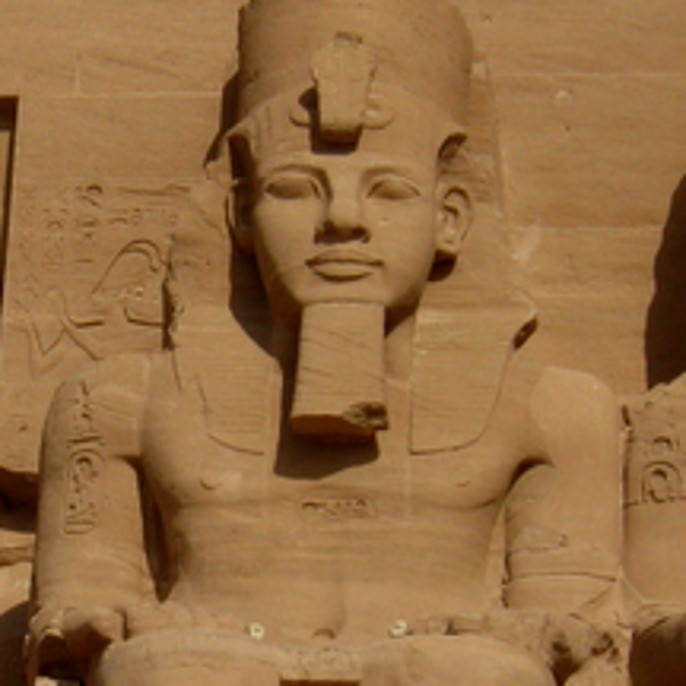
The poem “Ozymandius” was, again, published in 1818, during a time of intense interest in ancient Egypt in England. The Rosetta stone had been discovered in 1799, the decipherment of hieroglyphics was well underway, and western European countries were dispatching scholars and archaeologists to extract as much information and as many artifacts from Egypt as possible. There was genuine, respectful curiosity at work in 1818, as well as tomb robbing, and Shelley’s poem captures the overall spirit of nineteenth-century archaeology, a spirit at once astonished and belittling. Shelley’s sonnet’s speaker is awestruck by the scale, and ancient vintage of Ramesses II’s statue, but at the same time, the pharaoh is long dead, and a new empire has arrived to perform his autopsy.
After “Ozymandius”
I think that as moderns, many of us come to ancient Egypt with the same sense simultaneous veneration and aversion that we see in Shelley’s famous poem. It is hard not to feel a sense of wonderment at a culture that persisted for three millennia and produced monumental constructions and exquisite knickknacks that we are still studying today. At the same time, ancient Egypt, from end to end, was a 3,000-year-long, bone-crushing autocracy in which death-obsessed elites lashed cities full of slaves and workmen to build pointy mausoleums for them so that they could be comfortable in an afterlife that no one believes in anymore. “Look upon my Works, ye Mighty, and despair!” howls Ramesses II in his pulverized statue in Shelley’s poem, and of course, reading it, it is pretty easy to scorn the epic spectacle of hubris chastened by the sands of time.Ancient Egypt was an autocracy. There’s no denying it. As scholar Toby Wilkinson writes, “From human sacrifice in the First Dynasty to a peasants’ revolt under the Ptolemies, ancient Egypt was a society in which the relationship between the king and his subjects was based on coercion and fear, not love and admiration— where royal power was absolute, and life was cheap.”1 Additionally, ancient Egyptian culture did have an unusual fixation on life after death. Other ancient cultures burned their dead with far less pomp and ceremony, not sharing Egypt’s complex doctrines about the multipart self. The Book of the Dead, as we learned last time, is a very unique text, as far as we know, presenting a preoccupation with the afterlife not nearly as evident in contemporary Sumerian and Babylonian cultures.

The fertile banks of the Nile adjacent to Luxor today.
A lot of time has passed since Shelly published “Ozymandius” in 1818, and although Khufu’s pyramid and King Tut’s shiny mask will always be the supreme emblems of the bygone culture of the Nile, archaeology focused on ancient Egypt has turned up more and more information about daily life there during the Bronze and Iron Ages. Beyond the tombs, the grave goods, the monuments, the inscriptions, and the cold, humorless serenity of the pharaoh statues and colossi, there lived the Egyptians themselves, a busy, inventive, hardworking and increasingly cosmopolitan people to whom I hope to bring us a little closer in the remainder of this program. [music]
Thebes in the Autumn of 1363 BCE
For a moment, let’s forget about the Sphinx and the Great Pyramid. Let’s picture Thebes, the capital of the New Kingdom on the middle of the Egyptian Nile. The year is 1363 BCE. It is autumn. The sun hangs high on the fresh stonework of Luxor Temple. The harvesters cut wheat and barley out in the fields, the gleaners gather their leavings. Market stalls at the city entrances sell leeks, cabbages, figs, melons and pomegranates. From shores and boats, people wave at one another, and shoals of perch, catfish and eels weave through cattails and bulrushes. In scriptoriums, workers carefully copy the hieroglyphics of the Book of the Dead onto papyri and linen to be sold to the families of the bereaved, perhaps with unbroken solemnity, but more likely taking frequent breaks to engage in jokes and horseplay and enjoying beers together after work.
Luxor Temple today.
In the temple, king Amenhotep III, perhaps the greatest builder of all of Ancient Egypt’s leaders, is looking at a carving that will later be famous in history. Amenhotep has his hands on his hips and is nodding in satisfaction. The carving shows the pharaoh Amenhotep’s mother with the God Mutemwia, and describes, in lurid detail, how the two copulated to produce Amenhotep himself. The carving and the captions please the king, who believes now that posterity will see him as the creator deity, the direct son of a god – a Jesus Christ of the middle Nile.
Outside, though, the king’s weird fantasy about godhood is a world away from the bustle of the Theban streets. The pharaohs, after all, have always had big stone things being built for them. For the median citizen of the Egyptian capital, there are courtiers to dispatch, investments to consider, kids to raise, furrows to dig, sandals to fix, gossipy stories to exchange, romances to pursue, gifts to buy, and dinners to prepare. Of course, when the jubilee comes – this is the festival in which the king parades as a god, with lavish costuming and buildings commissioned for the occasion – when the jubilee comes, everyone will go out to see it. And as we learned in the previous episode, Ancient Egyptians weren’t some mercantile secular society – they had strong convictions about the afterlife and made offerings to their ancestors. But their relationship to their king was not merely one of thoughtless idolization. Their literature, as you will soon, proves it.
Ancient Egyptian Fiction: A Different Window into the Past
The name of this episode is “Beneath the Obelisks,” and, as the name perhaps implies, we’re going to try and figure out, in particular, what Egyptians thought about their kings and their social order. We will see that they were often reverent, but also resentful and critical, and even capable of astute legalistic analysis of the rights and wrongs of totalitarianism. If poor, egomaniacal Amenhotep III, while looking at the umpteenth statue of himself that he’d commissioned, knew that nearby, some papyrus scribbling genius was penning far more impressive than an egomaniac’s monument to himself, the pharaoh might have felt rather alarmed. He might have even had a trace of self-consciousness about the fact that he’d just paid someone to create a stone carving of his own mother having sex.The vast bulk of what we have inherited from Ancient Egypt is a sort of stream of consciousness fantasy world – masterfully carved in stone and gold – of a very small group of leaders and aristocrats. I think that because the monuments of Ancient Egypt are so unique, we’re conditioned to picture the region’s entire history as a bunch of sweaty, bronzed laborers trawling blocks through the dust while a stoic strongman wearing a headdress and artificial beard nods in approval. In fact, again, over the course of 31 dynasties and three intermediate periods, the population was not just bowing and scraping at the base of the Great Pyramid. There were coups and assassinations, divisions of power, and an increasingly steady influx of foreigners, too. And the kingdom was large. Even to the first cataract, the Egyptian Nile is over seven hundred miles long, and the Nile Delta extends two hundred miles from east to west at its widest. Regional powers and cultures lay beyond the shadows of pharaohs and pyramids and colossi, and were far less subject to the deifications and delusions of the kings.
.jpg)
The papyrus plant. You don’t exactly look at this picture and think, “literature,” but nonetheless the leaves of this plant were harvested, woven together into mats, and pressed into flat sheets. Learn about how it was made on this wonderful page from the University of Michigan. Photo credit: By SuSanA Secretariat [CC BY 2.0], via Wikimedia Commons
So, let’s get into the first story. Unless otherwise noted, quotes from ancient Egyptian fiction in this program will come from the William Kelly Simpson anthology, The Literature of Ancient Egypt, published by Yale University Press in 2003. Let’s go back in time, a dizzying four thousand years, to a turbulent period of Ancient Egyptian history. Let’s lean closely over a tattered manuscript that’s older than any religion now practiced, breathe in its mysterious scent, study its unfamiliar black and red hieratic script, and see what it says. [music]
“The Shipwrecked Sailor”
The Frame Narrative
It had been a long, difficult expedition down to Nubia, a historical region that includes the south of present-day Egypt and north of what is today Sudan. Having been in the distant south of the Egyptian empire, the men who had been on the expedition were returning home. The story doesn’t indicate what the men had been doing – it could have been a commercial or military enterprise. But more importantly than the challenges they had faced, and the distant lands to which they had ventured, was the fact that they were going northward along the Nile, back to the old heartland of Egypt..jpg)
Tomb art from Giza of an impressive Ancient Egyptian vessel, which could be propelled either by oars or wind power. Daily life in Ancient Egypt involved seeing these coming up and down the Nile and throughout the Nile delta.
The sailor wondered if the commander were nervous about his upcoming meeting with the king. Perhaps, thought the sailor, the commander could use some advice on how to prepare for the consequential meeting. The sailor advised him, “Wash up. . .So you can speak to the king with confidence, / So you can answer [him] without stammering. / The speech of a man can save him, / And his words can cause indulgence for him” (47). But still, the commander of the returning expedition was silent, gloomy and enigmatic.
At a loss for anything else to say, the sailor began a story – his own story, about how he was shipwrecked on a strange island. Hence begins the central narrative of “The Shipwrecked Sailor,” a story within a story. [music]
The Sailor’s Story in “The Shipwrecked Sailor”
In the midst of a vast body of water, in a great ship, the sailor voyaged, one member of a crew of a hundred and twenty brave men. In a strange section of the sea, on the way to some copper mines, the sailors were assaulted by a terrifying storm. This storm overtook them on what ancient Egyptians called the “Great Green” (48), or the Mediterranean. Howling winds and tall waves smashed against the ship, and when it was over, the vessel was obliterated and the sailors were tossed into the ocean. The sailor who is the main subject of this story was able to cling to a floating plank. Before long, he washed up onto the shore of an island.Utterly exhausted, the sailor staggered into a thicket and fell asleep in the shade. When he awoke, he found figs and grapes, strange berries, gourds and giant melons, and a profusion of fish and birds. It was a strange place, and it was strange that he was alive, and so he cut a hole in the ground, built a fire, and made sacrifices to thank the gods. The sailor stayed there for several days, lonely and melancholy, but there was enough in the alien land to subsist on.
On the fourth day, the sailor heard thunder, and was suddenly alert. He thought the distant rumbling might be waves crashing at the seashore, but then he saw something. The trees were moving, and the earth shuddered, and something huge came through the branches. It was a giant serpent, almost fifty feet high, glittering with gold and gems. The serpent peered down at the shipwrecked sailor, and over its eyes were great brows of lapis lazuli.
The giant serpent asked the sailor, “Who has brought you?” (45). The sailor collapsed onto his belly, mortified. “Who has brought you?” the serpent said again. The sailor didn’t speak. “Who has brought you?” it repeated, and it leaned down, picked him up, and took him to its den. Upon realizing that he would not imminently be eaten, the sailor was able to speak. He told the giant creature his tragic story. His friends had all drowned, he said, and mere chance had led to his survival. The serpent, then, did something quite unexpected. The creature offered the sailor words of comfort.
It said, “Do not fear, do not fear, citizen. / Do not turn white, for you have reached me. / See, God has allowed you to live: / He has brought you to this island of the spirit” (50). The serpent told the sailor he’d be able to return home in four months, and that he’d be buried there, as all ancient Egyptians wanted.

The general location of the land of Punt, somewhere in southeastern Egypt or perhaps the Arabian Peninsula. Hatshepsut (15th century BCE) sent an expedition there which returned with myrrh and incense, and Punt in the Ancient Egyptian imagination was a realm of exotic goods and finery.
The sailor was grateful – grateful for his safety, and grateful for the serpent’s kindness and understanding. He stammered and promised to spread fame of the snake’s grandeur all over once he returned to Egypt. The sailor even promised the serpent that “I shall have brought to you laudanum, oil, / Spice, balsam, and incense of the temples” (51).
At this, the serpent laughed and laughed. It chuckled, “I am, sir, the Prince of Punt. / Myrrh belongs to me. / That oil which you said will be brought, / It is the main product of this island” (52). Punt, by the way, was a territory at the south end of the Red Sea, encompassing parts of Eritrea, Ethiopia, Somalia, and Yemen. The serpent was not angry at the sailor’s overenthusiastic promises – only amused. And so the serpent, in due time, loaded the sailor up with the finest goods, including “myrrh, oil, laudanum, spice, / Cinnamon, aromatics, eye-paint, giraffe tails, / Large cakes of incense, ivory tusks, / Hounds, apes, baboons, and all fine products” (53).
The sailor, endlessly grateful for the hospitality and the presents, brought the gifts back home and bestowed them on the king. Upon receiving the lavish gifts, the king promoted the sailor into a higher position, and, though he’d lost his comrades and nearly lost his life, the sailor ended up safe, prosperous, and back at home. [music]
The Closing Frame Narrative in “The Shipwrecked Sailor”
This was the story that the sailor told the gloomy commander, to cheer him up. The commander was about to meet with the king at the end of his own expedition, and the sailor likely wanted to hearten his superior, by showing that the king was good to those who were good to him. But the commander was not convinced by the shipwrecked sailor’s heartening tale, and the frame narrative of the ancient Egyptian story “The Shipwrecked Sailor” ends with the commander speaking one mysterious, incredibly dark line.The commander said, “Do not be so proper friend. / What is the use of giving water to the fowl at daybreak / When it is to be killed in the morning?” In other words, you don’t need to comfort me. I’m done for. Thus, the story of the adventuring sailor, an attempt to console a forlorn commander, had not achieved its purpose. And that’s the end.
So let’s consider what this story might have meant three thousand years ago. Was there some real-life military commander who had been unjustly executed by a cruel and capricious king? Is the sailor’s folkloric narrative about the serpentine Prince of Punt disregarded because it is some outdated piece of paganism? Is it an excerpt from a far longer work, in which the tragic, haunted commander is a main character? These are all possible, and we might have just heard a single, small excerpt of a lengthy lost saga.
Understanding “The Shipwrecked Sailor”
But speculations aside, let me offer a simple interpretation of “The Shipwrecked Sailor,” informed by some straightforward historical analysis. The story comes down to us from around the time of ancient Egypt’s First Intermediate Period, or about 2180-2050 BCE. The First Intermediate Period of ancient Egyptian history was not a peaceful or orderly time period. It was an era of warring power blocs that might have been even worse than the despotism of the Old and Middle Kingdoms. Archaeology has shown that even during peaceful periods of ancient Egyptian history, life for the average commoner was not easy. Skeletons of tomb and temple workers over the course of ancient Egypt’s history show muscle tears, arthritis, bone breaks, hernias, and other signs of hard living. The civilization along the Nile was plagued by tuberculosis, Pott’s disease, and schistosomiasis, a disease caused by waterborne parasites. In such a place and time, one must have largely felt that one’s fate was out of one’s own control.The general autocratic order of Egypt, hard as it was on laborers and slaves, sometimes collapsed into something worse. When the Egyptian King Pepi concluded his legendary 94-year-long reign near the end of the third millennium BCE, Egypt’s sixth dynasty collapsed and the country fell into chaos. Seventeen kings ruled in twenty years. Then, two factions, operating out of Thebes in the middle Nile, and Heracleopolis in the north, fought for a hundred and ten years. Nubian forces (and remember, the sailor and commander of the story we just read are coming back from Nubia) – Nubian forces were also warmongering, and the peasantry suffered greatly under unregulated taxation by greedy local officials, faltering irrigation systems, and resulting famine.
On one hand, “The Shipwrecked Sailor” might be an escapist tale about a sea adventure. Just like in the Odyssey, a mariner offers a tale-within-a-tale, and in it, the principal theme is what ancient Greeks called xenia, or hospitality. A seafarer wrecks in a strange land, and he finds it friendly, rather than fearsome, and after some lumps and bumps, he’s safely on his way home again. But “The Shipwrecked Sailor” does not conclude with the titular character’s homecoming. It winds to its conclusion with the forlorn words of the commander, again “What is the use of giving water to the fowl at daybreak / When it is to be killed in the morning?”
Maybe, ultimately, “The Shipwrecked Sailor” is a folktale about forces beyond our control. Sometimes, these forces are good to us. In the story-within-the-story, the great serpent that the sailor meets gives him food and blessings, and the king, when the sailor returns home, offers him a promotion and material prosperity. In contrast, sometimes uncontrollable forces are not sympathetic to us. The sailor loses his 120-man crew to a tempest, the serpent loses his 75-member family to a meteor, and the commander – whatever it is that he specifically fears – is worried about something that he’s powerless to change – as powerless as a chicken awaiting slaughter.
The story likens the pharaoh’s power to that of a terrible cyclone or obliterating meteor. But rather than making us feel awe or admiration, we simply feel sad. Powerful things kill our friends and families, our siblings and children, be they storms, asteroids, or tyrants. The commander’s mysterious horror at the story’s end is, perhaps, horror at the unpredictability of a violent autocrat, who might rise up to harm his subjects as quickly as a natural disaster. Among many inscriptions commemorating the dominion of this or that ruler, or proclaiming this pharaoh’s victory at a battle, or that pharaoh’s union with some divine being, I think that “The Shipwrecked Sailor” helps us see what life was like for the other 99% of the Egyptians who lived beneath the obelisks, and the storms and shipwrecks of autocratic history. When we read ancient fiction, we often encounter jarring, sudden endings out of step with modern expectations of narratives. The Iliad, Odyssey, Aeneid, and a great many less famous works from pagan antiquity rumble to jarring conclusions with just the kind of moral ambiguity that we see at the end of “The Shipwrecked Sailor.” To many ancient pagan cultures, their pantheons full of lusty and scurrilous gods, humanity was a vulnerable thing beneath the powers of far greater forces, and that, as somber as it is, was one of the main points.
However, the next story we’ll look at, “The Eloquent Peasant,” doesn’t have such an irresolute and dispiriting ending. Written about two hundred years after “The Shipwrecked Sailor,” “The Eloquent Peasant” is a story about a commoner named Khunanup, whose persistence and intelligence in the face of persecution eventually both serve him well. While the meaning of “The Shipwrecked Sailor” is elusive, I think you’ll find “The Eloquent Peasant” to be comparatively pretty clear. And let me say ahead of time that in my opinion “The Eloquent Peasant” is one of the finest stories of the entire Bronze Age, one that I bet you’ll remember, and one that is relevant to any epoch in which the rich oppress the poor. As with the previous story, quotes from “The Eloquent Peasant” will come from the anthology The Literature of Ancient Egypt, published by Yale University Press in 2003. [music]
“The Eloquent Peasant”
In the countryside, just after the fall of the Twelfth Dynasty, or, very roughly 1800 BCE, there lived a peasant named Khunanup. A trader and farmer, Khunanup and his wife and children got along by growing provisions, eating what they needed, and exchanging any surplus produce for what they could not grow on their own. One day, the peasant Khunanup asked his wife to help him pack provisions for a journey, and shortly thereafter, he set out to a more central part of Egypt.In his donkey cart, the eloquent peasant Khunanup had plants, salt, wood, skins, seeds, birds, and other beautiful products of his homeland. He was passing through a stretch of countryside that belonged to a man named Rensi, but, knowing the penalties for trespassing on someone else’s fields, Khunanup stayed carefully on the path. The roadway wound down close to the river, and an overseer named Nemtynakte saw the peasant and his donkey cart approaching. The overseer studied the peasant’s wares, and the course of the roadway, and he thought carefully. Grain grew on the sloping hillside that led down to the track, and Nemtynakte the overseer devised a plan. He had a servant drape linen sheets over the pathway that lay beside the river.
Khunanup saw these sheets, and he stopped his cart. Nemtynakte confronted him, and said, “Watch out, peasant! Do not tread on my clothing” (27).
Khunanup was humble in his reply, but he knew he had the right to use the road. Khunanup said, “I shall do what pleases you, for my path is good” (27). The overseer Nemtynakte warned him again, and Khunanup again insisted that he was perfectly justified in using a public pathway. Khunanup said, “My path is good, but the [river]bank is steep, so my way (must be) through the barley, for you are obstructing the road with your clothing. Will you not let us pass on the road?” As the peasant slowed, however, his donkey leaned over and bit off a mouthful of grain. This was exactly what Nemtynakte had planned.

A nineteenth-century illustration of an ancient Egyptian peasant and his wife.
Some peasants might have returned home, scraped by on what provisions they had, and lamented the cruelty of the world. Khunanup was not one of these. He spent ten days hovering around Nemtynakte’s lands, telling the greedy overseer that his goods had been unjustly confiscated. Nemtynakte didn’t listen. Still, Khunanup was undaunted. He got his things, and went to the city to find the estate’s owner, Rensi.
It was difficult to get an audience with Rensi. Khunanup petitioned the landowner Rensi’s officials, who relayed the complaint to the great landowner. The officials made light of the overseer Nemtynakte’s offenses – bluebloods, protecting one of their own. They said the whole affair was probably nothing. But the landowner Rensi, for whatever reason, was curious to hear the argument of the persistent commoner, who had traveled all the way to the city to make his petition.
Hence proceeds the main part of the story “The Eloquent Peasant.” It’s a series of nine different petitions in verse which fill about thirteen pages, with occasional narrative breaks. Khunanup’s message to the landowner Rensi was that some justice needed to be brought to the greedy and duplicitous Nemtynakte, and, more generally, to impoverished people everywhere. While Khunanup’s mannerism is initially humble and sycophantic in his speeches, over the course of his nine petitions, his argumentative style becomes increasingly confident, and even insulting, leading to Rensi the landowner beating him at one point. Yet physical abuse, as before, was no bar to Khunanup’s unrelenting eloquence.
I’m going to stitch together excerpts from Khunanup’s speeches, quoting from the William Kelly Simpson translation. As we hear this working-class guy from 4,000 years ago speak up for himself, pay attention to how Khunanup moves from humble supplicant to fearless champion of the disenfranchised, his argument unfolding and his anger building over the course of his ten days of speaking. It’s a speech calling for justice for the repressed, and the prosecution of the wealthy and privileged who take advantage of them, anticipating the anti-monarchial and reformist arguments of thinkers like John Milton, Jean-Jacques Rousseau, Thomas Jefferson, John Stuart Mill, and Karl Marx, only, incredibly, it was set down during the Bronze Age. So here it is – the eloquence of “The Eloquent Peasant,” and just to be very clear, again I’m compacting nine days of speeches into one long speech to give you the gist of the whole thing. Khunanup said to the landowner Rensi, in the Yale University Press Vincent Tobit translation.
Chief Steward, my lord:
You are Re, the lord of heaven, with your attendants;
The provisions of all mankind are from you. . .
You. . .make. . .verdant the fields and revive. . .the desert.
[You’re the] Punisher of the thief, defender of the distressed,
Become not / a raging torrent against the supplicant. . .
If you veil your face against brutality,
Who then will reprove evil? (34-5)
[These days] Goodness is annihilated, for there is no fidelity to it,
(No desire) to fling deceit backwards upon the earth.
Who [these days] can sleep peacefully until dawn?
Vanished (now) is walking during the night,
Or even traveling by day. (36)
You [Rensi] are satisfied / with your bread
And contented with your beer;
You abound in all manner of clothing
But evil is done all around you.
You who know / the affairs of all men
Can you ignore my plight?
You who can extinguish the peril of all waters. . .
Rescue one who has been shipwrecked. (33)
[You] who [are] well provided should be compassionate,
For force belongs (only) to the desperate,
And theft is natural (only) for him who has nothing of his own;
That which is theft (when done) by the criminal
Is (only) a misdemeanor (when done by) him who is [desperate].
One cannot be wrathful with him on account of it,
For it is only a (means of) seeking (something) for himself. (33)
[Y]ou are mighty and powerful,
Yet your hand is stretched out, your heart is greedy. . .
Behold you are (like) a city / without a governor,
Like a people without a ruler,
Like a ship on which there is no captain,
(Like) a crowd without a leader.
. . .you are a constable who steals, a governor who takes bribes,
A district administrator responsible for suppressing crime,
But one who has become the archetype of the perpetrator. (36)
Your grain is excessive and even overflows,
And what issues forth perishes on the earth.
(You are) a rogue, a thief, an extortioner. . .
You have a plantation in the country,
You have a salary in the administration,
You have provisions in the storehouse,
The officials pay you, and still you steal. (41)
There is no one who was silent whom you caused to speak.
There is no one sleeping whom you caused to wake.
There are none who were exhausted whom you have revived.
There is no one who was closemouthed whom you have opened.
There is no one who was ignorant whom you have made wise.
There is no one who was unlearned whom you have taught. . .(40)
[C]ompassion has passed far beyond you. . .
[Y]our abode reeks of crocodiles. (33)
Idiot! Behold, you are struck!
You know nothing! And. . .you are questioned!
You are an empty vessel! And. . .you are exposed!
I appeal to you, but you do not hear it.
I shall now depart and appeal about you to Anubis.
With this final, blood curdling threat, Khunanup left the hall of Rensi the great landowner, after ten days of petitions which grew increasingly vehement and impatient. Even on the first day, Rensi found the peasant’s arguments powerful. He sent a copy of the first day’s speech to King Nebkaure, a reference to a real First Intermediate Period ruler, and Khunanup was promised the consolation of a small allotment of bread and beer to assuage his anger. But Khunanup did not want a token gift to placate him, and he pressed onward.
On the evening of the day of his last speech, Khunanup was summoned to Rensi’s quarters. Khunanup feared more beatings, but resolved to take what was coming, having said everything he had wanted to say. Rensi the landowner then made his proclamation. He had had all of Khunanup’s speeches copied – not just the ones from the first day – and he’d sent them to king Nebkaure. Nebkaure had read them. The news fell heavily on Khunanup’s ears. The peasant knew that his speeches had been seditious, and that pharaohs did not take kindly to any form of insubordination.
But Khunanup was shocked by the response he heard. The pharaoh had written that Khunanup’s speeches “were pleasing to his heart more than anything which was in his entire land” (44). After giving his unqualified approval, the pharaoh Nebkaure told the landowner Rensi to do with Khunanup as he saw fit. Rensi made his announcement. All of the lands of the thieving overseer – all of Nemtynakte’s donkeys, grain fields, linens, food, and finery, would be given to Khunanup. The two would have their places switched, with the fair-minded peasant in a position of prosperity, and the wicked Nemtynakte deprived of his former powers. And with that very modern happy ending, the story of “The Eloquent Peasant” comes to its conclusion. [music]
Understanding “The Eloquent Peasant”
So that was the “The Tale of the Eloquent Peasant,” once again from very roughly around 1800 BCE. We don’t know if there was a real Khunanup, or whether the story is just a collection of proverbs placed into a frame narrative by some long ago compiler. Either way, the very title of “The Eloquent Peasant” seems surprising in the context of ancient Egyptian thought. Fifth and sixth dynasty tombs featured carvings of tall kings and aristocrats at the triumphant moments of their lives, towering over wives and children, who barely come up to knee height. As historian Toby Wilkinson observes, “scenes of peasants at work, disease, deformity, dirt, and dissent had no place in the aristocratic ideal of the ruling elite.”3 In other words, for the patricians of ancient Egypt, the peasantry was out of sight, and out of mind.Why then, have two manuscripts come down to us that feature such an incendiary story? “The Eloquent Peasant” expresses vigorous, consistent criticism of the imbalance of wealth and power in ancient Egypt. Aristocrats are not only agents of injustice – they’re also parasitic, useless things that live on the backs of the strong and capable. Khunanup’s furious accusation that “There is no one who was ignorant whom you have made wise / There is no one who was unlearned whom you have taught” (40) – this line and a litany of similar statements against the wealthy paint a picture of a landed aristocracy that contributes no work, no ideas, and no goods to society, but instead only consumes the work of others.
In its most sophisticated moment, “The Eloquent Peasant” describes how the thefts of a poor person, made out of desperation to survive, are mostly excusable, whereas the thefts of the wealthy class, merely to swell their riches, are unforgivable. A poor man steals a loaf of bread and is beaten for it, and a rich man steals a wagon of bread and gets away with it. This is the social order of “The Eloquent Peasant,” and I think its conception of the inequalities of the justice system is hauntingly relevant to many different eras of history. Comparably, an Akkadian proverb from later on in the Bronze Age survives that says, “When you commit a crime (out of weakness), / The [river] will bear (it) away. / When you commit a crime (from a position of power), / Heaven itself will forsake you.”4 In other words, crimes of desperation are forgivable; crimes of the wealthy and powerful are far more malicious. The ancient Egyptians had their notion of ma’at, or universal order, and Mesopotamians had Shamash, the god of the sun who saw all and was associated with justice. Yet during the second millennium BCE, Egyptians as well as Babylonians knew, as we still do today, that in spite of our gods and our universal rules, justice isn’t always very fair and impartial in the way that it’s carried out in human societies.
Still, the tattered papyrus that contains the tale of Khunanup is an inspiring, and incredibly valuable historical document. Ramses II, or Ozymandius, built immense temples at Abu Simbel and Qurna. But what the story of “The Eloquent Peasant” shows is the story of the unprotected commoners who lived in the shadows of these temples, vulnerable to the predations of everyone on the social ladder above them. And while Bronze Age history is full of kingly inscriptions, pyramids, ziggurats, palaces and temples, it was also, as I’ve emphasized in this program already, full of intermittent revolts. Ancient Egypt had dozens of dynasties and periods of civil war because oftentimes, people like Khunanup did speak up, and then, sometimes, down came a regime. We have always, as a species, surely, had an inbuilt sense of what is fair and egalitarian, and what is not. The story of Khunanup is the story of working-class revolution in general – of eloquent peasants of any age who stand up for themselves and try to make a change. [music]
The Drunks of Menkaure
Speaking of the working class, some very ancient graffiti survives on the pyramids at Giza – graffiti in the form of inscriptions of the various gangs who raised the pyramids back during the 2500s BCE. One of the crews, in one inscription, commemorated themselves as “The drunks of Menkaure,” Menkaure being the pharaoh who was buried in smaller pyramid still atop the Giza plateau today.5 I always thought that inscription was funny. There are a lot of ridiculous conspiracy theories out there about how aliens built the pyramids, and general misinformation alleging the construction of the pyramids to be some great unsolved mystery. There’s little mystery. Barges for construction materials, nearby quarries, log rollers, dirt ramps, solid Bronze Age astronomy, and some long ropes to help with straight lines and measurements – that’s how they were built. All of that, and, evidently, some recreational binge drinking on the part of blue-collar ancient Egyptian labor gangs who spent their days cutting and moving stone. So let’s move on to the third and final story in this program.Our last tale for today is called “Prince Hordedef’s Tale.” It is the youngest of the three ancient Egyptian short stories we’re reading, and it actually has to do with the Giza plateau. In it, a peasant prophet comes to the court of King Khufu – the king who had the Great Pyramid of Giza built for himself. And this peasant prophet offers Khufu some very grim news about the impending end of the pharaoh’s dynasty. “Prince Hordedef’s Tale” was likely originally composed within a century of 1850 BCE, or around the time “The Eloquent Peasant” was set down. However, the manuscript of it that we now have comes from a couple of centuries after this. So, very basically, the story “Prince Hordedef’s Tale” is about a Pharaoh who lived around 2550, it was written around 1850, and set down very roughly around 1600 BCE. And again, it’s the tale of a peasant prophet coming to town and giving a lecture to the most famous pharaoh of the Old Kingdom. So here’s our final story for this program. This time, quotes will come from the Toby Wilkinson translation in the anthology, Writings from Ancient Egypt, published by Penguin in 2017. [music]
“Prince Hordedef’s Tale”
One day, King Khufu was listening to people tell stories in his court. To pass the time, perhaps sitting near where his pyramid would soon be erected, King Khufu had heard one already – a story that was ancient even in the time of old Khufu himself. But then another teller of tales, the prince Hordehef, stood up and addressed his father, the pharaoh. So far, said prince Hordehef, the great Khufu had heard stories of the times of yore. Wouldn’t Khufu like to hear a story about one of his subjects? A subject who was still alive, who knew both what was, and what would be? Khufu said he was interested. He told his son, the prince Hordedef, to go ahead and proceed with his tale.Hordedef did so. Prince Hordedef said that within Khufu’s kingdom, “There is a fellow called Djedi who lives [in a town]. He is a fellow of 110 years. He eats 500 loaves and the shoulder of an ox for meat and he drinks 100 jars of beer – right up to today. He knows how to reattach a severed head. He knows how to make a lion walk beside him with its leash on the ground. He knows the number of the chambers of the Sanctuary of Thoth.”6 Now, in my opinion, that’s one of the best openings in literary history. Want to hear a story about a necromancer who drinks a hundred jars of beer a day, has a pet lion, and possesses arcane knowledge of the divine? You’re damned right I do.
King Khufu was certainly interested in learning more about Djedi the alcoholic necromancer prophet. King Khufu had long sought to understand the realm of the god Thoth, and so King Khufu asked the wise man Hordedef to bring this Djedi fellow to him. The king’s will was obeyed. Hordedef traveled southward down the Nile, and then overland, perched in a fine palanquin. And soon, Prince Hordedef found the prophet Djedi.

The Westcar Papyrus (c. 1650 BCE), which contains “Prince Hordedef’s Tale,” showing classical Middle Egyptian in hieratic script. On display at the Egyptian Museum of Berlin. Photo by Keith Schengili-Roberts.
Djedi, at that moment, was having his head anointed and his feet massaged by a servant. Djedi, by the way, is described as a commoner, although in this scene he seems to be leading a pretty plush life. Perhaps prophets got foot massages as a professional perk, regardless of their social standing. Anyway, Hordedef told Djedi that the prophet looked great for his advanced age – again Djedi was 110 years old, and Hordedef said that the elder was remarkably robust. And then prince Hordedef then made his entreaty. Would the old commoner Djedi come to meet the pharaoh? They’d make sure he was well taken care of, and that after the visit, Djedi had money to spare.
Djedi welcomed Hordedef, knowing that Hordedef was the son of the pharaoh, and he gave Hordedef the kindest well wishings at his disposal. Hordedef was delighted at the other man’s courtesy, and the two men went arm and arm to the riverbank. The two men were about to disembark to head up north to the capital, but Djedi voiced one additional request. Could he have an extra barge? the prophet asked. He wanted to bring his children with him, along with his writings. Hordedef said this was no problem. Arrangements were made for a secondary boat, and up went prince Hordedef and the prophet Djedi to the court of the Pharaoh Khufu.
After their journey was complete, Hordedef brought Djedi to meet Khufu in the palace. The elderly sage was just as friendly and ingratiating to the pharaoh as he had been to the pharaoh’s son, and it wasn’t long before the pharaoh got to the heart of the matter. Khufu wanted to see some of Djedi’s legendary powers. He had heard, Khufu said, that Djedi could reattach severed heads. Djedi said that was true, he could reattach severed heads. Khufu said he’d have a prisoner brought to the court and beheaded, so that he could see Djedi work his magic. Djedi said that this wouldn’t work. He couldn’t reattach human heads, he said – perhaps the correct term is “recapitate.” But he could reattach the heads of animals.
Khufu, evidently still wanting to see the miracle of the reattached head, had a duck brought to his court. The bird’s head was chopped off. Its body was set on one end of the throne room. Its head was placed at the other end. The old sage Djedi uttered an incantation. And sure enough, the duck body waddled over to the duck head, the head and body fused back together, and the duck quacked. Khufu was evidently impressed. He wanted to see more “recapitations.” Djedi consented to reattach the head of a goose to its body, and then repeated the feat with a bull, and then repeated the performance once again with a lion.
King Khufu was satisfied that the elderly Djedi could indeed reattach heads to bodies. But King Khufu wanted something else from the commoner. Khufu, if you’ll remember from earlier, had learned that old Djedi knew “the number of the chambers of the Sanctuary of Thoth.” The “Sanctuary of Thoth,” in this story, is a mythical place, and the pharaoh wants to know how to get there. Thoth was the god of wisdom, writing, and magic, and so his secrets were very sacred indeed. So, getting down to business after all the heads were lopped off and reattached, the pharaoh Khufu asked the magician Djedi where exactly this “Sanctuary of Thoth” was that held so many secrets. And Djedi answered the pharaoh with a riddle. Djedi said that the sanctuary’s secret lay in a coffin made of flint that was hidden in the city of Heliopolis. The pharaoh wanted this coffin. He told old Djedi to bring it to him. Djedi said he couldn’t do so, because someone was already going to bring the pharaoh the coffin. This someone, said Djedi, was the eldest child of a woman named Ruddjedet, who was already pregnant with three children. The three children, said Djedi, would be the kings of Egypt.
Pharaoh Khufu’s mood darkened. Khufu didn’t know any woman named Ruddjedet. What the prophet Djedi’s news meant was that Khufu’s line was coming to an end. The prophet Djedi observed the pharaoh’s anger, and Djedi assured the pharaoh that three more of Khufu’s sons would be kings first, before his line came to an end. This news indicated a stay of execution, at least, but it was still grim. Khufu and his three sons would be the last of their line. Keeping his wrath in check, Khufu knew that the prophet Djedi had done him a service, and so Khufu made arrangements for Djedi to stay in the service of his son Hordedef, confirming that Djedi would have his considerable appetites sated – remember that the old prophet ate five hundred loaves of bread and drank a hundred jars of beer every day. And that is the story of the commoner Djedi, who came to the court of Khufu, warned the pharaoh of the downfall of his dynasty, and was rewarded for it. [music]
Ancient Egyptian Short Fiction: The Three Stories Considered Together
“Prince Hordehef’s Tale” is just one installment in a group of tales in a manuscript called the Westcar Papyrus, and at its end, in an epilogue, we learn about the mysterious woman who is going to give birth to the next dynasty after Khufu’s dynasty. It’s important to remember that the story of the old necromancer prophet Djedi was written almost a thousand years after the reign of King Khufu, so whoever wrote it knew that by the time King Khufu came along, the Fourth Dynasty would soon give way to the Fifth Dynasty. “Prince Hordehef’s Tale” is thus a piece of historical fiction, prophesying the end of an era long after the era in question had actually ended.“Prince Hordehef’s Tale,” like “The Eloquent Peasant” and “The Shipwrecked Sailor,” is a very early piece of narrative literature. While there is some artistry to it, the short fiction that ancient Egypt left behind is generally brisk and cryptic, with a bare minimum of characterization, and hardly any establishment of settings, the narratives taking place through dialogue and descriptions of events. In the story we just finished, we never hear anything about what the peasant sage Djedi looks like, nor what he’s thinking at any given moment; moreover, even the story’s descriptions of events are sparse. This is all normal for Bronze Age fiction. Literacy was the privilege of a tiny minority, and we can assume that more sophisticated storytelling existed in oral performances sung to music and given choreographed accompaniment. Yet even within the three tales that we’ve explored in this program, in spite of their brevity and narrative minimalism, there are some consistent themes. Social hierarchy is rigid and ruthless. The ingratiation of authority is immensely important to the wellbeing of the lowborn. Yet, the lowborn, through surpassing individual talents, can still sometimes bend the rules. A sailor befriends a gigantic serpentine prince. A peasant is so thunderous in his words of self-defense that he gains the approbation of a pharaoh. And a pharaoh, listening to the words of a peasant-sage, realizes that his dynasty’s days are numbered. All told, ancient Egyptian short fiction shows that there is ma’at, or order, in the age-old social hierarchy that puts kings atop obelisks, and slaves down in the dirt. And at the same time, ancient Egyptian short fiction shows that this order, in various ways, isn’t quite right.
Even though the surviving body of ancient Egyptian fiction that we have today is quite small, and even though it was set down by scribes probably working for wealthy patrons, it still, interestingly, reveals traces of dissent, disgust, and sadness at the economic imbalances of the autocracies that governed the Nile. Maybe this means that dissent, and a whole culture of political satire existed among the Egyptian masses like those beer-swigging workmen who carved their crew’s name into Menkaure’s pyramid – a culture of dissent that flourished in oral narratives, short plays, and folk songs, that’s been almost entirely lost to history. We began this episode with Percy Byssche Shelley’s “Ozymandius,” in which a modern person ponders the broken, sneering visage of a bygone pharaoh sinking into the desert. And it is possible that some ancient Egyptians saw pharaohs in precisely this same way. Whoever wrote “Prince Hordehef’s Tale” lived a thousand years after Khufu, and recorded a story about the mighty pharaoh who built the largest mausoleum in history being told that his days were numbered. In the fiction that they wrote, although it has its fair share of strongmen and pharaohs, ancient Egyptians pretty clearly understood that some of mightiest of pharaohs, like Ozymandius in Shelley’s poem, were cruel and unjust, and that all of them, eventually, would end up in the rubble heap of time. [music]
Moving on to Ancient Egyptian Wisdom Literature
So that takes us through a good, representative swathe of ancient Egyptian short fiction. It’s not an expansive genre, and, like the Book of the Dead, it was produced by a very ancient culture that’s sometimes hard for us to understand. Physically, a lot of the extant papyri aren’t in great shape, either, with damage to the writing material, smudges, or otherwise unrecognizable hieratic script that even the best scholars have trouble making sense of. Nonetheless, it’s fascinating stuff, and today you can read it for yourself in anthologies like the ones I’ve linked to in this show’s notes, and I highly encourage you to do so. Reading ancient Egyptian literature lets ancient Egypt speak for itself in a way that studying physical archaeology doesn’t always do.In the next episode, we’re going to look at a different side of Ancient Egyptian literature. While The Book of the Dead is our largest written window into ancient Egyptian religion, and the stories we explored in this episode bring the daily life of the bygone Nile a little closer to us, ancient Egypt left behind more genres of writing than the ones we’ve considered thus far. Next time, we’re going to consider a genre of writing called “wisdom literature.”
There was a lot of wisdom literature in antiquity, and really, wisdom literature is the oldest surviving genre of philosophical writing to have made it down to us. Wisdom literature, often organized into lists of maxims and proverbs, tells you how to live your life, how to be a good person, and how to succeed in the world. Dating all the way back to the Sumerian “Instructions of Shuruppak” in the 2500s BCE, a surprising quantity of wisdom literature survives from antiquity. And from ancient Sumer and Babylon, to ancient Egypt, to the Biblical Book of Proverbs, to the Meditations of Marcus Aurelius, all the way down to the self-help section of your local book store, human beings of any century seem to enjoy reading non-fiction that offers them pithy morsels of counsel and advice, if 4,500 years of written history is any indication. So next time, in Episode 6: The Pros and Cons of Wisdom, we’re going to look at a few Sumerian and Akkadian wisdom literature texts to get an idea of the genre, and just how ancient it is, and then we’ll explore two major works of ancient Egyptian literature from a later period than we did today, one called “The Instruction of Amenemope,” and the other, “The Instructions of ‘Onchsheshonqy.” And as we get to know these fascinating texts, you’ll be able to see that even though Ancient Egyptians worshipped Ibis headed deities and buried themselves with jars of beer, the ethical approach that they took to daily conduct was pretty close to the one we still have today. Thanks for listening to Literature and History. Try a quiz on ancient Egyptian fiction, or check out one of those anthologies of ancient Egyptian literature with the links in the notes of your podcasting app. I’ve got a song coming up if you want to hear it, and otherwise, see you next time.
Still here? So, I got to thinking. I got to thinking about that eloquent peasant, Khunanup. I wondered, what if he were rushed forward, almost four thousand years, to our time. I think he’d probably enjoy many facets of modern life, like medicine, and air travel, and ice cream. But I think he’d be a bit disappointed, too, by the economic discrepancies of our times. I got to wondering – what kind of music would Khunanup perform, if he were brought forward to our times? Do we have a genre of music, like Khunanup’s speech, that expresses predominantly lower-class dissent against modern-day oligarchies? Do we happen to have a whole style of music in which virtuoso lyrics are used to capture the anger, ingenuity, and protest of the disenfranchised? Why, yes, we certainly do! And it’s called rap and hip hop. So this is a tune that the eloquent peasant Khunanup might sing, as there have been many eloquent peasants, across many eras of history.
References
2.^ “The Shipwrecked Sailor” (6-8,12). Printed in Simpson, William Kelly, ed. The Literature of Ancient Egypt. Yale University Press, 2003, p. 47. Further references to this text will be noted with page numbers in this episode transcription.
3.^ Wilkinson (2010), Location 1560.
5.^ Strudwick, Nigel. Texts from the Pyramid Age. Society of Biblical Literature, 2005, p. 155.
6.^ Printed in Wilkinson, Toby. Writings from Ancient Egypt. Penguin Books, 2017, p. 237. Further references to this text will be noted parenthetically with page numbers in this episode transcription.