
Episode 123: An Introduction to the Hadiths
The hadiths are second only to the Qur’an in Islam. Short narratives about the Prophet Muhammad – the things he said and did – hadiths have been a source of wisdom and wisdom and inspiration for Muslims for more than a thousand years.
| Read Transcription | References and Notes |
| Quiz | |
| Episode on Spotify | Episode on Apple Podcasts |
| Previous Show | Next Show |
Episode 123: An Introduction to the Hadiths
Gold Sponsors
David Love
Andy Olson
Andy Qualls
Bill Harris
Christophe Mandy
Jeremy Hanks
John David Giese
KelleyGr
Laurent Callot
Maddao
ml cohen
Nate Stevens
Olga Gologan
Steve baldwin
Silver Sponsors
Lauris van Rijn
Alexander D Silver
Andreu Andreu i Andreu
Basak Balkan
Boaz Munro
Charlie Wilson
David
Devri K Owen
Ellen Ivens
Evasive Species
Hannah
Jennifer Deegan
John Weretka
Jonathan Thomas
Julius Barbanel
Michael Sanchez
Mike Roach
rebye
Top Clean
Sponsors
Katherine Proctor
Katherine Proctor
Carl-Henrik Naucler
Joseph Maltby
Stephen Connelly
Chris Guest
Sander
A Chowdhury
A. Jesse Jiryu Davis
Aaron Burda
Abdul the Magnificent
Aksel Gundersen Kolsung
Alex Metricarti
Andrew Dunn
Anthony Tumbarello
Ariela Kilinsky
Arvind Subramanian
Bendta Schroeder
Benjamin Bartemes
Berta Kienle
Brian Conn
Carl Silva
Cat Peterson
Charles Hayes
Chief Brody
Chris Auriemma
Chris Brademeyer
Chris Ritter
Chris Tanzola
Christopher Centamore
Chuck
Cody Moore
Daniel Stipe
David Macher
David Stewart
Denim Wizard
Dominic Klyve
Doug Sovde
Earl Killian
Eliza Turner
Elizabeth Lowe
Eric
Eric McDowell
Erik Trewitt
JK Huysmans
Francine
Friederike Otto
FuzzyKittens
Garlonga
Glenn McQuaig
J.W. Uijting
James McGee
Jason Davidoff
Jay Cassidy
JD Mal
Jillyp
Joan Harrington
joanna jansen
John Barch
John Sanchez
John-Daniel Encel
Jonah Newman
Jonathan Whitmore
Jonathon Lance
Joran Tibor
Joseph Flynn
Joshua Edson
Joshua Hardy
Kathrin Lichtenberg
Kathy Chapman
Kyle Pustola
Lat Resnik
Laura Ormsby
Le Tran-Thi
Leonardo Betzler
Lori Gum
Maria Anna Karga
Mark Griggs
MarkV
Martin Schleuse
Matt Hamblen
Maury K Kemper
Michael
Mike Beard
Mike Sharland
Mike White
Morten Rasmussen
Mr Jim
Nassef Perdomo
Neil Patten
noah brody
Oli Pate
Oliver
Paul Camp
Peter Goldstein
pfschmywngzt
purden@verizon.met
Richard Greydanus
Riley Bahre
Robert Auers
Robert Brucato
De Sulis Mineva
Rosa
Ryan Goodrich
Ryan Shaffer
Ryan Walsh
Ryan Walsh
Shaun
Shaun Walbridge
Sherry B
Sonya Andrews
stacy steiner
Steve Grieder
Steven Laden
Stijn van Dooren
Stuart Sherman
Sue Nichols
SUSAN ANGLES
susan butterick
Susan Hall
Ted Humphrey
The Curator
Thomas
Thomas Leech
Thomas Skousen
Thomas Woolverton
Tim Rosolino
Tod Hostetler
Tom Wilson
Torakoro
Trey Allen
Troy
Valentina Tondato Da Ruos
vika
Vincent Vandeven
William Coughlin
Xylem
Zak Gillman
If you are new to Islam, you might expect the Qur’an itself to be a comprehensive sourcebook on all the rules and regulations meant to govern Muslim life. And indeed, the Qur’an does contain a significant amount of timeless advice for living, and rules and regulations for Islamic society, as we learned a number of episodes ago. However, the Qur’an is also a fairly short text, and one that has most often been augmented by additional sacred material in Islamic history. The core of this material, for almost a thousand and a half years, has been the hadiths, again, sayings collections and short narratives about Muhammad, and his companions and successors – texts that answer questions and offer lessons supplementary to what is in the Qur’an. As the early hadith chronicler Ayyub as-Sakhtiyani observed in the first half of the 700s, “The Qur’an needs the Sunna more than the Sunna needs the Qur’an,” with Sunna once again meaning the way or path of Muhammad as reflected in the hadiths.1 Even more emphatically, around the same time, the historian Yahya ibn Abi Kathir observed that “The Sunna came to rule over the Qur’an, it is not the Qur’an that rules over the Sunna.”2 These statements are hyperboles more than precise statements of fact. The Qur’an, in Islam, is the peerless and beloved book that everyone knows. Still, the hadiths capturing as-sunnah, the way or path of Muhammad, elucidate elements of Muslim life not given very much, or any detail in the Qur’an, forming an outer halo of reference material around the Qur’an that, while it has evolved, has always been a part of Islam.
A special set of hadiths are called al-Ahadith al-Qudsiyyah, or the “sacred hadiths.” These are hadiths in which Muhammad presents a revelation of God’s word not found in the Qur’an, giving the al-Ahadith al-Qudsiyyah a revered status just below the Qur’an itself, but above ordinary hadiths. And while some hadiths capture soaring philosophical truths, others are far more applied. One hadith explains what to do when a fly lands on your cup.3 Another tells you how to clean your backside correctly after a bowel movement.4 Considering all of human life, from the earthy and detailed to the profound and complex, the hadiths are one of earth’s great extant genres of printed material, even though those of us outside of Islam rarely hear anything about them.
The Basics of the Hadiths
Hearing about the hadiths, which capture the Sunna, or the way, of Muhammad, we might at first suppose the hadiths are preserved in one or two standard editions – perhaps half a dozen volumes to be found adjacent to the Qur’an in a typical mosque or Islamic theological library. The hadiths, however, are not so concise as this. There are both Sunni and Shia canons of hadith literature, and the literature itself is oceanic, with hundreds of thousands of short narratives having been preserved about Muhammad, his companions, and his family. There are standard texts within the hadith literature – six major compilations in Sunnism, and four in Shiism. But the very shortest of these major compilations contains 4,341 hadiths – that’s again the shortest, and others contain more than twice that amount.5 And so one of the simplest things to understand about the hadiths is that they encompass a colossal amount of material – bookcases and even libraries worth of material, rather than a shelf or two.Beyond the fact that the hadiths are narratives about Muhammad, and that there are quite a few of them, there is a third and final basic fact about the hadiths that we need to get in our heads before going any further. The major Sunni and Shia hadith collections that I mentioned a moment ago were compiled centuries after Muhammad lived – mostly in the 800s and 900s – remember that Muhammad lived from 570-632. Given that Muhammad himself never wrote anything down, and that what we know about his life and teachings survived in a scattershot array of sources prior to being compiled two centuries after he passed away, in the two centuries between 632 and 832, as the Rashidun caliphate gave way to the Umayyad caliphate, which in turn gave way to the Abbasid caliphate, it is exceedingly likely that some hadith literature is the pious fiction of later centuries, rather than accurate reportage about Muhammad and his world. And in fact, a major part of Islamic intellectual history has been devoted to analyzing which hadiths are very likely true, which ones are nice but probably not true, and which ones are somewhere in between. A central component of every hadith is something called an isnad, a very fascinating part of early Islamic history unlike anything we’ve encountered before in our podcast, and a mandatory vocabulary word for the present episode.
I am going to make up an isnad now. We work in an office together. You tell me that the conference room is getting a new whiteboard. I ask you how you know. You say our coworker, Omar, told you. I say, how does Omar know? You say, well, Omar heard it from Layla, who heard it from Zara, who heard it from Ali, and Ali works in accounting, and he saw this quarter’s expense report. And that was an isnad. The word isnad literally means “support,” and in hadith studies it is usually translated as a “chain of transmitters” – in other words, X said that Y said that Z said that the Prophet Muhammad said A, B, or C. Isnads, in hadith literature, have always been taken very seriously, and in the words of scholar Jonathan Brown, “It was the presence of full isnāds leading back to the Prophet and transmitting his legacy that defined the core of hadith literature.”6 So, every hadith has an isnad, or chain of transmitters. The motivation behind isnads is an academic one. By tracing sources all the way back to the age of Muhammad himself, Muslims who originally compiled the hadiths were able to have some degree of certainty that the narratives they were passing on had come from reliable sources.
So those are the very basic facts about the hadiths – that they are illustrative anecdotes about the Prophet Muhammad, that they were generally compiled a couple of centuries after he lived, that there are a great many of them, and that their isnads, or chains of transmitters, record how each narrative came down through various generations of tellers. In the remainder of this episode, we’ll discuss the hadiths in a lot more detail. They are a complex subject to cover in a podcast episode, and so I think the best way to explore the hadiths will be to do so in a chronological fashion, beginning, of course, with Muhammad himself, and the efforts that his companions and family members made to preserve his great many teachings. [music]
The Earliest Chroniclers of the Hadiths
Later in this program, we will discuss some of the complexities of the hadiths, including their historicity and some of the debates about them in Islam. For now, though, I’d like to begin by giving a traditional, mostly Sunni, overview of the hadiths and how they came to be – in other words the way that hundreds of millions of us today understand that these prophetic traditions came together and got passed down to us.As we learned earlier in this season, the Prophet Muhammad was a very busy person, especially during the last decades of his life. A religious luminary, during his later years, he was also effectively a head of state, a judge, a diplomat, a military leader, a counselor, and a neighbor within the diverse population of Medina. And just as Muhammad shared the Qur’an with his followers, he also inspired them with advice, legal rulings, astute deductions, and no small amount of practical common sense. In previous episodes, we learned about how the Qur’an is generally understood to have been codified and set down, such that by the mid-640s, by the caliphate of Uthman, the book had assumed its present form. The hadiths, too, underwent a process of formalization and codification, beginning as firsthand narratives about Muhammad from those friends and family who knew him directly. Let’s talk about those friends and family – the people who interacted with Muhammad, and, by virtue of daily interaction with the Prophet, and remembering and passing on the things that he said and did, became the wellsprings of hadith literature in later Islamic history.
We have met a number of the family and companions of the Prophet Muhammad in this season, including his wife Aisha, and the caliphs Abu Bakr, Umar, and Uthman. When we come to the subject of the hadiths, however, and how they were recorded, we shift our attention to a different group of figures – converts and the children of converts a generation younger than Muhammad who became the first chroniclers of his life and times.
Of all early narrators of hadiths, the most prolific and famous is Abu Hurayra. Abu Hurayra, born in about 603 CE, was a generation younger than Muhammad, and he came from a different region of the Hijaz, arriving in Medina toward the end of the Prophet’s life. In addition to having a notoriously impeccable memory and being the fountainhead of a great deal of hadiths, Abu Hurayra has one of the most adorable names in world history. Abu Hurayra is said to have found a stray kitten and put the little animal in his sleeve to protect it and take care of it, and thus he became known as Abu, or the father of, Hurayra, the kitten. Abu Hurayra, the father of the kitten, was also the father of over 5,000 hadiths, together with isnads, again chains of transmission. After Muhammad died in 632, Abu Hurayra, who had only known Muhammad for a few years, spent a great deal of time talking to those who had known the Prophet – the caliphs Abu Bakr and Umar, Muhammad’s widow, Aisha, and more. Abu Hurayra, together with numerous others, made himself into a living library of hadiths, passing these prophetic traditions down his own students.
Abu Hurayra was one of a number of chroniclers who lived during Muhammad’s children’s generation. Others included Abd Allah ibn Umar, the son of the caliph Umar, Abd Allah ibn Abbas, also one of the all-time most important commentators on the Qur’an, Anas ibn Malik, who had been Muhammad’s servant, and finally, the Prophet’s young wife Aisha, also the source of a great many important hadiths. Within the study of the hadiths, the chroniclers I have just mentioned are some of what are called the mukthirun, or the “increasers,” the foremost transmitters of hadiths, born very roughly around the year 600, old enough to have known Muhammad and his generation, but young enough to have survived into the Rashidun and Umayyad caliphates. Between them, just these five were instrumental in the transmission of more than 14,000 hadiths.
In considering the very first preservers of the hadiths, we should make two important notes. First, these youngsters who knew Muhammad did not leave any written hadith compilations behind that have made it down to us today. Their histories of the Prophet were collections of oral anecdotes. One of the earliest gatherers of hadiths, Abd Allah ibn Amr ibn al-As, is said to have written down a large collection of traditions about Muhammad in a book called as-Sahifah as-Sadiqah, or The Truthful Script, but this collection has not survived. Thus, again the first thing to know about the earliest gatherers of hadiths is that preserved prophetic traditions through memorization and oral instruction. The second thing to know about the very early history of the hadiths is as follows. Generally, when early compilers recorded prophetic traditions, they did not offer their own eyewitness accounts. The commentator Ibn Abbas, for instance, whom I mentioned briefly a moment ago, passed down around 1,700 hadiths, but of these, only 40 are his own eyewitness testimonies of things that the Prophet said and did – the rest were secondhand and thirdhand accounts, using those isnads, or chains of transmission, about Muhammad. The same was the case with other early collectors of hadiths. Younger Muslims, though they had met Muhammad toward the end of his career, talked to the people who had known and worked with Muhammad for decades, and diligently worked to preserve everything that they had learned. Muhammad’s wife Aisha is an exception to this general rule. Though significantly younger than the Prophet, she lived with him for nearly a decade prior to his death in 632, and so naturally, she knew him quite well and offered posterity a wealth of firsthand observations about her husband’s life and personal routines.
The Preservation of the Earliest Hadiths

The Namara Inscription, in the Nabataean script, dated to about 328 CE. Muhammad’s Arabia had many dialects of Arabic, and the Arabic alphabet during his lifetime wasn’t yet standardized. The hadiths that record his ambivalence about having his non-Qur’anic statements set down for all posterity may reflect a general ambivalence about the reliability of writing itself.
The subject of writing down hadiths brings us to a very fundamental question about them. This question is what Muhammad himself may have thought about his words and deeds being recorded in writing, and moreover the status and state of writing in seventh-century Arabia. Let’s talk about this for a moment. A very famous and endearing hadith survives about Muhammad happening upon some farmers working to graft some date palms. The Prophet gave the farmers some advice, but the advice didn’t help. Afterward, Muhammad, in the hadith, said, “If there is any use in [my advice], then they should do it, for it was just a personal opinion of mine, and do not go after my personal opinion; but when I say to you anything on behalf of Allah, then do accept it, for I do not attribute lie to Allah, the Exalted and Glorious.”8 Muhammad, in this hadith, admits that some of the recommendations and counsel he offers is just his opinion as a person. And a foundational question in hadith studies, then, is whether or not Muhammad wanted his companions and followers to write down the things that he did and said as a part of his daily life.
There is actually some evidence that Muhammad did not. One of the most famous of all hadiths comes from a compiler named Abu Sa’id al-Khudri, about two generations younger than Muhammad, who knew the Prophet in Medina. This chronicler recorded Muhammad as saying, “Do not take down anything from me, and he who took down anything from me except the Qur’an, he should efface that and narrate from me.”9 This seems like a pretty clear directive, although, ironically, it is a directive that has itself been written down and preserved as a hadith, thus being something like a billboard that says that billboards are wrong. The same hadith from al-Khudri continues on to depict Muhammad stating that “he who attributed any falsehood to me. . .he should in fact find his abode in Hell-Fire,” although other chroniclers recorded the statement as “he who attributed any falsehood to me. . .deliberately. . .he should in fact find his abode in Hell-Fire.”10 This hadith seems, again, to prohibit hadiths. And the earlier hadith we heard regarding grafting palm trees, in which Muhammad stated that he didn’t pretend to be infallible in everyday matters when he was expressing his personal opinion also appears to suggest that the Prophet didn’t want every tidbit of his daily life and speech set down for all posterity. There are other hadiths, however, that seem to sanction the writing of hadiths. The chronicler Abd Allah ibn Amr ibn al-As, author of the first, although now lost, hadith collection, recorded this story, remembering that while Muhammad was alive,
I used to write everything which I heard from the Messenger of Allah. . .I intended (by it) to memorize it. The Quraysh [tribe in Mecca] prohibited me saying: Do you write everything that you hear from him while the Messenger of Allah. . .is a human being: he speaks in anger and pleasure? So I stopped writing, and mentioned it to the Messenger of Allah. . .He signaled with his finger to his mouth and said: Write, by Him in Whose hand my soul lies, only right comes out of it.11
So there we have a hadith, also from a young person who had known Muhammad, stating that Muhammad actually did want everything that he said to be written down, in stark contrast to the other hadith from around the same time, which records Muhammad as saying that he wanted followers to take teachings directly from him, rather than writing those teachings down.
The question of whether or not Muhammad wanted followers to write down his non-Qur’anic teachings and injunctions may actually have more to do with the nature of writing itself in seventh-century Arabia than anything else. The Arabic script, during the 620s, was still in development. Some letters that were written the same way were only comprehensible within context. Writing was essentially a stencil intended to aid what was mainly memorized – a tool for an oral culture, rather than an autonomous and standardized medium. With minimal vowels and small handful of consonants, written Arabic of Muhammad’s lifetime could not possibly match the precision and subtlety of spoken Arabic, and so the Prophet may have simply been reluctant to have his teachings approximated in writing, only to potentially be misinterpreted later due to the limitations of the Arabic script at that time. It’s interesting to note that during exactly the same years that Muhammad and his followers were figuring out how to best preserve his teachings, and how to preserve the Qur’an itself, over in the Visigothic kingdom of the Iberian Peninsula, Isidore of Seville was writing about how to standardize punctuation, spelling, accents, and typography in his encyclopedia, the Etymologies. The transition from oral to written culture is not a toggle switch that is pushed in half a generation, but instead a process that takes a long time, and in the seventh century, in Spain as well as Arabia, writing itself was still a tool in development.
Accordingly, those sahifas, or notebooks that I mentioned earlier, though they were extant and in circulation by the first half of the seventh century, were not autonomous tools, but instead more like a lecturer’s notes, such that the sahifa had to be passed down with accompanying oral details. As the 600s led to the 700s, though, and the first two caliphates burgeoned in size, the utility of writing for the transmission of information became increasingly indispensable. During the Umayyad caliphate, which endured from 661-750, hadith scholars continued the old traditions of oral transmission, and oral transmission aided by notes. But the growth, and the administrative challenges of the Umayyad empire also created legal and moral conundrums for its caliphs and governors. Some of these leaders wanted hadiths, and a lot of hadiths, to help them do their jobs. What had Muhammad said about governmental administration of a territory? Had the Prophet made any detailed formal proclamations on taxation? During the 710s, the eighth Umayyad caliph reached out to hadith specialists, looking for specific kinds of information – anything the Prophet had said a century earlier – to help them govern according to Islam. There was, then, a state level desire for, and funding for, hadith collections. This governmental need for hadiths, along with, more generally, the Arab aristocracy’s funding into research about the teachings of Muhammad, meant that narratives about the Prophet were a cherished commodity as the early decades of the 700s went by. And as the 700s passed, and the Umayyad Caliphate gave way to the Abbasid Caliphate the great intellectual engine of Islam began running at full capacity. One of its principal fuels were the hadiths. [music]
The Expansion and Development of the Hadiths Over the 700s

Malik ibn Anas (711-795) in an Ottoman manuscript, circa 1585-90. Also known as Imam Malik, Malik ibn Anas was a muhaddith and jurist, being the father of Maliki Sunnism, one of the four main schools of Sunni jurisprudence today. Based in Medina, Malik ibn Anas was the most important early author of a hadith collection – one that set the tone for much of what was to come in Islamic theology.
By the time of Malik ibn Anas’ generation, Islamic scholars weren’t just collecting hadiths and bundling them together at random. A body of works was coming into existence called the musanafs, or “topically organized books,” which sorted hadiths into category by speaker and subject. This form of organization made each musanaf a reference manual for Muslims of all echelons looking for information about specific subjects, much as the Babylonian Talmud had been organized into Tractates and Orders earlier on during Late Antiquity. The earliest surviving musanaf is that of Malik ibn Anas. The version extant today contains 1,720 narratives, subdivided into 527 hadiths from Muhammad, 613 pronouncements from Muhammad’s companions, 285 statements from successors from Malik ibn Anas’ own generation, with the remaining 300 or so being rulings and deductions from Malik ibn Anas himself.
The musanaf of Malik ibn Anas is important for two major reasons. The first is that Malik ibn Anas was considered particularly reliable by later hadith scholars. Malik ibn Anas had been taught by a scholar named Nafi Mawla ibn Umar, who had been taught by ibn ‘Umar, the son of the Caliph Umar, and ibn Umar had grown up around Muhammad and his closest companions, so the dude knew what he was talking about. This chain of narration – first generation, Muhammad; second generation, ibn Umar; third generation, Nafi Mawla ibn Umar; fourth generation, Malik ibn Anas – this specific chain of narration has been called the Silsilat al-Dhahab, or “The Golden Chain of Narrators,” and has long been held as especially reliable in hadith studies. So Malik ibn Anas, that Medinan scholar who lived from 711-795, was, first of all, an extremely important transmitter of hadiths.
Malik ibn Anas was also at the epicenter of three generations of jurists and theologians who would have a great impact on the future of Islam. If you look at a map of Muslim-majority countries today, the map can be subdivided into different regions according to which school of Islamic law is most prevalent there. The majority of these schools of Islamic law have roots in and around the generation of Malik ibn Anas, and the river of hadiths that was coming downstream through history as the 600s gave way to the 700s was the primary source of these schools of Islamic law.
One of Malik ibn Anas’ teachers was the Medinan scholar Ja’far as-Sadiq, the sixth imam of Shi’ism, who became the namesake of the Ja’fari school of Islamic law, which today dominates the madrasas of Iran, Azerbaijan and much of Iraq. Malik ibn Anas studied alongside another scholar and theologian named Abu Hanifa, the namesake of the Hanafi school of Islamic law, the largest school of Islamic jurisprudence, and today pervasive in Central and South Asia, Turkey, and the Levant. Malik ibn Anas himself, due to his scholarly strength and pedagogical lineage, became the father of the Maliki school of Islamic law, today prevalent in almost all of North Africa. The next two generations of scholars produced the heads of the other major schools of Islamic law, and these luminaries had direct ties to Malik ibn Anas. The jurist ash-Shafi’i devoured and memorized Malik ibn Anas’ writings, and studied with Malik in Anas in Medina, eventually writing his own elegantly organized works on Islamic law and in turn becoming the founder of the Shafi’i school of Islamic jurisprudence, present throughout the modern Islamic world but with particular concentrations in Malaysia and Indonesia. And finally, ash-Shafi’i’s student Ahmad ibn Hanbal, influenced by the scope, erudition, and clarity of ash-Shafi’i’s works, became a major hadith scholar and the founder of the Hanbali school of Islamic jurisprudence, today pervasive in most of Saudi Arabia.

A map of the schools of Islamic law as they exist today. The ideology of those color-coded patches was forged between 700 and 900, as scholars used a combination of hadiths, exegesis, and jurisprudence to set out how Islamic societies ought to be governed. Map by Peaceworld111.
This is all very basic Islamic history, but if you are new to it, it’s a flurry of names and schools of law that’s easy to get lost in. So let’s zoom out a bit and review what we’ve learned so far. The hadiths are sacred traditions about the Prophet Muhammad, and to a lesser extent his companions – the things that they said and the things that did. The initial wellspring of the hadiths were the people of Muhammad’s children and grandchildren’s generation who, while he was alive, but especially after he died, preserved many stories about him, often writing these narratives down in unofficial notebooks. The young sahaba, or “companions,” then gave way to tabi’un, or “followers,” as the 600s came to a close, and as the 700s opened, a fourth generation of chroniclers came to the forefront. While this fourth generation of scholars – that of Malik ibn Anas, the guy we were just talking about – while this fourth generation of scholars were removed from Muhammad by a century, they also had methodological rigor, approaching hadiths systematically and chronicling them into topically organized books. During the first half of the 700s, these musanafs, or topically organized books, included hadiths as well as the legal disquisitions of individual scholars, and out of this energetic admixture of prophetic tradition and legal work there arose most of the main schools of Islamic law still extant today, and that affect billions of people today. As fitnas, or civil wars, rocked the Umayyad caliphate, and the Abbasid revolution shook the Islamic empire in 750, the scholarly traditions of Islam, counteractively, created a trans-regional scholarly class who were often able to share and learn from one another’s work. Their sharing and pedagogy were still limited. The caliphates were gigantic, and so inevitably, some parts of some scholarly traditions evolved in isolation from one another, and Mecca, Basra, Kufa, Alexandria, and Damascus sometimes preserved traditions absent in other regions. But in the main, as Muhammad’s extra-Qur’anic teachings were safeguarded and transmitted from a second generation to a third, and then a fourth, and then fifth and sixth, a scholarly class came into being – one that first studied the Qur’an and hadiths, and then the Qur’an and hadiths together with earlier works of theology and legal scholarship. [music]
750-850: New Genres and Figures in Hadith Scholarship
We have been talking about the hadiths for a while in this episode, and now have a good overall sense of how they were preserved over the first four generations of Islamic history. We have not, however, reached the period of the canonical hadith collections – in other words the actual compilations that are widely used in Sunnism today. Because while the 700s saw hadiths becoming an integral part of Islamic scholarship, and the careers of many of Islam’s most prominent legal scholars, it was the 800s that gave birth to the most important hadith collections in Sunnism today.This is a very strange factoid, if you think about it for just a moment. Why would prophetic traditions from a later period be more influential and widely referenced than prophetic traditions from an earlier period? Didn’t we just learn that Malik ibn Anas and others in his generation, only a century removed from Muhammad, were creating topically organized hadith collections for all posterity? Didn’t we just learn that Malik ibn Anas and others of his generation had well-documented ties to those who had actually known Muhammad? What need was there for the hadith scholars of the 800s to exist at all?

A single isnad drawn out in a book by Kuwaiti scholar Muhammad bin Sulaiman al Jarrah. The study of isnads, which was all the rage during the eighth century, was not for the faint of heart! Image by Michel Bakni.
Because of the heightened interest in isnads, again, chains of transmitters, around 800, a new form of hadith literature came into being called the musnad. A musnad is a collection of hadiths organized by isnad – in other words, this group of hadiths is narrator A, who heard this from narrator B, who heard it from narrator C, who heard it from Muhammad – and there might be an entire section of the book that is devoted to the A – B – C – Muhammad chain of narrators. The musnad proved an ideal form for academic purposes, as it organized hadiths according to reliability and citation structure. The aforementioned scholar ibn Hanbal, who lived from 780-855, has the stature of Aquinas in Islam. Ibn Hanbal set down a musnad that contained a staggering 27,700 hadiths, which he himself said had been distilled from 750,000 that he’d reviewed.12 Ibn Hanbal’s collection survives to this day, and demonstrates the extent to which early Abbasid scholarship was invested in the production and warehousing of hadiths at an enormous scale. Ibn Hanbal’s collection was vast, and its thoroughness and academic organization were part of what made it useful. But the book also presented hadiths that ibn Hanbal admitted had unreliable isnads, included as worthy of discussion, in spite of their sometimes dubious progeny.
The vastness of ibn Hanbal’s musnad, a product of the first half of the 800s, presented the logical apex of what a hadith collection could do. 27,700 hadiths, organized by chains of narrator, are laid out in the collection across thousands of pages, forming a goldmine for later Abbasid scholars as well as today’s specialists. But ibn Hanbal’s musnad – and again a musnad is a hadith collection organized by chains of narrators – ultimately proved less popular than what came next in Sunni Islam. Over the middle part of the 800s, a new type of hadith collection came along that would soon be called the sahih, which means “authentic.” The sahih hadith collection was a ninth-century innovation, and all of the major Sunni hadiths today exist in sahih compendiums. The idea behind the sahih was simple. The musannaf of Malik ibn Anas’s generation around, say, 750, was very conveniently organized by topic. The musnad of ibn Hanbal’s generation around, say, 820, was very conveniently organized by isnad and it mainly concentrated on Prophetic hadiths. Around 850, the most famous hadith compilers who would ever live decided to utilize the best traditions that had come before them. They organized books topically. They focused on Prophetic hadiths. And they only included hadiths that included good, solid isnads. The sahih – again “authentic” – Sunni hadith collections, almost entirely the creations of the half century between 750 and 800, became the most useful repositories of narratives about the Prophet. They were organized. They were vetted by professionals. And again, they focused on Muhammad. Though undertaken more than two centuries after Muhammad’s death, the sahih books, and there are six major ones in Sunnism, became cherished parts of Islamic history. So let’s go on to al-Kutub as-Sittah, or the six authentic hadith books, which have been central to Sunni Islam for more than a thousand years. [music]
Al-Bukhari, Muslim ibn al-Hajjaj and al-Kutub as-Sittah
Almost two centuries after the hijra of Muhammad and his followers in 622, a pair of scholars were born. Over the course of the middle part of the 800s, these two scholars would write two hadith collections that are together called the Sahihayn, or the two authentic hadith collections, and are understood, in Sunnism, to be the most sacred books next to the Qur’an itself. These two scholars were the pupils of ibn Hanbal, who had written a hadith collection with more than 27,000 narratives. And while the two scholars we’re about to meet revered their teacher’s erudition, they also shared a sense that quality was more important than quantity, and that hadiths with authentic isnads were the ones that most deserved scholarly attention and reverence by the pious laity.
An English-language edition of Sahih Bukhari, or what we might call the “authentic hadith collection of al-Bukhari.” The books contain 7,400 hadiths organized into 98 chapters. Multivolume sets of al-Bukhari’s hadiths are among the most common books in the Arab world. Photo by Pete unseth.
Muhammad al-Bukhari had a scholarly contemporary who wrote the second most famous hadith collection. This contemporary was named Muslim ibn al-Hajjaj, or just “Muslim” today in scholarship. Muslim ibn al-Hajjaj spent his life and career in the northeast of what is today Iran, in the Khorosan province of the Abbasid empire. Muslim’s collection had around the same total number of hadiths as al-Bukhari’s – al-Bukhari’s has about 7,400, and Muslim’s contains about 7,750.13 Muslim’s collection has fewer topical chapter divisions (54, in comparison to al-Bukhari’s 98), and it omits the legal discussions included by al-Bukhari. And in order to understand the final major difference between al-Bukhari and Muslim, again the most famous two Sunni hadith scholars, whose works are found in millions of homes and institutions of study across the world, we need to make a simple observation about the 15,000 hadiths that these two scholars selected for preservation.
Put simply, within the Sahihayn, the two most famous hadith collections by al-Bukhari and Muslim, there are many repeated hadiths. Out of the roughly 7,400 hadiths in al-Bukhari, just 2,600 are distinct, and they’re repeated in variations by different narrators sufficiently to bring the total number up to 7,400. There are also many repeated hadiths in Muslim’s hadith collection, although Muslim compacts all variations of the same hadith together in one section, whereas al-Bukhari does not. Muslim’s organization means that his collection is sometimes especially useful in comparing different versions of the same hadith, or different versions of a chain of transmitters. And just as al-Bukhari and Muslim individually contain repetitions of the same hadith, the two scholars also have in common 2,326 hadiths. Thus, while Sunni hadith literature is indeed incredibly vast, it has an inner core of six authentic compilations, and the core of that core is the body of hadiths shared by the two most revered compilations of all – the Sahih al-Bukhari, and the Sahih Muslim.
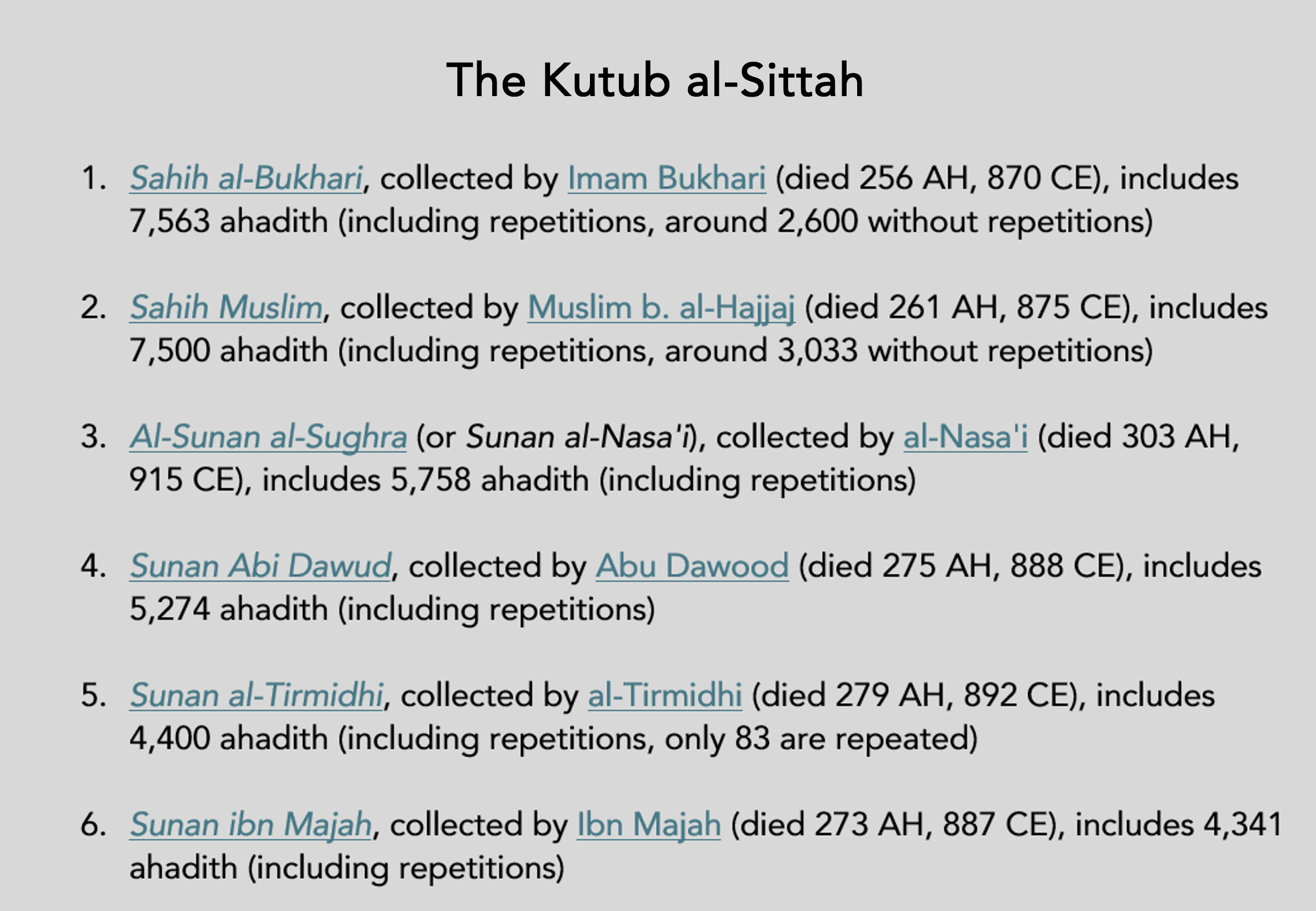
The six authentic collections of Sunnism, adapted from Wikipedia.
Between 840 and 900, two generations of scrupulous theological historians came to the forefront of Islamic intellectual history. Interestingly, all of them were from the northeast of the Abbasid empire – every single one born east of the Zagros mountains, and collectively they hailed from modern-day Uzbekistan, and the seam between Iran and Afghanistan, with only one of them, ibn Majah, from central, rather than eastern Iran.14 The authors of the six authentic hadith books, took their efforts as curators very seriously. They saw machismo and hubris in past generations of hadith scholars who simply tried to gather together as many prophetic narratives as possible. The point was not the length of the mixtape, so to speak, but the excellency of the contents therein and the accessibility of its overall organization. When al-Bukhari’s generation, and the generation of his students passed away, the most influential hadith collections that would ever be written were complete. There would be a great deal more work on hadiths in Islamic history after the year 900, but a lot of it would be rooted in the work of the six authentic Sunni hadith collections, themselves the result of a very laudable human instinct to write history accurately, and to make books useful and well-organized for those who need them. [music]
Further Developments in Hadith Scholarship after 900
With the six authentic hadith books of Sunnism complete around 900, we might wonder what else was left to be undertaken in hadith scholarship. Hadn’t Muhammad al-Bukhari and Muslim ibn al-Hajjaj and the other four revered compilers basically accomplished the mission? Hadn’t they reviewed the chains of narrators, separated the wheat from the chaff, and organized everything for all posterity? Wasn’t it time for high fives and baklava? The answer to these questions is no. Al-Bukhari and the other heavyweights of the 800s were comprehensive and intellectually responsible. They were not, however, immediately given the authoritative status that they now have today. As of the year 900, not everyone wanted hadiths to be rigorously parsed into authentic and inauthentic. Thus, in spite of the now-revered work of al-Bukhari’s generation, as theological debates factionalized Abbasid society, comprehensiveness and academic trustworthiness were often less important than polemic aim. And more broadly, al-Bukhari and the other authors of the six main Sunni hadith collections had created massive slabs of text, and massiveness, especially prior to the printing press, is not ideal for popularity and wide circulation.As the 900s dawned, new genres of hadith compilations came into being that might be thought of as genre compilations. The zuhd was a hadith anthology that focused on narratives having to do with asceticism and piety, focusing on moments of surpassing devoutness by Muhammad and some of his contemporaries. Other topical hadith collections focused on correct Muslim manners, on the punishments of hell and rewards of heaven, on correct formularies for prayers, and righteous deportment during eating, drinking, traveling, and more generally etiquette. These smaller, focused compilations were useful in pious households where literate parents might not have the money or time for a 4,000-page anthology, but still wanted to have some hadiths in their homes. And while some shorter hadith collections were topically focused, others were intentionally polemic.
Abbasid period intellectual history, as scholars synthesized Greek and Persian traditions with Islamic ones, could be theologically progressive. During the Abbasid period, some theologians, broadly known as the Mu‘tazilites, were emphasizing the use of reason and speculation in order to understand God. Counteractively, some hadith books, from the 800s onward, were compiled that specifically emphasized dogma over speculation, and received teachings over new ones. Following the sunnah – the ways of Muhammad – this was the righteous path, and not fraternizing with heterodox philosophy. Ironically, though, polemic hadith collections, as focused on the past as they were, were often less concerned with correct isnads than al-Bukhari and his generation had been. Against Shi’ites and those Muslim rationalists called the Mu‘tazilites, some Sunni compilers marshalled whichever stories they could in order to make their case, sacrificing academic responsibility for argumentative value.
From the second half of the 900s onward, though, the sheer variety of hadith texts began to necessitate some sort of agreed on canon. Beginning with the work of an Egyptian scholar around 950, we begin to hear lists of just a few hadith books that are understood as having surpassing excellency and accuracy.15 These lists sometimes included four books, and sometimes five, and increasingly, six. And the names most commonly mentioned, over the 900s, 1000s, 1100s, and 1200s, are al-Bukhari, Muslim ibn al-Hajjaj, Abu Dawud, at-Tirmidhi, an-Nasa’i, and ibn Majah. These are, again, al-Kutub as-Sittah, the six authentic books, with about 19,600 unique hadiths among them. For more than a thousand years, these books have been at the heart of Sunnism. Hadith production, even in spite of the growing centrality of the Kutub as-Sittah, proceeded through the 900s, with numerous compilers returning to the tradition of quantity over quality. One compiler produced a collection so gigantic that today it’s published as a 28-volume set, and other compilers produced even longer anthologies.16 But the six volumes of the Kutub as-Sittah, the most revered of which were the collections of al-Bukhari and Muslim ibn al-Hajjaj, ultimately stood the test of time.
I want to tell you, now, pretty briefly, about the next thousand years of history of Sunni hadith production. Hadith scholarship after the tenth century paid very close attention to isnads, again chains of transmission, and the credentials of any given transmitter. If you were a hadith scholar, and you could say that you had heard this or that hadith from this or that revered specialist, then in terms of genealogy, you placed yourself a bit closer to Muhammad and his companions. Connectedly, if you were a hadith scholar, you might receive ijaza, or permission for transmission, from your teacher, which would give you license to pass on hadiths you had heard from that teacher. Then, fortified with isnads that linked you to the earliest Muslims, and armed with permissions from specific instructors, as a hadith scholar, you had extra heft and, in all likelihood, you really did have a higher chance of understanding prophetic traditions. Theological and academic pedigree, then, was important in the history of hadith scholarship, in much the same way that modern academics might proudly list professors under whom they’ve studied on their resumes. Medieval Muslims, like intellectuals of any generation, understood that while you could read someone else’s book, there is also no substitution for personal, precise instruction.
By making himself a part of a distinguished isnad, then, a hadith transmitter could elevate himself among his peers. One way to seek distinction was for students to attend schools with excellent teachers, and to travel widely and seek permission to retransmit sacred narratives. Another, though, was to look for what became called ‘ali, or “elevated” isnads – in other words, isnads that were shorter, that placed scholars a bit closer to Muhammad’s generation. If the narrative you were passing on had fifteen people in it, it was much more subject to the telephone game of history. If it had fewer, though, it belonged to you a bit more, rather than being the property of a whole population of tellers. Scholars looking for elevated isnads sought out rare prophetic narratives – esoteric stories that, whether or not they were true, allowed transmitters the prerogative of a short train of transmission. A chronicler with a small sheaf of hadiths with unique and short isnads, then, was a specialist who’d made a niche for himself in the crowded field of hadith study – again, his narratives might not be accurate across the board, but they were unique, and based on at least some form of reliable precedent.
Hadith scholars, then, were interested in one another’s credentials, sometimes as much as they were the prophetic traditions themselves. Part of hadith scholarship was evaluating the isnads of whoever’s work you were reading. Who were the muhaddith’s teachers? Did he have any rare hadiths that he had traveled far to hear and curate for the scholarly public? What sorts of permissions had he been given from his teachers? These were key questions within early Islamic intellectual history, such that genres arose allowing compilers to showcase their erudition. The mu’jam, during the tenth century, became a genre in which hadith scholars recorded traditions, as well as information about their own travels, studies, and teachers. Sometimes self-aggrandizing, and generally very learned and reverent toward tradition, the mu’jam texts that survive show a general climate of devoutness and respect for authority in medieval hadith studies.

A forty-hadith manuscript from Safavid Iran, dated to 1559. The “forty hadith” collection, since the 1200s, has been a popular alternative to gigantic multivolume compilations.
There is really no easy way to generalize about what happened in hadith scholarship during the later Middle Ages. There were movements directed toward concision and usability, with scholars creating indexes filled with bibliographical citations, and others taking the key hadiths of al-Bukhari and Muslim ibn al-Hajjaj and sorting them into just one volume. At the same time, though, some hadith scholars followed the old siren song of creating the most massive, all-encompassing collection possible, such as an Egyptian scholar, who, sadly, passed away before he was able to complete a compilation that would have included more than 100,000 hadiths.18 There are ultimately two things that I’d like you to take away from this discussion of how the Sunni hadiths came to be.
The first is simple. Both before and after the six Kutub as-Sittah, or authentic hadith books of the 800s and a little after, the study of hadiths was central to Sunnism. But the six Kutub as-Sittah – and especially the collections of al-Bukhari and Muslim ibn al-Hajjaj – these were ultimately the most influential hadith books in Sunni history, and if you’re going to read just one hadith book, the single volume of al-Bukhari that’s available today, or even just the forty hadiths of al-Nawawi I mentioned a moment ago, which itself comes from al-Bukhari and Muslim ibn al-Hajjaj – these are the epicenter of Sunni hadith scholarship. Now, onto the second point about the formation of the Sunni hadith canon.
Sunnis have studied the hadiths in order to learn how to be good people, and good Muslims, based on the example of the Prophet Muhammad. But the rigor and scope of hadith studies as a discipline had a profoundly positive effect on Islamic intellectual history more broadly. Over the course of millions of pages of prophetic stories changing hands, and millions of hours of oral history being exchanged before that, and millions of individual studies of isnads, the epicenter of Sunni theology became an intellectual gymnasium that honed young minds and kept old ones in shape. Just as their Jewish contemporaries at yeshivas and synagogues studied rabbinical disputations, trying to understand and adapt the old Mosaic laws to the medieval present, during the Middle Ages, Muslims with a certain degree of intellectual muscle explored the vast expanses of the hadiths, which held the answers to so many crucial questions about life in the Islamic world. Past and present, Ulum al-Hadith, or hadith studies, is a serious and scientific endeavor, and we’ll discuss the details of the discipline more a bit later. But even from what you’ve heard thus far in this program, you can pretty quickly understand how, after the Abbasid revolution in 750, hadith studies became the training grounds for great minds. If you were a devout young Muslim kid in the 800s or 900s, growing up in Kufa, or Raqqa, or Baghdad, or Córdoba, or Isfahan, and you disciplined your mind by memorizing the Qur’an, and then exploring endless meshes of isnads and hadiths and laws related to them, and associated disputes within contemporary legal theory, you would have quite an agile intellect. With such baseline training, if you wanted to go on to study medicine, or mathematics; astronomy, or history; architecture, or poetry, you would have the memory and study skills transferrable to any number of fields. In such a fashion, hadith studies are, and continue to be a cornerstone of Islamic society, deepening the devoutness toward the past while at the same time sharpening minds for the present and future. [music]
The Basics of Shia Hadith Collections
We now have a general sense of how the hadiths came to be. We explored how an initial generation of young people who knew Muhammad passed on stories about him, and how, during the second half of the 800s, these stories eventually became parts of the rigorously researched and organized Kutub as-Sittah – the six authentic hadith books of Sunnism, and especially the Sahihayn – the two most pervasive books – of al-Bukhari and Muslim ibn al-Hajjaj. We discussed how different varieties of hadith collections came into being, and how some muhaddiths sought to become parts of isnads, or chains of transmitters, in order to exhibit their pedigree and credentials. The process of distilling laws and ordering society based on the Qur’an and hadiths is quintessentially a Sunni one. In Sunnism, the Islamic community, or ummah, is guided by the ulama, or scholarly class, schooled in the Qur’an, hadiths, commentaries, and law books. The ulama makes decisions about religious laws, decisions that are arrived at through ijma, or consensus, and these decisions are nearly as binding as the Qur’an and hadiths themselves. Sunni societies, then, have traditionally been governed by a theological intelligentsia who are academically accountable toward one another, and through research and scholarly debate, write rules and laws according to verdicts they reach as a collective. Now, let’s talk about the history of hadiths within Shiism.Just to be very clear for those of us new to Islam and Islamic studies, today Sunnis account for roughly 85% of Muslims worldwide, and Shias 15%. Because the name Sunnism comes from sunnah, or “tradition,” or “way,” and because the traditions and ways of Muhammad, in Sunni Islam, are preserved in the hadiths, it is tempting to assume that hadiths aren’t really a part of Shiism. In fact, hadiths are a part of Shiism – it’s just that Shiism has a different set of prophetic traditions.
Shiites, from the Rashidun period onward, believed that Muhammad’s cousin and son-in-law, ‘Ali, should have been the first caliph beginning in 632, that ‘Ali’s sons ought to have ruled instead of the early Umayyad caliphs, and that moreover, the genetic descendants of Muhammad should have led the Islamic world. The “people of the house” of the Prophet, specifically a set of Imams descended from ‘Ali, are the luminaries of Shiism. In Shiism, then, Imams of the bloodline of Muhammad through ‘Ali and Muhammad’s daughter Fatima were the foremost men who should have ruled as lawgivers.
The single most important difference between Sunni and Shia hadiths, then, is as follows. Sunnis believe that only Muhammad had prophetic authority. Shiites believe that Muhammad and a number of his male descendants had prophetic authority. Today, the majority of Shiites are Imami Shiites, sometimes called Twelver Shiites. In Imami Shi’ism, twelve successors of Muhammad are understood as having shared his esoteric knowledge, from his son-in-law ‘Ali all the way down to, twelve generations later, Muhammad al-Madhi, the hidden Imam, who will eventually emerge as the savior and redeemer of Islam on judgment day. The twelve imams of Imami Shiism were alive from the birth of ‘Ali around 600, all the way down to the death of the eleventh imam al-Hasan al-‘Askari in 874. Because Shiites believe in a lineage of prophetic descendants who lived and taught for three hundred years after the death of Muhammad, Shiite hadiths chronicle the words and deeds of prophetic descendants, as well as Muhammad himself.
Just as Sunnis, during the Umayyad and early Abbasid caliphates, were writing hadiths and biographies of Muhammad and his contemporaries, Shiites, following the death of ‘Ali’s son Husayn in 680, worked to collect traditions related to the descendants of Muhammad. There were sayings collections for the descendants of the Prophet, and books chronicling their various virtues, and they gradually became more organized and codified into compendiums and topical books. In particular, the sixth imam Ja‘far al-Sadiq, and his son attracted followers to collect traditions during the second half of the 700s and throughout the 800s. These sayings collections were quite like the Sunni hadith compilations that arose during the same period. The difference was that, while Sunnis were studying isnads to evaluate the veracity of generations-old Prophetic traditions, Shiites were chronicling the words of near-contemporary history. With the belief that each of the twelve Imams was infallible, if the sixth or seventh imam, in 750 or 775, said that Muhammad had said something, then the tradition was valid.
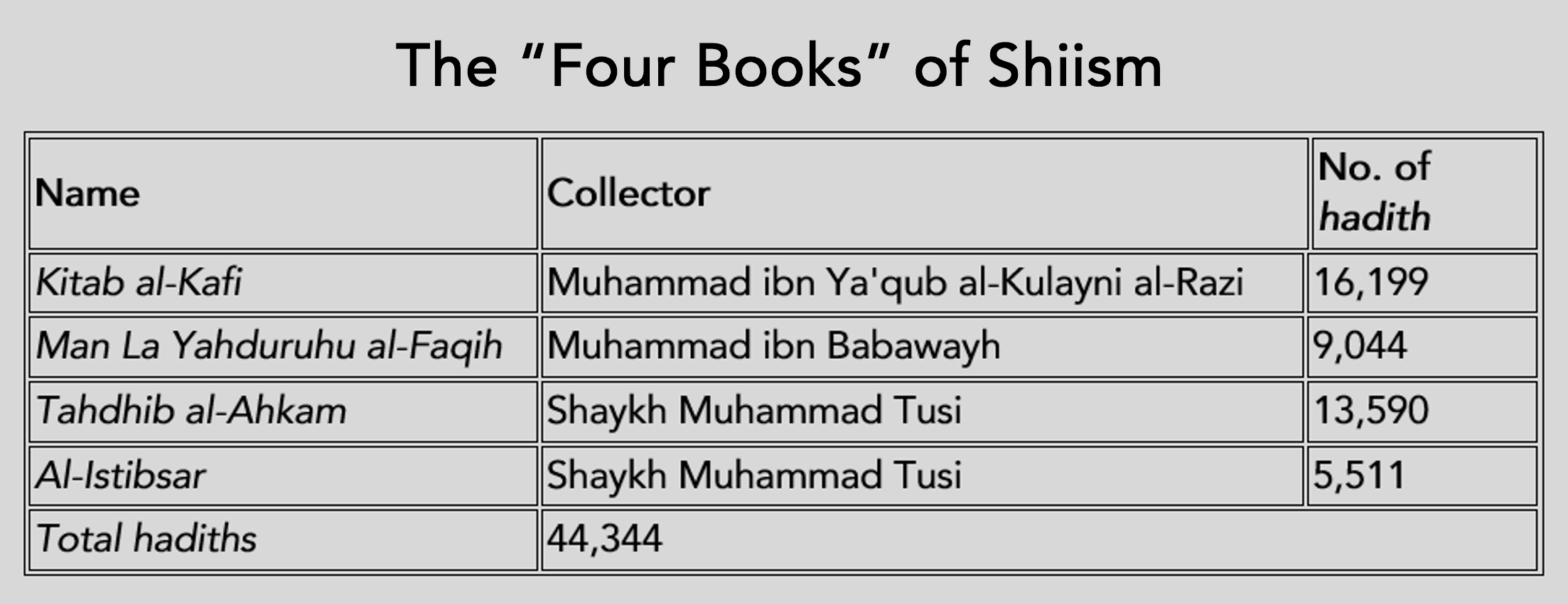
The four most prominent hadith collections in Shiism today, written by three Muhammads. Adapted from Wikipedia.
The most consequential phase of Sunni hadith scholarship, as we learned earlier, was from about 850-900. Shiism’s most influential hadith compilations came about a couple of generations later, beginning in the mid-900s, and concluding in the late 1,000s. There are four of them. The first, a fixture of Shiite religious libraries, is a work called al-Kafi, compiled by a Shiite scholar named Muhammad ibn Ya’qub al-Kulayni, or commonly, the Kafi of al-Kulayni. This vast collection of over 16,000 hadiths was amassed with the help of the ambassadors said to represent the hidden imam, and so al-Kulayni’s Kafi, completed just before the Major Occultation, is a storehouse of source materials about Muhammad and some of his genetic descendants, organized into carefully titled subchapters to help make it clear and navigable to devout Shiites who have studied it over the past thousand years.
The next great Shiite hadith compilation was that of Ibn Babawayh, who lived a generation after al-Kulayni. The title of Ibn Babawayh’s collection is a phrase translated literally as “He Who Has No Legal Scholar at Hand.” The collection is a reference book of over 9,000 hadiths engineered to help Shiites understand law and legal precedent as established by Muhammad and the Shia Imams who followed him. And two generations after Ibn Babawayh, one of his students’ students, generally called Shaykh Tusi, set down not one but two hadith collections, completing the core of the Shiite hadith canon. Shaykh Tusi passed away in 1067, and thus, the main Shiite hadith books came about between 900 and 1076 – a little while after the principal six Sunni hadith books.
What happened in Sunni hadith scholarship, largely, also happened in Shiite hadith scholarship. The Shiite muhaddith Shaykh Tusi, at work in the middle of the eleventh century, began placing particular emphasis on isnads and their reliability, as Shiites, naturally, wanted the stories they were passing down about Muhammad and his descendants to be reliable. Additionally, Shiites criticized hadiths based upon their contents, as well. The first main Shiite hadith collection, the Kafi, stated that “Everything is compared to the Book of God [or Qur’an] and the Sunna, and any hadith that does not agree with the Book of God is but varnished falsehood.”19 Shiite hadith compilations, then, especially the four that have been revered since the 900s and 1000s, had the same hardheaded intellectual common sense that Sunni hadith compilations did. If an isnad looked fishy, the content to which it was attached should be regarded cautiously. If the content itself looked out of step with the Qur’an and ways of the Prophet more generally, then, again, that content was suspicious.
Let’s talk about some of the similarities and differences between the main hadith collections of Sunnism and those of Shiism, around the year 1076, when the final major Shiite muhaddith Shaykh Tusi passed away. In 1076 CE, Shiites revered hadiths about the Prophet Muhammad. So did Sunnis. In 1076, Shiites revered hadiths illustrating the virtues of ‘Ali, and ‘Ali’s wife, the Prophet’s daughter, Fatima. So did Sunnis. In 1076, Shiites revered hadiths about Muhammad’s era that underscored the values of the Qur’an. So did Sunnis. There are thousands and thousands of hadiths to which Sunnis and Shiites of any generation give a mutual thumbs up. Where the sects parted company, by the eleventh century, were the Shiite hadiths revering the authority, and the inerrancy of the later Imams who had descended from ‘Ali. Hadiths lauding the character and wisdom of ‘Ali were fine. Those that valorized his descendants half a dozen generations down were, from the Sunni perspective, misguided.
Nonetheless, Sunni hadith scholarship around, again, 1076 still found the rigor of individual Shiite compilations strong, and just because a Shiite transmitted a few sectarian narratives didn’t mean that other narratives with strong isnads in a Shiite collection shouldn’t be taken seriously by Sunni scholars. Equally, Shiites still used and revered Sunni hadiths regarding ‘Ali, whom everyone loved, and Shiite disputants with a strong command of the Sunni hadith canon could debate Sunnis using Sunni literature. Enough crossover between the two corpuses existed, and still exists, that they together form a continuum with sectarian edges, rather than two wholly separate silos of text.
So, now that we’ve explored the rise of the main hadith canons of Sunnism and Shiism, we have two more things to do in this introductory program on the hadiths. First, I want to tell you a bit about ‘ulum al-hadith or hadith sciences, as a formal discipline – in other words, how for over a thousand years scholars have read, analyzed, and evaluated this massive body of material. Then, I want to talk at a very high level about how hadiths have been used in Islamic law and politics during and after the classical period of Islamic civilization. Let’s begin with ‘ulum al-hadith, the traditional methodology that, before even the Islamic Golden Age, was honing the minds and pens of some of the finest thinkers of the Umayyad and Abbasid periods. [music]
Ulum al-Hadith: The Science of Hadith Study
In the year 711, Umayyad forces crossed the strait of Gibraltar into the southern part of the ailing Visigothic kingdom, setting the stage for the imminent Muslim conquest of the Iberian Peninsula. But something else happened in 711 that also signaled changes to come, and this was the death of Anas ibn Malik, Muhammad’s servant who had been one of the foremost primary generators of Sunni hadiths. Anas ibn Malik, who allegedly lived almost a century, was one of the last living vestiges of Muhammad’s world, a man who could read contemporary hadiths and shake his head and say, no, Muhammad hadn’t said that one thing, or yes, Muhammad had said that other thing. With the passing of all of those who known Muhammad, in the early 700s, Islamic history lost its repository of primary sources on the Prophet’s life, and a real danger emerged that the production of hadiths could turn into fiction and hagiography. As early as the first Fitna, that conflict between ‘Ali and Mu’awiya, fake hadiths were in circulating attesting that Muhammad had preemptively condemned Mu’awiya, or that Muhammad had sanctioned Mu’awiya’s rule, and unscrupulous propagandists from the seventh century onward readily put words into the Prophet’s mouth to justify their political and ideological goals.
As early as the caliphate of Mu’awiya (661-680), hadiths were being forged for political and theological purposes. One of the reason hadith sciences emerged was to combat hadiths being made up for partisan purposes. Th eimage
From the 700s onward, then, all sorts of fake hadiths appeared in the Umayyad and Abbasid empires that served various agendas, or simply grew organically. Perhaps more subtle and dangerous than new fictions invented about Muhammad, though, were forged isnads, or chains of transmission. If a hadith already existed that justified a propagandist’s or a sectarian’s idea, that partisan could simply dress up the hadith’s isnad a bit and present it as more authentic than it had traditionally been considered. Subtle manipulation of an old narrative’s sources could be used to present a novel ideological school as something that Muhammad himself endorsed.
In summation, even by the year 711, the extant body of hadiths in Islam had wheat as well as chaff, and even for specialists, it could be hard to tell which was which. The first tool that emerged in Sunnism was a critical method with three different tiers, a method that began, first and foremost, with the evaluation of each hadith’s isnad. Chains of transmitters were always parts of Islamic tradition. Isnads are ultimately one of the foundations of Sunnism, and a safeguard to help keep Islam Islam, and not a loose, heterodox ideology subject to continuous evolution.
Isnad criticism, which was maturing by the mid-800s, was itself a multipart endeavor. Chains of transmission, after all, were made up of individual links of transmitters, and each transmitter could be considered individually. Transmitters, first of all, needed to be known individuals. In other words, an isnad couldn’t simply say, “Some guys at a well told Abu Hurayra this story about Muhammad,” because without knowing who the guys in question were, the narrative was suspect, regardless of its early vintage. This simple criteria, over the course of the 800s, was just one part of a greater methodology of evaluating chains of sources. Hadith scholars began to consider the individual students of specific hadith teachers. If one student, some decades back, had generated a bunch of hadiths that the other students of the same teacher had not, then that student was probably doing something fishy. Additionally, if one of the links in a chain of transmitters was an individual known by historians to be a bad person or a bad Muslim or both, then the isnad in question had a significant flaw in it.
By the early 900s, a multitiered system of evaluation existed for names in isnads. A hadith transmitter could be anywhere between thiqa, or reliable and citable in legal scholarship, all the way down to matruk al-hadith, or absolutely unusable. Between these two extremes, six more categories existed, wherein transmitters were placed according to different gradations of reliability. Analysis of the reliability of hadith transmitters was a serious and academic subject, with a flurry of works written evaluating the strength of certain transmitters, and other works pinpointing the weaknesses of other transmitters. Transmitter criticism was not immune to the personalities and prejudices of various critics, with some critics being fearsome, and some lenient; with some having vendettas and personal agendas, and others more or less invested in sectarian divergences in Islam – most importantly the Sunni-Shia split.
Transmitter criticism is a pretty granular and technical subject – something rather different than revering the lofty and sweeping verses of the Qur’an. And an even more granular subject in hadith studies, as early as the mid-700s, was al-ittisal, or the study of the continuity of transmission. An isnad might tell us that person X learned a hadith from person Y. But how did the learning take place? Was it in person? Or was the knowledge passed on through a hidden third party? If the teaching had allegedly taken place face to face, had the two transmitters actually lived during the same period, and were circumstances such that they could have actually met one another? Put simply, each isnad needed to have feasible continuity to it – the links of the chain needed to be reliable, but connections between the links also needed to be plausible. As detailed and academic as these rubrics of analysis sound, however, in Sunni hadith studies, some chain links are more automatically valid than others.
In Sunnism, from the beginning, there has been a special emphasis placed on the infallibility of the companions of Muhammad as transmitters of prophetic narratives. This emphasis makes sense on a fundamental level, of course, because those who knew Muhammad were well-positioned to pass down what he had actually said and done. However, Sunnism’s traditional emphasis that those who knew Muhammad, even if they were believers who just met him once, has some logical hiccups. First, hadiths by some companions contradict hadiths by other companions. Second, Muhammad was a very active person who met and talked to a lot of people. In the six hadith compilations central to Sunnism, there are 962 companions involved in chains of narration who are cited. If you had 962 people whom you had met quoting you, especially if you were a famous, divisive figure, some of those people likely wouldn’t get their facts straight. 962 people is a lot of folks, but later hadith collections mention vastly more than just 962 people. The great jurist al-Shafi’i wrote that there were more than 60,000 companions, and other Abbasid period scholars cited numbers higher than this.21 If you had 60,000 people whom you’d met quoting you, especially if you were a famous, divisive figure, some of those people likely wouldn’t get their facts straight. The notion that the hadiths of the companion generation are especially accurate, even when Muhammad’s passing acquaintances are cited as narrators, is still part of Sunnism today.
The subject of hadith studies is complex, so let’s once more pause briefly and review what we’ve learned so far in this portion of the program. ‘Ulum al-hadith, or hadith sciences, were born in order to separate the authentic from the false hadiths. Hadith sciences emerged as three different areas of scholarly practice, and we’ve just learned about the first two. Number one, hadith scholars found transmitters whom they decided, for various reasons, were unreliable. Number two, hadith scholars found isnads, or chains of narration, that were problematic due to vagueness, or historical logistics. Let’s go on to number three. The third foundation of hadith sciences, rather than having to do with transmitters or chains of transmission, had to do with analyzing the hadiths themselves.
From what you’ve heard so far, Sunni hadith studies up through the early Abbasid period seem very academically solid. They seem very academically solid, but for one significant idiosyncrasy. What about content? To give an example, the most famous Sunni hadith scholar al-Bukhari was skeptical about a hadith that said, “The Prophet forbade breaking apart Muslim coins in circulation,” and another that stated that “The signs of the Day of Judgment are after the year 200 AH [or 815 CE].”22 The problem with these two otherwise unimpeachable hadiths, al-Bukhari knew in the mid-800s, was that first, there were no Muslim coins when Muhammad lived, and second, that indeed, the world had not actually ended in 815. No amount of fancy source criticism related to transmitters or transmission could salvage these patently false proclamations, which al-Bukhari declared inauthentic. As commonsensical as al-Bukhari’s judgment was, in the 800s, Sunni hadith scholars rarely made such pronouncements. The reason for this is complex, and has to do with the Abbasid period Mu’tazilite rationalist school and its emphasis on reason and logic, as we discussed last time. Strict Sunni hadith scholars, wanting prophetic traditions to dominate Islamic piety, rather than human reason, felt more comfortable criticizing the mechanics of traditions than the traditions themselves. For some, if Muhammad had said that the world would end two hundred years after the Hijra, and scholars saw the world going on as it always had, the problem was still with the scholars, rather than the prophetic tradition.
Centuries later, in the 1100s and afterward, Sunni hadith scholars began engaging much more forcefully in what we might call content criticism. Mu’tazilite rationalism and Sunni hadith sciences had been at loggerheads in the 800s, but in the late afternoon of the Abbasid period, scientific rationalism was part of Islamic society at so many levels that Sunni scholarship began a more forceful period of hadith content criticism. If a hadith seemed way out of step with reality, or with the Qur’an, or the other teachings of Muhammad, during the later Abbasid caliphate, that hadith might be rejected on account of its implausibility or lack of orthodoxy. When the classical period of Islamic civilization ended with the Mongol invasions of the late 1200s, hadith sciences were already half a millennium old, and had produced many different methods for evaluating prophetic traditions. In general, after the Abbasid period and end of classical Islamic civilization, hadith studies were at once abidingly conservative and at the same time progressive. On the one hand, the old Sunni canon of six hadith collections stood the test of time. Al-Bukhari, Muslim ibn Hajjaj and the others, mostly during the second half of the 800s, had as much scientific rigor as any other generation, and they also lived reasonably close to the era of the prophet, and so their books, the Kutub as-Sittah, or “authentic books,” remain at the core of Sunnism to this day. On the other hand, though, the end of classical Islamic civilization also saw more inclusivity in hadith criticism, and willingness to take centuries old hadiths seriously and with respect, even if the graybeards of past caliphates had nitpicked their chains of transmission.
There’s a lot more to say about hadith sciences, and how they evolved in post-classical period, but this is an introductory program, so let’s review what we’ve learned a final time. Less than a century after Muhammad lived, professional historians were developing painstaking methods for authenticating the stories about him. These methods evolved over the centuries, and though they were never perfect, they were generally an academic, communal affair in which one scholar’s work was subject to the evaluation of others in his field. While the general nature of hadith studies is, I suspect, quite clear by now, before we move on, I want us to take a moment to consider how hadiths were actually read and used from the 700s forward.
It’s hard to exaggerate how many millions of pages have been written about the hadiths, and even by the year 800, how many multivolume collections had been compiled on the subject. The question is, if you were a literate Muslim person, living in Baghdad, taking a walk around the grounds of the House of Wisdom in, say, 875, what would you do with hadiths? Why might you spend the morning reading them? What was at stake? What would you be thinking about, as you went out to get lunch after half a day spent with the books?
The answer to this question is a lot of different things, actually. You might be a full-on muhaddith, like your soon-to-be-famous contemporaries al-Bukhari and Muslim ibn Hajjaj, planning your own doorstopper multivolume collection, armed with notebooks whose pages were covered with cobwebs of isnads, together with your notes on them. But not everyone who studied the hadiths wanted to eat, sleep, and breathe them every day. You might also study hadiths for different reasons. You might be working on a tafsir, or a commentary on the Qur’an, a commentary that needed excellent scholarly support from authentic traditions related to Muhammad. You might also be a mufti, or jurist, or a qadi, or judge, working on a legal treatise, or court case, related a very specific subject – agriculture, or water rights, or paternity, or inheritance, and you might be plumbing the depths of all available hadiths looking for specific prophetic pronouncements on one of these subjects. You might be an ideological firebrand with an axe to grind against the Baghdad status quo in 875, and have spent the morning in search of material that supported your ideas. You might be a government bureaucrat, sent by a supervisor to see what the hadiths had to say about some topic related to your division’s project at hand. You might be a devout middle-class nobody who was planting a little garden in the courtyard of his home and had just popped into the library to see if there were any cherished hadiths in which Muhammad had said something about plants. (Side note. He did, by the way. A beloved collection by the aforementioned thirteenth-century scholar al-Nawawi tells us that if someone gives you basil as a present, it’s good to graciously accept the gift, because basil is both lightweight and it smells nice, so the aforementioned average Baghdadi guy would very possibly end up planting basil in his garden, which is an objectively great idea.23) The point here is that we have been talking about hadiths at quite a broad, collective historical level, but that if we were regular literate Abbasid folks in 875 CE, the hadiths would serve a wide array of finite practical purposes. The encyclopedic nature of the hadiths, even at this early period, is foreboding, but in comparison, it’s easy enough to understand the utility of a shared storehouse of information, used by everyone from professional encyclopedists and lawmakers themselves, all the way down to everyday bureaucrats and gardeners. [music]
Hadiths and Lawmaking in Islamic Civilization
Having just considered how hadiths functioned in the daily lives of Muslims during the early Abbasid period, in the remainder of this program, I’d like to continue discussing how hadiths have been used, historically, to legislate and administrate Islamic civilizations. The derivation of Islamic law from the Qur’an and hadiths has always been a complicated process. The 114 surahs of the Qur’an have been fixed since the seventh century. The hadiths, however, have not. Coming up with law codes that do justice to both the Qur’an and the teachings of Muhammad as reflected in the hadiths has been one of the central intellectual endeavors of Islam. Trying to decide what to plant in your garden is one thing. But when legal experts are trying to draft law codes for entire civilizations, law can become quite complicated, quite quickly.The architecture of religious law in Sunnism has several different layers. The foundational layer is the Qur’an. The second layer up is a composite of the most reliable and canonical hadiths. The layer after that is ijma, or the consensus of the ulama, or Muslim lawmakers and theologians. Sunni law often has a place for a fourth layer – those hadiths whose chains of transmission are unreliable, but which otherwise fit so well into the framework of the other three layers that they can be cited as useful sources on a subject. On the one hand, these are four broad, sturdy layers of legal source materials. On the other hand, though, of all four layers, only the Qur’an itself has been a stable entity over time. Many hadiths have scuffs and cracks in them, either due to unreliable isnads, or because they contradict one another, or because they are out of step with the Qur’an or the consensus of the ulama, or lawmakers and theologians. While the ulama in Sunnism often has strong consensuses, corroborated by the Qur’an and hadiths, different scholars and different schools of law altogether also have disagreements on how to read and interpret the Qur’an and hadiths, meaning that ijma, or consensus, is neither uniform through time, nor place.
Let’s consider an example of these different layers of source materials working together in contemporary history. Women in Islamic societies generally wear one of a number of different kinds of veils – hijabs, or niqabs, and more besides these. The requirement for women to cover their heads is not explicitly stated in the Qur’an, as this was more generally a Late Antique Near Eastern custom that existed in Byzantine and Sasanian civilization at the aristocratic level, as well as Arabia. Muslims who are critical of the veil as mandatory headwear for women have cited the lack of a Qur’anic mandate on the subject, and proclaimed that the hadiths on the subject aren’t reliable. On the flipside, Muslims who endorse veils have emphasized that the Sunni scholarly body that makes up the ulama, in the Classical period as well as the modern one, have ijma, or broad agreement or consensus, that headscarves on women are required in Islam.
The familiar example of the veil there can give you an idea of how the different layers of reference material work together in Islamic jurisprudence, and how sometimes, the ulama can make rulings even if those rulings aren’t thoroughly undergirded by the Qur’an and authentic hadiths. The example of the veil is such a heated topic in contemporary history, though, that I’d like to look at some other ways that the ulama has formed consensus about the Qur’an and hadiths. Those of us outside of Islam, and more generally outside of Christianity and Judaism, sometimes think of Abrahamic jurisprudence as something fundamentally oppressive – a bunch of callous patriarchs trying to rule over a subjugated laity. In Islam, however, as in Christianity and Judaism, there is a broad common ground between the ulama, again, religious lawmakers and theologians, and the citizenry, and sometimes the consensus of the ulama simply reflects the hardheaded common sense of the society more generally.
Let’s look at an example – one related to inheritance. In Sunnism, sometimes broad consensus among legal scholars, or the wide transmission of a hadith, can outweigh the doubtful status of a hadith’s sources. For instance, there is a hadith that appears in four out of the six paramount Sunni hadith collections.24 In the hadith, Muhammad proclaims that a killer cannot inherit money from the person whom he kills. The hadith is common sense – a legal bulwark against murdering wealthy relatives for profit. But the hadith also has shaky isnads, meaning that Muhammad may have never proclaimed it. Nonetheless, the hadith scholar at-Tirmidhi, in the 800s, announced that experts agreed that laws could be anchored on the hadith in spite of its dubious progeny, and all of Islam’s law schools today agree on the ruling that a murderer cannot inherit from his victim. On subjects in which inherent logic and wisdom are present in hadiths with faulty sources, hadiths can still have some legal weight in Sunni jurisprudence. The ulama, then, can reach broad consensus in a number of different ways.
On other subjects of law, however, hadiths can sometimes lead schools of Islamic law to different conclusions, and no collective consensus can be found. The great Sunni hadith scholar at-Tirmidhi wrote a lengthy analysis of what Muslims should do when one of their five daily prayers were interrupted and then resumed, and what the extant schools of law had decided on the subject. As Muslims know, at the end of each of the five daily prayers, a Muslim performs a final prayer, turning to the right and left and proclaiming al-salam ‘alaykum wa Rahmat Allah, or “May the peace and mercy of God be upon you” to those praying on either side of her, thus concluding the daily prayer. This final part of the daily prayer is called the Taslim. There are hadiths on the subject of interrupted prayers, and the Sujud as-Sahw, or additional prostrations to atone for interrupted prayers, in which Muhammad does different things. In one, Muhammad’s prayer is interrupted, and the prophet prostrates twice in penitence, and then performs the Taslim. In another instance, one prostration occurs before, and then the next after the Taslim. Different schools of Islamic law today have different rules on what to do when prayers are interrupted, depending on how their founders read, analyzed, and reconciled the different hadiths on the subject of interrupted prayer.
So, to summarize, in Sunni jurisprudence, the ulama, or lawmaker or theologian class, uses hadiths and the Qur’an in order to make legal rulings. That basic interactivity – the ulama using the Qur’an and hadiths in order to reach consensus – that general concourse of study, analysis, disputation, and ruling, is not only the heart of Sunni lawmaking. It is, more generally, the heart of Sunni Islam. Sunnism is the analysis of the Qur’an and prophetic traditions for the sake of leading a good, pious life. In between the bygone period of the Prophet, and any later period of Islamic history, Sunnis have used a living bridge of scholarship to the past in order to legislate the present. This bridge is built of hadiths, but also the inertia of cultural traditions and precedents. It is made of millions of pages of text – prophetic narratives, isnads, legal scholarship, exegesis, and the more than 6,000 verses of the Qur’an. And as solid as this vast aggregate is, it is also mortared together with living consensus, and the earnest efforts of many generations.
So to close this show, let’s read two hadiths – a pair that, between the two of them, tell us a lot about the history of hadiths themselves. The first is an extremely famous one in Sunnism, anthologized in the great Sunni compilers Abu Dawud and at-Tirmidhi, and later, in the 1200s, in the Forty Hadiths of Al-Nawawi. In this hadith, at Muhammad’s farewell sermon, he leaves his companions with the following advice.
I counsel you to have [fear] of Allah, and to listen and obey [your leader], even if a slave were to become your [leader]. Verily he among you who lives long will see great controversy, so you must keep to my Sunnah and to the Sunnah of the [Rashidun Caliphs] those who guide to the right way. Cling to it stubbornly. . .with your molar teeth. . . Beware of newly invented matters [in the religion], for verily every. . .innovation. . .is misguidance.25
The hadith is as clear as it is simple. No matter what happens, in the tumultuous times to come, cling to the original ways and teachings of the Prophet, rather than the newfangled innovations of future generations. It is a conservative message, favoring the old ways over the new, and tacitly acknowledging that schism and controversy would follow the period of Muhammad’s prophetic ministry.
But old ways, too, must be innovated at some point, and time is a river into which most things sink. And additionally, a cardinal feature of all Abrahamic theology is the tension between progressive theology and conservative theology, and then theology that, while pretending to be conservative, is innovating a revisionist past. Sunnism is, as I’m sure you can understand here at the end of this program, the search for correct Sunnah, the authentic ways of Muhammad. But as when early rabbis wrote the Halakha of the Talmud and early Christian church fathers set down extrabiblical laws, during the later 600s and after, Muslim scholars did their best to revere the past while living in the ever-moving present.
To move onto our second and final hadith, this one survives in Sahih Bukhari, the most famous Sunni hadith compilation. In it, a minor companion named ‘Amr bin Salama remembers how his father converted to Islam rather late in the time of the Prophet Muhammad’s ministry – not until after the conquest of Mecca in early 630. The companion ‘Amr bin Salama, in this hadith, tells us that he memorized some of the Qur’an at a very young age, and that when his tribe began converting, Muhammad gave them instructions for how prayers were to be carried out. The youngster ‘Amr bin Salama, who knew the Qur’an best of all among the new converts of his tribe, was selected to lead the prayer. He says, in this hadith,
So they looked for such a person and found none who knew more Qur’an than I because of the Quranic material which I used to learn from the caravaners. They therefore made me their Imam (to lead the prayer) and at that time I was a boy of six or seven years, wearing a. . .black square garment [called a Burda, that] proved to be very short for me (and my body became partly naked). A lady from the tribe said, “Won’t you cover the [buttocks] of your reciter for us?” So they bought (a piece of cloth) and made a shirt for me. I had never been so happy with anything before as I was with that shirt.26
It’s a story about a youngster becoming an imam at quite a young age and doing the best he can in spite of being inadequately outfitted. As slightly crude as the detail about poor ‘Amr bin Salama covering his bottom while he preached is, the story also reflects some of the staying power of Sunnism. Here was a kid who, whoever he was, had a good memory and knew the Qur’an. Up he went to preach, and the ummah, or Islamic community, recognized that what the little boy lacked in pants he made up for with expertise, and one garment later, the young imam was correctly attired and ready to serve his community.
The story of the hadiths is the story of that community, beginning with those who knew Muhammad well, and continuing with those who knew him a little or had just met him, and then on and on through the generations all the way down until today. It is the tale of a collective, and of diligent, probabilistic intellectual work. Inasmuch as piety requires Muslims to respect the hadiths, it also mandates that the hadiths be studied critically, lest the innovation of a later generation be mistaken for the sacred traditions of Muhammad. But beyond even Islam, the story of the hadiths is a quintessentially human one. History is a slippery thing to hold in our hands, and sacred history, even more so. We all like the idea of being able to understand posterity, and to soak up wisdom from bygone sages. At the same time, though, we know that studying history means sitting on a train racing ever further away from the past, on long, winding tracks built by those who lived in between. [music]
Moving on to the Byzantine-Sasanian War of 602-628
So that completes our introduction to the hadiths. Over these past ten shows on Muhammad, the Qur’an, the early caliphates, and the hadiths, we have learned the foundations of Islamic history, what happened over Islam’s first two centuries, and in this show, how a body of extra-Qur’anic materials grew to have authoritative and legislative power in Islamic civilization. That is all important stuff, and I am proud to have had you along for this leg of our long journey.When outlining this season, I had a bit of a puzzle in front of me. I wanted to tell the story of early Islam in the way that you have heard it over these past ten shows. At the same time, though, during the life of Muhammad, something was happening that was absolutely epic in scale and dramatic in its turns of fortune, and this was the Byzantine-Sasanian War of 602-628. This war was fought during the Prophet’s lifetime. The war was a large part of the reason why the Rashidun caliphate was able to steamroll the Byzantine and Sasanian empires. Understanding the Sasanian side of this war, in particular, is extremely useful in understanding later Islamic history. So next time, we’re going to briefly do something we don’t usually do in Literature and History. We’re going to go back in time from the Abbasid period, and learn the story of what’s often called “the last great war of antiquity” – that terminal conflict between Rome and Persia, although neither empire knew that it would be.
With the main course of our season on early Islamic history complete, let me check in for a just a moment and fill you in on our podcast’s goals for the end of this season, and the beginning of the next one. As we wrap up this season on early Islamic history, my goal is to begin steering us back toward literature, and away from theology and general history. In shows to come, I hope to devote many hours to classical Arabic and Persian literature. This literature should be better known in the Anglophone world, and for various reasons, I think presenting the Islamic golden age and the European medieval period as one big, fat, surprisingly connected system is the right thing to do. We just need to lay a bit more groundwork on the eastern end of this system, and next month’s episode on the Byzantine-Sasanian War of 602-628 will set most of that groundwork in place. After the story of the last great war of antiquity, we’ll wrap this present season up with two early figureheads of classical Arabic literature, just to get a taste of what’s to come, then consider what happened to Zoroastrianism during the Abbasid period, and then finally, have a closing episode that concerns itself with early Sufism. As we bring this podcast’s seventh season to its conclusion, we’ll be ready to move on to a much more literature-heavy season on down the road – one that is about the Arabic and Persian literature being written during the centuries of Beowulf, Chretien de Troyes, Dante, and company.
However, speaking of Beowulf, Literature and History’s next season will concern itself with early European vernacular literature. Focusing on the North Sea and Celtic Sea and the centuries between about 500 and 900 CE, we’re going to consider the very earliest roots of European literature, including texts written in Anglo-Saxon, Old Irish, and Old High German. For reasons we will soon learn, speakers of these three languages were both early and prolific in their production of vernacular literature – prolific enough to have left behind some very old, and in some cases very revered poetry and sagas. Now that we have a sense of the scale of history during the Rashidun, Umayyad, and Abbasid periods, as well as the sophistication of these three empires, as we turn toward frosty, foggy, feudal, faraway northern Europe, we’ll do so with a sense of what was going on in the contemporary Islamic world. For Muslims of, say, the 800s, living in the metropolises of Iraq, Egypt, and the Levant, and inhabiting the same river basins and seacoasts that humanity had since time immemorial, the clammy shores of East Anglia, Essex, and Kent would have seemed far more exotic than the comfortable old world of the Fertile Crescent.
I have a quiz on this episode in the notes section of your podcasting app if you want to review what you’ve learned about the hadiths. I did write a song about the hadiths, but I decided not to record it. These are very sacred texts, and they are revered by a global ulama not, as a rule, known for mixing religion and comedy. Considering that, and in spite of the fact that I really wanted to have a chorus with the line “Who’s your Baghdadi?” I’ve chosen to err on the side of academic and respectful. So, thanks for listening to Literature and History, and learning all about the hadiths with me, and the Roman emperor Heraclius, and his nemesis, the Sasanian emperor Khosrow II and I will see you next time, in Episode 124: The Last Great War of Antiquity.
References
2.^ Ibid, p. 162.
3.^ Mishkat al-Masabih 4115.
4.^ Bulugh al-Maram 97.
5.^ This is Muhammad ibn Majah’s Sunan ibn Majah.
6.^ See Brown (2009), p. 14.
7.^ Ibid, p. 19.
8.^ Sahih Muslim 2631 (43:184). https://sunnah.com/muslim:2361
9.^ Sahih Muslim 3004 (55:92). https://sunnah.com/muslim:3004
10.^ See Brown (2009), p. 7.
11.^ Sunan Abi Dawud 3646 (26:6). https://sunnah.com/abudawud:3646
12.^ See Brown (2009), p. 31.
13.^ There’s always some discrepancy about exactly what constitutes hadiths within these books. Brown (2009) gives 7,397 for al-Bukhari, and 7,748 for Muslim.
15.^ The scholar in question was Ibn as-Sakah. See Brown (2009), pp. 40-1.
16.^ This was Abu al-Qasim al-Tabarani.
17.^ This is Ibn ‘Asakir’s History of Damascus.
18.^ This was Jalal ad-Addin as-Suyuti.
19.^ Printed in Brown (2009), p. 149.
20.^ Brown (2009), p. 76. The quote is from Yahya b. Sa‘id al-Qattan.
21.^ See Brown, p. 92.
22.^ Printed in Brown (2009), p. 100.
23.^ Al-Nawawi. Riyad as-Salihin 1786.
24.^ The narrative appears in al-Tirmidhi, al-Nasa’i, Abu Dawud, and Ibn Majah.
25.^ Forty Hadith of an-Nawawi (28). https://sunnah.com/nawawi40:28
26.^ Al-Bukhari 4302 (64:335). Printed in Sahih al-Bukhari. Mohee Uddin, 2020, pp. 384-5.