
Episode 128: Early Sufism
Sufism emerged in the 700s and 800s as a powerful part of Islam’s development under the caliphates. This episode covers its early history, focusing on a generation of thinkers who lived between about 850 and 920.
| Read Transcription | References and Notes |
| Quiz | |
| Episode on Spotify | Episode on Apple Podcasts |
| Previous Show | Next Show |
The Foundations of Sufism from 850-920
Gold Sponsors
David Love
Andy Olson
Andy Qualls
Bill Harris
Christophe Mandy
Jeremy Hanks
John David Giese
KelleyGr
Laurent Callot
Maddao
Mike Roach
ml cohen
Nate Stevens
Olga Gologan
Steve baldwin
Silver Sponsors
Alexander D Silver
Andreu Andreu i Andreu
Boaz Munro
Charlie Wilson
Devri K Owen
Ellen Ivens
Evasive Species
Hannah
Jennifer Deegan
John Weretka
John-Daniel Encel
Jonathan Thomas
Julius Barbanel
Michael Sanchez
rebye
Top Clean
Ukko
Sponsors
Carl-Henrik Naucler
Joseph Maltby
Robert
Stephen Connelly
A Chowdhury
A. Jesse Jiryu Davis
Aaron Burda
Abdul the Magnificent
Aksel Gundersen Kolsung
Alex Metricarti
Anthony Tumbarello
Ariela Kilinsky
Asher DeLarme
Basak Balkan
Bendta Schroeder
Benjamin Bartemes
Brian Conn
Bruce Spencer
Carl Silva
Carolyn Sabol
Cat Peterson
Charles Hayes
Chief Brody
Chris Auriemma
Chris Brademeyer
Chris Tanzola
Christopher Centamore
Chuck
Cody Moore
Daniel Stipe
David
David Stewart
Denim Wizard
Dominic Klyve
Elizabeth Lowe
Elliot Cole
Eric
Eric McDowell
Erik Trewitt
Anonymous
Francine
Friederike Otto
FuzzyKittens
Garlonga
Glenn McQuaig
J.W. Uijting
James McGee
Jason Davidoff
Jay Cassidy
JD Mal
Jillyp
Joan Harrington
joanna jansen
Joe Dudley
John Barch
John Sanchez
Jonathan Whitmore
Joran Tibor
Joseph Flynn
Joshua Edson
Joshua Hardy
Anonymous
Kathrin Lichtenberg
Kathy Chapman
Kyle Pustola
Anonymous
Lat Resnik
Laura Ormsby
Le Tran-Thi
Leonardo Betzler
Lexi Mayhew
Lori Gum
Maria Anna Karga
Mark Griggs
MarkV
Matt Hamblen
Maury K Kemper
Michael
Mike Beard
Mike Sharland
Mike White
Morten Rasmussen
Mr Jim
Nassef Perdomo
Nicholas Stern
noah brody
Oli Pate
Oliver
Paul Camp
Peter Goldstein
purden@verizon.met
Richard Greydanus
Riley Bahre
Robert Auers
Robert Brucato
Rosa
Ryan Booth
Ryan Goodrich
Ryan Shaffer
Ryan Walsh
Shaun
Shaun Walbridge
Sherry B
Sonya Andrews
Starshell
Steve Grieder
Steven Laden
Stijn van Dooren
Stuart Sherman
Sue Nichols
susan butterick
Susan Hall
Ted Humphrey
The Curator
Thomas Bergman
Thomas Leech
Tim Rosolino
Tod Hostetler
Tom Wilson
Torakoro
Troy
Valentina Tondato da Ruos
vika
Vincent Vandeven
William Coughlin
Zak Gillman
Zita Farkas
Other Sponsors
too many to list
Today, Sufism is perhaps more famous than it is well-understood. European orientalists of the eighteenth century sometimes presented Sufism as a trans-Eurasian mysticism, more with Indian and Persian roots than with Islamic ones.1 Western proponents of Sufism sometimes trumpet it as a “message of love, harmony, and beauty,” to use one modern author’s words.2 Readers of the aforementioned poets, unfamiliar with the long theological history of Sufism, have sometimes misconceived the movement as a sort of low-carb Islam, sharing the Qur’an’s impeccable monotheism and moving compassion, but detaching itself from the bookcases of Islamic law and hadith studies. These simplifications of Sufism, however well-intentioned they are, divorce the movement from its original context, as well as its core principles. The roots of Sufism are thoroughly Islamic, and as we’ll see in this episode, inseparable from the cultural history of the first few caliphates.
Our goal in this program, to repeat, is an overview of the early history of Sufism – how it came about, and how it developed a theological niche in Islam during the late 800s. We will not, therefore, be talking about Rumi and Hafez. But we will learn about something just as interesting and inspiring. We will settle into one generation of thinkers in the early Islamic Golden Age, and get a sense of what was going on in the metropolitan centers of Abbasid society from 850-920. During these decades, the most influential hadith chroniclers who ever lived were wrapping up their work.3 The literary historian Abu Tammam had completed the most important early anthology of Arabic poetry, and diverse generations of Muslim poets had already ensured that Islamic civilization would have a literary history to match its geographical conquests. Translation movements were already flourishing under caliphal decrees, helping speakers of Arabic have access to a vast bedrock of ancient Greek, Syriac, Persian, and Sanskrit knowledge. In the midst of this renaissance of intellectual and theological work, between 850 and 920, Sufism gradually edged into the Islamic cultural mainstream, becoming less associated with monkish mavericks, and more with ordinary Muslims who went to work, had families, and wanted something a little bit extra out of their spiritual lives. As we’ll see in this episode, between 850 and 920, it was not all smooth sailing for Sufis. Some of them very publicly alleged to have experienced moments of ecstatic unity with God, and these claims, to the skeptical, ran the range between heretical and absurdly conceited. However, in the main, in Islamic history, Sufism has always been provocative and eccentric enough to raise conservative eyebrows, and almost always passionately Islamic enough to make those eyebrows go right back down, and this was the case with the generation that concerns us today.
The great lesson that Sufi history from 850-920 holds for us, then, is this. Just as Islam approached its 300th birthday, and just as a scholarly class was wrapping up the footnotes of law codes and hadiths still standard today, Islam itself was still changing, too. Its intellectual class included pedantic legalists, fastidious checkers of citations and sources, and talented synthesizers of past works. But it also included Sufis, some of whom did not find the pursuit of ecstatic unity with God at lunch break incompatible with a long day of work on law or hadiths at the proverbial office. And just as Greek mathematics and Persian literature washed into Arab Muslim culture, so, too, did an electrifying and passionate new way of envisioning the individual believer’s relationship with God.
So in this program, in addition to learning about what Sufism is, we will also learn about how and why it was part of the golden age of the early Abbasid period. And we’ll explore how even though some grouchy theologians decried early Sufis as egocentric fraudsters, between 850 and 920, Sufism made a room for itself in the great mosque that is Islam, and it’s been there ever since. Let’s begin, very simply, by learning about what the word “Sufi” means, and then what the two words “Islamic” and “mysticism” mean when you put them together. [music]
Wool Wearers and the Pioneers of Early Sufism
The word Sufism, tasawwuf in Arabic, probably comes from the Arabic word “wool,” or suf, and in its inception, roughly the 700s CE, it was used to describe various religious devotees who wore wool. More commonly, Muslims wore cotton and linen, and so those who dressed themselves in wool garments were making a self-conscious statement about their piety. Wool, cheaper and less comfortable, was a way for some pious believers to mark themselves as spiritually-minded minimalists. There have been other explanations for the term “Sufi,” but a fairly broad consensus now exists that the name initially meant something like “wearers of woolen garments.”4 In all likelihood, only some Sufis wore wool, and the nickname stuck because it was a convenient way to yoke a lot of different kinds of ascetics under a single label.But to move forward, generally speaking, who were the first Sufis? What drove them to cordon themselves off as a distinct sect? The most common explanation for Sufism’s genesis is that the movement arose during the early imperial period of Islam as a reaction to the worldliness, injustices, and alienation of the Umayyad and early Abbasid caliphates.5 These regimes were Islamic, but so much inequality plagued the caliphates that sects like the Kharijites arose almost immediately in order to protest and act out against the power structures beneath the Umayyads and Abbasids. In earlier episodes, we learned about these second two caliphates of Islam, with the Umayyad era in particular being called “an age of anxiety.” From the Indus Valley to the Iberian Peninsula, millions of people came under the control of a single, frequently unstable new state system, and as Islam reached its 100th birthday in 722, the Umayyad caliphate was a place of ethnic, economic, and sectarian divisions. A regime held sway over this troubled empire, but only barely, and when the Umayyad caliphate gave way to the Abbasid caliphate in 750, millions of Muslims felt as poorly served by the new regime as they had by the old.
Eighth-century Muslims lived in a world of paradoxes. The heirs of Persian, Greek, and Syriac intellectual history, they were ruled over by hereditary monarchies whose ham-handed authoritarianism wasn’t fooling anyone. Students of the measured and mellifluous Qur’an, they lived under an autocracy whose greed and hedonism were grossly out of step with the central Islamic doctrines of charity and equality among believers. Their religion had emerged in a tightly-knit community of Arabs, in which the strong helped the weak, the rich helped the poor, and everyone knew everyone else. But a century later, Muslims were living, increasingly, in large, polyglot cities, and being ruled over by new bureaucracies in which dynasties of pencil pushers and authoritarian military clans called the shots. The Qur’an called for an interdependent umma – a community of believers knit together in their gratitude toward God and kindness toward one another. But the typical Umayyad or Abbasid city was something else – a swarm of motley masses, ruled over by despots who were often not very good Muslims – places characterized by anonymity and mercantilism more by than faith and community.
These paradoxes unleashed a cataract of creative energy in and after the eighth century. Writers, as we’ve seen in earlier episodes in this season, used literature as a form of escapism and diversion. But in addition to poetic pursuits, during the 700s, more piously minded Muslims dealt with the avarice and secularism of the first Islamic empires through work centered on religion. Hadith scholars looked to the past, collecting and organizing Prophetic sayings because they were the keys to interpreting the Qur’an and being a good person. Devout linguists sopped up as much genuine Bedouin Arabic as they could from the peninsula, because they wanted to understand the language of the surahs. Islamic exegetes and lawmakers did something similar, writing commentaries and law codes to offer paths to devoutness in the complex cities and provinces of the caliphates. And at some point during the 700s, in a movement very much related to these other spiritual and intellectual pursuits, Sufis began their own devotional practices, also for the purposes of staying true to the Qur’an, and to Muhammad. As historian Alexander Knysh suggests, “The growing complexity of Muslim life, which was now controlled, especially in urban centers, by a ramified military and bureaucratic apparatus, had to be matched by the complexity and sophistication of its cultural and spiritual expression. In response to this societal need, Islamic asceticism-mysticism evolved naturally out of the Mediterranean cultural milieu to form an integral part of Muslim societies.”7

The tomb of Mu’awiya in Damascus. The first Umayyad caliph’s death in 680 marked an Islamic empire that had already moved far from the Hijaz, and was progressing toward materialism as it expanded, a fact not lost on early Sufis.
Whether Sufism arose due to the charisma of Hasan al-Basri, or a handful of believers in the generation before him or after him, or whether it was just a grassroots sensibility that arose independently in many different places throughout the 700s, the movement had many precedents in earlier history. Throughout antiquity, when times were tough, and dictatorships made the political participation of the individual meaningless, communal movements focused on renunciation and individual piety helped give participants a sense of meaning and hope. Just as the earliest Christian monks hiked south from Alexandria in order to homestead in the dry country beyond the Nile Delta in the 200s CE, half a millennium later, eighth-century Sufis sought spiritual richness over worldly gain, living lives of personal purity and self-examination. Asceticism, in both third-century Rome as well as the eighth-century Islamic empires, gave participants a sense of agency and progress in larger societies that denied them both. In any age, when everyone is binge drinking and having orgies, there are some of us who just want to live in yurts, read a lot, drink water, and gaze up at the stars.
“Islamic Mysticism:” A Definition
Early Sufism, in summation, was a movement characterized by spiritualism and self-abnegation undertaken in part as a response to a callus and overindulgent society. But early Sufism was also more complicated and nuanced than this. Imagine, for a moment, a T-chart. We’re going to fill out this T-chart, and when we’re done, you’ll have a good understanding of what made early Sufism a renunciation movement much like others that had existed before it, and also, what made early Sufism unique. Sufism is often called “Islamic Mysticism,” and the titles of the two columns of our T-chart will be “ISLAMIC” on the left, and “MYSTICISM” on the right. Let’s begin on the right-hand side, and start with the “MYSTICISM” part.There were a lot of cult movements, prior to Sufism, in which participants focused on personal purity and self-improvement. Pythagoreans and Orphics, as early as 500 BCE, were going vegetarian and thinking penitently about the next life. Platonic theology awarded the contemplative elite of philosophy with blessed transcendence from reincarnation. After the conquests of Alexander of Macedon, Cynics and Stoics, and in a different way, Epicureans, all focused on moderatism and self-governance. Jewish sects like the Therapeutae and Essenes emphasized ritual purity. After the Common Era began, many different Abrahamic groups did the same sorts of things. New Jewish Christian groups like the Ebionites and Elkasaites lived communal lives of self-regulation and contemplation, and Manichaeans, beneath their elaborate pantheon and creation story, were a purity cult focused on personal transcendence. So, too, were the Gnostics, probably the group most similar to Sufis, a myriad population of believers who sought the sanctification of divine knowledge, or gnosis, and a union with their own celestial origins. These traditions were a thousand years deep in the soil conquered by Muslims during the first century of Islamic history – traditions of renunciation that led to transcendence.
From the time Plato wrote the allegory of the cave to the time that the Neoplatonist Plotinus prophesied that believers were all a part of the universal One; from the time Zeno of Citium told stoics that they were square-jawed and autonomous in a world of flab and decadence to the time that Gnostics envisioned their bright divinity trapped in a grubby world, cult movements focused on the self share some central ideas. The self is part of a select group with access to special knowledge. Access to that special knowledge requires a significant amount of discipline, work, and introspection. But with the right measures taken, the self, and the associated in-group, are bastions of sanctity within the debased and disorderly welter of society.

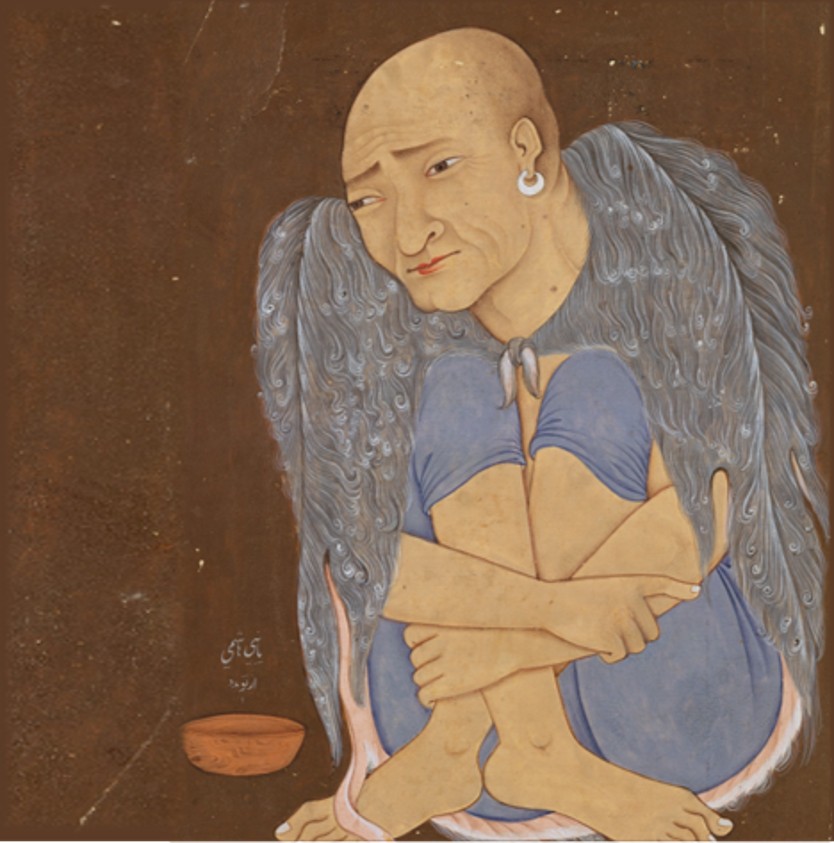
An album leaf from around 1600 done with watercolor of a dervish. The dates from substantially later than the period that concerns us in this episode.
And that completes the right-hand column of our “ISLAMIC MYSTICISM” T-chart, the column labeled “MYSTICISM.” From what you’ve heard so far, Sufism sounds like a generic ideology of monotheistic piety and self-improvement. By the time it came along in the 700s, as we noted a moment ago, there was already a 1,000-year-long history of folks banding together for the purposes of personal growth and spiritual awakening, often because the folks involved lived during difficult periods of history. But while Sufism naturally had plenty in common with similar movements that had come along before it, Sufism, even in the early days, also had some very distinctive characteristics. Put concisely, Sufism, in its inception, was not a lightweight, new age form of Islam, but instead, an introspective approach to the religion specifically focused on understanding the Qur’an, hadiths, and Islamic law. From our earliest records of Sufism onward, the movement was characterized by both a distinct combination of erudition in traditional Islamic primary texts – the “ISLAMIC” part, and adventurous self-seeking and minimalist lifestyles, or the “MYSTICISM” part. Early Sufis were, like their contemporary Talmudists, both conservative traditionalists as well as intellectual innovators. So let’s turn, now, to the left-hand side of our “ISLAMIC MYSTICISM” T-chart. The right-hand side taught us about early Sufism as a general ascetic movement. The left-hand side will teach us about what made it Islamic.
Early Sufis, as we’ve already learned, believed that looking inward was necessary for understanding God and focusing on ultimate reality. They also believed that introspection was a key to understanding the Qur’an and the hadiths. Today, if you know anything about Sufism at all, you might know that Sufi poetry is full of intense language involving intoxication, passionate love, and the ecstasy of oneness with God. If we read Rumi and Hafez, we might envision the earliest Sufis as bohemians drinking actual wine and carrying out love affairs, like some of their poetic contemporaries. However, the real pioneers of Sufism were more bookish than bohemian, and more hardcore theologians than they were religious dabblers. Hasan al-Basri, whom I mentioned earlier – one of the earliest figures associated with Sufism, was a major Qur’anic commentator. The early Sufi teacher al-Muhasibi, who lived from about 781-857, taught that meditation on the truths of the Qur’an and the hadiths was the best means of detaching oneself from worldly concerns and bringing one’s heart close to God. Al-Muhasibi wasn’t some brahmin from the sticks. He spent most of his life in the capital in Baghdad, and studied under one of the four doctors of Sunni law, al-Shafi’i. Three other early Sufi theologians, Dawud al-Ta’i, Abd al-Wahid ibn Zayd, and Shaqiq al-Balkhi were students of another of the four doctors of Sunni law, Abu Hanifa. The reclusive Sufi figurehead al-Fudayl was an Islamic scholar, and student of Ja’far al-Sadiq, the architect of the Ja’fari school of Shia law. That’s a lot of names and schools of law from the bustling century between 750 and 850, so let me put it very plainly. Sufism’s earliest roots were countercultural, but they were also scholarly. Its earliest participants sought fulfillment through the renunciation of wealth and possessions, and in their place, an intensified focus on understanding the Qur’an and the hadiths. If you have ever read something, or studied something so passionately that you’ve forgotten your own life for a little while, then you can understand what they were up to. They wanted transcendence through work and study of traditional materials, and not through repose and leisurely musing.
So that completes our T-chart’s second half. It is important to understand that from the beginning, Sufism was an ascetic movement centered on individual purity and self-improvement, but also that from the beginning, Sufis focused on the study of the Qur’an and the understanding of the hadiths. It was mysticism, but from the beginning, it was an industrious, intellectual, and Islamic mysticism.
Now that we have a basic sense of how Sufism is Islamic mysticism, and not just mysticism, we can learn a bit more about the ideology’s early history. Sufism would not be as famous as it is today were it not for Sufi writings. From very early on, Sufis developed a highly distinctive style of writing about the individual’s search for God, a style in which individual experience mattered, and a new landscape of metaphor and hyperbole was emerging that would be highly influential in Arabic and Persian literature. Just as Augustine’s Confessions chronicles a flawed individual’s passionate struggle to open his heart to God, Sufi writings from the movement’s opening centuries have an emotional immediacy that can still be felt more than a thousand years later. [music]
The Earliest Roots of Sufism
As I mentioned at the outset of this episode, our primary subject in this program will be a single generation of Sufis who lived from 850-920 – in other words, two centuries deep into Islamic history. It was at the end of the 800s, in the words of historian Christopher Melchert, that “something like classical Sufism had developed.”10 The generation on whom we’ll mostly focus today developed doctrines, guidebooks, and personal narratives that have survived and can offer firm evidence about the ideology as it existed around 900 CE.However, Sufi hagiographers and historians have long traced the roots of the movement back to the 600s, and the companions of the Prophet Muhammad. So before we move on to consider the impactful generation of Sufis who lived between 850 and 920, let’s learn a bit about how Sufi chroniclers themselves have traditionally understood Sufism’s beginnings.
In ancient and medieval theological history, instructional lineage is a big deal. In other words, monks of a certain order might say that Monk X taught Monk Y, who taught Monk Z, who taught Monk A, and on down through the centuries, each pedagogical relationship understood as preserving and passing on a core of traditions central to that monastic order. This model of instructional heredity is an important part of Sufism. There are fourteen major orders of Sufism today. These orders trace different chains, or silsilas, of transmission all the way back to the generation of Muhammad. While all Sufi orders place the roots of Sufi teachings in Muhammad and the revelations of the Qur’an itself, different orders emphasize different figures within the first couple of generations of Muslims. Among Sufis, Ali, and his sons Hasan and Husayn, and their descendants have traditionally been understood as having had Sufi values. Sometimes Muhammad’s companion Salman the Persian, has been, as well, and in a crucial generation between the grandchildren of Muhammad, and then those born in and after the 700s, the scholar and teacher Hasan al-Basri, whose name we heard earlier, is often a prominent name in Sufi lineages during the second half of the 600s – again he lived from roughly 642-728, and thus toward the later period of the friends and family of Muhammad himself.

Rabia of Basra in an illustration from an unknown date.
All told, there is fiction and pseudepigraphy in early Sufi hagiography that is normal for the genre, and some silsilas, or chains of instructional transmission, have curious chronological gaps in them. Nonetheless, it is almost certain that various kinds of practices today associated with Sufism existed within Islam from the mid-600s onward. Stories and anecdotes survive in a variety of sources about the first few generations of Muslims fasting, or eating very little; about Muslims voluntarily living in squalor and poverty, about Muslims going without sleep, or removing themselves from society, or restricting their speech, or reciting the Qur’an at regular intervals, or small parts of the Qur’an at great length, or practicing celibacy.13 During the two centuries after Muhammad died in 632, certain Muslims were drawn toward different forms of austerity and self-renunciation.
The self-renunciation of the earliest Sufis, or proto-Sufis, attracted dubiety just as much it did esteem. The early teacher Hasan al-Basri, worried that his generation of ascetics would be more concerned with making public spectacles of their asceticism than with focusing on their inner devoutness, cautioned his followers, saying: “Piety is not in one’s clothing. It settles in the heart and is confirmed by one’s work and deed.”14 As the 700s wore onward, other early figures associated with Sufism made similar remarks, emphasizing that devotion was characterized more by interior spiritual seeking than by public displays of austerity. This dichotomy seems to have been an important one very early on in Sufi history. Should practitioners swear off all worldly attachments, including marriage and lucrative employment, and concentrate on spiritual fulfilment, somehow subsisting off of public welfare? Or should they live more ordinary lives, devoting themselves to individual relationships with God, but steering away from extreme acts of self-renunciation? As the 700s gave way to the 800s, various believers opted for different positions along this continuum, and as historian Christopher Melchert writes, “persons called ‘Sufis’ by their contemporaries [early on] seem to have been [understood as] disreputable, marginal figures, often involved with political opposition and certainly not demonstrably mystics. Only in the second half of the ninth century does it appear that there were persons called Sufis who were also acceptable to the Sunni mainstream.”15
To sum up, for two centuries between the mid-600s and the mid-800s, practices that would later be central to Sufism flowered in Islamic civilization. Perhaps under the influence of communitarian ascetic movements typified by Christianity, or Buddhism, and perhaps in an evolution indigenous to Islamic society, Muslims of a certain disposition sought to do more than was strictly required by Qur’anic teachings and the norms of other practitioners around them. Some of them wore wool. Some of them preached and grandstanded. Some mostly kept to themselves. All of them were theologically restless, their probing, creative dispositions leading them to seek out personal relationships with God. By 850, Sufi ideas and practices were part of the fabric of Abbasid society, and especially urban Abbasid society. And although as a distinct theological movement, Sufis were perennial targets for persecution, it was in the second half of the ninth century that the movement became settled enough in certain echelons of Islamic society to begin leaving behind a substantial quantity of writings. [music]
Early Sufi Writings: Abu Sa’id al-Kharraz and Abu’l-Husayn an-Nuri
Now that we have a basic definition of Sufism, and a sense of its earliest history, let’s settle into the main course of today’s episode – a generation of Sufi thinkers who lived between 850 and 920. During these decades, especially in Baghdad, an erudite group of Sufi teachers left behind some texts in which we can see some of the more recurrent and substantial ideas of Sufism emerging. One of them is known today as Kharraz. The Baghdadi teacher Abu Sa’id al-Kharraz passed away around 899. Kharraz was a widely-traveled teacher who left behind a text called Kitab al-sidq, or The Book of Truthfulness. His name means “the cobbler,” and so he may have had working-class roots. Kharraz’s Book of Truthfulness lays out the manifold steps that a believer must take in order to pursue closeness with God, emphasizing that believers must advance through the following stations: “repentance, knowledge of the lower soul, knowledge of the devil, scrupulousness, knowledge of God’s commands and interdictions, renunciation of the world, trust in God, fear, shame, knowledge of God’s bounties and gratitude, love, acceptance, desire and intimacy.”16 The manifold path of the Sufi, according to Kharraz’s writings, leads to a remembrance of the individual’s closeness with God. Sometime in the late 800s, the Sufi teacher Kharraz wrote that that as the believer approaches the divine,his heart gains a quick understanding, and his thoughts become clear, and light lodges in his heart: he draws near to God, and God overwhelms his heart and purpose. Then he speaks, and his heart surges with the recollection of God: the love of God lurks deeply hidden in his inmost heart, cleaving to his mind, and never leaving it. Then his soul is joyfully busied with secret converse with God, and passionate study, and ardent talk. So he is, eating, or drinking, or sleeping, in all his motions: for when God’s nearness takes possession of a man’s heart, it overwhelms all else, both the inward infiltrations of the purposes and the outward motions of the [body].17
The passage, like so much Sufi theology, is beautifully written, and full of language that captures the experience of the individual believer. By the second half of the 800s, Islamic theological writings spanned the gamut between dry and scrupulously academic and legalistic on one side, and ardent and personal on the other, and Sufi writings like Kharraz’s, by focusing on the experience of the individual believer, appealed to those more focused on their own personal journeys than those trying to stake out a place within the ranks of professional jurists and theologians.
While Kharraz’s work appealed to seekers in search of spiritual improvement, it also had methodological rigor. Another one of his books, the Book of Light, taxonomizes the especially pious into seven different subgroups, only the highest of which can reach a togetherness with the divine, and even this highest subgroup has different tiers. For Kharraz, the believers who complete all of the many stations of the journey toward the divine are annihilated in their union with God. In a paradigmatic description of a Sufi in ecstasy, Kharraz wrote,
[The believer’s] spiritual station consists of a joyous rapture. . .due to continuous beholding of [God], and if it is said to one of those [in this station] “What do you want?” [the believer] answers “God.” If it is said to one of them “What is your knowledge?” he answers “God.” And if his limbs could talk they would say “God.” For his members, his joints, and his limbs are filled with the light of God. He knows nothing but God and all his knowledge is from God, yes, he himself is from God, through God, unto God, and with God. His identity and his reckoning have vanished. If one says to him “What are you?” he would be unable to answer “I,” because of the preponderance of God’s decrees. This is the reality of their ecstasy. And when he reaches the peak of nearness, he cannot even say “God.”18
It’s quite a nice passage. The Sufi believer, already inclined to self-abnegation, reaches the highest ecstasy by means of a self-dissolving union with the divine. To Kharraz, God’s unity is so ubiquitous, and so complete, that the notions of individuality itself, and individual consciousness are both erroneous. As scholar Ahmet Karamustafa puts it, for the early Sufi thinker Kharraz, “The consequence of God’s oneness is the erasure of any lingering feeling of subjectivity on the part of human individuals.”19

A watercolor of Majnun in the Wilderness from the second half the 1500s.
Colorful stories survive from early Sufi history about other Sufi teachers who took these ideas to their logical extremes. Let’s learn about another Sufi sage of this same generation. Kharraz’s contemporary Abu’l-Husayn an-Nuri, likely received his name, Nuri, which means “light” on account of his unique and luminous personality. Nuri, who died around 907, was also from Baghdad. Nuri was, according to one tradition, a shopkeeper who gave his food to the needy and was known for fasting. There are a lot of people from history whom I wish I could have met, and Abu’l-Husayn al-Nuri is definitely one of them. Biographical accounts of Nuri indicate that he genuinely had moments during which he completely forgot his own individuality, and seemed to think that his body, and mind, and everything around him were just connected nodes of God. A story survives that Nuri was watching another man stroke his beard during a daily prayer, and that Nuri exclaimed, “Take your hand off of God’s beard!” At another juncture, hearing a dog bark, Nuri said to the dog, in a formal Islamic expression normally addressed to God, “Here I am! At your service!” When asked where he had been the previous night, Nuri is said to have remarked “Last night I was in my house with God.”21 A man clearly comfortable breaking with conventions, Nuri was at one point in the court of a caliph, and, claiming to be the overseer of public morality, he smashed some of the caliph’s wine jars. When the caliph demanded to know who had appointed Nuri as the overseer of public morality, Nuri said, “He Who appointed you caliph!” – in other words, God.22
Hearing God in the barks of dogs, and imagining himself as actually within the company of God while at home on an ordinary evening, Abu’l-Husayn al-Nuri sounds a little bit loopy. At the same time, Nuri clearly shared his contemporary Kharraz’s sense that individuality is an illusion, and that reality is just the variegatedness of God himself. The Sufi’s goal, in both of these early thinkers, is to take the path of self-renunciation in order to understand that they are small parts of the divine who, in understanding themselves, understood God.
The notion that we are all part of a cosmic oneness, whether we encounter it in Plotinus, or Buddhism, or Sufism, or somewhere else, is a really reassuring one. Life is hard, sometimes, and lonely, too, and faith in our inherent togetherness as a single, radiant, sentient unity is something that a lot of us believe today. However, in the history of Abrahamic religions, including Islam, God isn’t always the kind of being who wants you to sit on a yoga mat, eating granola and feeling fantastic about yourself. And connectedly, the notion that the devout believer, even through rigorous personal training, can find a shortcut to God seemed egotistical even to early Sufis like Nuri. Thus, while the Baghdadi Sufi Abu’l-Husayn al-Nuri – again he died around 907 – while Nuri had moments during which he seems to have genuinely felt in communion with the divine, at other junctures, Nuri emphasized that the journey beyond individuality was daunting even to him.
In a humbler moment, Nuri wrote that “[God’s] Greatness is higher than that there should be a way to Him other than by Him or that He could be changed by what He created. No, there is no guide to God except Him.”23 In other words, however devout he was, Nur was no peddler, trying to tell others that he’d found some definitive path toward ecstasy with the divine. Elsewhere, Nuri wrote that reason and intellect could not bring one into conjunction with God, and when Nuri was asked how he had occasionally felt oneness with God, Nuri said, “By. . .lack of all determination. Whatever I thought and contemplated about happened otherwise. And whatever I did He ruined.”24 Hardly a self-congratulatory mystic, then, for Nuri, sometimes ecstatic oneness with God happened, and more often, in spite of his best efforts, it didn’t. Eventually, Nuri adopted a practice of vigilance, and listening – waiting for joyous moments in which God would show him the evanescence of himself and everything around him.
A final quote by Nuri will illustrate what makes early Sufism stand out in the annals of Abrahamic theology. This quote has to do with the heart, something on which Nuri wrote extensively. Nuri wrote that:
The first thing created by God in the heart of one for whom He wishes happiness is light. Then this light becomes brightness, then rays, then a moon, then a sun. And when the light appears in the heart, this world and what is in it grows cold to his heart. And when [the heart] becomes a moon he renounces the next world and what is in it. And when it becomes a sun he sees neither the world and what is in it nor the next world and what is in it: he knows nothing but God. And his body is light and his heart is light and his speech is light, “Light upon Light, God guides whom He will to his light.”25
The passage you just heard closes with one of the Qur’an’s most famous verses, the Lamp Verse (24:35) from Surat al-Nur. But Nuri’s main idea there isn’t particularly Qur’anic. Qur’anic salvation is, naturally, Abrahamic, which means it’s posthumous. Believe and be a good person, and you go to Jannah and not Jahannam after you die. In that early Sufi quote you just heard, though, the Sufi believer not only renounces the material world, but also whatever follows it, because all worlds are God. The goal is thus not carting one’s lumpy individuality from earth to heaven, but instead the joyous obliteration of one’s singularity within the eternal being of God, even before death. [music]
Junayd of Baghdad: Sunni Legal Scholar and Sufi
So, we’ve met two prominent Baghdadi Sufis at work in the second half of the 800s, Kharraz and Nuri. Through reading their work, we’ve come to understand that during the 860s, 870s, and 880s, in the epicenter of the Islamic world, Sufi ascetics were teaching a new kind of piety. This piety, although its devotee were inclined to rhetorical extremes, was rooted in Islamic teachings. In the Qur’an, Surat ar-Rahman says, “All that is upon [the earth] passes away. And there remains the Face of thy Lord, Possessed of Majesty and Bounty” (55:29).26 For early Sufis, if everything in creation, including individuals, are just dust in the wind, then seeking the finality of union with God even before death was the most pious thing that one could do. The Sufi doctrine of fana, which means “annihilation” or “extinction” in Arabic, as in the destruction of the self, has roots in the formative century of the 800s, in the work of thinkers like Kharraz, Nuri, and their more famous contemporary, Junayd of Baghdad._invites_the_Christian_youth_to_accept_Islam_at_the_Sufi_meeting,_witnessed_by_Saqati,_from_Breaths_of_intimacy_(Nafa%E1%B8%A5%C4%81t_al-uns),_by_J%C4%81m%C4%AB_(d._1492).jpg)
Junayd of Baghdad invites young Christians to convert to Islam, in an illustration of a book called Breaths of Intimacy (1595) by the poet and statesman Jami.
Born around 830, Junayd’s first couple of decades were lived beneath the mihna, or inquisition of 833-851, that ugly period of Abbasid history during which several caliphs forced Islamic scholars to accept the doctrine of the Qur’an’s createdness. Junayd, immersed in the study of law during his early years, eventually became fascinated with the central Islamic notion of tawhid, or the unity and oneness of God. This idea is in many ways the heart of Islam itself, as we’ve learned in past episodes – in contrast to the mushrikun, or “associators,” who assign various partners to God, the Qur’an emphatically drives home God’s tawhid, or unity, oneness, and uniqueness. This thoroughly orthodox idea lay at the heart of the ideas that Junayd developed.
One of those ideas, again, was fana, literally, “annihilation,” though in Junayd’s philosophy it means something like “transcendence from self-consciousness.” Junayd believed in fana because he found evidence in primary Islamic materials that seemed to support it. In one hadith, God says, “When I love [a servant], I become his hearing with which he hears, his sight with which he sees, his tongue with which he speaks, and his hand with which he grasps.”27 The language here pretty clearly describes a loving fusion between God and the devout believer, in which the believer’s consciousness disperses due to immersion in the divine presence.
While Junayd of Baghdad saw evidence for Sufi doctrines in the hadiths, he also saw evidence for Sufi doctrines in the Qur’an. As we learned in prior episodes, the Qur’an shares the creation story of Genesis, with some small variations. One of these variations is an interesting verse in Surat al-Araf, in which God speaks to the children of Adam and Eve. To quote the Qur’an, “[God] said, ‘Am I not your Lord?’ and [the children of Adam] replied, ‘Yes, we bear witness’” (7:172). To most readers, these verses simply show God giving the second generation of humans a quick review session, and confirming that they know who created them and everything around them. But the early Sufi Junayd of Baghdad read this verse and found proof of something else in it. What Junayd believed was that Adam and Eve, and their children, were so thoroughly intermeshed with God’s presence that they didn’t yet realize they existed as discrete entities. The very first humans, then, in Junayd’s estimation, had an ingrained awareness of their own lack of individuality. The closeness of humanity to God is central to later Sufi doctrine. There is a verse in the Qur’an in which God says that he is “closer to him than his jugular vein” (50:16), and Sufis eventually embraced a doctrine called Qurb – the notion of spiritual proximity to the divine that devout believers can work toward experiencing.
Junayd had one more idea that we need to cover, but before we get there, we need to take a moment to ponder the implications of what we’ve learned so far. The early Sufi thinkers Kharraz, and Nuri, and Junayd of Baghdad were all interested in the transcendence of individuality. They all believed that by seeing beyond the husk of one’s selfhood, one could get a glimpse of the permanent, omnipresent oneness of God. The question is, what was next for Sufis? If a devout student of Kharraz, or Nuri, or Junayd, fasting and meditating on some peaceful afternoon by the Tigris in, say, the 880s or 890s actually, for a moment, felt the astounding ubiquity of divine presence, completely losing herself in the process, did she just rest on her laurels? Or was she to keep seeking the same spiritual high? Was ninth-century Sufism’s core simply the search for transient intervals of spiritual ecstasy?
For Junayd of Baghdad, at least, the process of fana, or the annihilation of selfhood, was an important step, but it was not the end of the Sufi’s journey. To move us onto another major idea in early Sufism, Junayd taught that those who experienced fana and came back down to the ground did so with an enriched and more genuine understanding of the divine. In other words, after following an arduous path of self-examination and asceticism, once you felt the erasure of personhood and became, for a moment, one with God, when you returned, you had a clarity that allowed you to teach others. Junayd compared Sufis who had achieved fana to banners of truth and lighthouses – an elect set of guides who could not only instruct others in Sufi teachers, but also, could use their lucid understanding to do work in the mainstream Islamic disciplines of exegesis, jurisprudence, hadith studies, and more.
Thus, Junayd of Baghdad understood Sufism not as some eccentric offshoot of Islam, but instead as the key to its innermost chambers and its most orthodox pursuits. Being a Sufi was not mutually exclusive with being a muhaddith, or hadith scholar, nor a faqeeh, or Islamic jurist, because the stringent, self-denying path that Sufis took added to both their acumen and the authenticity of their beliefs. But unfortunately, as completely inoffensive as the Baghdadi Sufis we’ve met so far seem, some of their contemporaries took objection to them. [music]
Ghulam Khalil’s Inquisition of 877 and Its Aftermath
A popular preacher named Ghulam Khalil arrived in Baghdad around 877. According to a later Medieval historian, Ghulam Khalil evidently learned that certain Sufis in Baghdad emphasized God’s abiding love of humanity. The preacher, perhaps hearing secondhand accounts of the ascetic spiritual journey we’ve just been discussing, concluded that the Sufis of Baghdad believed they could achieve a loving oneness with God, and in doing so, ascend to a level of lawlessness, as their saintly spirituality gave them direct access to the divine. This was troubling stuff to the preacher Ghulam Khalil, and he began maligning the Sufis of Baghdad as heretics. Eventually, the preacher convinced the Abbasid caliph’s mother to begin a mass arrest of prominent Sufis, and seventy were summoned during the subsequent inquisition.As the public controversy of 877 deepened, accusations against the Sufis intensified. The prosecutor Ghulam Khalil caught wind of reports that the Baghdadi Sufis were engaging in sexually aberrant behavior, and these rumors added to the conservative outrage against them.28 But more than the sensational rumors about the private lives of Sufis, the issue at hand for Ghulam Khalil was what theologians call antinomianism. Antinomianism, which comes from the Greek words for “against law,” is the rejection of religious laws on the basis that believers are saved by divine grace. Antinomianism, for religious legalists, whether real or perceived, is an infuriating trend, because it means that some believers feel that they are above the law due to special dispensation from the divine.
There was a problem, however, with Ghulam Khalil’s 877 persecution of Sufis in Baghdad. The most prominent Baghdadi Sufi was the guy we have just been discussing. Junayd of Baghdad was literally a Sunni jurist, schooled in the traditions of other jurists. He was not exactly a loosey-goosey antinomian, wearing tie-dye and peddling a fast track to salvation, but instead a serious traditional theologian who believed Sufism was part of the teachings of the Qur’an and hadiths, and part of the key to understanding them further.

A seventeenth century watercolor of a Sufi.
The judge questioned the seventy Baghdadi Sufis. He asked them about their prayers, and what they did to remain pure, and evidently, he found them unimpeachable. The judge came to understand how devout the Sufis were, and how little they asked of the world, because Nuri, at a climactic moment, said, “God has servants who hear by God, see by God, go by God, and come by God, eat by God, and are clothed by God.”29 This remark, epitomizing as it did the humble resignation of the Sufi believer, pushed the judge over the edge, and he is said to have proclaimed, “If these people are heretics, then there is not a single monotheist on earth!”30
It’s a great story, surviving in later Sufi traditions, and I have no idea whether or not it’s true. Whatever happened in 877, we can hope that no one was hurt in the prosecution, and that all of the theological ruffled feathers and chest beating resulted in a greater degree of mutual understanding. However, if later history is any indication, the Ghulam Khalil persecution in 877 was merely the first major outbreak of strife between Sufis and various reactionary groups that bristled at the movement’s more distinctive doctrines. Sufis worked to prevent such persecutions. In the century after 877, some Sufi thinkers wrote apologetic texts elucidating Sufism for newcomers, offering guides to the correct Sufi path, and at the same time emphasizing that Sufism was complementary to mainline Sunni Islam, and not a heterodox replacement for it. These apologetics, together with the genuine orthodoxy and erudition of many Sufis, helped keep Sufism much closer to the center of Islamic history than Gnosticism ended up being to Christian history. Nonetheless, from the late 800s up to the present day, Sufis, with their esoteric path centered on individual relationships with God, proved perennially nettling to various hardline, puritanical Islamic groups focused on exoteric theology, legal consensuses, and dogma. With their charismatic leaders, and their gutsy optimism that believers can lose themselves in rapturous communion with God, unfortunately, Sufis were sometimes easy targets.
Sufi apologetic literature continued to emphasize that the movement was not some ecumenical new age group – a diet Islam, so to speak – skipping over the letter of the law in order to hang out in astral meditation clubs. Junayd’s generation of Sufis were Muslims with deep convictions and ascetic lifestyles, placing an emphasis core Qur’anic principles like tawhid, or the unity of God, with a grave seriousness unusual among many of their Muslim contemporaries. The persecutions of Sufis that happened in and after the ninth century were sometimes rooted in earnest doctrinal differences. However, as we’ve learned from studying other sectarian quarrels in Abrahamic religious history, theological disputes frequently have more to do with power, control, money, and social prejudices than they do with God.
Mansur al-Hallaj and the Persecution of 922

A Sufi in ecstasy in a landscape, c. 1650 from Isfahan, and done in ink and watercolor.
One point we’ve observed at several junctures throughout this episode has been that, as outlandish as Sufi poetry and prose can sound, and as hyperbolic as Sufism’s theological language can be, its participants were not social outsiders. Baghdadi Sufism, from 850-910, was a metropolitan phenomenon. Its practitioners were city-dwellers, and largely of the middle class. They were not political firebrands, penning criticisms of caliphs. They were not, generally, theological agitators, bellowing sermons to try and seduce students away from madrasas. Though certain colorful Sufis made a spectacle out of their asceticism and isolation, many of them were married professionals living routine lives in the capital.
The lenient outcome of the trial of 877 may have been precisely because the accused Sufis involved were broadly known as normal, upstanding citizens and good Muslims. A few quirky ideas did not make them heretics, and besides, orthodoxy was still being worked out, pen stroke by pen stroke, and disputation by disputation, by a punctilious class of lawmakers whose dry bookwork only had a limited appeal to the average believer on the street. In summation, Junayd’s generation survived and prospered because they were upstanding Muslims who didn’t color too far outside of the lines. But a fourth figure in the generation active between 850 and 920, a Sufi named Mansur al-Hallaj, did end up flouting convention enough to warrant a death sentence.
Al-Hallaj, who died in 922, had a colorful and itinerant early life. He traveled in the distant northeast of the Islamic world, and eventually made it as far east as India, making a living as an itinerant preacher. Around 900, he settled in Baghdad, befriending two esteemed Sufis there. As friendly as he was with Baghdad’s Sufis, al-Hallaj seems to have not shared his contemporaries’ adept sense of where to draw the line. Al-Hallaj threw himself into political controversies. Eventually, al-Hallaj was brutally tortured, lashed, and then beheaded at the behest of the Abbasid caliph’s vizier, in front of a large crowd along the banks of the Tigris.
The story of al-Hallaj is a famous martyr tale in the annals of Sufism. In later Sufi legends, al-Hallaj is famously alleged to have said “I am the Truth,” either in public or in private, and to have not recanted the statement when under the duress of public punishment. We’ve heard enough about Sufism so far to understand that such a statement – “I am the Truth” – was likely a figurative hyperbole about the speaker’s union with God. However, for a prosecuting vizier looking for a reason to take down a political agitator, “I am the Truth” sounded like someone claiming to be the incarnation of God, as “The Truth” is one of Allah’s 99 names and attributes in the Qur’an. In Sufi stories about al-Hallaj’s execution, the poor martyr is killed for heresy due to an impassioned outburst of faith.
What actually happened is challenging to pin down. Some historians record that al-Hallaj constructed a replica of the Kaaba in his yard, and that he was inviting believers to circle it rather than performing the actual hajj in Mecca.31 Al-Hallaj may have been staging and performing public miracles, and he may have run into trouble for this. Al-Hallaj may have publicly castigated the policies of the Abbasid vizier who had him executed. Whatever it was landed him in hot water, though, again, al-Hallaj died an awful death in the spring of 922 in Baghdad at the hands of the state. His death, however, was not for Sufism, so much as it was for being a political provocateur and a religious iconoclast. The execution of al-Hallaj did not set in motion a greater assault on the Sufis of Baghdad. And why would it? They were a part of the social fabric of the city. Baghdad in 922 was a town with oodles of creeds, and a lot of different kinds of people from all over the world. Sufis, over their past century there, were part of the greater ambient energy of Islam, and not some outside force directed against it. [music]
Other Sufis of the Period: Sahl al-Tustari and al-Hakim al-Tirmidhi
Baghdad, as we’ve learned so far, between 850 and 910, was home to a variety of Sufis and Sufi practices, some of them more restrained than others, including Kharraz, or “the Cobbler,” Nuri, or “Light,” and Junayd of Baghdad, who survived a state persecution, and Mansur al-Hallaj, who did not. But as you can imagine, Baghdad wasn’t the only place in the Islamic world in which believers were swearing off worldly niceties and pursuing profounder individual relationships with God. The generation of Sufis with whom we’ve concerned ourselves throughout most of this episode also included other luminaries who lived outside of Baghdad.Beyond Baghdad, one of the most famous Sufis active during the second half of the 800s was the Persian mystic Sahl al-Tustari. Tustari grew up in the southwest of what is today Iran, but like so many Persians from this region during the early caliphates, he migrated to Iraq. Tustari, like other Sufis of his generation, could be incendiary on one hand, and straightlaced on the other. On the incendiary side, Tustari is famous for having said, “I am the proof of God for the created beings and I am a proof for the saints of my time.”32 On the straightlaced side, Tustari said that Sufis were not capable of miracles, he fasted and lived a pure life, and he insisted that “Every ecstatic experience to which the [Qur’an] and the [hadiths] do not bear witness is false.”33 In other words, although Tustari saw himself as an exemplar of what the devout believer could do, he also believed that the road to ascendant piety led thoroughly through the pages of the Qur’an and knowledge of the Sunna, or the ways of Muhammad. And as provocative as Tustari’s statements sometimes were, he died at the age of 80 of natural causes in Basra, around 896, proof that the metropolises of the Islamic Golden Age could be places of considerable religious tolerance.
Tustari’s work dealt with themes many other Sufis in his generation were investigating. He taught that each devout person’s life is a clash between the heart, which is inclined upward, toward God, and then the baser self, which turns believers toward personal egotism. Like other Sufis of his generation, he explored the notion of an elect, predestined by God to understand divinity more than others, and to use their understanding to teach. And like other Sufis of his generation, Tustari wrote marvelously, using passionate figurative language to describe the individual’s relationship with God. For instance, Tustari wrote that the first step in a union with God rendered the individual as something like a cadaver being washed at a morgue, turned and turned inertly in the hands of the washer, the washer being God. It’s an extended simile worthy of Homer, and like so much later Sufi literature, the image strikes a combination of intensity and strangeness that’s difficult to forget.
Of all of the major Sufis whom we’ve met so far – of all these diverse theologians at work from 850-920 – the most prolific lived far, far away from Baghdad and Basra. His name was al-Hakim al-Tirmidhi, and he spent most of his life and career in the city of Termez, in the southernmost part of present-day Uzbekistan, just over the border with Afghanistan. The Sufi al-Hakim al-Tirmidhi, by the way, should not be confused with the much more famous Muhammad ibn Isa al-Tirmidhi, the Sunni hadith scholar. Around eighty works survive from the Sufi author al-Hakim al-Tirmidhi, vastly more than from anyone else from this period of Sufi history. And I want to introduce you to al-Hakim al-Tirmidhi by reading you some of his autobiography, because, you know, how often do you get to hear a ninth-century autobiography? This translation is from a book called Interpreting the Self: Autobiography in the Arabic Literary Tradition, published by the University of California Press in 2001. Al-Tirmidhi writes that after coming home from the hajj at about the age of 27 – this is going to be a fairly long quote, by the way:
I began reading books of the praises of God—blessed be His name—and collecting phrases with which to admonish myself and to inspire thoughts of the Hereafter. Meanwhile, I was searching the nearby towns, but could find no one to guide me along the path, or preach to me and strengthen my resolve. I was confused; I did not know what God wished for me. Nevertheless, I pursued my fasting and my prayer, until at last the words of a man of [mystical] knowledge reached my ears. I came across the book of [a great teacher] and examined it, and was thus guided to some knowledge of the discipline of the soul. I took up this practice and God helped me. Inspired to deny myself my desires, I found that I could train myself to do one thing after another, even to the point of denying myself cool water. I would refrain from drinking from the river, thinking, “Perhaps this water had flowed here wrongfully.” So I would drink from a well or from a big watercourse.
I became enamored of solitude at home and of walking in the wilderness. I took to wandering amid the ruins and the cemeteries on the outskirts of town. I sought for trustworthy friends to support me, but could find none, and so I withdrew to those ruins and lonely places. . .
I continued in my practice of self-denial, pushing aside my desires, staying at home to be away from people, and constantly addressing myself to God in supplication. In this way, one thing after another was opened up to me. I discovered strength and awareness in myself, and I sought out those who could help me. We would meet at night, practicing the remembrance of God.34
In the autobiography, al-Tirmidhi describes his spiritual journey in great detail, including many of the visionary dreams his wife and other devotees have had, in lucid, vivid prose. Al-Tirmidhi’s autobiography, written very roughly around the 870s or 880s, invites us to remember something very simple about early Sufism’s appeal.
Sufism appealed to the individual believer. It spoke to the raw, lonely side of human experience. When al-Tirmidhi wrote the account you just heard, there were hadith scholars busily sorting through isnads, or chains of narrators, and happy to be a part of the academic project of deciding which prophetic narratives about Muhammad were legitimate. There were legal scholars, scratching their chins over great tomes which tried to determine consensuses on various detailed questions of law. But these bookish, cultivated pursuits were not for everyone. Like Saint Augustine, in the 390s, some Muslim believers, 500 years later, found the specifics of their own spiritual experiences worth something, and they were not content to be a cog in a giant machine of hadiths and legal treatises. Al-Tirmidhi, however, unlike Saint Augustine, would not eventually be at the heart of his parent religion’s orthodoxy. Al-Tirmidi, in some ways, was pretty out there.
Al-Tirmidi wrote extensively of an elect group called the Friends of God. The Friends of God understood that the throne of God sat on top of the material world, which was held up by an angel, planted on a rock, and the rock sat on three horns of a bull, whose hooves rested on a great fish, floating in a deep sea. The so-called “Friends of God,” according to al-Tirmidhi, could ascend through seven different echelons of enlightenment in order to actually reach the throne of God, although they could not be any more elevated than that. Al-Tirmidhi was so taken by the notion of the “Friends of God” that he wrote a book titled The Difference between the Miracles of Prophets and the Miracles of Friends. This text emphasized that the “Friends of God” understood creation, and the inner meanings of divine utterances. The Friends of God could make miracles happen, and were capable of seeing into the future, walking on water, and moving supernaturally quickly. And unsurprisingly, al-Tirmidhi not only believed that he was one of those “Friends of God.” He believed that he was at the top of the hierarchy of the “Friends of God,” essentially, latter-day prophets who should steer Islam forward.
Al-Tirmidhi, as megalomaniacal as he must have been, still had a core of Islamic traditionalism. He and other sages of the Islamic northeast took jurisprudence seriously, along with exegesis and the study of hadiths. Yet you can see, just from a quick introduction to al-Tirmidhi, how some audacious Sufis nettled more traditional Islamic scholars. By the year 900, Islamic jurisprudence, hadith studies, and Qur’anic interpretation were hardcore, academic fields. The generation of hadith scholars alive during al-Tirmidhi’s lifetime had worked their fingers to the bone studying and categorizing tens of thousands of short narratives about Muhammad, because they believed that Muhammad was the Prophet of God and they wanted to know exactly what he had said. These scholars and researchers, naturally, didn’t like the idea of theological showmen alleging direct friendships with God, and by extension, their unique fitness to direct the course of Islam. To the Islamic scholarly establishment in the year 900, such pretensions were as boorishly conceited as they were disrespectful to the prophetic legacy of Muhammad himself.
Still, al-Tirmidhi wrote marvelously, he was a very devout person, and if his ecstatic sense of a personal relationship with God seemed overweening to certain contemporaries, he was a healthy part of Islam’s manifold history as the religion approached its three hundredth birthday. He seems to have been a person of considerable financial means, and he passed away in prosperity, having led an energetic life and corresponded with likeminded theologians from all over the Islamic east. His prosperity at the turn of the tenth century, and the magnificent mausoleum that still holds his remains on the banks of the Oxus River in Uzbekistan today demonstrate that Islamic history, notwithstanding its occasionally draconian places and times, has generally had considerable tolerance for theological oddballs. [music]
The Malamatiyya
To wrap up our history of some of the main characters of Sufism between 850 and 920, I want to introduce you to one final subset of the movement. In the city of Nishapur, in the northeast of present-day Iran, a different group associated with Sufism emerged during this period. This group was known as al-Malamatiyya, or the “Path of Blame.” Early Sufi sects, like other horizontal dualists before them, divided the human self into two parts. The higher part was capable, with the right training, of communing with God. The lower part was tied to worldly concerns. Early Sufis, put simply, tried to reach upward to the divine in spite of the ball and chain that held them down. The Malamatiyya, or those on the Path of Blame, were essentially a penitent sect, taking the dualistic model of selfhood with grave seriousness.Unlike many other Sufi groups of their generation, the people of the Path of Blame don’t seem to have believed that they could transcend their baser selves. The lower self, for the people of the Path of Blame, was debased, but it was also insurmountable, and so the best thing a devotee could do was to be humbly conscious of her own finitude. Participants on this Path of Blame, unlike some of the more presumptuous Sufis of their generation who kept high profiles and made public displays of their asceticism, lived quiet, unpublic lives. They believed that conspicuous public displays of good works, or the proclamation of doctrinal correctness, were simply manifestations of egotism that swelled the influence of the lower self. Living lives of contrite inconspicuousness, then, the Iranians on the Path of Blame did not believe that religious faith should be public theater. They wore no distinguishing clothing, and seem to have been drawn from urban guild groups of workmen already inclined to communitarian solidarity.
Al-Malamatiyya, or those on the Path of Blame, form a useful contrast to some of the more prominent Sufis at work around 900. Some Sufi sages were celebrities and proselytizers, advertising paths upward to joyous closeness with God. For the self-abnegation that they practiced, they sought a commensurate public recognition, making spectacles of their asceticism. Other Sufis were quieter and more reflective, seeking spiritual transformation even though they felt thoroughly encased in their own mortality. From modern-day Iraq to modern-day Uzbekistan, Sufism evolved differently in different places. Other than Muhammad and the Qur’an, it had no central, authoritative tract or architect. Later Sufi orders constructed silsilas, or chains of teachers, that led, unbroken, back to the Prophet Muhammad, but the links of each chain vary from order to order, and the histories of intact pedagogical lineage were written in later centuries.
Summing Up: The Attraction of Sufism Circa 900

Sultan Muhammad’s Samson, a watercolor on parchment from a collection of Hafez’s poetry. This Safavid masterpiece shows intoxication up in heaven as well as down on earth as part of the experience of all created beings.
But to stay on the subject of ninth-century Sufism, the Qur’an speaks to the uncertain, imperfect individual as well as the studious collective. One of the names for God in the book is al-Qarib, or “the Near,” and when you read certain Surahs it is as though there is a warm, eminent, patient, admonishing voice speaking directly to you. Sufis of the generation we considered in this program, wherever they were born, and whatever social class they came from, must have loved that aspect of the Qur’an. The book, after all, is not a punctilious contract between a deity and a polity of believers. Its verses are full of love and compassion, and the assurance that believers will remember, and return to God, because this is what they’re designed to do.
The creative energy of Sufism, from 850-920, grew out of a convergence of forces. In different places, inspired by earlier teachings, Muslim believers sought transcendence. The Qur’an taught that the pious would ascend to Jannah. But for some, that transcendence couldn’t come soon enough, and the very existence of individuality and embodiedness were illusions that could be overcome. Through asceticism and various multifold paths; through focused worship communities and the study of the Qur’an and hadiths; through public sermonizing and quiet individual contemplation, Sufis of this generation sought to be dissolved into God, some of them edging into the pantheist doctrine that everything was God, anyway.
The content of Sufism, although much of it may well have developed independently, was completely precedented. The philosophy of Plotinus and the teachings of Gnostic scriptures, together with all of pagan antiquity’s monist and ascetic movements, demonstrate that dissolving one’s personhood into a cosmic oneness was a common idea in antiquity, and that’s only mentioning ideologies on the Abbasid caliphate’s western side. The content of Sufism, again, was thoroughly precedented, but the form was resplendent. At just the moment when Arabic and Persian literature were beginning to flourish beneath the sun of the Islamic Golden Age, Sufi writers began chronicling their experiences with the divine. Sufi theological writings from 850-920 are personal, urgent, vulnerable, dark, and rapturous. Departing from the sedulity of Islamic scholarship, Sufis wrote stirring passages about the experience of being annihilated in God’s presence, in prose and poetry full of hyperboles, extended similes, and forceful metaphors. When individuality itself is diffused into divinity, all of a sudden, the basic machinery of language, with its subjects and objects and presumed causality, is subject to strange new rules. As the poet Rumi wrote,
Out beyond ideas of wrongdoing and rightdoing,
there is a field. I’ll meet you there.
When the soul lies down in that grass,
the world is too full to talk about.
Ideas, language, even the phrase each other
doesn’t make any sense.35
In this poem, beyond individuality and particularity, there is simply a fullness, the nearness of which is so palpable that describing it would be redundant.
Sufism might have gone the way of Gnosticism. Both movements were diverse, both entailed a lot of new theological writings, and both came under the crosshairs of persecutors. Sufism might have been a curio that never made it past the early Islamic period. But Sufism, for reasons we’ve explored in this episode, had strong staying power. It was, in contrast to Gnosticism, in general pretty orthodox, staying close to the Qur’an, its earliest participants often Islamic scholars. Notwithstanding the occasional grandstander and edgy metaphor, early Sufism taught that the individual needed to revere and aspire toward the cosmic unity of God, which, again, was congruent with the core principles of Islam. Subsequently, rather than being a separate ideological edifice, Sufism became a varnish that seeped into the brickwork of many different phases of Islamic history. In moments of prayer, and moments of tragedy, and moments of joy, from time to time, many of us feel more than just ourselves, whether we’re pious folks on prayer mats, or astrophysicists gazing up into the night sky. Sufism speaks to that core impulse in us – to press against the outer edges of our individuality and to feel, during moments of haunting awareness, that we are small, temporary coalescences, borne along by the river of time and space, and for a great many of us, by God. [music]
Sufism and Monotheism in the Ninth Century
We will learn more about the history of Sufism in later episodes, and of course, the great literary history that Sufism went on to inspire. To bring this episode toward its conclusion, I want to briefly introduce that literary history. The fourteenth century Persian writer Hafez Shirazi began one of his most famous poems with these lines:The red rose bloomed and the nightingale became drunk.
O wine-adoring Sufis, this is a summons to joyfulness.
Behold how beautifully a crystal goblet broke
The foundation of repentance, that looked as strong as a rock!
Bring wine, for in the palace of magnanimity,
What difference is there between a sentry and a sultan, or between a sober [person and] a [drunk]?36
These are the kinds of provocative, or at least provocative-sounding statements that have made Sufi poetry decently well-known in the English-speaking world. Even if we don’t understand drunkenness as a metaphor for the expanded and radiant awareness of the oneness of God, the poem is still beautiful. It is exhilarating, whether we get there with extensive spiritual training or booze, to reach a moment of consciousness in which the hierarchies in our brains, and the barriers between ourselves and externality start to give way to strange new awarenesses. Rumi wrote, in one of his poems, “Don’t hand me another glass of wine. / Pour it in my mouth. / I’ve lost the way to my mouth,” and here, the very physicality of the speaker seems to have been occluded by the nearness of God.37

A painting from the British Museum of a Mughal aristocrat visiting a Sufi holy man and ascetic.
From the Tanakh, to the New Testament, to the Qur’an, and all of the religious history in between them, we’ve been through Abrahamic theology from end to end in our podcast. And as we conclude this 1,500-year-long history of how Judaism, Christianity, and Islam came to be, early Sufism invites us to remember something very important about all three of them. That is simply that there is often an inherent joyousness in monotheism. This joyousness comes up often in the Qur’an. It comes up often in the New Testament. Sometimes, it arises in the Tanakh. Its main emphasis is that you are not alone, and that you are a part of something greater than your capacity to imagine. Thousands of years into Abrahamic history as we are, it’s easy to forget that beneath the sects and stories, that is the paramount, and uplifting quintessence of Judaism, Christianity, and Islam – that as the Qur’an says, when the party’s over and the lights go out, God will be there, just as everything all around you is a dazzling emanation of God in the first place.
Ninth century Sufis, like all Abrahamic communities, processed this core message in different ways. Some felt that they had actually joined in oneness with God, and their writings about evanescing into the divine inspired some of literature’s all-time greatest poets. Others were not so optimistic, living lives more penitent than they were triumphant. Some were introverted, practicing self-renunciation in the private rooms of their houses; others were public figures of various stamps, advertising their ideology through decrying the materialism around them or otherwise preaching Sufi messages. The way that Sufism emerged in the Abbasid caliphate is not only interesting for its own sake. Early Sufism also offers an important lesson about all religious history.
In secular academies, sometimes we are taught to understand religion as a cultural kill switch. It shows up, pummels ideological diversity into conformity, and the future is dour and oppressive. Sadly, this has happened often in history, and it’s happening today. But the long, strange trip we’ve taken through Abrahamic history has also taught us that religious revolutions have been profound cultural accelerants, as well. Islam was not a readymade template, dragged and dropped onto tens of thousands of square miles of topography. It changed the world, but it was changed by the world, too, over its first few centuries. As we’ll see in the next season, as Christianity zinged around the remnants of the western Roman empire, it spread Latin and the Bible, but at the same time, Germanic and Celtic traditions made their way into Christianity, as well. Ninth-century Islamic history shows Abbasid civilization both absorbing and processing Qur’anic teachings, and doing so in some very different ways, from academic to zany to both at once.
This season of our podcast has been titled “Early Islamic History,” and toward the end of it, we’ve jumped around a bit. From learning about the Byzantine-Sasanian War of 602-628, to the Zoroastrian Bundahisn, to the fables of Ibn al-Muqaffa and the poetry of Bashshar ibn Burd, we’ve covered some material not strictly crucial to the early centuries of Islam. However, I still think a small taste of Abbasid period literature, and the rich religious history at the golden age’s outset, is critical for understanding what happened when the Qur’an came into the world. The book, in the period of history that concerned us today, had a vast spectrum of readers and adherents, from formally trained scholars, to new converts; from cautious sticklers to theological edgelords; from stuffy specialists to casual readers; from experts on hadiths to rationalists ready to toss tradition by the wayside. The early Abbasid period, with its great rumble and textual mass production, was not a period groping after a Prophet lost in the rear-view mirror of history. The Abbasid period wrote Islamic history, it systemized the hadiths, it authored the most influential books of law, and it birthed the denominations and movements within Islam that are still flourishing today. It is one of the great ironies of religious history that, even as we try to stay true to the traditions of the past, we innovate and extemporize, writing the lost chapters of sacred history with modern pens. Yet even though Renaissance paintings show the Virgin Mary in impeccable sixteenth-century clothing, they still hang in European churches and cathedrals. And even though some well-intentioned Sufi hyperboles might have made Muhammad or Ali raise an eyebrow, Sufi inflected theology and poetry still sits on tens of millions of bookshelves today. Religion might indeed come to us from the great beyond. But it is definitely a part of a seesawing human impulse to hold the past in our hands in order to understand the present. The poet Rumi, whom we’ve heard in this episode, talking about dwelling in an empty vibrancy beyond language, and being so intoxicated that he doesn’t know where his mouth is, also wrote this:
As long as my soul stays in my body,
I am a slave of the Quran
and the dust on the path of Muhammad.39
These are the words of a devout genius, like others who lived before him in Islamic history. Rumi, like the early Sufis we met in this program, felt faith so ardently that it made them restless. And as odd, or striking, as their writings can sometimes be, Sufis, like the early Abbasid period more generally, were floating in the giant slipstream of Muhammad, and trying to understand the implications of what he had said and done. [music]
Moving on to the Close of Season Seven
Well, everyone, that was an introduction to early Sufism, and especially a formative generation who lived from 850-920 who really began to codify the movement and bring it into the mainstream. Sufism will be a fixture in some upcoming seasons, but I hope even this brief presentation has helped acquaint you with the basic facts of Sufis and how they came to be.We now have a decent grasp of early Islamic history, from the pre-Islamic period of the 500s all the way up to the 800s. When we return to the Islamic world next, in Season 9, we will get very comfortable in the 800s and 900s, spending a lot of time with Abu Nuwas, al-Jahiz, al-Mutanabbi, al-Ma’arri, and more. We’ll come back to Sufism, of course, taking a look at Al-Ghazali’s writings on Sufism, together with those of ibn Arabi and others. Everything that we’ve learned in these past eighteen episodes and forty hours will be indispensable to understanding Arabic and Persian literature written during the Middle Ages, and beyond that, the greater global history of the early Medieval period. So next time, we’re going to bring Season 7 on early Islamic history to a conclusion, in Episode 129: Abrahamism. It should be a good one. As we usually do at the close of a long sequence of programs, we’ll review what we’ve learned, consider it in detail, and then see what we make of it, and how it fits into this greater story. This will be a very special episode, because it will mark the end of our decade long coverage of all the primary and many of the secondary writings of all three Abrahamic religions, so you don’t want to miss it, and at the end, I’ll introduce what we’re going to learn in in our podcast’s next season on the literature of early medieval Europe. I have a quiz on this program at literatureandhistory.com. Keep listening if you want to hear something fun and extra, and if not, I’ll see you next time.
Still here? So next time, we’re going to mark ten years of Literature and History. And over the past ten years, I’ve spent a lot of time at the microphone. In doing so, of course I flub lines sometimes and have to retake them, and once in a while, when the mistake has resulted in something funny, I saved the mistake, thinking I’d splice together a reel of outtakes at some point. That’s what you’re about to hear – some of the actual sound booth mishaps, cases of the giggles, and stuff like that. With all of the grave seriousness inherent in Sufism and the overall solemnity of ninth- and tenth-century monotheism, I thought that some silliness was in order. So this is again your host, screwing up and having fun, usually very late at night after work in one of several different sound booths I’ve used over the years. I hope you get a laugh out of it, and I’ll see you next time as we finish up our long biography of God in Episode 129: Abrahamism.
References
2.^ Jironet, Karin. Sufi Mysticism and Jungian Psychology: Individuation, Self-realization, Higher Consciousness. Printed in Knysh, Alexander. Sufism: A New History of Islamic Mysticism. Princeton University Press, 2017, p. 42.
3.^ These include al-Bukhari, Muslim ibn al-Hallaj, al-Tirmidhi, al-Nasa’i, Abu Dawud, al-Darimi, and ibn Majah.
4.^ See Karamustafa, Ahmet T.Sufism: The Formative Period. Edinburgh University Press, 2007, p. 6.
5.^ See Knysh, Alexander. Sufism: A New History of Islamic Mysticism. Princeton University Press, 2017, pp. 15-34 for a discussion of various theoretical approaches to the rise of Sufism.
6.^ Jayyusi, Salma. “Umayyad Poetry.” Printed in Arabic literature to the end of the Umayyad period. Ed. A.F.L. Beeston et. al. Cambridge University Press, 1983, p. 387.
7.^ Knysh, Alexander. Sufism: A New History of Islamic Mysticism. Princeton University Press, 2017, p. 31.
8.^ See Karamustafa, Ahmet T. Sufism: The Formative Period. Edinburgh University Press, 2007, p. 1.
9.^ The translation is that of Karamustafa (2007), p. 2.
10.^ Melchert, Christopher. “Origins and Early Sufism.” Printed in Ridgeon, Lloyd, ed. The Cambridge Companion to Sufism. Cambridge University Press, 2015, p. 3.
11.^ Attar of Nishapur’s Tazkirat al-Awliya has a long account of Rabia’s early life.
12.^ Printed in Al-Udhari, Abdullah. Classical Poems by Arab Women. Saqi Books, 1999, p. 118.
13.^ See Melchert (2015), pp. 4-7.
14.^ Quoted in Melchert (2015), pp. 11.
15.^ Ibid, p. 13.
16.^ Printed in Karamustafa (2007), p. 8.
17.^ Kharraz. The Book of Truthfulness (30b-31a). Translated by A.J. Arberry. Oxford University Press, 1937, p. 66.
18.^ Printed in Ogén, Gören. “Religious ecstasy in classical Sufism.” Religious Ecstasy on Papers Read at the Symposium on Religious Ecstasy Held at Åbo, Finland. Almqvist & Wiskell International, 1982, p. 234.
19.^ Karamustafa (2007), p. 10.
20.^ Printed in The Qur’an. Translated and with an Introduction and Notes by M.A.S. Abdel Haleem. Oxford University Press, 2010, p. 344.
22.^ Ibid, p. 13.
23.^ Ibid, p. 13.
24.^ Ibid, p. 14.
25.^ Ibid, p. 15.
26.^ Nasr, Seyyed Hossein, ed., et. al. The Study Quran. HarperOne 2015, p. 1313.
27.^ Wasa’il al-Shia, Vol. 4, Section 1, Chapter 17, Hadith 4544. Retrieved from https://wasail-al-shia.net/r/4570.
28.^ See Ramli, Harith. “Opposition to Sufis in the Formative Period.” Printed in Routledge Handbook on Sufism. Routledge, 2021, p. 121.
29.^ Karamustafa (2007), p. 12.
30.^ Ibid, p. 12.
31.^ Karamustafa (2007), p. 25.
32.^ Ibid, p. 39.
33.^ Ibid, p. 40.
34.^ Reynolds, Dwight, ed. Interpreting the Self: Autobiography in the Arabic Literary Tradition. University of California Press, 2001, p. 122.
35.^ Rumi. “A Great Wagon.” Printed in The Essential Rumi. Translated by Coleman Banks. HarperSanFrancisco, 1995, p. 36.
36.^ Hafez (XXV). Printed in The Poems of Hafez. Translated by Reza Saberi. University Press of America, Inc., 1995, pp. 19-20.
37.^ Rumi (1995), p. 6.
38.^ Baudelaire. “Get Drunk.” Paris Spleen (XXXIII). Translated by Louise Varèse. New Directions, 1970, p. 74.
39.^ Rumi. The Rubáiyát of Rumi: The Ergin Translations, Volume 2 of 4. Edited and Compiled by Millicent Alexander with Shahazad Mazhar. Powerhouse Publishing, 2024, p. 263.