
Episode 130: An Introduction to Early Medieval Literature
Learn about how literature in vernacular languages began, and Latin literature continued, during the early centuries of the Middle Ages.
European Literary History from 500-1000
Gold Sponsors
David Love
Aksel Gundersen Kolsung
Andy Olson
Andy Qualls
Asher DeLarme
Bill Harris
Christophe Mandy
Jeremy Hanks
John David Giese
KelleyGr
Laurent Callot
Maddao
Mike Roach
ml cohen
Nate Stevens
Olga Gologan
Steve baldwin
Silver Sponsors
Alexander D Silver
Andreu Andreu i Andreu
Boaz Munro
Charlie Wilson
David Macher
Devri K Owen
Ellen Ivens
Evasive Species
Hannah
Jennifer Deegan
John Weretka
John-Daniel Encel
Jonathan Thomas
Julius Barbanel
Michael Sanchez
Morten Rasmussen
Parodysbird
rebye
Taylor Boudreaux
Top Clean
Ukko
Sponsors
Carl-Henrik Naucler
Joseph Maltby
Robert
Stephen Connelly
A Chowdhury
A. Jesse Jiryu Davis
Aaron Burda
Abdul the Magnificent
Ahmed Malik
Alex Metricarti
Andrew Dunn
Andrew Verras
Ariela Kilinsky
Basak Balkan
Bendta Schroeder
Benjamin Bartemes
Brian Conn
Carl Silva
Carolyn Sabol
Cat Peterson
Charles Hayes
Chief Brody
Chris Auriemma
Chris Brademeyer
Chris Tanzola
Christopher Centamore
Chuck
Cody Moore
Daniel Stipe
David
David Stewart
Denim Wizard
Dominic Klyve
Elizabeth Lowe
Elliot Cole
Eric
Eric McDowell
Erik Trewitt
Anonymous
Evan Nelson
Fawad Zakariya
Francine
Friederike Otto
FuzzyKittens
Garlonga
Hillary Drake
J.W. Uijting
James Breslin
James McGee
Jason Davidoff
Jay Cassidy
JD Mal
Jillyp
Joan Harrington
joanna jansen
Joe Dudley
John Barch
John Sanchez
Jonathan B Whitmore
Joran Tibor
Joseph Flynn
Josh Stegmaier
Joshua Edson
Joshua Hardy
Anonymous
Kathrin Lichtenberg
Kathy Chapman
Kyle Pustola
Anonymous
Lat Resnik
Laura Ormsby
Le Tran-Thi
Leonardo Betzler
Lexi Mayhew
Lori Gum
Mélanie Ruelens
Maria Anna Karga
Mark Griggs
MarkV
Matt Hamblen
Maury K Kemper
Michael
Mike Beard
Mike Sharland
Mike White
Mr Jim
Nassef Perdomo
Nicholas Stern
noah brody
Oli Pate
Oliver
Olivia Fay
Paul Camp
Peter Goldstein
purden@verizon.met
Richard Greydanus
Riley Bahre
Robert Auers
Rosa
Ryan Booth
Ryan Goodrich
Ryan Shaffer
Ryan Walsh
Shaun
Shaun Walbridge
Sherry B
Sonya Andrews
Sophie
Starshell
Steve Grieder
Steven Laden
Stijn van Dooren
Stuart Sherman
Sue Nichols
susan butterick
Susan Hall
Ted Humphrey
The Curator
Thomas Bergman
Thomas Leech
Tim Rosolino
Tod Hostetler
Tom Wilson
Torakoro
Troy
Valentina Tondato Da Ruos
vika
Vincent Vandeven
William Coughlin
William King
Zak Gillman
Zita Farkas
Other Sponsors
too many to list
Stræt wæs stanfah, stig wisode
gumum ætgædere. Guðbyrne scan
heard, hondlocen, hringiren scir
song in searwum, þa hie to sele furðum
in hyra gryregeatwum gangan cwomon.
Setton sæmeþe side scyldas,
rondas regnhearde wið þæs recedes weal,
bugon þa to bence. Byrnan hringdon,
guðsearo gumena.
And now, in English.
It was a paved track, a path that kept them
in marching order. Their mail-shirts glinted,
hard and hand-linked; the high-gloss iron
of their armor rang. So they duly arrived
in their grim war-[garb] and gear at the hall,
and, weary from the sea, stacked wide shields
of the toughest hardwood against the wall,
then collapsed on the benches; battle-dress
and weapons clashed. (320-8)1
That was a famous passage from Beowulf, in which the title character and his men arrive at the hall of Heorot. I read that poem for the first time when I was about thirteen. When I was young, of course, I just read the modern English translation of the original Anglo-Saxon. All the same, the language of the translation, with its reproduction of the original alliterative verse, was magical – “hard and hand-linked; the high-gloss iron,” and “in their grim war-[garb] and gear at the hall.” These were dazzling lines to me as a kid, conjuring up the image of a weathered warband from the frosty north of the Dark Ages, somehow saying so much more than they actually said. And I wanted to read more.
I came back to Beowulf much later, in college. And again, the 3,000-line epic tale of a hero fighting a scary monster, and then a much scarier monster seemed too good to be true – a wheelbarrow full of inimitably pagan soil with a few Christian pebbles in it; a tale that suggested the depth and profusion of what must have once been a massive body of Germanic oral literature, sung by forgotten eons of bards who came of age in cultures quite a ways north of the balmy Mediterranean, beyond the Rhine, beyond the Danube, and on the mysterious, forested side of the old Roman limes Germanicus.
Beowulf, along with most of the literature that we will read in this season of the podcast, came from a period that is sometimes called the Dark Ages, and sometimes the Early Middle Ages – broadly, the years between 500 and 1000 CE. In the history of European literature, from a very high altitude, two transregional things happened during these five centuries. The first was the expansion of Christianity into two parent populations we can broadly call Celtic and Germanic peoples. The second, related transregional trend was the adoption of the Latin alphabet by speakers of various vernacular languages, an adoption that allowed northwestern Europeans to set down literature in languages like Old Irish, Old Welsh, Anglo-Saxon, Old High German, and Old Saxon, in addition to Latin. Without Christianization, there would have been no widespread catalyst for literacy, and with almost no exceptions, early medieval literature was the product of churches, abbeys, monasteries, and those who worked there.
Before we go any further, let me just make a point of terminology clear for newcomers to this period. When we talk about medieval literature, we often use the word “vernacular.” The word “vernacular” means the language spoken by ordinary people in any given region. As an example, around the year 1000, when the Nowell Codex, which contains Beowulf, was set down in Anglo-Saxon, Anglo-Saxon was the language of common folks in present-day England, and thus, Beowulf was written in a vernacular language. Latin, however, was the international language of western Europe and the tongue of the educated. So to put it simply, when we say the word “vernacular’ in the context of the medieval period, it generally just means “not Latin.”
Alright, so here, at the outset of this season, we have a timeframe – 500-1000 CE, give or take a century or so on either side. And we have our languages – the international language of Latin, and then the Celtic languages of Old Irish and Old Welsh, and the Germanic languages of Anglo-Saxon, Old Saxon, and Old High German. And we’ve just learned that the word “vernacular” is a useful word that means “not Latin,” since, for instance, saying “Old Irish, Old Welsh, Anglo-Saxon, Old Saxon, and Old High German” again and again is as pain in the neck, and so we just use the phrase “vernacular languages.” Now, I’d like to begin the long, wonderful story of early medieval literature by telling you a surprising anecdote about it. It was all written by one person – or really, one type of person. Let’s meet that person. [music]
Osric the Monk
I want you to imagine, for a moment, that you are a medieval monk, sitting at a desk in your monastery. It is a summer day in 750 in Malmesbury, in what is today England, and outside, the berries are ripe and the birds are singing in the oak and beech trees. Contrary to popular belief, they had sunny days during the Dark Ages – it wasn’t all mud and rain and doom and war cries. So, again, a warm summer day in 750 in western England, just south of the Cotswalds. Your name is Osric. Your native language is a dialect of Anglo-Saxon, or Old English, and you live in the kingdom of Wessex. Hi, Osric! You just wrapped up a long breakfast in the refectory and helped the other guys with the dishes. Some of your friends have quite a productive herb garden going in the central cloister, not to mention the big vegetable patch they’re growing on the north side of the nave. Later, you’re going to run an errand. For the present, though, you’re in your favorite place, and that’s the scriptorium, where books are stored and written. You’re a monk, which means that in addition to your native Anglo-Saxon, you also speak and write in Latin. Just a generation ago, a famous Anglo-Saxon writer named Aldhelm lived at your very same monastery, and together with his contemporary, Bede, over in Northumbria, these two talented churchmen brought Latin writing to new heights in Britain – everyone is reading their works, now. But in addition to Anglo-Saxon and Latin, you also know some other languages. Everyone in your profession in Britain knows a bit of Irish, because generations of Anglo-Saxon students were educated over in Irish monasteries back during the 500s and 600s, and guys are still going over there today for their schooling. Speakers of Anglo-Saxon can also converse a bit with those from down on the continent who speak dialects of Old High German and Old Saxon, as these languages are all Germanic languages, and are thus somewhat mutually intelligible. Your monastery guesthouse has hosted various churchmen from all over the region, and it’s always fun to trade vernacular words with visitors. Now, Osric, the monk from the year 750 CE, let’s talk about the manuscripts that are sitting around you.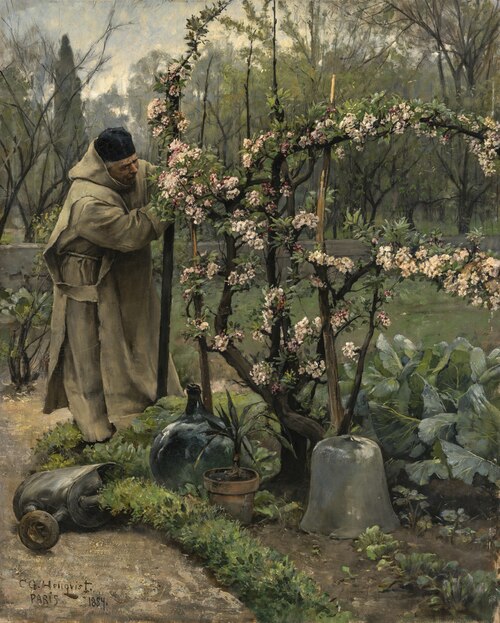
Carl Gustaf Hellqvist’s Monk Gardening (1884). Though the painting is 1000 years younger than the period that concerns us in this episode, it’s still a nice reminder of the daily lives, work, and hobbies of monks since Late Antiquity.
Around you both are some books in vernacular languages in the monastery library, but not very many. At the moment, you’re working on a letter. Your abbot is corresponding with a couple of guys down in Francia, and you’re drafting the correspondence, because you’re a crack-shot with the formal language of Latin epistles, and everyone likes your handwriting. The subject of the letters? Well, the guys at your monastery are really good at beekeeping – you need wax for candles for working in the evenings. But bees produce a secondary and delightful by-product, and your old abbot is trying to send some honey south to Francia, to one of his old friends. Later, you’re going to accompany this old abbot to a summertime fair in the local town. A bard everyone knows is going to be singing songs in Anglo-Saxon and maybe do some numbers in Brittonic, too, and you don’t want to miss it. You’re Christian, but doggone it, you like those old Germanic and Celtic songs and stories – they’re part of who you are, too.
That summer morning, in the shoes of our hypothetical monk named Osric, is a good scene to begin learning about the literature of the early Middle Ages. Osric’s world is provincial. Malmesbury, a village 20 miles inland from Bristol Channel and at the back end of medieval Wessex, isn’t exactly at the center of the world. And yet Osric knows multiple languages, he’s corresponding with churchmen down on the continent and elsewhere, he knows some ancient Mediterranean literature and the great big canon of the Bible, and he’s a part of Latin and vernacular intellectual history that’s unfolding throughout northwestern Europe. If you asked this hypothetical monk Osric whether he considered himself English, he would probably give you a strange look. Osric, in 750, lives in the kingdom of Wessex, but his cultural identity, like so many cultural identities in the Middle Ages, is made up of numerous overlapping parts – he is a person, after all, who lives in an ancient Celtic territory that became Romanized, who speaks a Germanic language, practices an eastern religion, and speaks Latin to similar clerics from present-day Ireland, Wales, France, Scotland, England, France, Germany, Italy, and on and on. What survives of early medieval literature was, on the whole, set down by centuries of Osrics – polyglot professionals whose compound identities contravene stereotypes about the Dark Ages as parochial and backward.
Osric, on any given day, might have joked around in the monastery dormitory in Anglo-Saxon, tried to remember vowel affections in Old Irish with a visitor at the guesthouse, and imagined and corresponded in the intercontinental and ancient world of Latin, and to him, this was just plain old ordinary life. Today, however, we tend to subdivide early medieval literature somewhat arbitrarily into different bodies of texts, and if you have had any coursework that covers medieval literature, you have almost certainly been affected by this subdivision.
The Complexity of Dating Early Medieval Literature
The literature of the early medieval period has generally been divided in two ways. The first way has been to separate Latin works from those in written vernacular languages. The second way has been to separate works written in Celtic languages, namely Irish and Welsh, from works set down in Germanic languages, namely Anglo-Saxon, Old Saxon, Old High German, and later, Old Norse. These subdivisions are generally benign – we tend to want to know about our own national literatures, and specialists can’t be expected to know a dozen ancient languages, and although the early medieval world was more connected than is commonly understood, its vernacular cultures did evolve somewhat independently of one another. Nonetheless, following modern trends in medieval scholarship, throughout this season of the podcast, we’re going to keep people like Osric in mind. The literature that survives from this period was, again, mainly the product educated clergymen, at work in Christian institutions. These Christian institutions served different demographics in different longitudes and latitudes. But from northwestern Ireland down to southeastern Germany, monks, abbesses, priests, canonesses, and deacons read, wrote, and corresponded in Latin, and as the greater region Christianized, the clergy was increasingly insulated from the workaday usurpations and feuds of the early medieval period.Latin language literature in northwestern Europe goes back to the Roman period, and it continues unbroken throughout the Middle Ages. In our podcast, we’ve traced the evolution of Latin literature in a lot of detail, from the earliest surviving Latin inscription in the Roman forum to work of the Merovingian court poet Venantius Fortunatus in the second half of the 500s. We will read more Latin literature this season, because it’s not like Latin suddenly stops being cool after the fall of the western Roman empire. But what about vernacular literature? When and where was the first European vernacular literature written down? When did one of medieval Europe’s many Osrics suddenly get a strange glint in his eye and then dash out some vernacular poetry?
This is a really important question, and it’s one that a lot of people have about the early Middle Ages, so listen closely. Vernacular literature – at least what survives of it – starts showing up in scraps in manuscripts from the 700s, and then at more substantial length in manuscripts from the 800s. Although this hardcopy evidence is pretty incontrovertible, determining what, precisely, constitutes the earliest surviving vernacular literature from Europe is tricky and divisive. Let me explain why, using an example. The physical manuscript that contains the poem Beowulf is generally dated to the half century between about 975 and 1025 CE. Scholars have studied that physical manuscript, and others like it, quite a bit. Using paleography, or the study of historical handwriting styles, along with internal historical references, and spectrometric analyses of inks gives specialists enough information to date medieval manuscripts with reasonable accuracy, and sometimes we get lucky, and a physical manuscript actually has a date of composition included in it. So the physical manuscript in which Beowulf was preserved was set down around roughly the year 1000. But what about the story that’s told in this physical manuscript? Was Beowulf’s story made up right around the year 1000 CE, or was it a much older tale that circulated orally, or in older manuscripts that perished? Could it have been written by our man Osric, way back in the summer of 750?

The Nowell Codex, which contains Beowulf, was for a long time treated as an oddment, only of interest for the historical data that it held, even though the Thorkelin translation came out in 1815. J.R.R. Tolkien helped popularize the poem in the modern era as a major work of European literature.
We also have many manuscripts from before 1000. These older manuscripts, though they don’t contain a lot of literature, contain enough vernacular language to give us an idea of what vernacular languages sounded like early on. Beginning in the 700s and 800s, we start to have surviving manuscripts in which Latin and various vernacular languages sit side-by-side on the same ancient pages. The earliest manuscript of the Northumbrian monk Bede’s Ecclesiastical History, dated to roughly 740, includes the Anglo-Saxon “Caedmon’s Hymn” alongside the Latin of Chapter 24. “Caedmon’s Hymn” generally gets the credit for being the first surviving piece of English literature. The earliest written Old Irish in a manuscript also has monkish origins, surviving in glosses, or marginal notes written during the 700s in Latin manuscripts of the Bible.4 Old Welsh and Old High German glosses, or marginal notes, also survive in Latin Bible manuscripts from the 700s onward.5 In all of these manuscripts, you can see that by the year 800, a scholarly class of Osrics, trained in monasteries and fluent in both Latin on the one hand, and then, depending on region, Old Irish, Old Welsh, Anglo-Saxon, and Old High German and their respective dialects on the other, had the skills, the educations, the physical equipment, and the facilities to start writing down literature in their native languages.
But to return to the subject of Beowulf, and its roots in the pagan sagas of pre-Christian Europe, long before even these early surviving instances of written vernacular European languages, it is very safe to assume that a large and evolving body of oral literature existed in non-Roman parts of Europe. So, now that we’ve covered some basics about the languages and complex chronology of early medieval literature, let’s spend a moment going back in time – back from the Dark Ages, to the Even Darker Ages, and explore what we know about what Celtic and Germanic oral literature was like before the Christians showed up and started pestering everyone to learn how to read and write. [music]
Barbarian Bards and Poets in Pre-Christian Europe
Let’s picture the non-Roman populations of Europe – the barbarians, so to speak – in about the year 200 CE. Perhaps the biggest and simplest difference between Roman and barbarian civilizations in northwestern Europe around this time is that barbarian societies were more rural. Romans constructed cities and towns, and as Christianity came along, it used the Roman drag-and-drop template to build dioceses that were at first anchored in metropolitan areas. The Roman empire’s cities grew where trade and agricultural abundance facilitated business, and because the empire was commercially interknit, it maintained transportation networks. These transportation networks allowed for the transit of military personnel who, when everything was working correctly, could be deployed to secure provinces and frontiers. The Roman state was most firmly staked into islands and continents by means of Rome’s trademark cities, towns, villas, and roads.If you were magically transported back to Europe in 200 CE, whether you landed in Roman or barbarian territory, chances are, you’d be working in fields. However, if they were Roman fields, they would be surrounded by a gridwork of institutions and a state apparatus that added a bit more stability to your life and career. Barbarian lands, by contrast, whether in Arabia, or up in Scotland, had the basic organizational unit of the tribe, or petty kingdom. Sometimes coalitions formed, and sometimes these coalitions lasted for a while. But on the long historical time scale, the non-Roman parts of Europe, prior to the early medieval period, were peopled with shifting, decentered civilizations – civilizations unfortunately as vulnerable to Roman incursions as they were to other barbarians migrating in from elsewhere.
As diffuse and fragile as barbarian civilizations often were, they were neither internally homogenous, nor primitive. Early medieval literature from Europe may have been set down by Christian pens, but it still gives us plenty of clues about what ancient Celtic and Germanic societies were like. They were, by and large, patriarchal, rigidly structured societies economically rooted in agriculture and animal husbandry. Where shorelines were close, trading and raiding were often parts of barbarian economies. The basic unit of tribe or petty kingdom was often broken into subdivisions of clan, and around the chief or king was a small retinue of personnel that varied somewhat according to region. A fixture, however, in the personnel of the chieftain or petty king, whether in present-day Ireland, or Germany, or Denmark, was, somewhat surprisingly to modern sensibilities, a poet.

Thomas Jones’ The Bard (1774). The painting shows a Welsh bard decrying the invasion of Edward I, with a henge in the background to draw a link between medieval musicians and ancient druids.
When we picture poets today, I think we imagine creative writers, expressing themselves through original works of verse. In the ancient Celtic and Germanic worlds, however, poets were compound figures with different responsibilities. Rather than singing verses about how their girlfriends broke up with them in the mead hall, they sang sagas with which their audiences were familiar. Like archaic Greeks, barbarian cultures in long ago Europe had their own evolving webs of mythology, and so if you wanted to entertain a crowd, you were better off doing covers of well-known stories than originals. Documents from early medieval Ireland lay out a rigid hierarchy of poets, emphasizing that a master poet needed to have 350 compositions committed to memory.8 Taking requests and playing favorites, then, barbarian bards were carefully trained and professionally vetted, and they worked crowds with time-tested songs, stories, and cycles.
These stories and cycles, to their original audiences, were not entirely fiction. With tens of thousands of lines of poetry committed to memory, including lines about the history and genealogy of living tribal or monarchical dynasties, Europe’s early barbarian poets were understood as historians, in addition to jukeboxes. Though they surely performed pieces that were gross and bawdy for drunk audiences, and pieces that were pious and reverent on sacred holidays, barbarian bards were also boosters and propagandists for the regimes that employed them, memorizing and embellishing legends about any given king’s lineage. They were thus stewards of history and fiction and everything in between, sought after for their praise poems just as much as they were feared for their satires.
In the predominantly rural, decentered world of barbarian Europe, poets were not only entertainers and advocates for their employers. If medieval literature is any clue, ancient bards were also politicians themselves. Early medieval literature’s scenes of diplomacy and negotiation often feature poets as go-betweens for feuding kings, and envoys who can turn saber-rattling into peace, or the other way around. Poetic diplomats, schooled in history, invested in the status quo, and ultimately members of the same professional fraternity, were probably excellent candidates for peacemaking at moments when feuds threatened to rise to a boil.
We don’t have enough information to understand the full scope of what ancient Europe’s bards did, and who they were, from a smattering of documents that survive from the 600s, 700s, and afterward, and from literary sources produced later on, still. Sagas and cycles, written down by monks who were also poets, probably contain some professional self-aggrandizement about how awesome and important poets used to be. Nonetheless, taking an extremely widescreen view of west Eurasia during Late Antiquity, which our great many episodes leading up to this one helps us be able to do, we can draw some common-sense conclusions about what bards likely did in pre-Chrisitan Europe.

John Martin’s The Bard (c. 1817). A characteristically romantic period painting of a bard as a solitary, countercultural figure. We still have this image of artists today! But during Late Antiquity and the early medieval period, bards were public figures, associated with prominent kings and chieftains, and involved in diplomacy and politics.
This was how literature thrived and grew in barbarian Europe. One final detail to consider has to do with the bards themselves. Where did filis, scops, and skalds come from? Did they emerge from misty glades, inspired by forest spirits? Did they busk next to pigpens and in barns, and slowly make names for themselves? From the annals of, in particular, early medieval Irish history, we have evidence that bards became professionals in a manner somewhat more organized and systematic than this. In 200 CE as well as today, musical training and memorization, along with talent in improvisation, are difficult, specialty skills. Celtic and Germanic societies had bardic dynasties, in which poets were born into literary families and trained from a young age in subjects like history, literature, music, augury, law, and other fields, depending on their region. The bottom line here is that barbarian poets were not bohemians so much as they were diligent and versatile public servants, accountable to patrons and the public alike.
As Christianization proceeded in present-day Ireland, the Netherlands, Germany, Denmark, and elsewhere, over the 400s, 500s, 600s, and afterward, the professional bards of Celtic and Germanic societies met their monotheistic counterparts. Priests, deacons, and monks, although their theology was different, were also public servants, telling stories and networking with local leaders in order to secure resources for their evangelical operations. If we picture, say, what is today northwest Germany in 500 CE, it’s easy to see the difference between a Christian priest teaching the Gospels, and a Saxon skop singing a saga about Woden. However, both individuals were trained members of professional organizations, both individuals were quite educated by the standards of their time and place, and both individuals, being plugged into the extant socioeconomic order, had a vested interest in maintaining the stability of that social order. As generations and generations passed, pagan poets defected to Christian monasteries, churches and abbeys, and a new, hybrid professional was born – the Christian cleric, very often a monk – with knowledge of pagan literary traditions. And by such individuals, a lot of what survives of medieval literature in European vernacular languages was first set down.
And speaking of Woden, the oldest, purest example of Germanic pagan belief was written by a Christian cleric around very roughly 900. This cleric, for whatever reason, jotted down the following two-part incantation against illness. Here is an Old High German charm, or incantation, again from about 900, that says a whole lot about the early Middle Ages.
Phol and Wodan in the woods rode,
where Balder’s foal its foot sprained.
Then Sinthgund spoke [the charm], Sunna’s sister
then Freya spoke over it, Folla’s sister,
then Wodan spoke [the charm], as he was well able.
Be it bone-wrench [sickness], be it blood-wrench
be it limb-wrench,
bone to bone, blood to blood,
limb to limb, locked together. . .
Omnipotent holy father, our God, who alone performs great miracles, look down upon your servant. . .through Jesus Christ our lord.9
This Old High German manuscript was set down well into the early Middle Ages and after the conquests of Charlemagne, in a Christian world. But as you just heard, there, the cleric who recorded it, probably synthesizing old oral material with Christian verses, indicated that Wodan and Baldur and Freya all prayed to Jesus Christ, and that the prayer that they voiced could cure all sorts of ailments. This medley of pagan stories and Christian piety is very typical of the literature of the period. To return to our hypothetical monk Osric, even devout Christians still lived in worlds rich with old regional folklore and spiritualism, and these traditions clearly continued to flourish, even if direct evidence on them is thin.
So, we’ve considered some of the basics of early medieval literature. We’ve learned about the general circumstances of its production, and that dating a lot of it accurately is a significant challenge. We’ve learned that prior to Christianity, bards and poets were cornerstones of various barbarian civilizations in northwestern Europe, and that as Christianization proceeded, many old tales from the polytheistic world did end up being recorded by monks and other clerics, even if some narrative tinkering took place between the generations. With these basics covered, let’s go a bit deeper, and spend some time exploring the four regions that produced the earliest surviving vernacular literature from Europe. [music]
Roman Britannia: a Review
Let’s begin with Anglo-Saxon, or Old English, and learn about how Anglo-Saxon, and later Anglo-Saxon literature, came to be.
Hengist and Horsa were, according to Gildas and later Bede, who embellished what Gildas set down, a pair of brothers who led a military invasion of Britain. Whoever the pair originally were (if they weren’t made up altogether), the actual Germanic migrations to Britain took a long time and were the work of numerous generations.
Patrick, around the year 400, was like a lot of his contemporaries in the outer Roman provinces. Nearly four centuries of Roman colonial presence had not effaced the culture of the native Celtic Britons. On the contrary, growing up around 400 CE, Romans like Patrick spoke Common Brittonic, and their circles of acquaintances included pureblooded Britons, Romans from all over the empire, and every possible combination thereof. People like Patrick are called Romano-British by historians today. It’s important to understand that the Romano-British population of Britain in about 400 CE wasn’t a bunch of imported Romans from Italy speaking Latin, who ruled over subjugated Celtic Britons. Many Celtic Britons, centuries into the Roman presence there, were themselves Roman owners of Roman villas and holders of important governmental posts, and by the time of Roman Britain’s twilight, there was a true hybrid Romano-British population, made up of people from both backgrounds, partly Christianized and steeped in the very ancient culture of the Greco-Roman Mediterranean, though most of them had never been there. This population, as Roman power shriveled in western Europe, faced significant privations.
In the early 400s, beset by a series of overlapping emergencies, the western Roman empire no longer had the resources to maintain an army in Brittania. Our historical sources on what was happening on the island of Britain during the 400s CE are meager, but it’s safe to presume that some of the wealthier citizens of Roman Britain packed up their valuables and immigrated to stabler regions of the empire. Larger Romano-British cities established mercenary militias in order to try and stave off the chaos that arrived in the wake of the Roman military’s withdrawal from Britain. As the meshwork of Roman rule and law retracted, the countryside and coasts became more and more vulnerable to banditry and piracy. Roman Britain had never been a unified polity solidly beneath Roman rule. During the 200s and 300s CE, whenever the Roman empire fell into crisis, its outermost extremities faced pressure from barbarian groups, in addition to insurrections from disgruntled internal populations. And so when Roman legions, between 380 and 410, disembarked from the island to help their comrades down on the continent, the unassimilated native populations of Britain and Ireland that had been there all along knew that opportunity was afoot. The western reaches of Britain endured raids by Irish pirate ships, one of which kidnapped Saint Patrick and brought him over to Ireland. Picts harried the northeastern stretches of Britain. But most pivotally for the region’s history, sailing westward over the North Sea from what is today northwestern Germany and the mainland of Denmark came numerous waves of Germanic settlers.
The Adventus Saxonum
Over the course of the late 400s and early 500s, the settlement of eastern and southern Britain by Germanic immigrants, or the adventus saxonum, to use the fancy Latin term, was one of the most impactful events in medieval history. There is a lot of scholarship on the subject of how Germanic immigrants came to dwell in, and rule over much of Britain. In an upcoming episode, we will read early medieval primary source texts on the subject, written by Gildas, Bede, and others, and explore the great question of how eastern and southern Britain came to have an Anglo-Saxon hegemony by 600. For now, it will suffice to say that the Anglo-Saxon settlement of Britain, following a great deal of archaeological research and DNA analysis of human remains and modern populations, is now generally understood to have been less of a large-scale military operation, and more of a gradual peppering of Germanic populations, boat by boat and family by family, that somewhat gradually led to the Anglo-Saxon domination of the east and south of the island in the form of a number of petty kingdoms. This settlement process began slowly between about 450 and 470, and then sped up considerably between 470 and 520, as word reached the continent that fertile farmland and decent weather were available over in Britain.Let’s talk for just a moment about the Germanic populations who hopped on boats to come over to Britain. There is a well-known passage in the Roman historian Tacitus, written roughly around the year 100 CE, about the nature of Germanic peoples. Here’s that passage.
The people of Germany appear to me indigenous, and free from intermixture with foreigners, either as settlers or casual visitants. For the emigrants of former ages performed their expeditions not by land, but by water, and that immense, and if I may so call it, hostile ocean, is rarely navigated by ships from our world. Then, besides the danger of a boisterous and unknown sea, who would relinquish Asia, Africa, or Italy, for Germany, a land rude in its surface, rigorous in its climate, cheerless to every beholder and cultivator, except a native?12
The passage, in hindsight, is pretty funny. Tacitus says that the North Sea is scary to navigate, and that it’s cold up there above the Danube, and so surely, the Germanic peoples had always been up there, and no one ever actually went to live in present-day Germany, or Belgium, or the Netherlands. He also wrote that “a family likeness pervades [all Germans]. . .eyes stern and blue; ruddy hair; large bodies, powerful in sudden exertions, but impatient of toil and labor, least of all capable of sustaining thirst and heat. Cold and hunger they are accustomed by their climate and toil to endure.”13 Tacitus is a solid ancient Roman historian, but he shared his general age’s compulsion to aim clumsy generalizations at huge and manifold ethnic groups. He also, with an evident penchant for warm weather, couldn’t imagine that anyone would leave the Mediterranean sauna to live up in the continental interior.
In reality, by 400 CE, the Germanic speakers who hailed from the southeastern part of the North Sea basin came from a wide variety of backgrounds. They spoke different Germanic languages. Their archaeological sites show different artwork and burial practices. The region in which they lived felt the same effects of the large-scale population migrations that impacted the rest of west Eurasia and North Africa during the 200s CE and onward. Scandinavian and Baltic populations were adept at navigating the waters of the North Sea, just as Germanic speakers were, and so the northern shores of continental Europe were not, as Tacitus imagined, some timeless enclave of pureblooded people with blue eyes, but instead, a region from which people came and went just like everywhere else.
Germanic barbarian populations had a long and complicated relationship with the Roman empire. The word “barbarian” persistently conjures up the image of racial and cultural outsiders, but as students of Roman history well know, increasingly over the 200s, and 300s, and 400s CE, Germanic speakers were fixtures in the Roman military, and moreover, Roman civilization. Germanic populations frequently abutted and percolated into outer Roman provinces, trading and working with locals in the empire, and flourishing in the process. By and large, by the time the Anglo-Saxon migration to Britain began around 450, speakers of Germanic languages knew about Rome, and many of them knew other barbarians who had lived in and traded with Rome directly.14 [music]
The Angles, Saxons, and Others
So that’s a primer on Germanic peoples and Rome in general. Now, let’s zoom into the subject of Angles and Saxons, and start with the Angles, the Germanic people from whom England gets its name. The Angles probably hailed from the southern part of the Jutland Peninsula, on the Baltic Sea coast along where present-day Germany and Denmark share a border. The Roman historian Tacitus, whom we heard quoted a moment ago, mentioned the existence of a tribe called the Anglii as one of a number of peoples who lived up in the north of what is today Germany. Tacitus has little to say about the Anglii – only that they and comparable tribes in the region were culturally similar and protected by woodlands and rivers.15 Three hundred years after Tacitus lived, as the western Roman empire collapsed, the Angles began trickling over to Britain. In addition to somewhat fairer weather and good soil for planting, the turbulence in the east and north of the giant island had also left large swathes of turf with lower population density. And so the Angles, over the course of the years between 450 and 600, colonized the northeastern part of Britain up to about the latitude of Edinburgh, pushing the Romano-British population in that part of the island westward over the course of many generations. The wars that took place during these early centuries are the subjects of some of the oldest literature in the Welsh language.Then, there were the Saxons. The Saxons were also a Germanic people. Their native territory probably abutted that of the Angles, and thus geographically, their home turf was the northwestern edge of modern-day Germany along the North Sea. Beginning in the 300s, the Saxons start showing up in works of Roman history and other Latin texts. The historian Ammianus Marcellinus reports Roman military clashes with Saxon tribespeople, and the Roman poet Claudian, praising the rule of the emperor under whom he lived, celebrated the fact that under Honorius, “The Saxon is conquered and the seas safe. . .What avail against [Honorius] the eternal snows, the frozen air, the uncharted sea? The [Orkney Islands] ran red with Saxon slaughter.”16 These lines, written around roughly 400 CE, are from a court poem that aimed to flatter the emperor Honorius. While the poetry is exaggerated, those lines from Claudian, together with a number of other references to Saxons by Roman writers during the 300s, pretty conclusively suggest that by the late 300s, the Saxons were a robust coalition in the North Sea increasingly emerging as Roman power collapsed in the area. The Saxons, first in a trickle and then in a steadier flow, began settling in Britain in the second half of the 400s, making homes for themselves in the fertile southeastern and south-central territories of what is today England.
Now, there is more history to discuss. Frisians and Jutes likely also came over and settled, and if this were a program on English history, we would beeline to the subject of the early Anglo-Saxon kingdoms. For our purposes, perhaps the simplest thing to remember is the populations that migrated westward over the North Sea between 450 and 600 were not a monolithic, militarized fleet of German dudes deadlifting bales of sourcrout with broadswords strapped to their backs, but instead, a diverse hodgepodge of warriors, women, and children with backgrounds from all over Northern Europe taking advantage of a power vacuum to try and scratch out a living.
So that’s a quick introduction to the multigenerational population migration that led to Anglo-Saxon becoming the main vernacular literary language of eastern and central Britain by about 700. We also learned a bit about the withdrawal of the Roman legions from Britannia in the 400s, and that a Celtic language called Common Brittonic was the most widespread one on the large island during the centuries of Roman Britain, before the Anglo-Saxon migration. In a few minutes, we will move on to the subject of early medieval Irish, Welsh, and German literature. However, while we are on the subject of migrating masses of people, we need to talk about another migration that was especially important for literary history. This was the migration of Christian missionaries and clergymen into the pagan regions of northwestern Europe during Late Antiquity and the early medieval period.
From modest beginnings in hardscrabble farms and crossroads, preaching and giving alms to slaves, laborers and aristocrats alike, Christian pioneers were at work improvising institutions all over the region, and the operations that they set up in and around pagan territories, as early as the 300s and 400s, did an enormous amount of good for literary history in the long run. [music]
Monasteries and Evangelism in the Early Medieval Period
Monasteries were the most important institutions for the literacy and literature of the early Middle Ages. In earlier episodes of Literature and History, we learned about the earliest roots of monasticism – of how third- and fourth-century communes of Christian ascetics first began appearing in the Egyptian countryside, and how by the late 300s, monasticism had become one of the vanguards of Christianization in the Roman empire. And we learned that monasteries were very diverse as institutions. By 400, there were indeed minimalist Christian collectives in the hinterlands of Rome’s vast imperial territory, where monks fasted, prayed, and scratched out a living through subsistence agriculture. But there were also urban monasteries, where devout aristocrats converted their mansions into Christian institutions, as well as country villas transformed into Christian centers of learning and missionary work. During the late 300s and throughout the 400s, as the craze for monasticism of various forms took hold, these religious operations were a countercultural force in the late empire, offering opportunities for women, slaves, and freed slaves to participate in somewhat more egalitarian communities than the parent civilizations around them. For restless women, of whom only childbirth and motherhood were expected, and for various subjugated and dispossessed Europeans of the laboring class, Christian institutions offered a more equitable social hierarchy based on community service and piety, rather than inherited wealth or martial ferocity.Monasteries, nunneries, and hybrid operations often arose due to the donations of pious members of the gentry. A wealthy convert in, say, present-day Ireland, or Germany, or Sweden, or, for that matter, Syria, Iran, or Algeria might go all in on Christianity and devote his or her income entirely to a missionary enterprise. As this happened, barns became chapels, manors became dormitories, bathhouses became sculleries, and statues to Roman, Celtic, Germanic and other deities were set aside and replaced with crosses. In Britain, at a key juncture, Pope Gregory the Great opted for a gradualist approach to conversion. When asked by a bishop what should be done with pagan temples in Britain, Pope Gregory, as historian Rolf Bremmer summarizes,
advised him not to destroy them, but to remove and destroy the idols, cleanse the buildings with holy water and replace them with altars and relics so that the true God could be worshipped. In this way, the newly converted would be given the opportunity to still follow the well-trodden path to the same sanctuaries as their forebears had visited, but which had now been refurbished and adapted to new rituals. Likewise, Gregory counselled [this bishop] not to abolish the local custom of sacrificing cattle in the autumn but to ‘convert’ these festivities and maintain the butchering, but now in praise of God.17
It’s quite a nice anecdote, dispatched from the Pope in the summer of 601, reminding us that in spite of sensational stories of mass conversions and martyrdoms in medieval saint’s lives, the real process of Christianization involved courtesy, diplomacy, and respect for the inertia of old pagan traditions.
And as barns and mansions and temples were repurposed for various Christian uses, Christians also built educational facilities. Wherever they would fit, small classrooms were improvised both indoors and outdoors, where pupils learned to write Latin letters on wax tablets, and to read from precious parchment manuscripts. These manuscripts were often produced in the scriptoriums of larger monastic operations, regional hubs whose larger-than-subsistence earnings allowed them to fund the more specialized labor of book production. Our hypothetical monk Osric, working at the monastery of Malmesbury in 750, was employed by a fairly large institution. His contemporaries lived and wrote in all sorts of church institutions, large and small.

An image of the Dominican friar Vincent of Beauvais working in a scriptorium in a 15th century French manuscript. While monks and monasteries didn’t have a monopoly on books and writing, scriptoriums and monastery libraries were consistently invaluable for the transmission of knowledge throughout the medieval period.
Monasteries were the beachheads of Christianization in early Medieval Europe, but they grew organically as much as they were driven by the central command of the papacy. They were physically diverse, ranging from scrappy communes in the countryside to palatial establishments in towns. And they were organizationally diverse, ranging from lone institutions to larger federations financially and ideologically braided together with one another.
Between papal missions like Gregory’s dispatch of Augustine of Canterbury in 596, and startup monasteries driven by the endowments of wealthy individuals, there was another kind of monastery in the early Middle Ages. This third type of monastery, especially in Gaul, was driven by bishops. Bishops were often aristocrats during Late Antiquity and the Early Middle Ages, and even if they didn’t come from wealth, they were effectively the leaders of ecclesiastical city-states within kingdoms, having considerable financial resources at their control. Many bishops, whether bluebloods or commoners, believed in the spiritual, humanitarian, and intellectual utility of having monasteries in their dioceses, and so, setting aside endowments to fund monasteries, they also commissioned abbots to run them.
With so much energy and resources poured into them, by the year 600, European monasteries ranged from improvised institutions driven by aristocrats that petered out after a generation or so, to monasteries founded by bishops that were intended to stand the test of time. And because monasteries and missionary operations were generally so diverse by the year 600, a monastery in one region might be operated and ideologically driven rather differently from a monastery in another region. Between 600 and 1000, especially in Britain, monasteries seesawed between being run by strict abbots and celibate monks on one hand, and then on the other, secular clergymen who were married and allowed more organizational laxity in their monasteries. At the center of the tug-of-war between more monkish monasteries and more liberal monasteries was something called the Rule of Saint Benedict.
The Rule of Saint Benedict, which emerged around 530, was neither the first, nor the only rules list set down to govern monastic life, but it was ultimately the most influential. Its 73 chapters outlined monastic life as it’s broadly understood today. Monks living under the rule of Saint Benedict were required to follow the directives of their abbot, to be humble and industrious, to read aloud at mealtime and in the evenings, and generally to live a minimalist, ascetic lifestyle focused on devoutness and service to the broader Christian community. British monasticism endured two different earthquakes during the Early Middle Ages. The first was the Anglo-Saxon hegemony from roughly 500 – 650. The Anglo-Saxons were initially pagans, much to the dismay of British monks. A ruling hegemony of Germanic pagans certainly didn’t help spur British monasticism along, and although prominent Anglo-Saxon monarchs converted over the early 600s, a much more sinister and direct threat confronted British and Irish monasteries several generations later.
The first Viking attack on a British monastery took place in June of 793 at the wealthy monastery of Lindisfarne. Subsequent Viking incursions led to the plundering of other vulnerable coastal monasteries around Britain and Ireland. The monastery on the small island of Iona, off the west coast of what is today Scotland, was raided in 795, 802, and again in 806, after which the poor Christians who lived there moved to the monastery of Kells, today in County Meath in Ireland, pointedly, some distance inland and away from the dangerous coast.
Scandinavian invasions of Britain, Ireland, and elsewhere were catastrophic to the delicate economies and social orders of early medieval kingdoms. Just as the Carolingian renaissance went into full swing and the coronation of Charlemagne seemed to hearken the birth of a new Rome, a new generation of invaders smashed into a nascent feudal world often unprepared for them. The polymath and court poet Alcuin of York wrote the following famous Latin lines on the subject of the Viking invasions:
Thus was the order of this world subject to change and so it will be,
let no one have trust in the permanence of joy.
He who once hunted in the fields for the stag
lies in bed, now that weary old age is at hand.
He who once reclined joyously on his purple couch
can scarcely cover his chill limbs with an old rag.
The long day closes in black darkness eyes
which used to count each solitary wandering mote.19
These are beautiful lines of Latin poetry, having something of Ecclesiastes in them, and reminding us of the full magnitude of what Scandinavian migrations cost the cultural progress of northwestern Europe during the 800s. They also remind us that Latin literature continued to be produced with ingenuity and skill throughout the medieval period, that that it’s silly to ignore Latin.

Alfred or Ælfrǣd (r. 871-886) helped encourage the production of writing in Anglo-Saxon. Here he poses while wearing what appears to be a crayfish. Image by Saforrest.
By the 900s, Britain had absorbed five centuries of immigrant populations from the east – first Germanic, and then Scandinavian. Monasteries were an ineradicable part of life on the island. And in the middle of the 900s, a new reform movement spread through them that led to the physical production of the main Anglo-Saxon manuscripts from which most Anglo-Saxon literature is drawn today. A moment ago, we learned a bit about how the Rule of Saint Benedict, again first created around 530, was essentially a set of regulations that incrementally set the norms for life and work in European monasteries. British and Irish monasteries, for the next five centuries, and following the general cultural trends of the Early Middle Ages, embraced these general regulations. In the mid-900s, though, something else Benedictine happened to monastic life in Britain, and this was something called the Benedictine reform movement.
The archbishop of Canterbury, Dunstan, had a career that mostly coincided with that of King Edgar, who ruled from 959-975. Together with other bishops, Dunstan and King Edgar adopted a new framework of rules called the Regularis Concordia, a conversion of the much older Benedictine Rule, only aimed at British monasteries. The Benedictine reform movement, most importantly for the purposes of literary history, encouraged more rigorous, standard education in reading and writing. The efforts of Archbishop Dunstan’s generation paid off. The four main poetic codices of Anglo-Saxon literature that we’ll read nearly every word of were produced in the generation after Dunstan passed away. Between about 970 and 1025, the Exeter Book, the Vercelli Book, the Junius manuscript, and the Nowell Codex, which contains Beowulf, were all written. Of the four main dialects of Anglo-Saxon, the West Saxon dialect dominates the Old English literature that survives today, reminding us that Wessex eventually won the long game of thrones that characterized early English history, and ninth- and tenth-century reforms in the church helped bring about the beginnings of English literature as we know it today.
This literature contains stuff that a lot of us learn in the English-speaking world. Beowulf is a masterpiece. Some of the lyric poems from the Exeter Book are also frequently assigned in English literature courses, like “The Wanderer,” “The Seafarer,” “The Wife’s Lament,” and “The Ruin,” poems that have an overall air of reflective melancholy. Once we leave these familiar flagstones, however, we find some very rich material that’s not nearly as well known. There are works of history in Anglo-Saxon. There are travel narratives in Anglo-Saxon – both realistic accounts of journeys as well as fantastic fables. An old Greek novella from antiquity, Apollonius of Tyre, made its way into Anglo-Saxon. And there is also a sheaf of material that sits somewhere between sacred and secular – retellings of stories and anecdotes from the Bible, including the books of Judith and Exodus, and a synopsis lauding the virtues of the various apostles of Jesus. During the 800s, 900s, and 1000s, as we’ll learn throughout this season, Biblical tales were rehashed in multiple Germanic languages, and the way that they were transformed to suit the sensibilities of different vernacular cultures brings exuberant and strange new energy to the tales of Exodus, Judith, Acts, and the Gospels.
So that’s a fairly quick summary of the various ways in which monastic institutions spread during and after the decline of the Roman empire, with a special emphasis on the bumpy process of Christianization in early medieval England. We learned about how between 500 and 1000, the monks and other learned Christians of Britain and Ireland weathered some hard times. And we also learned that in spite of two periods of renewed paganization, first under the Anglo-Saxons from roughly 450-600 and then Scandinavian Viking settlers around 800, the studious abbots, brothers, and other cloistered folk of the region kept reading and writing, and indeed, after some kingly and episcopal encouragement and monastic reforms, they were doing so in the Anglo-Saxon language as well as Latin.
Now that we’ve had a short introduction to how Roman Britannia became Anglo-Saxon England, and the important role that Christian institutions played during this long process, let’s broaden the scope of our discussion a bit. So far, this has been the kind of introduction to early medieval literature that you would have read a generation ago – in a word, Anglocentric. But as it turns out, and as our hypothetical Osric the monk would have known in the year 750 CE, there were other folks in the region than the Anglo-Saxons setting pen to parchment to write prose and poetry. It’s time for us to meet some of those folks and to explore some of the other literatures being produced in northwestern Europe during the centuries between 500 and 1000. [music]
The Celtic Side of Early Medieval Literature

John Duncan’s Riders of the Sidhe, a famous image of the Tuatha Dé Danann, a supernatural caste who figure variously into medieval Irish literature.
A quarter of a century ago, the standard anthologies of English literature that I read as an English major did a nice job of laying out early Anglo-Saxon literature. Indefatigably, for generations, English majors like me were taught that “Caedmon’s Hymn,” as preserved in old manuscripts of Bede’s Ecclesiastical History, is the first surviving work of Anglo-Saxon literature, and then after Caedmon’s Hymn, onward and upward we went through the Dream of the Rood, various poems from the Exeter Book, and then Beowulf, and then onward further, still to Anglo-Norman England.
When I took my first English literature class in college, I was an 18-year-old Californian kid, and I was absolutely captivated by the trajectory of literary works that I just described. My professor, in the first class of the semester, made certain points of terminology very clear – that the big island was called Britain, and the smaller island to the left was called Ireland; that you don’t say “British Isles” because they’re not all British, and there’s a good 800 years of fraught history on that particular subject; that the United Kingdom was England, Scotland, Wales, and Northern Ireland; that Great Britain was a specific descriptor that meant England, together with Scotland and Wales, but not Northern Ireland. Also, there was Britannia, the Roman name for the large island, and then Britons, the general name for the indigenous inhabitants of the island in Roman times, who spoke Brittonic, and they were not to be confused with Bretons, who spoke and still speak Breton within the territory of not Brettany, but Brittany, the peninsula that extends northwest into the Celtic Sea from present-day France. My teacher had a whole handout on this, because, let’s be honest, the subject is a bit confusing to outsiders, and I can imagine she was pretty tired of explaining everything that I just summarized.
So, newly educated in the basic nomenclature of northwestern Europe’s most famous archipelago, I marched forth through Volume One of the Norton Anthology of English Literature, maybe the most common book English majors were required to pick up at student bookstores for half a century. The first 141 pages of this tome taught me exactly what we’ve already learned in this episode. Some Germanic settlers paddled over to the east and southeast of Britain in the 400s and 500s. Then later, some more heavily armed Scandinavian settlers paddled over and settled in the east and northeast and elsewhere in the 800s. As a result, Anglo-Saxon literature’s roots were in the North Sea – that was why Beowulf took place over in Denmark and Beowulf himself was from Geatland, generally agreed to be southern Sweden. Anglo-Saxon literature, with its poetry and tales of seafaring and shores, emerged from multiple maritime cultures, and a whole lot of crisscrossing between Britain, Scandinavia, and the northern continent. Other seas, like the Aegean, also produced bodies of literature in earlier times in much the same way.
But there was another sea in the region, too. And this second sea was not east of Britain, but southwest of it. In early medieval Ireland, there was a story about the ancestors of the Irish, climbing a tower in Galicia in what is today Spain, and looking out over this sea to the north, and for the first time, seeing their promised land of Ireland.20 I first began really thinking about the Celtic Sea when I reached page 141 of the Norton Anthology of English Literature which explained, with alarming brevity, that hang on, the legend of King Arthur was Celtic in its origins, and the stories of Tristan and Iseult, and the works of Marie de France, and Chrétien de Troyes, and more generally the legends surrounding the Holy Grail all had Celtic roots. And on the subject of the Celtic literature of the early medieval period, my Norton Anthology of English Literature, which was 2,974 pages long, offered exactly eleven pages. To be fair, it was an anthology of English literature, and to be equally fair, they were pretty good pages, including a breakneck three paragraph introduction to Celtic history and culture, then an excellent short selection from the Irish Ulster Cycle, and then a nice snippet from the Welsh Mabinogion. I read those tantalizing excerpts from the most famous works of medieval Irish and Welsh literature, but then, following the guardrails of my course of study, during college, at least, I never got to read early Irish or Welsh sagas.
But I did later in life. And I decided that if I ever got to teach the literature of that archipelago northwest of France with all the belligerently confusing names, I’d try to present it a bit more panoramically. We should have about twelve shows, or twenty-four hours of free educational audio on early medieval Irish and Welsh literature by the time this season comes to an end, in addition roughly another twenty-four hours on the earliest medieval literature with Germanic roots. For the present, especially for the many of you out there listening across the planet who are not of European extraction, let’s learn the most basic of basics about early medieval Ireland, and early medieval Wales. We will begin by talking about a group of people called the Celts.
“Celtic” is another one of those confusing words for the uninitiated. I think most of us over here in the States, unless we have specific heritage in certain areas of Western Europe, hear “Celtic” and think of lively acoustic instrumental music, trees of life, nice curvilinear artwork, and maybe Ireland. [music] And on the subject of traditional Irish music, to state the obvious, hell yeah. Anyway when we start to read about Celts in ancient history, unless we have some background on the subject, the confusion builds pretty quickly. The word “Celt” first appears as Κελτοί (Keltoi) in ancient Greek – Herodotus mentions them way back in the 400s BCE as living in southern Germany. These Iron Age Celts were, according to ancient historians, a force to be reckoned with. In 387 BCE, a population of Celts had invaded the Italian peninsula. As the ancient Greek historian Diodorus Siculus wrote about three centuries later,
The military tribunes of the Romans, exercising their special power, when they heard of the advance of the Celts, armed all the men of military age. . .the Celts deployed their troops in a long line and, whether by fortune or design, stationed their choicest troops on the hills. The trumpets on both sides sounded the charge at the same time and the armies joined in battle with great clamour. The élite troops of the Celts, who were opposed to the weakest soldiers of the Romans, easily drove them from the hills.21
The Celts then went on to sack Rome, a calamitous event that was not repeated for the next 800 years. Now, if, when you think of Celts, you think of Irish folk music and druids, hearing that a people called the Celts sacked Rome back in 387 BCE comes as somewhat of a surprise. How did they get all the way down there? Did they wear green?
These questions are silly, as I’m sure a lot of you out there know. The word Keltoi, when ancient historians used it, referred to a massive population of people who settled in western Europe, the Iberian Peninsula, Britain, and Ireland during the final millennium BCE. Celtic domination of western Europe was at its apex around the time of the sack of Rome in 387 BCE. When Romans began to take over the Iberian Peninsula way back around 220 BCE, the tribes that they fought were Celtic. When Julius Caesar fought the Gauls between 58-50 BCE, he was fighting Celtic tribes. When forces under the emperor Claudius began conquering Britain in 43 BCE, the tribespeople whom the Romans fought were Celtic. Rome, from about 200 BCE onward, hit Celtic culture in a multi-century wave from the Mediterranean that washed ever northward and westward, taking over Celtic territories until by the year 100 CE, only Ireland and the northern reaches of Britain had not been subsumed by the empire.
The Romans never conquered Ireland. On the east side of the Irish Sea in the year 400, the main language was a Celtic language historians call Common Brittonic. On the west side of the Irish sea, around the year 400, a different Celtic language was spoken – one called Gaelige, the Irish word for the Irish language. Ireland, during the 350-year-long tenure of Roman rule over in Britain, was still in the splash zone of Roman culture. The Roman Atlantic scooted shipping traffic up and down the rim of the Celtic and Irish seas, and archaeologists have found plenty of Roman odds and ends in excavations in Ireland that can be dated back to the first centuries of the Common Era, so Ireland certainly wasn’t sealed off from the commerce or culture of Britain or the continent. Nonetheless, Ireland was able to march to the beat of its own Celtic drum for a remarkably long time, and when it Christianized, it did so in a way that was so distinctive that Irish monks and other clergy had a disproportionate impact not only on the Christianization of Britain, but more broadly, the clerical culture of western Europe as a whole. We’ll get to that story, soon, but the important thing to remember for now, especially if you’re new to this subject, is that Ireland, unlike so much of the rest of western Europe, spent the Roman imperial period largely unbothered by legions, legates, and Latin.
Now, we need to talk very broadly about Celtic languages for a moment. We’ve already learned that the Anglo-Saxon language developed when Angles, Saxons, and a hodgepodge of others from the east settled on the island of Britain. What about Old Irish and Old Welsh, though? First of all, linguists divide living Celtic languages up into two branches. To start in the on the left, or west side, there are Goidelic, or Gaelic languages, which include the Irish language. On the right, or east side of the Irish Sea, there are the Brythonic, or Brittonic languages, which include Welsh. There are other Gaelic and Brittonic languages, and some are still spoken today, or are undergoing revivals. But for the purposes of understanding early medieval literature, the most important immediate thing to know is that lot of the literature from the Early and High Middle Ages survives in various phases of Irish and Welsh. Both of these, as we just learned, were Celtic languages, Irish being of the Goidelic branch, and Welsh, of the Brythonic branch.
So, now that we’ve discussed the Celts from a high level, and the dominant Celtic literary languages of the Middle Ages, let’s talk a bit more about early medieval Ireland. Ireland is, and always was, quite a unique place. But its uniqueness, during the early Middle Ages, had less to do with druids, magic, and trees of life, and more to do with intellectual horsepower and unique way that Christianity was able to expand there, in a region that had no old substructure of Roman civilization or culture. So let’s talk a bit about the earliest literature that survives from Ireland. [music]
Early Medieval Irish Literature: A Quick Overview
The English novelist and academic J.R.R. Tolkien published The Hobbit and The Lord of the Rings between 1937 and 1955. These books were inspired by Tolkien’s work as a philologist and historian of early medieval Europe, with the Anglo-Saxon Beowulf, the Old Norse Saga of the Volsungs and Poetic Edda being Tolkien’s largest influences. These influences were from medieval Germanic literature, rather than Celtic literature. And in 1944, J.R.R. Tolkien made a general pronouncement about Celtic literature in one of his letters. He wrote:I do know Celtic things (many in their original languages Irish and Welsh), and feel for them a certain distaste: largely for their fundamental unreason. They have bright colour, but are like a broken stained glass window reassembled without design. They are in fact ‘mad’. . .but I don’t believe I am.22
To be fair to Tolkien, there are medieval Irish sagas and long stories that are pretty digressive and confusing, and every scholar is certainly entitled to their own opinion. Tolkien did adapt numerous elements from Celtic mythology into his beloved stories about Bilbo and Frodo, as we’ll see in later episodes. But nonetheless, the take on Celtic literature in general there is pretty pejorative. In it, we can see a curious and somewhat pernicious line drawn between present-day England and Wales, on the right side of which is Germanic stuff, and on the left side of which is Celtic stuff, with the Celtic stuff being imagined as, to use Tolkien’s word, “mad.”

Offa’s Dyke was built toward the end of the 700s during the Mercian Supremacy. To nineteenth- and some twentieth-century literary scholarship, the red line here marked a boundary between Celtic literary culture and Germanic literary culture, although these cultures were braided together throughout the medieval period.
There are indeed parts of medieval Irish and Welsh literature that are pretty discursive and weird. But a lot of medieval literature is strange to our modern ears, involving a soup of superstitions that have both pagan and medieval Christian ingredients. The problem with the perennial Anglophone categorization of Celtic literature as unhinged is ultimately that it imagines qualitative division between Welsh and Irish culture on the left, and then Anglo-Saxon and Old Norse on the right. Such categories have had long term consequences as to what is commonly taught in Anglophone classrooms, and what isn’t. Today, in my country, at least, Beowulf is a household name, and Cú Chulainn is not; Odin, Thor, and Freya are household names, and the Dagda, Lugh, and Brigid are not. There are some reasons for this kind of partitioning. The literary anthology that I mentioned earlier was, again, an anthology of English literature, and English is a Germanic language, and as someone who regularly gets asked when I’m going to cover this or that literary work, or why I didn’t cover this or that literary work, I have an unusual amount of compassion for anthologists whose time and page space are both finite. However, if we, as historians of medieval literature have tended to, envision some kind of ghostly line between medieval Celtic, and medieval Germanic literary traditions, we position ourselves to miss out on some of the best literature of the Common Era, because from its earliest surviving remnants, Old Irish and Old Welsh literature are both absolutely incredible.
In a few episodes from this one, we will look at some Old Irish poetry – famous poems like “The Scholar and His Cat,” and “The Old Woman of Beare,” together with some others. This earliest surviving Irish language poetry was set down very roughly around 800, within a century of Bede, and the small corpus of early Irish lyrics, which you can read in modern translations like those of Gerard Murphy, suggests a world of pious cleric-poets, a bit more shut in than their pagan bardic predecessors, but nonetheless capable champions of the language and indigenous traditions of Ireland. In the 800s and 900s and likely well before, these early Irish poets wrote traditional Christian material. They composed nature poetry, verses about oddments from daily life, and short pieces steeped in Celtic lore, too. The earliest poetry that survives in Irish is marvelous, and even in modern prose translations that can only approximate it, it reveals a class of monkish scholars whose superabundance of literary energy surely produced far more masterpieces than have survived. Also early in Irish literary history are a pair of voyage tales – the Voyage of Bran and the Voyage of Máel Dúin, along with several other voyage stories that we’ll look at soon.

A page from the medieval Irish Book of Leinster, set down during the 1100s, which contains a version of the Lebor Gabála Érenn or Book of Invasions and the Táin Bó Cúailnge, or The Cattle Raid of Cooley.
But reading all of them for yourself, unfortunately, will take some legwork. As of the time of recording this, the four giant Irish cycles, and a lot of other early medieval Irish literature, is only available in old translations and scholarly periodicals from as far back as the nineteenth century. The most substantial anthology available today, an edition called Ancient Irish Tales, was published ninety years ago. It’s great, but, as it’s intended for general audiences, the authors don’t tell you much about the manuscripts from which they’ve taken individual tales, and so you get a thousand years of stories without much historical context. The collection is also pretty limited, containing excerpts from the four cycles without a lot of explanation about what’s been omitted.
The big literary publishers Penguin and Oxford have stepped in to help a bit. Penguin, back in 1981, published the promising sounding volume, Early Irish Myths and Sagas in 1981. The book is absolutely worth getting, but at less than 300 pages, it’s only able to include 13 of the 150 or so tales of the four great cycles.25 Oxford issued a full translation of Acallam na Senórach, or Tales of the Elders of Ireland, in 1999, a novel-length tale within the Fenian Cycle that’s another great first step into medieval Irish literature. Penguin published a great translation of the Táin in 2007 – that’s the most famous part of the Ulster Cycle that’s sometimes called the “Irish Iliad,” and we’ll learn all about it later in this season. But these more modern volumes are pretty small samplings of the broader corpus of medieval Irish literature, and while writing upcoming episodes in the present season, I’ve had to rely on a whole lot of older translations and scholarly materials that are way off the beaten path for general readers. That old subdivision between Celtic and Germanic literatures, unfortunately, still impacts what’s available in bookstores today.
However, while I’ve worked behind the scenes with a patchwork of dated and newer translations, they have been more than enough. This season will present the Mythological Cycle and the Ulster Cycle in a lot of detail in multi-episode sequences – we’ll get to the other two cycles later. The great medieval Irish cycles are, in my personal opinion, along with the Shahnameh and Epistle of Forgiveness, among the most towering works of medieval literature to have generally fallen through the cracks of the past few generations of literary studies in the Anglophone world beyond Ireland itself, and although I love Beowulf, presenting the Mythological and Uster Cycles to you as huge, connected narratives may be the most valuable thing that I’ll do in this whole upcoming sequence of episodes. And as we set Irish literature from the 800s, 900s, and 1000s alongside Anglo-Saxon literature from the same centuries, we’ll do something that has sometimes eluded the past few generations of scholars and readers. Unlike scholarship and stereotypes have from time to time over the past century and a half, we won’t assume that there were mystical Celts over to the west and everyone else over to the east. We will assume, as the Osrics and other clerical intelligentsia knew during the early medieval period, that the literate classes of Ireland, Britain, and the continent were all connected, and that the literature they wrote is, from Donegal to Denmark, one of the single greatest keys to understanding the early medieval period.
You’ll love the Irish literature that we’re going to read over the next few months. It does have some enchanting, mystical scenes – iconic moments like the voyager Bran gliding over the Atlantic Ocean in a boat and looking down through the water and seeing a faery kingdom, with the sea’s surface dissolving into the foliage of trees profuse with golden leaves and acorns, beneath which are flowery fields and ageless, joyful people. But as fun as Irish mythology is and has always been, there was also, somehow, as early as the 600s, something of the whip cracking wit and experimentalism of James Joyce and Flann O’Brien in Irish works set down at the end of Late Antiquity. A Latin poem from Ireland done some time during the 600s describes a group of students eating buttered bread as follows, to a modern translation: “With dentous movements we ground grainous crustlets / on which a spread conserve of [Irish] oil pullulated.”26 It could be a line from Finnegan’s Wake, and I wanted to quote it upfront here to remind you that although the architects of medieval Irish literature existed a long time ago and in a world where Celtic folklore still lived and breathed, they were also ambitious wordsmiths who brought volcanic energy to storytelling. The primary texts of early medieval Irish literature do offer stories of overlapping worlds and beings who move between them, but much more pervasively, they are full of high standards for wordplay, showstopper runs of lines, and massive talent, and their unique qualities demonstrate again and again how long, and how deeply the craft of storytelling has been a part of Irish culture. [music]
The Earliest Literature in Welsh: An Overview
Let’s move on, now, to the subject of early medieval Welsh literature. Earlier in this episode, we learned about the arrival of the Germanic immigrants on the eastern and southern shores of Britain after about 450. This arrival, while more gradual and less concertedly militarized than has sometimes been understood, nonetheless pushed speakers of Brittonic languages to the north and west. These speakers of Brittonic languages were not a unified mass during Late Antiquity. Much of Britain had an overlay of Roman civilization four centuries deep on the island by 450, and when Angles and Saxons began shoving westward, the people whom they shoved, while Common Brittonic was their dominant language, were a diverse lot. As Anglo-Saxons began bunching up into kingdoms from the 450s to around 600 in Kent, and Sussex, and Wessex, and then East Anglia, and then Mercia and Northumbria, elsewhere, to the north and west in post-Roman Britain, various Brittonic kingdoms also consolidated. These kingdoms included Elmet, Gododdin, Rheged, and Strathclyde, encompassing a territory from Lincoln to Edinburgh in Britain’s northeast, and from the Lake District up to Glasgow in the northwest. These Brittonic kingdoms are often called the Old North in the scholarship. Roman control of Britain was always splotchy the further north the Romans went, and so when Roman control of the island collapsed in the early 400s, Brittonic powers in the Old North were free to grow in power and influence. Additionally, during the 400s, 500s, and 600s, on the west side of the island in what is today Wales, a number of kingdoms emerged out of the collapse of Roman power. These kingdoms included Gwynedd, Powys, Gwent, and others. From a very high level, then, as Germanic peoples grabbed hold of Britain from the right and bottom, an assortment of Celtic peoples held on from the left and top. Though they were diverse, the Brittonic speakers of the Welsh kingdoms, and those of the Old North, had more in common with each other than they did with Mercians and Northumbrians, and the earliest Welsh literature has roots in a complex patchwork of wars between Brittonic peoples and Germanic peoples.One of the main source texts on what was happening in Britain in the 400s and 500s is a long sermon by a British monk named Gildas. Gildas may have been from the Old North, and was certainly on the Brittonic side of the divide. But although Gildas saw the Anglo-Saxons as pernicious pagan invaders, he was also ambivalent about the indigenous inhabitants of the island. The monk Gildas wrote, around very roughly 550 CE,
[I]t has always been a custom with our nation, as it is at present, to be impotent in repelling foreign foes, but bold and invincible in raising civil war, and bearing the burdens of their offenses: [we] are impotent, I say, in following the standard of peace and truth, but bold in wickedness and falsehood. . .Kings were anointed, not according to God’s ordinance, but such as showed themselves more cruel than the rest; and soon after, they were put to death by those who had elected them, without any inquiry into their merits, but because others still more cruel were chosen to succeed them. If any one of these was of a milder nature than the rest, or in any way more regardful of the truth, he was looked upon as the ruiner of the country, every body cast a dart at him.27
Here, we have the pessimistic assessment of a pacifist cleric unfortunate enough to live through the general chaos of the post-Roman world. The Anglo-Saxons, to Gildas, were heathen invaders, but the speakers of Brittonic languages, whose forefathers had lived under Roman and Christian rule and ought to have known better, had also degenerated into anarchy, greed, and violence.
As fractious as the Brittonic side of post-Roman Britain was, though, it shared a parent language, and the Christianity resident there brought its clergy to have ties with their counterparts on the other side of the Irish sea, even as the dioceses of Roman Britain went pagan once more where Anglo-Saxons assumed control of them. And it was out of this social tumult – this strife between the Celtic west and Germanic east from 450-650, that historical events took place that would later be the subjects of the earliest Welsh literature – a series of conflicts, and poets who lived through them that would be recorded in subsequent centuries, which we’ll get to in just a moment.

The Old North around the time of the Anglo-Saxon migration. Gododdin is where the very early Welsh collection Y Gododdin has its roots. Some of the earliest Welsh literature concerns itself with the calamities of centuries past that took place in this region.
The 800s also begin to give us our first physical evidence of literature in the Welsh language. Poetic and prose compositions in Old Welsh start showing up in fragments beginning in the 800s. An otherwise Latin manuscript from the second half of the 800s contains the first surviving poems in Old Welsh, one of them a lovely devotional composition marveling on the wonders of the created world, and the other a fragment from what may have been a heroic saga.29 Also from the 800s, probably from northern Wales, came an important Latin work called the Historia Brittonum. The Historia Brittonum, once attributed to a monk named Nennius, was set down around 830, and offers a fascinating but historically dubious patchwork of anecdotes about Britain, comparable to other energetic but scattershot works of early medieval history.
So, let’s turn, now, to the subject of medieval Welsh literature. The most famous work of medieval Welsh literature is the Mabinogion, a collection of eleven or sometimes twelve stories probably compiled at some point between the Norman Conquest of 1066 and then 1282, when Edward I conquered Wales.30 The Mabinogion is superb, but it will be the subject of a later season of our podcast. For the present season, we’ll consider earlier Welsh literature, literature that can be thought of as west-Brittonic as much as it can be conceived as Welsh. This literature mainly comes from four manuscripts.
In 1868, the Scottish historian William Forbes Skene published a volume called Four Ancient Books of Wales. The anthology included works from the four most important manuscripts of medieval Welsh literature – this won’t be on the test, but these include the Black Book of Carmarthen, the Book of Aneirin, the Book of Taliesin, and the Red Book of Hergest, and these four manuscripts were written down between about 1225 and 1400.31 Now, these four manuscripts contain a huge amount of the extant canon of medieval Welsh literature. The fourth one contains all eleven stories of the Mabinogion. Within these four manuscripts, there is poetry with archaic word forms that can be dated as far back as the 600s, and there is poetry that was written during much later centuries, and generally speaking, all of it is mixed together. Let’s consider the oldest material in these later medieval manuscripts.

A page from the Black Book of Carmarthen from the mid-1200s, the oldest manuscript full of medieval Welsh poetry.
Also among the oldest surviving Welsh poetry is a body of verses written in a structure called the englyn, a Welsh poetic form whose closest familiar cousin might be the haiku. Rigidly structured by syllable into three- and four-line stanzas, the early englynion that survive in later medieval manuscripts, interestingly, have the same historical context as other very archaic sounding Welsh poetry, mentioning heroes from the 500s and 600s. These bygone wars in the Old North, in the medieval Welsh literary imagination, were fruitful grounds for early poetry. In them, literate Welsh clergymen of later centuries harvested and repurposed the saga poetry of the heroic past, sometimes valorizing the Welsh side of long-ago conflicts, and at others, painting war and its participants in tragic and melancholy colors altogether. Other short poetry survives, as well, that’s likely from before the Norman Conquest – short lyric poetry in which individual speakers express sorrow, loss, and yearning in ways comparable to surviving Anglo-Saxon poetry of the 800s and 900s.32
To sum up, then, the small body of poetry that, on linguistic grounds, scholars believe is likely the oldest Welsh literature, consists of elegies for fallen warriors, panegyrics for bygone kings, and some short poems by individual speakers that generally express longing and lamentation. This actual body of early Welsh literature does not, therefore, sound very “Celtic” by the definitions of Tolkien and Matthew Arnold – there is little magic, or madness, and as a corpus, again, it feels as much like Anglo-Saxon literature as anything else. The Mercian king Offa may have walled off Wales at the end of the 700s. And Wales, like Ireland, was steeped in indigenous cultural traditions. But the real people who wrote down the existing corpus of Welsh literature were clerics steeped in Latin learning, and a lot of empirical data suggests that even by the 800s, manuscripts were moving freely between them, in spite of barriers built by kings and stereotypes of later centuries.
The ultimate literary output of Wales during the medieval period was profoundly influential. While continental romance poetry, like that of Chrétien de Troyes, has roots in Welsh literature’s world of Arthurian legends, the very early Welsh poetry that we’ll look at in this season is equally fascinating and important. Dating medieval poetry on linguistic grounds is always a tricky subject, but the elegiac and heroic poetry of early medieval Wales is as good a contender as any for the earliest surviving European vernacular literature, rooted as it is in the bedlam of the post-Roman world. [music]
The Earliest Literature from in and around Germany
Let’s turn our attention, now, to the subject of literature written in and around Germany during the early medieval period. The enormous territory that is today Germany, eastern France, and Low Countries did not have a single language in the year 800, when Charlemagne was crowned as the Emperor of Rome. The earliest German literature thus survives in some pretty different languages – most importantly Old High German, Old Saxon, and Old Low Franconian, not to mention, of course, Latin.
Albrecht Dürer’s Emperor Charlemagne (c. 1512). The coronation of Charlemagne as Emperor of the Romans in 800 seemed to mark the dawn of a new and prosperous era, but this was just the time that Viking invasions were picking up momentum, and Charlemagne’s grandsons tore the empire apart a generation after his death.
Carolingian court poetry was home to genres that had existed in Latin verse for 800 years – particularly the praise poem, and the Latin poetry that came from Charlemagne’s circle was especially fond of structural gimmicks like acrostics. A famous line of poetry from the period of the Carolingian renaissance attests that “Our times are transformed into the civilization of Antiquity. Golden Rome is reborn and restored anew to the world!”34 While this line, written in a dialogue of the court poet Moduin, was set down with some irony in its original context, there was a heady optimism in Charlemagne’s court that indeed, beneath the Holy Roman Emperor, classical learning would arise anew, in a Christian world.
Rome, however, during the 800s, proved gone for good. What actually arose in early medieval German literature was a rich marbling of classical, Christian, and Germanic traditions, perhaps best typified by a Latin heroic poem called Waltharius. This short epic, of about 1500 lines, is written in the Latin hexameters of Virgil, but its subject is the heroic deeds of a Visigothic king named Walter of Aquitaine. Written down some time in the 800s or 900s, the Latin Waltharius is set in the same legendary world as the later Nibelungenlied, and in spite of its Latin language and the many direct quotes from Virgil in the epic, it is the first Germanic heroic saga of any length. Other major works of early medieval European literature in the Germanic world were also set down in Latin, like the satirical beast fable Ecbasis captive, and the works of Hrotsvitha, a canoness who, in the mid-900s, in what is today central Germany, wrote plays in the style of the Roman dramatist Terence, though the plays were on Christian themes.
In summation, in the Germanic world on the continent, during the 800s and 900s, literary infrastructures rooted in the church and in the courts of powerful kings fostered the creation of some foundational works of medieval Latin literature. The 800s and 900s also saw the authorship of the first major works that survive in Germanic vernacular languages. Two of these are retellings of the Gospels. During the first half of the 800s, an Old Saxon epic poem called the Heliand, which means “savior,” synthesized the four Gospels into one long narrative. At 6,000 alliterative lines, the Heliand is half the length of Homer’s Odyssey. And while the Heliand is a sacred narrative chronicling the life and deeds of Jesus, it is also a goldmine of very early Germanic stock phrases and formula that would have been used in secular heroic poetry. In addition to the Heliand, a similar, slightly longer work called the Evangelienbuch survives from the middle 800s, an epic poem that both sets out and analyzes the events of the Gospels. At 7,000 lines, the Evangelienbuch is also a giant piece of vernacular literature from a very early period, and its author, Otfrid, also wrote a preface that emphasized theology could be written in vernacular languages just as well as they could in Latin. These two remixes of the New Testament Gospels may not sound very interesting at first glance. Most of us know the story told in Matthew, Mark, Luke, and John. However, the Heliand and Evangelienbuch together are a giant block of 13,000 lines of Old Saxon and Old Low Franconian, making them a sizable window into what literature in the west Germanic languages once sounded like in oral poetry.
What survives of secular German literature in the German language is pretty small. A short poem called the Hildebrandslied mixes High and Low German, telling of a father and son who fail to recognize one another, and subsequently fight to the death. Set during the time of early Ostrogothic Italy – the early 500s – this solitary fragment of Germanic heroic poetry in German was written down during the early 800s, though it might be a transcription of quite an old oral tradition. There are some short works, also from the 800s called “charms,” that survive in Old High German – we heard one of them earlier – that charm that involved both Woden and Jesus Christ. Charms are essentially spells recited to protect against ailments and bad luck, and a small collection of these show what was maybe once a fusion of pagan religion, folklore, and Christianity that thrived on the continent during the process of Christianization.
The medieval German literature I’ve just described is from a very early period. It wasn’t until around 1200 that the most famous works of medieval German literature were set down – works like the Nibelungenlied, Wolfram von Eschenbach’s Parzival, and Gottfried von Strassburg’s Tristan. We’ll take a long look at all of those in upcoming seasons on the High Middle Ages. However, the earliest German literature that survives – the stuff we’ll read in this season – is also really important. Carolingian court poetry provides us with a long, immersive look into what Charlemagne’s intellectual circle actually sounded like, and how they saw themselves in the world. The major Latin works of the period show us some important firsts, the Ecbasis captivi being the earliest European beast fable, and the works of Hrosvinta show us both the first known female German poet and the first known female playwright in west Eurasia. The two German language adaptations of the Gospels are sacred works, but they are also clearly works of creative writing undertaken by poets steeped old Germanic literary traditions. The oldest short texts that survive in vernacular languages from Germany – the charms and epic fragments – are frustratingly brief, but they can also teach us a lot about how Christianization was fusing with pagan folklore in the region.
Early medieval German literature can seem a bit unglamorous. Within it, there is no masterwork like Beowulf or the Ulster Cycle to attract outsiders and to inspire cinematic adaptations. The history behind it – the political alliance between Pope Leo III and Charlemagne – is juicier and more operatic than the literature that has survived. And yet the literature of early medieval Germany is as important as it is surprisingly fun to read. Carolingian court poetry, as dry as it sounds, reveals the friendships, the social fabric, and the troubled geopolitics behind the first Holy Roman Emperor. And other Latin and vernacular literature written in and around Germany during the first centuries of the Middle Ages, though we don’t hear much about it in the English-speaking world, is indispensable to understanding the new cultures that were born when Christianity permeated the barbarian populations never conquered by Rome. [music]
The Interregional Approach to the Early Middle Ages
So that, everybody, was an introduction to early medieval literature. By the end of this season, you’ll know how the literary traditions of northwestern Europe began. And while we’ll stop off in a lot of different places, from western Ireland all the way down to what’s today northern Switzerland, and hear a lot of stories, we’ll also be hearing just one story. That story is the tale of Osric, whom we met in the beginning of this show – the tale of how, during the 600s, 700s, 800s, and afterward, a new culture was produced in western Europe due to the coalescence of three things. These three things were: first, classical learning from the Roman past; second, Christianity; and third, numerous diverse indigenous cultures whose unique identities are, to this day, what makes Europe Europe.
A map of Europe in 814, the year of Charlemagne’s death, and smack dab in the middle of the period that concerns us. A century later, due to Scandinavian invasions and settlement, the region would appear very differently.
Our interregional approach over the coming year will allow us, increasingly, to understand connections between different regional literatures, and to watch some parallel developments unfold. The interregional approach is also intuitive to me, personally, as a guy with a Welsh first name, an English middle name, a German last name, and some Irish and Scottish roots, too; who, like so other many American mongrels, is equally curious about everything in the early Middle Ages. But as excited as I am about the transnational approach we’re about to take to the era, exploring the early medieval literature of four different regions back-to-back requires some executive decisions upfront on my part – decisions which I will now quickly explain.
My plan in this season is, to put it simply, to move from left to right. We’re going to begin in Ireland, then go east to Wales, then farther east to Anglo-Saxon Britain, and then finally, farther east still, to present-day Germany and the Low Countries. We will not, in other words, begin in the 700s, and then move on to the 800s, 900s, and so on, hopscotching between regions as we do so. I think that by spending a while in each region, we’ll have time to sink in and get our bearings. By the time we finish some medieval Irish voyage literature and two of the main medieval Irish cycles, you’ll have a good grasp on what was going on in Ireland during the early Middle Ages, and a lot of that information will be relevant to the earliest Welsh literature, and so on as we continue eastward.
And speaking of Ireland, medieval Irish literature presents a special challenge to a presenter like me. This challenge, which I mentioned earlier, is that the four prose cycles of medieval Ireland – the Ulster Cycle, the Mythological Cycle, the Cycle of Kings, and the Fenian Cycle – were produced over a thousand years, between very roughly 700 and 1700. These cycles are, once again, essentially collections of stories and novellas, interspersed with poetry. Some of their prose and poetry is very antiquated, in all likelihood having origins in the ancient days of heathen bards, written in Old Irish that sounds like the 700s and 800s. But a lot of their prose is also in Middle Irish, and Early Modern Irish; in other words, sounding like the centuries from 900 through 1650 or so. Medieval Irish writers loved these cycles, and they kept editing them, and adding to them – adding prequels and sequels and other inserts that made them longer and longer. In summation, the Ulster Cycle, the Mythological Cycle, the Cycle of Kings, and the Fenian Cycle cannot really be squished into any one timeframe. In this season of the podcast, however, and very soon, in fact, I’m going to tell you the whole stories of the Mythological and Ulster Cycles, and although those two story cycles don’t entirely fit in the early medieval period, they don’t really fit into any period.
And let me make just one more quick point up front here. During 900s and after, there were other literary traditions at work in Europe than ones I’ve mentioned in this program. Major Icelandic works from the 1200s have ties to the reigns of Norwegian and Danish kings who ruled in parts of England during the 900s and 1000s. The earliest poetry written in Old Occitan, often called Provençal literature, starts to show up in the same centuries. We’ll get to Occitan and Icelandic literature in future seasons, but as we focus on Ireland, Britain, and Germany in the present one, and the centuries between 500 and 1000, it’s important to keep in mind that in France, Norway, Sweden, Denmark, and elsewhere, new vernacular literature was also being produced, even though hardly any of it survives from this period.
So welcome, one and all, to the Middle Ages! It only took us ten years, 130 episodes, 45 bonus episodes, 340 hours, and two and a half million words, and I myself even became middle aged in the process, which will doubtless be useful in some way or another. This will be our home for a while, even though we’re going to jet set east from time to time to explore some Arabic and Persian literature produced in the eastern Abrahamic world. As we move from modern-day Ireland, to Wales, to England, and then Germany and the Low Countries, we will also move from the rubble of the post-Roman world to a new order of reciprocal military and legal compacts broadly known as feudalism. If you’ve listened to the whole show up to this point, you have a massive amount of preparation for what comes next. You know the Abrahamic scriptures and the history behind them. You know classical literature and the history of ancient Greece and Rome. You know Late Antiquity, up to Merovingian France and the medieval blockbuster works of Boethius and Isidore of Seville. And if you haven’t listened to the show up to this program, that’s no problem at all. The early medieval period is a great jumping in point to our long story, and to literary history in general. It’s the moment at which, in hundreds of different locations across Europe, the coffee of the ancient world met the donuts of dozens of different indigenous cultures, and morning rose across the continent as we know it today. [music]
Moving on to Saint Patrick
In our next program, we will explore the life and works of Saint Patrick. Patrick’s exact dates are uncertain – he was certainly alive and at work during the 400s CE, most famously as an evangelist in Ireland. A number of prominent fictional biographies were written about Saint Patrick later on in history, offering us charming stories about how Patrick made the snakes go away from Ireland, and depicting his life as a comic strip of miracles and adventures. However, Saint Patrick himself also left behind a short autobiography, and a letter to a warlord who had attacked and kidnapped some of the people he’d converted, and these primary Latin source texts straight out of the 400s CE, paint a picture of a person who’s much more heroic than the dauntless wizard of later Christian hagiographies. In the texts that Saint Patick actually left behind, he is a humble, embattled, overworked, kind man, as unmistakably focused on compassion and humanitarian aid as he is completely unpretentious. The primary source texts of Saint Patrick’s life are the perfect gateway to the early medieval period, as they show how Christianity made its way into the unpredictable worlds of Celtic and Germanic pagan societies. As the western Roman empire fell, and huge territories decomposed into warbands and tribes, thousands of churchmen like Patrick disembarked on missionary efforts, making it up as they went along. The collision of Christianity with this chaotic world is the very thing that produced the literature that we’re going to spend this season reading.If you want to hear a song I wrote about the early medieval period, stay on for a moment longer. There’s a quiz on this program in the notes section of your podcasting app. If you want to listen to 100 hours of Literature and History bonus content on Apple Podcasts, Spotify, or YouTube, just click the first link in that Notes section – the first week is free to subscribe to the bonus catalog. And now, onto that song. By the way, newcomers to the podcast, each episode of this show ends with a comedy song. Some people love them. Not everyone listens to them. No pressure. But, if you want to hear it, stay on. If not, see you next time!
So I got to thinking about the Dark Ages. Remember that guy Osric from the beginning of this episode? I got to thinking, and I wondered what it would be like if the monk Osric met a sassy, TikTok and Instagram savvy modern youth. What would these two very different individuals discuss? Would they find any common ground – one of them from an organic world of community, handicraft, faith, and the other from our modern digital era? I got to thinking about all of that, and I wrote the following tune, which is called “Who’s Medieval, Now?” I hope you like it, and please, join me next time for the story of Saint Patrick – everyone loves this guy, and we should all hear his actual story at least once.
“Who’s Medieval, Now?” [song]
References
2.^ For the orthography of early medieval England, see Crick, Julia. “The art of writing: scripts and scribal production.” Printed in Printed in Lees, Clare A., et. al., eds. The Cambridge History of Early Medieval English Literature. Cambridge University Press, 2013, pp. 51-4.
3.^ See Love, Rosalind. “Insular Latin literature to 900.” Printed in Printed in Lees, Clare A., et. al., eds. The Cambridge History of Early Medieval English Literature. Cambridge University Press, 2013, p. 123.
4.^ These are the Würzburg Glosses and Milan Glosses. There are Old Irish dry-point glosses in the Ussher Gospels that date back to around 600.
5.^ In the Murbach Hymns and Cassel Glosses for Old High German; for Old Welsh, the Lichfield Gospels.
6.^ Shelley, Percy Bysshe. “A Defence of Poetry.” Printed in The Norton Anthology of English Literature, Volume 2, edited by M.H. Abrams et. al. Norton, 2000, 799.
7.^ See Mark Williams on the meaning of llyfrawr. Williams, Mark. “Magic and Marvels.” Printed in Evans, Geraint, and Fulton, Helen, eds. The Cambridge History of Welsh Literature. Cambridge University Press, 2019, p. 55.
8.^ See Ó Cathasaigh, Tomás. “The literature of medieval Ireland to c. 800: St Patrick to the Vikings.” Printed in The Cambridge History of Irish Literature, Volume 1, Edited by Margaret Kelleher and Philip O’Leary. Cambridge University Press, 2006.
9.^ Anonymous. Merseburg Charm H. Printed in Murdoch, Brian. Old High German Poetry: An Anthology. Uppsala Books, 2025, p. 41.
10.^ See Diodorus Siculus. Bibliotheca historica (5.21-3). Pytheas (fourth century BCE) probably used the term, as well.
11.^ See Cunliffe, Barry. Britain Begins. Oxford University Press, 2014.
12.^ Tacitus. Germania (1.2). Printed in Tacitus: Complete Works. Delphi Classics, 2014. Kindle Edition, Location 635.
13.^ Tacitus. Germania (1.4). Printed in ibid, Location 654.
14.^ For the familiarity with Latin of the Anglo-Saxon settlers, see Bremmer, Jr., Rolf H. “Across borders: Anglo-Saxon England and the Germanic world.” Printed in Printed in Lees, Clare A., et. al., eds. The Cambridge History of Early Medieval English Literature. Cambridge University Press, 2013, p. 187-90.
15.^ Tacitus. Germania (40).
16.^ Claudian. In Eutropium (391-2) and Panegyric on the Fourth Consulship of the Emperor Honorius (31-2). Printed in Claudian I. Translated by Maurice Platnauer. Loeb, 1922, pp. 169, 288.
17.^ Bremmer (2013), p. 201.
19.^ Alcuin. Carmen 9, 99-106. Printed in Godman, Peter. Poetry of the Carolingian Renaissance. University of Oklahoma Press, 1985, p. 130.
20.^ The story is told differently in different recensions of The Book of Invasions, but clearly, it was a standard tale. See Macalister, R.A. Stewart. Lebor Gabála Érenn: The Book of the Taking of Ireland. Volume 2. Educational Company of Ireland, 1939, p. 27.
21.^ Diodorus Siculus. Library of History (114.1-4). Printed in Complete Works of Diodorus Siculus. Delphi Classics, 2014. Kindle Edition, Location 15878.
22.^ Tolkien, J.R.R. Letter 86. Printed in The Letters of J.R.R. Tolkien: A Selection. Houghton Mifflin, 2000, p. 26.
23.^ Jackson, Kenneth Hurlstone. “Introduction.” Printed in A Celtic Miscellany. Penguin Classics, 1986, p. 19.
24.^ Williams, Mark. “Magic and Marvels.” Printed in Evans, Geraint, and Fulton, Helen, eds. The Cambridge History of Welsh Literature. Cambridge University Press, 2019, p. 52.
25.^ For the total number see Ní Mhaonaigh, Máire. “The literature of medieval Ireland, 800-1200: from the Vikings to the Normans.” Printed in The Cambridge History of Irish Literature, Volume 1, Edited by Margaret Kelleher and Philip O’Leary. Cambridge University Press, 2006, p. 33.
26.^ Love, Rosalind. “Insular Latin literature to 900.” Printed in Printed in Lees, Clare A., et. al., eds. The Cambridge History of Early Medieval English Literature. Cambridge University Press, 2013, p. 130.
27.^ Gildas. On the Ruin of Britain (1.21). Good Press, 2020, pp. 26-8.
28.^ E.g. Rhys Roberts, Euryn. “Britain, Wales, England, c. 600-1450.” Printed in Evans, Geraint, and Fulton, Helen, eds. The Cambridge History of Welsh Literature. Cambridge University Press, 2019, p. 15.
29.^ These are the “Juvencus Nine” and the “Juvencus Three,” from the Juvencus Manuscript.
30.^ For the timeframe see Luft, Diana. “Commemorating the Past After 1066: Tales from the Mabinogion.” Printed in Evans, Geraint, and Fulton, Helen, eds. The Cambridge History of Welsh Literature. Cambridge University Press, 2019, p. 74.
31.^ Dates in Luft (2019, pp. 28-38) include the Black Book of Carmarthen (c. 1225-50), the Book of Aneirin (c. 1260), the Book of Taliesin (c. 1300-50), and the Red Book of Hergest (1382-1408).
32.^ See Fulton (2019), p. 44.
33.^ The fields were gathered under the Classical and Late Antique Trivium and Quadrivium.
34.^ Moduin. Egloga: Poetry and the New Age. University of Oklahoma Press, 1985, p. 191.