

Episode 1: The Tower of Babel
For thousands of years, cuneiform was the means of transmitting information through space and time in the Ancient Near East. Then, something happened.
| Read Transcription | References and Notes |
| Episode Quiz | Episode Song |
| Episode on Spotify | Episode on Apple Podcasts |
| Next Show | |
An Introduction to the History and Literature of Mesopotamia
Hello, and welcome to Literature and History. Episode 1: The Tower of Babel. In this first program of our podcast, we will read what is likely the oldest surviving piece of literature on Earth. And we will learn about the civilization that produced that oldest surviving piece of literature. But before we travel way back in time – back to ancient Sumer, around 2500 BCE in what’s today southern Iraq, I want to start this whole podcast with a story that puzzled me for about twenty years. It’s a much younger story than the Sumerian one that we’ll get to in a moment. The story of the Tower of Babel puzzled me for decades, a short, grim, and cryptic tale right near the front of the Bible. But later in life, after I learned a lot more about what the world was like when the Old Testament was written, I think I finally figured it out. And over the course of this first program, as we journey through some of the most ancient civilizations on Earth, I’ll tell you everything I know about the tale of the Tower of Babel, and what it may have meant to those who wrote it. The story of the Tower of Babel is in Chapter 11 of the Book of Genesis. Here it is, in the New Oxford Annotated Bible:Now the whole earth had one language and the same words. And as [the descendants of Noah] migrated from the east, they came upon a plain in the land of Shinar and settled there. And they said to one another, “Come, let us make bricks, and burn them thoroughly.” And they had brick for stone, and bitumen for mortar. Then they said, “Come, let us build ourselves a city, and a tower with its top in the heavens, and let us make a name for ourselves; otherwise we shall be scattered abroad upon the face of the whole earth.” The LORD came down to see the city and the tower, which mortals had built. And the LORD said, “Look, they are one people, and they have all one language; and this is only the beginning of what they will do; nothing that they propose to do will now be impossible for them. Come, let us go down, and confuse their language there, so that they will not understand one another’s speech.” So the LORD scattered them abroad from there over the face of all the earth, and they left off building the city. Therefore it was called Babel, because there the LORD confused the language of all the earth; and from there the LORD scattered them abroad over the face of all the earth. (Gen 11:1-9)1
Whether you’ve heard this narrative before, or you’re just hearing it here for the first time, the events of the story are, on the surface level, pretty clear and easy to understand. Humanity was migrating eastward. We built an imposing city of bricks, and a vast tower. The God of the Tanakh, or Old Testament, observed the city, and especially the tower, and experienced something – maybe jealousy, or wrath, or even fear. God then scattered the population of Babel. The city, along with its lofty tower, stopped being constructed. And suddenly, we unfortunate humans could no longer understand one another’s speech. The city was thereafter called Babel, which is a pun in Hebrew – balal in biblical Hebrew means “to confuse.” With its once unified language confused, and its great construction projects forestalled by divine command, Babel – in the Book of Genesis, at least – falters, and the rest of Chapter 11 proceeds by getting back to the main narrative subject – the ancient forefathers of the Israelites.
.Jpeg)
Marten van Valckenborch’s painting of the famous tower (1595). Spectacular, but not much like Etemenanki, the real Ziggurat of Babylon, where cuneiform was in wide circulation.
There are a couple of straightforward answers. People in the ancient world told a lot of tales about mortals being punished for their hubris, or pride. Maybe that Tower of Babel got a bit too tall, and that Old Testament God that thought those who built it needed to be taken down a notch. That’s a very standard interpretation. Further, Babel sounds like Babylon, which was no coincidence. A couple of generations of unfortunate Judahites got forcibly moved to that famous, cosmopolitan city and the region around it 500 miles east of Jerusalem in the 500s BCE during what’s often called the “Babylonian captivity,” and Babylon did have a tower – a large ziggurat that stood for quite a long time. It’s just that even these perfectly decent explanations of the Tower of Babel story still don’t explain it very well.
If you’ve read the first eight or nine books of the Bible, you know that the Old Testament God has lot of ways of taking down a city. He’s got fire and brimstone. He’s got plagues. He can turn rivers to blood and kills firstborn sons. He shatters walls with trumpet blasts. So why, when he comes to Babel, does he confuse the language, dust off his hands, and have done with it? The other kingdoms that oppose the Jewish faithful in the Old Testament – big ones like Egypt and Assyria, and smaller Canaanite city states, like Jericho and Hazor – they all face murderous forms of divine retribution. Why does Babylon basically get spared? Why does the kingdom that forcibly resettled a generation of Judahite nobility get off so lightly, with an atypical slap on the wrists? Why does all of humanity have to suffer from the admittedly significant inconvenience of not understanding one another’s languages just because one lousy town added too many floors to its most infamous building?
Eventually, I found an answer to these questions that I think is quite satisfying. I didn’t find this answer in the Bible itself, nor even academic Biblical scholarship. I found it in stories a thousand a half years older than the Bible, written in what is today the southern part of Iraq. [music]
The Halfway Point of Recorded History
There was a time – before Biblical archaeology – before we deciphered Sumerian and Akkadian writing and Egyptian hieroglyphics in the nineteenth century, before we learned to read the Ugaritic and Hittite languages at the beginning of the twentieth century – there was a time when the Bible was humankind’s solitary written record of the events of the ancient near east during the late Bronze and early Iron Ages. Up until very recently, biblical books like Samuel and Kings stood, exalted and solitary, as our best hope of understanding a long period of ancient near eastern history. We had not yet dug up the thousands and thousands of documents that we have today from the Bronze and Early Iron ages – tablets, monoliths, tomb carvings, fragments of broken pottery, monumental inscriptions, king lists, letters, cylinders, prisms, receipts, papyri and other texts. But in the past 200 years, we have learned a lot about what was happening in the ancient near east during the Bronze Age. And by cross referencing king lists, annals of historical conquests, hieroglyphic carvings in tombs, and the occasional, invaluable mentions of ancient eclipses, which can be dated precisely, we have been able to shine light on the ancient civilizations of Iraq, Egypt, and elsewhere – civilizations that predate our own by more than 4,000 years.Most of us recognize the opening words of the Book of Genesis – “In the beginning when God created the heavens and the earth, the earth was a formless void” (Gen 1:1). And when we hear these words – especially if we’re not historians of antiquity – we feel as though we’re hearing a story that is old beyond old – the opening of a monolithic text that predates everything, and that comes from a moment at the very dawn of recorded history. But it doesn’t. The Old Testament, if we put it on a shelf alongside narrative and theological texts that predated it, no longer seems very old.

Judges 4 tells the story of Deborah; Judges 5 contains the poetic song of her victory (thought by many scholars to be the oldest verses in the Bible). The only female judge, and a prophet, to boot, Deborah is an exceptional case in the Old Testament, likely because her story was ancient and revered enough to pass muster. The painting is Johanna Unger’s Debora (19th century).
But those two full-scale epics, the Odyssey and Iliad of Homer, are also youngsters in the timeline of human literature. Because long before the main portions of the Old Testament were written and compiled, all around the Eastern Mediterranean and west Eurasian supercontinent, a number of civilizations were producing stories and theological texts. To the north of the Israelites, in modern day Syria, a civilization called Ugarit had a literary and theological tradition with a number of distinct parallels to the Old Testament, and this tradition was recorded on stone tablets in the mid-1300s BCE. Across the Eastern Mediterranean, to the north, during roughly the same time, the ancient Hittites of what is today Turkey recorded stories about gods and monsters that you can now read for yourself.4 Southwest of the Israelites, across the Sinai Peninsula, stories and spellbooks survive from Ancient Egypt that date back to almost 2000 BCE, some thirteen hundred years older than the oldest books of the Old Testament. But as old, or older than all of these narratives are the stories of ancient Iraq – sagas like the Descent of Ishtar, the Atrahasis, the Enuma Elish, and the Epic of Gilgamesh.
Most of us have never heard of any of these texts, except, maybe, the Epic of Gilgamesh. For some reason we’re content go back as far as the Bible and maybe the works of Homer, around about 700 BCE, and let the rest remain a mystery. We don’t – to speak at a more general level – we don’t often realize that the Old Testament was written at about the halfway point of recorded history, and that it is an anthology of diverse writings that may have been influenced by prior works, and not, by any means, the earliest text to have emerged from the ancient world.
I want to start this podcast with the tale of the Tower of Babel not because that story especially old. I want to start with the Tower of Babel because I think that tale of that tower is a fantastic starting place to clear up some misinformation about the ancient world, and to open up doorway to a whole lot of absolutely wonderful writing that was set down way back between 2500 BCE and 700 BCE – before the Bible, before Homer, and during a whole epoch of ancient history that set the course for everything that’s happened, ever since.
Two Rules for Understanding Ancient History
There are a couple golden rules that are good to learn if you’re new to ancient history. And when I say “ancient history,” I don’t mean the history of youngsters like ancient Greece, Rome, and Israel – I’m talking about the Bronze Age – Sumer, the Old and Middle Kingdoms of Egypt, Babylon, Assyria – those cultures that carried the torches of human civilization for thousands of years and hardly ever get the credit for it today. The first rule of understanding ancient history is that everything is always vastly older and more connected than you think it’s going to be. Within the ancient world in, say, 2000 BCE, humanity was not subdivided into a bunch of isolated, hermetically sealed civilizations, each with their own indigenous culture and ethnicity. Humanity, in 2000 BCE, was swarming all over the place, just like we still are today, and our species was a giant sponge made of smaller sponges, with the fluid of commerce and culture flowing freely in every direction. A century in the Bronze Age was just as long as a century is now, and migrations, changes in language, economics, and new fads moved just as quickly as they do today.
Edwin Long’s The Assyrian Captive (1880). Some nineteenth-century orientalist artwork, in spite of its eroticism and guesswork, still tried to imagine the everyday life and people of the ancient near east.
A Sumerian language epic survives from around 2100 BCE called “Enmerkar and the Lord of Aratta.” Mainly, this very ancient epic chronicles the contest between the legendary king of a major city-state in Sumer, and his rival over in the highlands of what is today Iran. But thrown into this epic is a short, inset tale. Here’s the tale. At one point, long ago, the main character, the Sumerian King Enmerkar, tells one of his officials, “there being no snakes, / there being no scorpions. . .mankind had no opponents.”5 In these long ago times, “(in) the (whole) compass / of heaven and earth / the people entrusted (to [the highest god]) / could address [the highest god] / verily, in but a / single tongue” (145-6). But then something happened. This old Sumerian epic, written almost a thousand and a half years before the Bible, explains that “In those days. . .[another god]. . .estranged the tongues / in [human] mouths / . . .many were put there. / The tongues of men / which once were one” (147, 150, 155-6).6 That was again, a story set in a Sumerian epic from about 2100 BCE. And yes, it’s an older version of the same story we just read in Chapter 11 of the Book of Genesis at the opening of this program. Once, there was one language. A god or gods then intervened, and that’s why things are the way they are today, and why we speak so many languages.
The simplest takeaway from this parallel between the Bible and a much older Sumerian epic is that the Bible’s Tower of Babel story isn’t entirely original. There were older versions of the same tale, and they aimed to explain one of the most vexing problems in all of human history – that we want to talk, but we can’t always understand each other. Stories explain things. Stories have a lot of purposes, but one of the most common reasons we’ve written them, especially as we go back into the myths of the Iron Age and the Bronze Age, is to try and explain how things came to be the way that they are.
We like origin stories, or, as literary scholars call them, “etiological stories,” meaning stories that explain the roots or sources of things. And when we talk about ancient history, we tend to fall into the trap of using origin stories to explain the inception of extremely old and complex things. For instance, you will still hear the Greek thinker Socrates getting called “the father of philosophy,” even though philosophical texts predate him that go back a thousand years prior.7 We still hear that Classical Athens was the first democracy, when various forms of participatory government were common in the ancient Aegean basin and elsewhere during antiquity. We like to tell Tower of Babel tales that concisely explain where and why things arose, but as I just emphasized, in my opinion, the first rule of understanding ancient history is knowing that everything is always older and more interconnected than we think, and the second rule is that in spite of our species’ addiction to origin stories, Socrates is not the father of philosophy, just as Herodotus is not the father of history, because fathers have mothers and fathers, who themselves have parents, and on and on, back into the fog of prehistory.
Still, we do actually need to talk about one origin, in this first episode of the Literature and History podcast. We need to talk about the origin of something that arose around the time of that legendary King Enmerkar fellow who told the Sumerian version of the Tower of Babel story we heard a moment ago. That something was an innovation that began developing in the 3000s BCE and then reached maturity over the course of the early 2000s BCE in order to record and transmit information. The invention was called cuneiform. [music]
Mesopotamia: The Basics
Cuneiform was a writing system. The word “cuneiform” comes from the Latin cuneus or “wedge” and forma or “shape,” because cuneiform writing was made from a wedge-shaped reed stylus pressed into a carefully formed clay tablet. Cuneiform was a writing system used to record many different languages, just as the Latin alphabet today is used to write languages as different as Spanish, Finnish, and Vietnamese. And one of the most incredible things to know about cuneiform is that it was continuously in use for three thousand years – from about 3100 BCE all the way down to about 100 BCE.Let’s go back to the beginning, and learn about the time and place that produced the first cuneiform writing. We’ll start broadly. The earliest writing that archaeologists have found has come from a region of ancient Iraq commonly called Mesopotamia. Mesopotamia wasn’t a city, or a civilization. Mesopotamian wasn’t a language, or a distinct culture. Mesopotamia was, again, a region. Its name comes from a Greek description of “the land between the rivers” – meso, or “middle,” and potami, or “river.”
When we picture ancient Iraq today, I think we’re liable to envision ziggurats rising up out of foreboding, arid, leafless flatlands. This is a good image to forget right away. Mesopotamian people thrived within the wetlands of the lower Tigris and Euphrates rivers. Mesopotamian cities and suburbs, when they weren’t actually seated in marshes, had access to irrigation canals, and everywhere, waterfowl and fish joined agriculture to feed multiple civilizations during antiquity. Over the years, climate change and much more recently, the aridification of southeastern Iraqi wetlands by Sadaam Hussein in the 1990s have dried up massive, fertile ecosystems that, prior to oil, were Iraq’s greatest natural resource since before even the Bronze Age. Thus, if you happen to have seen modern photos of Mesopotamian ruins that look parched and lifeless, this is the result of a mixture of natural climate fluctuations and pernicious human public policy. In short, then, in the 2000s and 1000s BCE, Mesopotamia was not scorched beige and barren brown. Mesopotamia was deep green – green, and black, the colors of crops and rich, well-irrigated soil. There is an old legend about hanging gardens in the city of Babylon. An ancient Greek historian from the first century BCE wrote that within Babylon, “There was also. . .the Hanging Garden, which was built. . .by a. . .Syrian king to please one of his concubines; for she, they say, being a Persian by race and longing for the meadows of her mountains, asked the king to imitate, through the artifice of a planted garden, the distinctive landscape of Persia.”8 This old story, and the alleged Hanging Gardens of Babylon, are most likely a tall tale passed down by bygone Greek historians and geographers who were enthusiastic in terms of writing about the distant east, but didn’t have a lot of great information to go on. There seems to have been an Assyrian palace in Nineveh that had an aqueduct or other system of water engineering, and a wall relief that survives from the more northern city displays what looks like a palace that’s profuse with a lot of greenery.9 But the story of the so-called Hanging Gardens of Babylon, whether it’s true, or kind of true, or just a fairytale, still has a valuable history lesson in it. That is by the time the oldest phase of Babylonian civilization began – around 1800 BCE – all of southern Mesopotamia – the whole Tigris-Euphrates floodplain – was a gigantic manmade garden. Surviving Mesopotamian writing, of which there is a lot, including various hymns to temples, never describes a mountainous garden in Babylon that some king built for his Persian lover. But surviving Mesopotamian writing, in seemingly every other sentence, mentions canals, earthworks, docks, barges, levees, quays, oars, dikes, schools of carp, shorebirds, and crops, crops, and crops, because again, the whole thing was a big, carefully engineered garden.

A map of Mesopotamia. Note the locations of Uruk and Ur (lower right), Babylon (upriver) Assur (the later Assyrian capital further up the Tigris) and Jerusalem.
By 3000 BCE, Mesopotamia was a bustling place, and various kinds of businesses were booming. If you walked down a street in the very ancient cities of Eridu or Uruk in 3000 BCE, you’d have seen a lot going on. Sheep, goats, and cattle were the quadrupeds of choice, grazing out on the fringes of the irrigated regions of towns and villages, and various herders attended to them. Then there were crop fields – barley was king, along with wheat, lentils, and peas, and date palms could flourish even out on the desert fringe. If you went into town from the outskirts, past the pastoral suburbs and date orchards, and through the farms, you’d reach the city’s commercial hub. In a place like Uruk, one of the oldest and most famous of all Mesopotamian cities, you’d pass through various commercial and residential districts. Interestingly, because Mesopotamia was such a soggy place – living in a floodplain means you’re prone to the occasional high waters – if you walked through ancient Mesopotamian metropolis in 3000 BCE, you’d note that dwelling places were perched on top of the rubbly remains of older dwelling places. High ground, and stable ground, were hot commodities. Mud bricks were Mesopotamia’s construction material of choice, and so if you were building a fresh new cottage, or worker’s dormitory, or tavern, or tannery, or storehouse, or temple, you’d just pulverize the old building and build the new one atop its broken bricks. And if you went into the center of a Mesopotamian city in 3000 BCE, where people met to do business, you’d see something else. Farmers were selling bushels. Herdsmen were selling sheep. Merchants were buying and purchasing all kinds of things. Taxes were being levied. Temple donations were being collected and inventoried. Put simply, a lot of stuff was changing hands. And it was from the bustle of all this economic activity, and the increasingly complex demands of urban life, that the first standard writing system that we know of began to emerge in ancient Iraq. [music]
The Beginnings and Basics of Cuneiform
The name “Sumer” is generally used to describe the oldest literate Mesopotamian civilization. Sumerian civilization, with roots in the 3000s BCE, had its heyday, with a couple of interruptions, between about 2900 and 2000 BCE. The very existence of Sumer came as a surprise to all of humanity when it was discovered that a culture older than even Babylon, and never even mentioned in the Bible, had once called the land between the rivers home. Today, a lot of Sumerian archaeological sites have been excavated, and a lot of Sumerian texts have been translated, and subsequently, we know a bit about the civilization that generally gets the credit for pioneering the first standard writing system.The Sumerians themselves actually had a story about how writing was invented. The story involves the same legendary Sumerian king whom we heard about earlier. King Enmerkar ruled that important early Sumerian city of Uruk around very roughly 2800 BCE, but the stories that we have about Enmerkar were written a lot later, around roughly 2100 BCE.10 We don’t know if this King Enmerkar of Uruk was a real person or not. His successor was another epic hero named Lugalbanda, and Lugalbanda was the father of Gilgamesh, and so Enmerkar might have been a sort of King Arthur figure about whom later generations just made up numerous tales. Anyway, here’s the story that Sumerians themselves told about the emergence of writing. The story was that the legendary King Enmerkar of Uruk was having trouble getting an envoy or diplomat to remember a message that the king needed carried over to a neighboring kingdom. Enmerkar was frustrated, and, as this very old Sumerian story tells us,
[T]he lord of [Uruk]
smoothed clay with the hand
and set down the words on it
in the manner of a tablet.
While up to then
there had been no one
setting down words on clay,
now, on that day,
under that sun,
thus it verily
came to be;
the lord of [Uruk]
set down wo[rds on clay,]
thus it verily
came to be!11
So, what do you think? Do you think it’s true? Did one Sumerian king just come up with writing? Of course not. This is an origin story, or an etiological tale, to use the literary term again, just as the Tower of Babel story aimed to explain why there are so many languages. And contrary to this roughly 4100-year-old Sumerian account, writing was not just invented by one dude.
The real roots of writing are everywhere, and they’re much less romantic. The very oldest things that we might sort of call writing are not cuneiform tablets, but instead what archaeologists call “bullae” and “tokens.” “Bullae” which comes from the Latin bulla, meaning “bubble,” or “blob,” are round clay envelopes. These round clay envelopes were marked with official seals, and within them, clay tokens were placed. If you sold me ten sheep, you might put ten tokens in a sealed clay envelope, and then we’d each smoosh our personal clay seals onto the sides of the envelope. The clay envelope would be baked. Then, on down the road, if we ever had a disagreement about how many sheep you’d sold me, we’d have an official record of it. These clay envelopes and tokens started becoming more complex over the course of the 3000s BCE, in civilizations in present-day Iraq and Iran. The envelopes started having more intricate symbols pressed into them, and different tokens had different markings on them, as well.
Something like writing, then, existed in the 3000s BCE, and it flourished among riparian and pastoral societies where trade and commercialism had begun to join the production of crops as cornerstones of civilization. As the more complex Bronze Age rose out of the long Neolithic, and towns and cities, like Sumerian Uruk, graduated from subsistence agriculture into more diverse economies, people and goods were moving around more than ever. In the urban centers to the east and west of the Zagros Mountains that today divide Iraq from Iran, life was getting more complicated. And in one place in particular, the older, more basic system of clay envelopes and tally tokens flowered into something much more complex.
That place was the ancient city of Uruk, again the city of those legendary kings Enmerkar, Lugalbanda, and Gilgamesh. Although Enmerkar, as we learned a moment ago certainly did not singlehandedly invent writing, the city of Uruk is one of the places where a high concentration of very early cuneiform tablets has been discovered. Today, the ruins of Uruk lie about 150 miles southeast of Baghdad. A dirt heads eastward up from the Euphrates into an unirrigated flatland, where a single guard collects a modest entrance fee, after which the occasional visitors can wander the archaeological site unchaperoned. A bilingual sign at the entrance announces in Arabic and English, “The first written words started here.” The site or Uruk, now, scorched by hot Iraqi summers and reduced to rubbly mounds by time, doesn’t look like the kind of place where humanity’s most important invention came to maturity. But it might have been.

A proto-cuneiform tablet from some time between 3100-3000 BCE, recording the distribution of some beer. Photo by BabelStone.
So the origins of writing, as far as we can tell, were practical, rather than artistic. If you needed to prove you gave another guy ten sheep, and not five, you could show a baked clay tablet with both of your seals impressed onto it to a town official, and set the record straight that way. If you owned a barley plantation, and needed to track orders and deliveries in a formal way, you could do it. Writing was a technology that became necessary when larger groups began congregating, and the circulation of goods became sufficiently complex to necessitate the creation of detailed records. It’s not really a glamorous origin story, but thankfully, it’s pretty easy to understand.
What the oldest Uruk tablets lack in variety or literary verve, however, they make up for with another quality. In the Uruk tablets, you can see writing being born. You can see pictographs and tally systems becoming standard, and evolving into a mixed system of syllables, determinatives and logograms that became more uniform and more precise over time. In the oldest clay tablets there is an essential human rationality and creativity at work – an attempt to create a generalizable logical structure that the widest possible variety of readers could understand. The growth and diversification of cuneiform was like that of programming languages in our own age –the clay tablet, like the computer, was a vehicle that captured languages and innovations within those languages, all, ultimately with the aim of transmitting information.
So let’s look at a piece of proto-cuneiform. The tablet we’ll consider is dated to around 3100 BCE, when Uruk had a population of as many as 25,000 residents, making it a metropolis by ancient standards.13 The tablet sitting on our desk is just five words long. Here is what it says.
“2. Temple. Sheep. God. Inanna.”14 I’ll read that again. “2. Temple. Sheep. God. Inanna.” So say five words on a 5,000-year-old Uruk clay tablet. “2. Temple. Sheep. God. Inanna.”
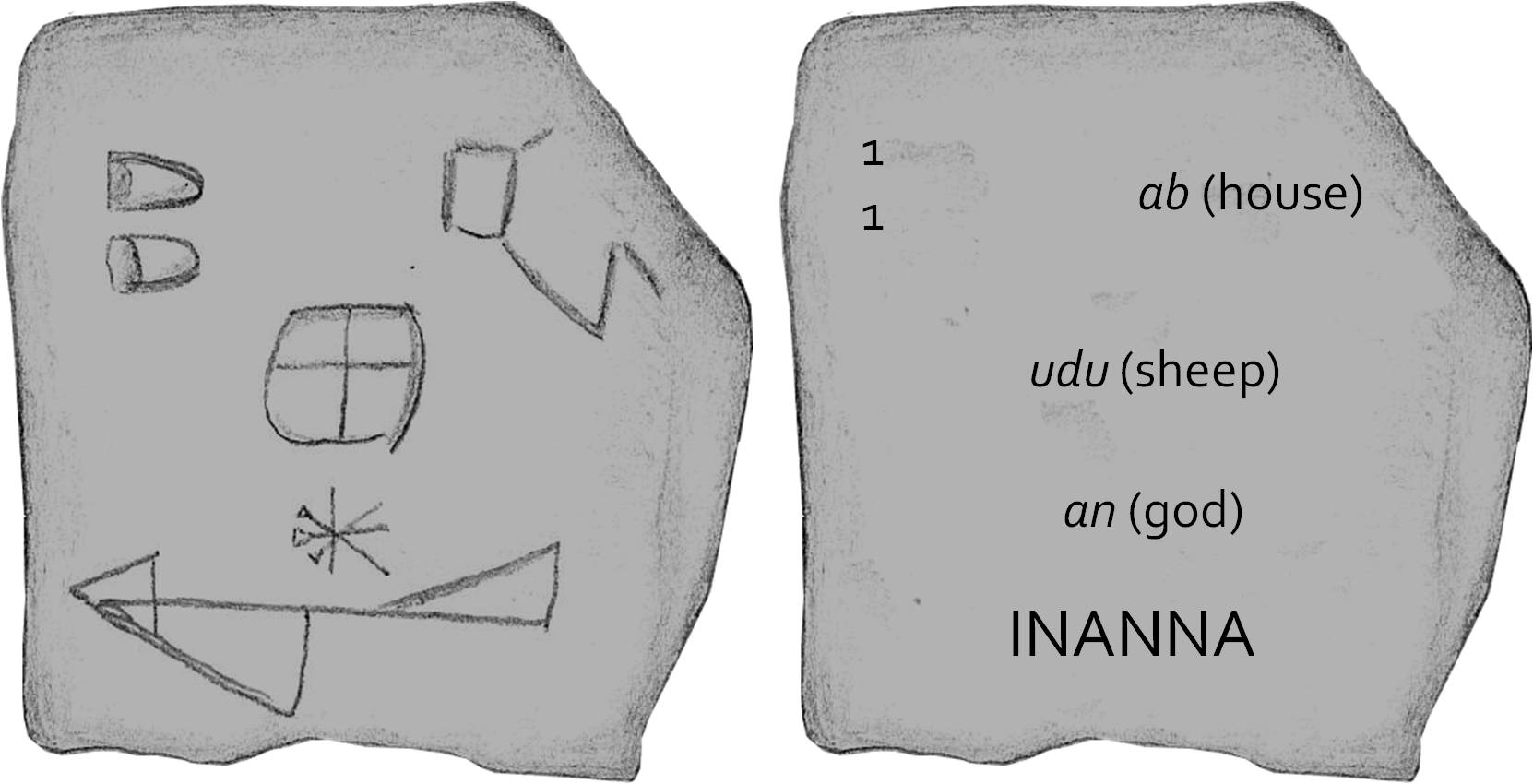
A very early proto-cuneiform tablet. Adapted from Kern, R. “Interactions of the material, the social, and the individual,” in Language, Literacy, and Technology. Cambridge: Cambridge University Press, 2015.
So that’s the story of how writing came to be. The sheer mass of data archaeologists discovered in the dig site of Uruk – receipts, student exercise sets, business agreements, package labeling, contracts, and so on, have offered archaeology and history a deep, compelling portrait of a civilization that predates anything we ever knew about until scarcely a hundred and fifty years ago.
Before we move on, let’s talk just a little bit more about cuneiform tablets as physical objects. First of all, cuneiform was pretty cumbersome to work with and transport. If you’ve seen pieces of it in museums, you know basically what it looks like. Cuneiform tablets vary in size and the state of their preservation – the best of them are neat rows of syllables and logograms on squarish tablets with rounded corners, but many of them look like glops of spilt cement, and it seems miraculous that specialists have been able to piece them back together and read what’s on them. Cuneiform required a lot of knowledge to produce – both knowledge of the writing system’s signs, but also understanding how to mix up clay at just the right composition and sit it out in the sunshine so that you could see it while you worked. It also required a steady hand and excellent eyesight – I’ve stared at cuneiform tablets at the Oriental Institute in Chicago, the Penn Museum, and the British Museum for minutes at a time trying to understand how human beings could even write such tiny, intricate letters on mushy, undulating surfaces. Because it was so difficult to produce and to read, cuneiform was a specialty trade. As scholar Jeremy Black writes, “Knowledge of writing was as restricted in ancient Sumer as the ability to understand the intricacies of the stock market is today. . .There were different degrees of literacy, painstakingly acquired over many years. . .Writing was not therefore something to be scattered around freely but a hard-won professional skill to be dispensed judiciously and sparingly – and usually for a fee.”15 In summation, while writing was always a specialty trade in the ancient world, in Sumer, due to the intrinsic complexities of squishing tiny reeds into perfectly processed clay in a complex and evolving sign system, cuneiform was, again, especially cumbersome to produce, and awkward to lug around.

The banks of the Euphrates. The place where writing began. Note the clay and silt deposits in the foreground.
Because of cuneiform, we know far more about the ancient civilizations of the Fertile Crescent than we do of much more recent ones. Of the Goths and the Gauls of later Roman times, we know almost nothing other than what others wrote about them. But Mesopotamia stamped its autobiography in clay beginning five thousand years ago. We know names of everyday people, their trading records, logs of temple offerings and sacrifices, and we have legal documents, like deeds of sale and rental agreements. Most of it is pretty humdrum stuff. There are a lot of school exercises that survive, too – young cuneiform scribes learned how to write by copying the contents of other tablets. But within Mesopotamian cuneiform, there are also, beginning around about 2500 BCE, some texts that we can start to call literature, and it is to that literature that I want to turn in just a moment.
So, thus far in this program we have learned about when, where, and how writing first came to be. Along the way, we considered some important rules to remember for newcomers to ancient history – that first, generally, things are a lot older and more interconnected than we might expect, and second, that although we humans always like simple origin stories for things, huge human traditions and technologies most often have multiple cultural points of origin, and they emerge slowly, rather than appearing in a flash during a single generation. As a case in point for both, we considered how the Tower of Babel story, which seems very ancient to us, came from a long tradition of telling tales that tried to explain why there are so many languages. We’ll come back to the story of the Tower of Babel a little later on this program. What I want to do now, again, is to move forward in Mesopotamian literary history and to a text that is a pretty good candidate for the oldest surviving piece of literature on earth. [music]
Mesopotamian Literature and the “Hymn to Kesh”
Now, everybody out there listening, I want to ask you a question. How much Mesopotamian literature do you think there is? I’m talking about literature from ancient Iraq, dated from about 2500 BCE to 100 BCE, and in this case, I mean, literature that’s been translated into English that you can read for yourself. If this were one of my classes, I’d call on people in the audience, and say, “How much do you think?” But it’s a podcast, so let’s move forward..jpg)
The alabaster disc of Enheduanna, discovered at Ur in the 1920s. Photo by Mefman00.
There are more, but I’m afraid it’s boring to list all of that and that I’m sounding unintentionally pompous, so I’ll just say that all of these books together, which I love very much, weigh in at precisely 3,285 pages of literature, originally written in cuneiform, that’s been translated into English. That is a lot of stuff that was lost for 3,000 years, and later recovered.
I wanted to describe the physical books that contain all of this literature to give you an idea of just how much writing there is from Mesopotamia that’s been translated today. We’re not talking about the Epic of Gilgamesh and a couple of other scraps here and there. We have numerous other epics, in which heroes and gods go on adventures, along with works of history, love poems, incantations, philosophical dialogues, prayers, letters, proverbs, myths long and short, of all kinds, satire, humor, lamentations, and a lot of erotica – in short, more or less all of the human genres, as we would expect, with a whole galaxy of parallels to later ancient Hebrew, Greek, and Latin writing, again, just as we would expect.
So let’s take a volume from that big stack of books, and open it up to the very earliest literary text that’s made it down to us from antiquity, and read the oldest sucker in the pile and see what we think of it. The text we are setting on our desk for a moment is called the “Hymn to Kesh.” It’s about 131 lines long, or eight pages of poetry with the footnotes included. And it is a praise poem to a temple in a city called Kesh. The “Hymn to Kesh” that we’re going to read was set down around roughly 2500 BCE, although there are fragments of even older copies.16 We don’t know where the city of Kesh was in ancient Iraq, but it was an important cult center, because its name comes up elsewhere in Sumerian literature.
Temple hymns were a thing in Mesopotamia. In fact, they’ve generally been a thing in human societies. When the whole town pools resources to build a nice new temple, or abbey, or church, or baptistry, it’s not uncommon for the local poet to be hired to compose a fitting dedication for the ribbon-cutting ceremony. Mesopotamians weren’t literally cutting ribbons, but, when a Mesopotamian city undertook the complex work of planning, then fundraising, and then actually designing and building a temple for everyone to enjoy, they seem to have often hired bards to perform a dedication, and then a scribe would write down the poem that had been sung or recited, and the cuneiform holding this important composition would be stored and copied and distributed to other towns, because cities were proud of their temples.
The “Hymn to Kesh” begins by referencing a god named Enlil. Enlil was often understood as the loftiest Sumerian deity, associated with wind, and the sky.17 One day, the “Hymn to Kesh” says, Enlil decided it was time to invest a chosen city with sacred insignia. Great Enlil looked all around the lands of Sumer, and out of all the many cities and towns in the Tigris-Euphrates floodplain, Kesh seemed most prominent, as though it were raising its head up proudly from the basin around it. The god Enlil began to sing praises of the city of Kesh, and then, someone came to help him. That someone was the goddess Nisaba, the Sumerian goddess of writing. As Nisaba listened to powerful Enlil’s words, the “Hymn to Kesh” tells us, “she spun, as it were, a web / out of those words, / and writing them down on a tablet / she laid them (ready) to hand.”18
The high god Enlil sang, and the goddess of writing Nisaba wrote. And here is how lofty Enlil described the temple of Kesh as he admired it. Enlil said, in the Yale University Press Thorkild Jacobsen translation:
[Temple] Kesh, doorpost of the country. . .
Grown (to vie) with the hills,
embracing heaven,
house, grown (to vie) with the mountains,
lifting the head above the mountains,
opalescent like the deep,
green like the hills. . .(14-17)
House Kesh, built in a good place,
like a princely barge floating in the sky. . .(21-2)
like the boat of heaven,
the lordy crown of the mountains. . .(24)
House, the lordy crown of which
is worn (up) in heaven’s midst,
the foundation terrace of which
is filled into the deep,
the shadow of which
covers all lands. (35-8)
House, mountain above ground,
Below, the springs of the deep. (52)
The high god Enlil, then, as you just heard, celebrated the Temple of Kesh as majestic and worthy of the loftiest praises. And toward the end of that passage, as you just heard, Enlil said that the temple’s heights touched the heavens, and its roots touched the deep. This is a common thing that Sumerians would say about their temples – Sumerians believed that beneath the earth, there was a massive underground ocean called the Apsu, which makes sense, as they lived in a great big wetland.19 Thus, in Sumerian temple hymns, temples are said to encompass heaven, the earth, and the underworld, being a place where all three meet.
Moving forward in this most ancient of poems, later lines describe the deities that inhabit the Temple of Kesh, one of whom was the very important mother goddess of the mountains, Ninhursaga. While the Temple of Kesh was home to gods and goddesses, in fact, as the poem explains, “inside its gate / a great nation is settled, / inside the door. . .of the house / is a great independent country. . .the corners of heaven / and the corners of earth” (93-6). This imaginative portion of the poem pictures Kesh’s temple as the home of numerous deities and as encompassing the entire cosmos. And a side note, by the way – whoever wrote this hymn was laying it on thick here – we get it – best temple ever. Moving on, though, we get just a bit more of a sense of what the Temple of Kesh was like toward the end of the hymn. The poem describes sacred drums being sounded there, and officials wearing robes and ceremonial headwear, and ritual songs being audible from without the wonderful temple. And, with a few closing lines, the “Hymn to Kesh” celebrates the city of Kesh as a place with something for everyone; a place where visitors could convene with the gods, and a place where the great mother goddess Ninhursaga herself served wine. And that’s the “Hymn to Kesh,” from likely some time in the 2500s BCE. It is, along with another text called the “Instructions of Shuruppak” that we’ll look at in a later episode, widely considered the oldest piece of Sumerian literature, and thus the oldest surviving piece of human literature.

John Martin’s The Fall of Babylon (1831). Ancient Mesopotamia has been imagined in overly moralistic terms, with the fall of Babylon in 539 BCE imagined as something Biblical in its proportions. While it was a major event, a lot of Babylonian life and business continued as usual after the Achaemenid empire conquered Mesopotamia.
But as wacky as some of the “Hymn to Kesh” sounds 4500 years after its composition, a lot of it sounds pretty familiar, too. The people in the long-gone Sumerian city of Kesh, probably through a combination of private donations and taxes levied, raised up a new temple, or maybe rededicated it, or celebrated an addition to it. Whatever the exact circumstances that occasioned the hymn, the citizens of Kesh were proud of their temple. It was a sacred structure, and for the religiously inclined, it held the cult statues and spirits of powerful deities – most importantly the mother goddess of the mountains, Ninhursaga. The temple was also, for everyone in town, a nice civic landmark and a small regional employer. So the hymn that you just heard summarized, when it was first performed, perhaps on some sunny green morning in the 2500s BCE, prior to a day of feasting and drinking, would have been a joyous, civic occasion of a community coming together and listening dedicatory poetry.
Literature, before the invention of writing, was always oral. And even after writing started being used, as we learned earlier, reading and writing were very specialized. As a result, most people who encountered to literature listened to poetry at special occasions like the one we just considered. That was how poets made a living for most of history – performances of covers and originals and medleys – because even though reading and writing existed, they were such esoteric skills that you were not going to pay your bills selling cuneiform tablets in the town square. And because most literature, long after the invention of writing, was still oral, when we look at very old literary texts like the Sumerian “Hymn to Kesh,” in a lot of cases, we’re often looking at something like performance notes, or at best, well-transcribed song lyrics, rather than things that large numbers of people were sitting down and reading for leisure.
Even so, what remains of the earliest surviving human literature is absolutely spellbinding to read. The extant Sumerian epics, together with later, longer poems than the one we just read are frankly unique. There is often a surprising insouciance and cheeriness in even the loftiest Sumerian stories, and I wanted to tell you that just to prove a point. Sumer was no picnic. No ancient society was. But civilization took a huge leap forward there because agriculture was unusually easy. You don’t need crop rotation when seasonal floods are slopping fresh, nutrient rich soil up and down rivers, canals, and irrigation channels at regular intervals. With food production being turbocharged by geography, and the presence of potable water a given; with clay being a miraculous, ubiquitous building material that was also used for writing itself, Sumer had a lot going for it. Thus, as short and cryptic as the “Hymn to Kesh” is, it’s not a bad text to read to start learning about Sumer. I think that because ancient history was so consequential, and it happened so long ago, we tend to think of ancient people as solemn and grave – as stoic as the worn statues that some of them left behind. The “Hymn to Kesh” is a nice reminder that Mesopotamians, 4,500 years ago, were celebrating, drinking, having fun, and overall, making it up as they went along.
One of the most important early translators of Sumerian poetry wrote that “The strictly literary Sumerian works can be defined generally as works of praise.”20 This is a funny generalization to aim at an entire civilization’s extant literary output – that Sumerian literature praises things. But it’s also a pretty good generalization about what Sumer passed down to us. There are sad works of Sumerian literature – lamentations, for instance, and a lot of Sumerian literature is just really dense and hard for even the best specialists on earth to understand. But on the whole, the first major literate civilization on earth often comes across as surprisingly upbeat. There are oodles of jubilant praise poems that survive to temples, gods, and towns. And there are narrative poems that are just as celebratory. In one story that’s 4,000 years old, the Sumerian goddess Inanna is given divine power when she and another god get so drunk that the other god just gives her the power on a whim while inebriated.21 In one of the major Sumerian sagas, also involving Inanna, that goddess of Uruk who had two sheep donated to her at the temple, there is an absolutely epic sex scene between the two protagonists that is simultaneously strange, graphic, and endearing all at once.22 Gilgamesh’s father, Lugalbanda, in the most famous cuneiform cycle about him, is able to gain superhuman powers by befriending a baby bird.23 The full story of King Enmerkar, which I’ve quoted a couple of times, concludes with a bizarre wizard battle, in which two sorcerers spawn creatures out of a river to attack one another, but one wizard doesn’t seem to understand the premise, and keeps creating completely harmless, cuddly animals to assail his adversary.24 There is really nothing else like Sumerian literature out there. The great scholar of ancient near eastern writing Benjamin Foster wrote that some Mesopotamian literature “has no connection with any living cultural tradition.”25 And that, really, is the magic of reading stories that are 4,000 and 3,000 years old. We can draw some connections. There was something like a Tower of Babel story written way back in 2100 BCE. But at the same time, the poems and stories written in earth’s most ancient texts were the work of fascinating strangers, and the way that they looked at the world is a reminder that human culture might have gone in quite a different direction if the events of the Bronze Age had played out differently. [music]
The High Noon and Decline of Sumer
Speaking of the events of the Bronze Age, let’s now turn our attention to the subject of history for a while, with the aim of getting back to the story of the Tower of Babel before too long. In this program so far, we have learned about how the earliest cuneiform developed, and then read the Sumerian “Hymn to Kesh,” generally dated to the 2500s BCE. Between the “Hymn to Kesh” and the story of the Tower of Babel in the Bible, about 2000 years of history went by in the ancient near east. Let’s zoom out, and get a high-level view of those two millennia in the ancient near east.When we ascend to cruising altitude like we’re about to, like we’re about to, it’s important to remember that labels like “Sumerian” or “Babylonian” or “Assyrian,” and later on, “Greek” or “Roman” are very general terms for large, diverse, evolving populations of people. As an example, the Romans of 200 BCE would not have had very much in common with Romans of 400 CE. Different provinces of the Roman empire, during any specific century, decade, or year, had different gradients of culture and language groups and religion. In just the same fashion, although you’re about to learn about the three main phases of Mesopotamian civilization, keep in mind that these phases had interruptions, and that Mesopotamian civilization never stood still. Any given ancient Sumerian city, even back in 2500 BCE, would have been home to Dilmunians from modern-day Bahrain, Elamites from present-day Iran, Hurrians from up north, Bedouins from the south, immigrants from Canaan over to the west, and Egyptians from further west, still, and in all likelihood, a smattering of foreigners from Anatolia, the Mediterranean, Central Asia and the Indus Valley. Again, the first rule of understanding the ancient world is that everything is always older and more interconnected than we expect, and this interconnectedness means that even though Sumer, Babylon, and Assyria are handy-dandy proper noun to describe giant globs of the human population over time, ancient people were restless, mobile, opportunistic, and smart, and as a result, the civilizations in which they lived were always changing.
So let’s start with Sumer, and move forward from there. Sumerian civilization was the most important and impactful civilization in Mesopotamia during the 2000s BCE. It wasn’t the only one, though. For two centuries, between about 2300 and 2100 BCE, two other imperial powers interrupted the Sumerian rule of Mesopotamia. The first of them is the most famous. The Akkadian empire, first led by the conqueror Sargon of Akkad, came to rule over much of Sumer around 2300. Sargon of Akkad was the father of history’s first named author. His daughter, Enheduanna of Ur, wrote Sumerian poetry, being the first named author in history, as I mentioned earlier. The poetry that Enheduanna of Ur wrote was in a genre that we’ve already learned about – temple hymns, and an astounding 42 poems of Enheduanna still survive today that celebrate the great houses of worship in the lands that her father Sargon had conquered.26 While Enheduanna wrote in Sumerian, she also spoke Akkadian, the language of the new empire.
The 2300s gave way to the 2200s, and a people from present-day Iran came west and established a brief dynasty in Mesopotamia. They were called the Gutians, and they held sway over Mesopotamia for the century between about 2200 and 2100. The Gutians from the eastern highlands, in 2100 BCE, relinquished control over Mesopotamia to a new dynasty of Sumerian kings. This new dynasty of Sumerian kings is generally called the Third Dynasty of Ur, and it ruled over the land between the rivers from about 2100 to 2000 BCE, ushering in what’s often called the Sumerian Renaissance.
Most of the long Sumerian literature that we have today is a product of the century between 2100 and 2000 BCE. During this century, a pair of talented kings, Ur-Namma, and his son Shulgi, first solidified control over lands that had been seized by the eastern Gutians. These kings moved the epicenter of Sumerian political power from Uruk about 50 miles to the southeast, to the city of Ur, and through sponsorship of major building projects, public works, and the arts, they helped bring Sumerian civilization to its apex.

The reconstructed ziggurat of Ur, the most famous monumental construction of the Third Dynasty of Ur. The original would have towered over irrigation canals, sheepfolds, crop fields, and thousands upon thousands of cuneiform tablets. Photo by Kaufingdude.
The city of Ur, during the last century of Sumerian power in Mesopotamia, was a remarkable pinnacle of progress and refinement during the Bronze Age. Its robust bureaucracy and economic organization have encouraged comparisons to the Soviet Union in scholarship, and the features of advanced civilization archaeologists have discovered in Ur are stunning – consistent tax regulations and collection processes, boardinghouses that cared for women and children, state sponsored academies, weights and measures, an umbrella system for state employees that tracked, paid, and provided food for something like a million workers, and of course, a gargantuan ziggurat emblematizing the extraordinary achievements of the Sumerian people and their kings.27 If Ur hadn’t fallen due to internal dissention and an ill-timed invasion from the east, it would be much more famous than Greece or Rome as a wellspring of human civilization and technology.
But at the end of the 2000s BCE, Sumerian rule of Mesopotamia ended forever. A population of nomadic westerners from Syria and Canaan called the Amorites, from about 2000 BCE onward, would be a continuous presence in the land between the rivers. One of the most famous pieces of Sumerian literature, the “Lament for Ur,” captures the feeling on the ground when the epicenter of Sumerian rule fell to western conquerors. The Lament for Ur, at its crescendo, concludes that:
the storm that annihilates countries
stunned the city [of Ur],
the storm that will make anything vanish
wickedly stomped it,
the storm burning like fire
cracked the skin of the people. . .
covered Ur like a cloth,
veiled it like a linen sheet.28
These tragic lines seem to tell of the decisive fall of a people and civilization. And yet although the rulership of Mesopotamia would change, Sumerian culture would seep everywhere into the literature and folkways of later civilizations. [music]
From Sumer to Babylon: 2000-1500 BCE
Sumerian civilization relinquished control of Mesopotamia around 2000 BCE. What came next was a period of more pluralistic control of the land between the rivers, when major urban centers were divided between Amorite rulers, with many vestiges of Sumerian civilization surviving unchanged in spite of the leadership changes. Eventually, one Amorite ruler, a king named Hammurabi, brought his city-state to a position of sovereignty over nearly all of Mesopotamia. This city-state was called Babylon, or more properly, Old Babylon, and Hammurabi ruled there from about 1790-1750 BCE. Babylon would thereafter, notwithstanding some lumps and bumps, be the most important and influential Mesopotamian city for more than a thousand years. Different dynasties would rule there, and the city endured various sacks by foreigners. But for a good thousand years after 1700 BCE, Babylon was the flower of Mesopotamian civilization, and the most sophisticated and developed west Eurasian city, producing advances in technology, philosophy, mathematics, literature, and more.Babylonians spoke a different language than Sumerians did. The parent language of Mesopotamia after 2000 BCE is called Akkadian. Old Akkadian dates back to Sargon of Akkad around 2300 BCE. But by the time of Hammurabi in 1800 BCE, Akkadian had sopped up a lot of other linguistic influences, and it had become, in two different dialect groups, the main language of Mesopotamia. Most extant cuneiform is Akkadian cuneiform, rather than the older Sumerian cuneiform. Akkadian was a semitic language, like Hebrew and Arabic, and it was spoken over a wider geographical area and during a much longer time period than Sumerian was.
When Hammurabi took the throne in Old Babylon around 1800 BCE, the Sumerian language, and Sumerian writing didn’t just go away. In fact, much as Latin remained the language of learning in medieval Europe, Sumerian became the language of the exalted past, and wealthy Babylonians hired tutors so that their kids could be operational in the more ancient tongue. Sumerian and Akkadian, then, had a multi-century overlap before the Sumerian language finally fell into disuse over the 1600s BCE and afterward. An interesting consequence of this overlap is that some Sumerian literature was actually written after Sumer fell from power.
Mesopotamia During the Later Bronze Age

A letter from King Tushratta of the Mitanni (nothern Iraq) to the Egyptian Pharaoh Amenhotep III negotiating a marriage.
During a few decades around 1340s BCE, the power of Ancient Egypt was concentrated in a city called Amarna – about a hundred miles south of present-day Cairo. Now, most people know that the written language of Ancient Egypt, during most of its existence, was hieroglyphics. And so in the 1890s CE, modern archaeologists were surprised at the discovery of almost 400 tablets, written in Akkadian cuneiform, stored in a palace chamber in the ruins of Amarna, in Egypt. What was this mass of Mesopotamian writing doing so far from Mesopotamia? Why was it so far southwest of Iraq, all the way over present day Jordan, over the Sinai Peninsula, hundreds of miles down the Egyptian Nile? The cuneiform tablets discovered in Egypt in the 1890s were letters. They were a correspondence between the scribes of the Egyptian Pharaoh, and the scribes of the kings and diplomats of faraway lands to the east and north – kingdoms in present day Turkey, Syria, and Iraq. The language of their composition was graceful and courteous, and what historians call the Amarna Letters provide modern scholars with a window into the international relations of the Late Bronze Age.
Cuneiform was so popular and widespread that as the 1000s BCE drew to a close, civilizations outside of Mesopotamia were using it to communicate with each other. There’s a treaty that hangs in the UN in New York today that was originally written in the 1250s BCE to secure peace between ancient Egypt, and the Hittite kingdom in Anatolia. In this 3,000-year-old treaty, each king proclaims, “He is my brother, and I am his brother. He is at peace with me, and I am at peace with him forever. And we will create our brotherhood and our peace, and they will be better than the former brotherhood and peace of Egypt and [the Hittites].”30 Cuneiform, then, even outside of its birthplace of Mesopotamia, had become a tool for Bronze Age bromances between heads of state just like these, and ultimately, it helped entire civilizations secure and maintain peace with one another. By the end of the Bronze Age in about 1200 BCE, cuneiform had come a long way since that 5-word Uruk tablet that said, “2. Temple. Sheep. God. Inanna.”
The Rise of Assyria
By the Late Bronze Age, two out of three of Mesopotamia’s civilizations had seen the light of history. So far, you’ve met two of the main characters in ancient Mesopotamian history. And if the story of the land between the rivers were a play, Sumer would be the dignified old matriarch. Babylon, the heir of Sumer’s intellectual and literary culture, would be the older son. But then, there was also a younger son, a volatile, brilliant, violent son. This son was called Assyria.Assyrian civilization, based in the northern cities of Ashur and Nineveh, learned from its neighbors how to smelt iron, ride horses, and employ wheeled chariots in battle. First in the 1120s, and then resurging again around 900 BCE, the Assyrians dominated the civilized world for hundreds of years. Assyria was the youngest son of old, once-forgotten Sumer. Peoples of the ancient world knew them to be commercially inventive, militarily dominant, and exceptionally brutal with kingdoms that rebelled against them. At the height of its power in the mid-600s, Assyria had conquered a territory that included even Egypt.
These two sons of Sumer, Babylon and then Assyria, rose and fell during different periods of later Mesopotamian civilization. There were many other characters on the stage of ancient Mesopotamian history – Hittites, Hurrians, Kassites, Mittanites, Syrians, and, eventually, Israelites. But the leading roles went to Babylon, and Assyria. Scholarship sometimes compares Babylon and Assyria to Greece and Rome, respectively – Babylon being the cultural wellspring, and then Assyria being the military and imperial superpower.
But stereotypes only take us so far. The largest library ever unearthed from antiquity, after all, did not come from the splendorous southern realm of Babylon, but instead, from up north – from what is today Mosul, Iraq, and what used to be the major Assyrian metropolis of Nineveh. This library is one archaeologists call the library of Ashurbanipal.
Ashurbanipal was one of the last rulers of Assyria. Ashurbanipal knew that cuneiform was important. Ruling from 668 to 627 BCE, he was one of the most infamous strongmen of ancient history. He sacked an upstart king in the southern realm of Babylon. He demolished enemies in the east. On one of Ashurbanipal’s palace walls is a famous relief of him having dinner with his wife, sipping some wine. Birds are singing. A musician is playing the lyre. And nearby, the mutilated severed head of one of his enemies hangs from a tree. You know, a dinner scene just like we would have today. Wine. Music. Corpses.
_(14779048991).jpg)
Copy of the palace relief of Ashurbanipal. Note the head on the upper left.
Anyway, in addition to being a feared conqueror, Ashurbanipal was also a collector. He took pride in his ability to read and write. And he had collectors scouring Mesopotamia for cuneiform tablets, and also, creating fresh copies of old stories to preserve them for posterity. The library that the Assyrian king Ashurbanipal built in 650s, 640s, and 630s BCE contained at least 30,000 clay tablets – at least, that was how many were there when the library was discovered in 1853. Among these texts were the Babylonian Enuma Elish, the Mesopotamian creation epic, along with the longest and best-preserved copy of the Epic of Gilgamesh. The late Assyrian king Ashurbanipal also left behind letters, and his correspondence reveals a dogged, meticulous effort to acquire, index, and store every single significant piece of Mesopotamian writing he could get his hands on. And frequently, in the tablets Ashurbanipal collected, copied, and safeguarded up at Nineveh is the haunting phrase, “For the sake of distant days.”
You don’t expect a warrior emperor to double as a scholar and curator of antique objects. But Ashurbanipal knew that knowledge was precious, and took steps to ensure that his kingdom preserved and cherished its wealth of written records. Ashurbanipal could not have known that Assyria would fall fifteen years after his death, never to recover. And yet Ashurbanipal’s desire to preserve cuneiform in the 640s and 630s BCE was likely due to what he saw happening around him. Because the world, in the 600s and 500s BCE, was changing very quickly. [music]
Assyrian and Babylonian Attacks in Canaan, 800-580 BCE
The Bible was written during the vortex of the 600s and 500s BCE. Its earliest authors were educated citizens of the tiny western kingdom of Judah, with its center in Jerusalem. They wrote about the history around them, sometimes embellishing events, and at other times, with what seems to be a fair degree of accuracy. The great ancient near eastern empires of Babylon and Assyria show up a lot in the Old Testament, especially in the books of Kings and Chronicles. And archaeology and the Bible alike agree that waves and waves of Assyrians moved into the northern kingdom of Israel. Attempts at diplomatic relations were made, with Israel always being the disadvantaged underling, but when these relations repeatedly broke down, the northern kingdom Israel was destroyed, and various Canaanites fled southward toward the drier towns and outposts of Judah.
John Martin’s Fall of Nineveh (c. 1829). The painting chronicles the fall of the Assyrian capital in 612 BCE.
In its decisive conquest of Assyria, Babylon had help. A whole coalition of Babylonian allies was needed to besiege and sack the later Assyrian capital of Nineveh. When it was over, with Nineveh destroyed and Assyria defeated, the city of Babylon, a hundred miles south of present-day Baghdad, became the dominant civilization of west Eurasia. Its only rival after the conquest of Assyria was Egypt, which it destroyed just seven years later. Thus, in 605, Babylon, oldest son of the Mesopotamian matriarch Sumer, was once again at the helm of civilization. To most of its neighbors, large and small, there was no reason to suspect that things would change any time soon.
Just as the southern Canaanite kingdom of Judah had been attacked by the Assyrians in the 600s BCE, as the 600s passed into the early 500s, Judah was beleaguered by the Babylonians. To the inhabitants of the tiny city-state of Judah who contributed to the Bible, in the 610s BCE, and 600s, and 590s and 580s, Babylon was a terrifying superpower, blasphemous and doomed to divine damnation. And from the Babylonian perspective during those same decades, Judah was an odd little kingdom in the boondocks that knew nothing about the main line of civilization’s evolution. When this odd little kingdom bucked the yoke of Babylonian power one time too many, the Neo-Babylonian empire followed standard operating procedure, sacked the small capital of Jerusalem, and redistributed its population to the east, in Mesopotamia.
The Babylonian Captivity

A map onsite at Babylon today in Iraq showing the scope and outlying areas of the city under Nebuchadnezzar II, when the Judahites lived there.
It’s hard to imagine what it would have been like for those Hebrew-speaking citizens of Judah who were exiled from their little city-state in the west to the metropolis of Babylon, where a ziggurat towered over the urban center and suburbs. Certainly, as the Judahites lived within sight of the actual tower of Babylon, surrounded by the venerable eastern culture that had produced it, they must have felt resentment and enmity. But they also, as time passed and new friendships formed, perhaps came to appreciate the splendor and deep history of the land between the rivers. Judah was on the fringes of the Negev desert. Babylon, seated in a lush green floodplain, was the heart of Ancient Near Eastern civilization – a place that glittered with the direct cultural lineage of 2,500 years of recorded history. No wonder those verses of the Book of Genesis show God saying, incredulously, “Look, they are one people, and they have all one language, and this is only the beginning of what they will do; nothing that they propose to do will now be impossible for them” (Gen 11:6). If you had seen Babylon in the mid-500s, with its ancient ocean of Akkadian cuneiform, maybe you would have said the same thing.
We’re getting closer to finally making sense of the Tower of Babel story. It was likely written around the time that Hebrew-speaking scribes found themselves an ethnic and linguistic minority in the land of their exile. They would have had little love for the older culture of Babylon, as they lived within sight of Babylon’s giant tower to the god Marduk. They likely had to learn some of its language – the late Babylonian dialect of Akkadian, and some of them might have even been trained in the composition of cuneiform on clay tablets. Immigrants of any generation, after all, have to learn new trades to get along.
But we still haven’t unraveled the mystery of why some Biblical author wrote a story about Babylon’s language being confused. Wasn’t Akkadian cuneiform, in the 500s BCE, actually the way that a lot of the earth communicated? The Babel story ends with the words, “So the LORD scattered them abroad from there over the face of all the earth, and they left off building the city” (Gen 11:8). Why does the story of the Tower of Babel have this bizarre ending? Was there some real history behind it?
Population Migrations and Changes in the Demographics of Mesopotamia
Indeed, there was. When exiled Judahite writers set down set down the tale of the Tower of Babel, or when their children or grandchildren did, these westerners from Canaan were recording a real, and enormously consequential historical event that was unfolding in the eastern metropolises of the land between the rivers. We can call this event the end of Mesopotamia. This event was a long one. By the time the Judahites arrived in Babylon in the 580s, the millennia-long hegemony of Mesopotamia had been declining for a long time. The decline had started back around 1200 BCE, when climatological shifts caused widespread droughts, population migrations, warfare, and a general tumult in the ancient Mediterranean and near east called the Bronze Age Collapse. The Bronze Age Collapse leveled the dominant civilizations seated in what’s today Greece, and Crete, and Cyprus. It ravaged the New Kingdom of Ancient Egypt – this was Egypt at the summit of its power. The Bronze Age Collapse mostly destroyed the dominant monarchies of present-day Turkey, Syria, Lebanon, Israel, and most of all, Iraq. This collapse caused a dark age to fall over the entire region. Trade and transportation networks collapsed. Economies ceased to function. Enclaves of developing civilization were snuffed out by marauders and opportunistic warlords.
Edwin Long’s The Babylonian Marriage Market (1875). The Bible irreversibly colored Babylon in the European imagination as a place of turpitude and eroticism.
The immigrants coming into Mesopotamia from the west, from the Bronze Age Collapse of 1200 BCE onward, brought with them new languages, as immigrants so often do. Mesopotamia had, for generations, absorbed new peoples, with new languages. Because whoever you were, and wherever you were from, when you moved to Babylon, or Nineveh, if you wanted to do business, you used cuneiform. The main character of our story for today – that dauntless clay tablet – had an extraordinary run of it. Cuneiform was one of the main connective tissues of the civilizations in western Eurasia and some of Northeastern Africa for around two thousand years. But then something came along that outmoded cuneiform, and, in the process, commenced the burying of Mesopotamian culture for the next 2500 years. This new technology was the phonetic alphabet.
Cuneiform on clay tablets is a great choice if you want to bury something in a hot climate for four thousand years, and hopefully, have it understood by future generations. But, as we discussed earlier, cuneiform is also difficult to learn. You have to memorize a huge number of signs, learn the use of the styluses, and master the art of finding appropriate clay, storing it, getting the moisture content correct, finding light bright enough by which to read those little monochromatic impressions, and then baking cuneiform tablets afterwards. A phonetic alphabet on cloth or leather, however, is easier to learn and quicker to produce. If you don’t know correct spelling for a word, you can still approximate it, whereas with cuneiform, if you don’t know the symbol, you’re out of luck. Phonetic writing on wood, and potsherds, and leather, on the other hand, required no scribal schools, nor years of specialized training, and no cumbersome implements for its construction. Phonetic writing spread like wildfire. By the 600s, and 500s, as latter-day Assyrian and Babylonian civilization flared up for the very last time, even the rulers Mesopotamia’s kingdoms began to understand that their culture’s ancient literary and theological history was living on borrowed time. Ashurbanipal, one of the last kings of Assyria, almost certainly sensed civilizational change in the air, as he warehoused cuneiform in the 640s and 630s. So too, did the very last king of Babylon. [music]
The Twilight of Babylon
The very last king of Babylon was named Nabonidus, and he reigned from 556-539 BCE, during the last years of the Babylonian captivity of the Israelites. King Nabonidus of Babylon was not liked by his own people.The final Babylonian king’s interests were scholarly and archaeological. He left Babylon altogether for much of his reign, spending time in the desert oasis of Tayma, in present-day Saudi Arabia. He had little interest in dominant Babylonian religion, or the Babylonian god Marduk. Instead, Nabonidus excavated buildings, sought out ancient artifacts, and tried to build a chronology of Mesopotamia’s history. In the midst of Babylon’s ascent to the summit of world power, as it absorbed new linguistic groups, coped with new technologies, and faced dynamic new challenges, its last king looked backward, far into the past. He worshipped an old Sumerian moon god – the same one Sargon’s daughter Enheduanna had written hymns to 1,700 years earlier, and he built a museum full of antiquities. Nabonidus’ reflective, scholarly disposition could have been that of a professor, or a museum director. But as a king, he shirked his responsibilities and instead ruminated on former times.
The late kings of Assyria and Babylon, Ashurbanipal and Nabonidus, understood that the era of the clay tablet was coming to an end. The future was phonetic writing on organic materials; the past was cuneiform – and it was being buried beneath new construction projects built by foreign laborers who knew nothing about Akkadian, could not read Mesopotamia’s ancient writing, and didn’t care about it. These foreigners brought with them new languages, and new gods. One of these gods, depending on the Judahite who wrote his name, was called El, El-Shadday, Elohim, or Yahweh.
According to the Bible, the God of the Old Testament, right in the middle of the 500s BCE, elevated an anointed one. This anointed one, as the Book of Isaiah puts it, had been empowered “to subdue nations before him / and strip kings of their robes, / to open doors before him – and the gates shall not be closed” (Is 45:1).31 This anointed one, God himself says in the Bible, “is my shepherd, / and he shall carry out all my purpose” (Is 44:28).32 Some of the exiled Judahites would have been there, in the city of Babylon, to see the arrival of this anointed one at the end of the Babylonian captivity in 539. The anointed one who arrived at Babylon and ended the Babylonian captivity was not Jesus, nor an angel, nor, even, a priest of monarch of Jerusalem. He was a king from Persia – the first king of a new global superpower that would rule Iran, and much of Iraq and beyond for the next thousand years.
When King Cyrus of Persia and his forces arrived at the gates of Babylon on October 12th, 539 BCE, the city of Babylon underwent a peaceful power transition. Its nominal monarch, the poor, bookish Babylonian Nabonidus, was captured. And soon thereafter, some of the descendants of those who’d been exiled from the bygone kingdom of Judah a generation before turned west, and headed back home city of Jerusalem to rebuild their temple. The anointed one had freed them. King Cyrus of Persia may not have been Jewish, but like the overlords of other ancient empires, Cyrus didn’t particularly care which religions were being practiced in his conquered territories, provided that the citizenry paid taxes and remained peaceful, and so Old Testament books like Isaiah and Ezra memorialized Cyrus very fondly.

Gustave Doré’s illustration of the Tower of Babel story. I suspect the depictions of the Tower of Babel with its winding outer staircase were inspired by the Great Mosque of Samarra near Baghdad, although the latter was built around 850 during the Abbasid period.
The Tower of Babel tale wasn’t even an original story. It was a recycled tale, as we learned earlier in this program. Sumerians, ages before, had told a tale that explained why we speak so many languages, and so the eleventh chapter of Genesis was likely inspired by older near eastern folklore and theology. Derivative though it might have been, sometimes we adapt and retell old stories because they resonate with our contemporary experiences. And I think that the Biblical Tower of Babel tale had a very specific resonance in the late 500s, as the first Persian empire seized control of Mesopotamia. In addition to being a boilerplate yarn that explained why there are so many languages, I think the Tower of Babel story is also about the end of cuneiform.
Babylon, to us today, is almost a bad word. Due to various accounts of the Neo-Babylonian empire’s military aggressions in the Old Testament, together with the New Testament book of Revelation, with its nasty metaphor for the city of Rome as the Whore of Babylon, we tend to imagine Babylon as some cruel and decadent civilization that collapsed under the weight of its own debauchery. The real Babylon, at least in terms of its humanitarian and ethical record, was an ordinary ancient civilization like any other. What made it unique, when some of the early authors of the Bible were there in the 500s BCE, was not that it was depraved or full of bad people, but instead that it was the epicenter of a civilization that had a continuously-recorded 2500-year history. But when Babylon was conquered in 539 BCE by King Cyrus and the Persians from the east, that history came to its dusk. Akkadian cuneiform would sputter along for a few more centuries. But by 539 BCE, the flood tides of phonetic alphabets had washed ashore from the eastern Mediterranean, and the future didn’t like look wedges in clay anymore. And so maybe the tale of the Tower of Babel was also about the tablet of Babel. Because when the sun finally set on Akkadian cuneiform, across the 400s, 300s, and 200s BCE, the medium of communication that had knit the ancient near east together for 1500 years cracked. And afterward, Jews, Greeks, Romans, and others had to make do with the more slippery and evolving technology of phonetic alphabets. [music]
Moving on to the Enuma Elish and Atrahasis
Well, everybody, in this first program, we’ve learned how writing came to be, read the oldest piece of literature on earth, and had a high-level overview of Mesopotamian history from about 3000-500 BCE, and I think that’s about enough for one podcast episode. If I’ve done a decent job in this show, I’ve made you at least marginally interested in earth’s oldest surviving literature. And in the next two programs, we’re going to read the longest and most famous Mesopotamian epics – the Enuma Elish and Atrahasis in Episode 2, and then the Epic of Gilgamesh in Episode 3.The Tower of Babel in Babylon had just to its south a temple complex called Esagila. This temple complex was dedicated to the most important god that you have likely never heard of. His name was Marduk. For more than a thousand years, Marduk was the highest Babylonian deity, and the first story we’ll read next time, the Enuma Elish, is about how Marduk came to rule the cosmos. The second story we’ll take a look at in Episode 2 is the longest Mesopotamian flood story, and it’s called the Atrahasis. There are a number of flood stories from Mesopotamia, and at least one of them very likely influenced the tale of Noah and the Ark that stretches from Chapters 6-9 of the Book of Genesis. But in addition to their educational value and their possible impact on the Bible, the Enuma Elish and the Atrahasis are examples of Bronze Age poetry at its absolute best, and I can’t wait to take you through both of these very old stories in detail, using lots of quotes from good modern translations.
About Literature and History
Before we go, though, let me tell you a little bit about this podcast, and how it works, since this is the inaugural episode. First of all, as you’ve likely gathered by now, this is a long-form, single-narrator podcast about literary history. There are no ads, and there never will be, and there’s no fluff about what I had for breakfast, and no contemporary politics. This is neither a faith-based nor a secularist podcast – my approach to sacred works like the Tanakh, New Testament, Talmud, Qur’an, and Hadiths is that these texts are so mountainous in importance that you have to be a idiot not to respect them, and just as much, not to respect those who believe in them.Generally, each program in this podcast will be an introduction to a literary work, then a summary of that work that expects no prior knowledge, and then an exploration of the history behind that work of literature. As an example, in a couple of episodes from now, when we cover the Epic of Gilgamesh, I’ll first introduce you to the basics you need to know to understand the epic, and then summarize the book in a lot of detail with plenty of quotes from scholarly translations, and then explore what the Epic of Gilgamesh can tell us about ancient Babylonian society. Teaching literary history, which I’ve done for a lot my career, means teaching the history behind literature, and trying, within reason, to use literature to understand history.
People forget, too often, that literature is raw history, straight, no chaser. It is the actual voice of the past, and it turns on the sound to what is otherwise a silent movie. Within the pastoral poetry of Virgil there is a looming dread and incredulity at one of the all-time bloodiest periods of Roman history in the 30s BCE. Within the most famous plays of Aeschylus, there is a contagious joy and optimism at the pinnacle of ancient Athenian civilization in the 450s BCE. You can, and should, read about bygone civilizations in history books. But in reading their actual writings – the poetry and books that the Classical, and Late Antique, and Medieval, and later periods left behind – you can listen to the voice of the past in the present, and step slightly out of time, as we did when we read the “Temple Hymn of Kesh” a little while ago, and listened to the earnest hopes of a group of long gone Mesopotamians dedicating a 4,500-year-old temple in a bygone Sumerian city.
My name is Doug Metzger. Through a lifetime of studying literature, a Ph.D. in it, teaching it, and researching it, novels, plays, and poems are still magic to me. Literature has been my passion and much of my career for 25 years, and even though I’ve earned some academic certificates, published some stuff, and developed some more sophisticated approaches to reading over the years, every time I open up a story, or start reading a new poem or reading or attending play, I feel like a little kid again, and I still laugh, cry, grin ear-to-ear, and swear under my breath at books, just like I always have. I started this podcast because although there are a fair number of literature podcasts out there, most of them as I record this seem to be either interviews with authors or round table discussions of books that seem to assume that you, too, have read the book. Both of these approaches are great – there’s no right way to teach or read literature – I just thought that a chronological narrative history about literature would also be useful, a history that does not assume that you’ve read the books which are discussed in the episodes.
Literature and books have been at the center of my life for a long time. And although there are thousands of reasons to read literature, I think that all of these reasons can be broken down into two big ones.
First, I think literature is an adventure. It’s a voyage into the vast diversity of the lives that have come before us. If you read a Homeric hymn, or a tragedy of Seneca, or a dream vision of Chaucer, or an ancient Egyptian instructional narrative, or a love poem by the Latin writer Catullus, you will discover ways of looking at the world that are often quite unlike your own. Seeing the world through the perspectives of past cultures and nations makes us realize that our own outlook is neither neutral, nor the product of some inevitable forward evolution, but instead, just a small, momentary node in an unfolding story.
While literature can lift us out of our own time, and invite us to question even our most basic cultural assumptions, literature also teaches us that much of the core stuff of human experience is pretty similar over the churn of generations. Parents and children, rain and sun, hope and loss, blood and water, love and laughter, ambition and failure and unrequitedness – these central parts of the human condition are subjects of the literature of the Middle Bronze Age as much as they are the books that we’re still writing today. Read the Odyssey, the poems of Sappho, the Book of Ecclesiastes, the letters of Cicero, or the saga of Beowulf, and somewhere in these very old texts you’ll find echoes of thoughts and experiences that you’ve come to independently – even idiosyncratic, everyday ones. In this sense, I think literature makes us feel less alone in the cosmos, and more a part of a synchronous family of sisters and brothers, all in it together, thick and thin.
Ultimately, then, reading literature can be a search for difference, and a search for familiarity – a reminder that we should never take our cultural perspective for granted, and at the same time a reminder that we have all breathed the same air, drank the same water, and done variations of the same things, over the course of five thousand years of recorded history, and hundreds of thousands of years of prehistory prior to that.
One of the main things that I think we’ll find, especially during these early episodes on the ancient world, is that people are very similar across the long flow of the generations. We tend to look back and say that the ancient Greeks were this kind of people, and then the ancient Romans were this other kind of people, and so on. And of course, there are always some differences between civilizations. But there are also gradients of civilizations, and extents of participation within civilizations, and people in the ancient world moved around all the time, just like we do, today, as we’ve learned in this first show. So as we progress together through these early programs on writings from the remotest periods of antiquity, I hope to show you some of the ways in which we are just as ancient as the ancients, and they are just as modern as us. [music]
[music] This podcast has some built-in bonus features, if you ever happen to need them. One of these is that every episode is fully transcribed on the podcast website – that’s literatureandhistory.com – no dots, dashes or underscores. Each episode transcription is complete with footnotes, maps, and illustrations. Most of us listen to podcasts while we’re doing other things like driving or exercising, and so it’s not practical for me to tell you to look at a map or a painting while you’re listening. But if you happen to hear something that interests you, that you want to look up, or read for yourself, every episode is, again, fully transcribed, and there’s a search box on the website if you want to look through the text of the entire podcast, and see maps, artifacts, sources consulted, and that kind of thing.
Additionally, each episode has a free quiz. These quizzes, like the whole website, will work great on a phone or computer or whatever, and I hope they help you retain the material you learn in each episode. Some of these ancient names I mentioned in this program – Nabonidus, Ashurbanipal, Sargon, and all that – it’s good to see these names in print, and test your retention of what you’ve heard. Those quizzes are easy to find on the podcast website and the notes to each show in your podcasting app. There’s also an anonymous survey on the website – I’ll take any feedback you have there, and input from that survey will help me make this project as useful as it can be for as many people as possible.
And finally, I am a musician in addition to a humanities department academic, and all of the background tunes and interstitial pieces in this podcast’s episodes are original music performed by me. Additionally, almost every episode of this podcast ends with a comedy song. Now this, I realize, is pretty unconventional in the realm of educational podcasts, but I thought it would be a fun thing to do to lighten things up at the close of each program. We literature people tend to be a little bit stuffy, and dare I say, pretentious, as though we’re not just normal jackasses trying to figure things out like everyone else in the world.
The comedy tunes in this podcast start out modest and short and simple and, as the podcast progresses, grow increasingly longer and more extravagant, but I don’t ever want you to feel obligated to listen to any of them if you don’t want to. You’re here for the literary history, first and foremost, and so if you want to skip the comedy songs, I will always put them at the end of each show. So if you want to hear me sing a short, silly song about cuneiform, I’ve got one for you, and if not, thanks again for listening, and I’ll see you next time for Episode 2: Before the Flood – on two of the longest and most important narratives to have survived from ancient Mesopotamia.
Still here? Alright. This first comedy tune, which is a whopping thirty seconds long, is called “The Days of Cuneiform.” And it tries to imagine what it would have been like to live in Mesopotamia and to use cuneiform on a daily basis.
So that, again, was Literature and History’s first little comedy song. As I said, they get longer and more elaborate as the program continues, and if you find any of them particularly funny, they’re all up on YouTube – some of them have even been made into cartoons, and you can find links to each show’s comedy song in the notes section of your podcasting app, or on “Songs,” from the podcast’s main menu. So, a final time, I hope you’ll join me for Episode 2, in which we’ll hear the story of the Mesopotamian Enuma Elish, and Atrahasis – when and where these texts came from, and why they might be the most important stories that hardly anyone has ever heard of. Thanks for checking out Literature and History, my name is again Doug Metzger, and I hope to see you next time.
References
2.^ The New Oxford Annotated Bible, commenting on Judges 5.1-31, observes that “Many scholars believe that this song is the oldest part of the Bible” (362n). The poem references the northern region of Canaan before the fall of Samaria under Assyria in 722 BCE, and thus it was likely composed before this date.
3.^ See ibid pp. 1233, 1389, 1675, 1717.
4.^ The stories translated in Hittite Myths (ed. Harry Hoffner, Society of Biblical Literature, 1991) aren’t physically in great shape, but Kumarbi Cycle in particular is invaluable for a picture of Ancient Near Eastern theology and culture.
5.^ “Enmerkar and the Lord of Aratta” (136, 140). Printed in Jacobsen, Thorkild. The Harps that Once. . .Sumerian Poetry in Translation. Yale University Press, 1987, p. 289. Further references to the Enmerkar epic will come from this edition and be noted parenthetically with line numbers in this episode transcription.
6.^ The “highest god” in question is Enlil, and the other deity is Enki.
7.^ Classical Period Babylonian stories texts like the “Dialogue Between a Man and His God,” “Lament for a City,” and “The Faithful Lover,” while they don’t have the measured aims of a Platonic dialogue, show that Old Babylonians were interested in the same questions as the rest of us. See Foster, Benjamin. Before the Muses: An Anthology of Akkadian Literature. CDL Press, 2005, pp. 148-55. Mature period Akkadian philosophical texts like “The Poem of the Righteous Sufferer” have long been understood as having significant philosophical weight.
8.^ Diodorus Siculus. The Library of History (2.10). Printed in Complete Works of Diodorus Siculus. Delphi Classics, 2014. Kindle Edition, Location 2295.
9.^ The gardens in question were those of Sennacherib (r. c. 704-681 BCE).
10.^ The story is from the Third Dynasty of Ur, making its date of composition roughly from 2100-2000 BCE.
11.^ “Enmerkar and the Lord of Aratta” (503-7). Printed in Jacobsen, Thorkild. The Harps that Once. . .Sumerian Poetry in Translation. Yale University Press, 1987, p. 312.
12.^ See Podany, Amanda. The Ancient Near East: A Very Short Introduction. Oxford University Press, 2014, p. 21.
13.^ See Ibid, p. 17.
14.^ Ibid, p. 17.
15.^ Black, Jeremy. “Introduction.” Printed in The Literature of Ancient Sumer. Oxford University Press, 2004, pp. xl-xli.
16.^ For the dating, see Jacobsen (1987), p. 377, and Black (2004), p. 325.
18.^ “Hymn to Kesh” (11-12). Translated by Thorkild Jacobsen. Printed in The Harps that Once. . .Sumerian Poetry in Translation. Yale University Press, 1987, pp. 10-11. Further references to this hymn in this edition will be noted with line numbers in this episode transcription.
19.^ The much longer Cylinders of Gudea describe the Ninurta temple in Girsu as spanning a similarly cosmic distance.
20.^ Jacobsen (1987), p. xiii.
21.^ This is “Inanna and the God of Wisdom.” See Wolkstein, Diane, and Kramer, Samuel Noah. Inanna: Queen of Heaven and Earth. Harper and Row, 1983, pp. 12-27.
22.^ See “The Courtship of Inanna and Dumuzi.” Wolkstein and Kramer (1983), pp. 30-49.
23.^ See “Lugalbanda and the Thunderbird.” Printed in Jacobsen (1987), pp. 320-43.
24.^ See Black, et. al. (2004), pp. 3-11.
25.^ Foster (2005), p. xviii.
26.^ There are, naturally, questions about the authorship of these 42 hymns. Pseudepigraphy was everywhere during antiquity.
27.^ See Kriwaczek, Paul. Babylon: Mesopotamia and the Birth of Civilization. Saint Martin’s Press, 2012, p. 140.
28.^ “The Lament for Ur” (200-4). Printed in Jacobsen (1987), p. 460.
29.^ The “Poem of the Righteous Sufferer” hails from the mature period, along with the longest extant legends of Etana, Nergal and Ereshkigal, the Anzu, and Adapa.
30.^ Printed in Podany (2014), p. 91.
31.^ Printed in Coogan, et. al. (2010), p. 1028.
32.^ Ibid, p. 1028.