
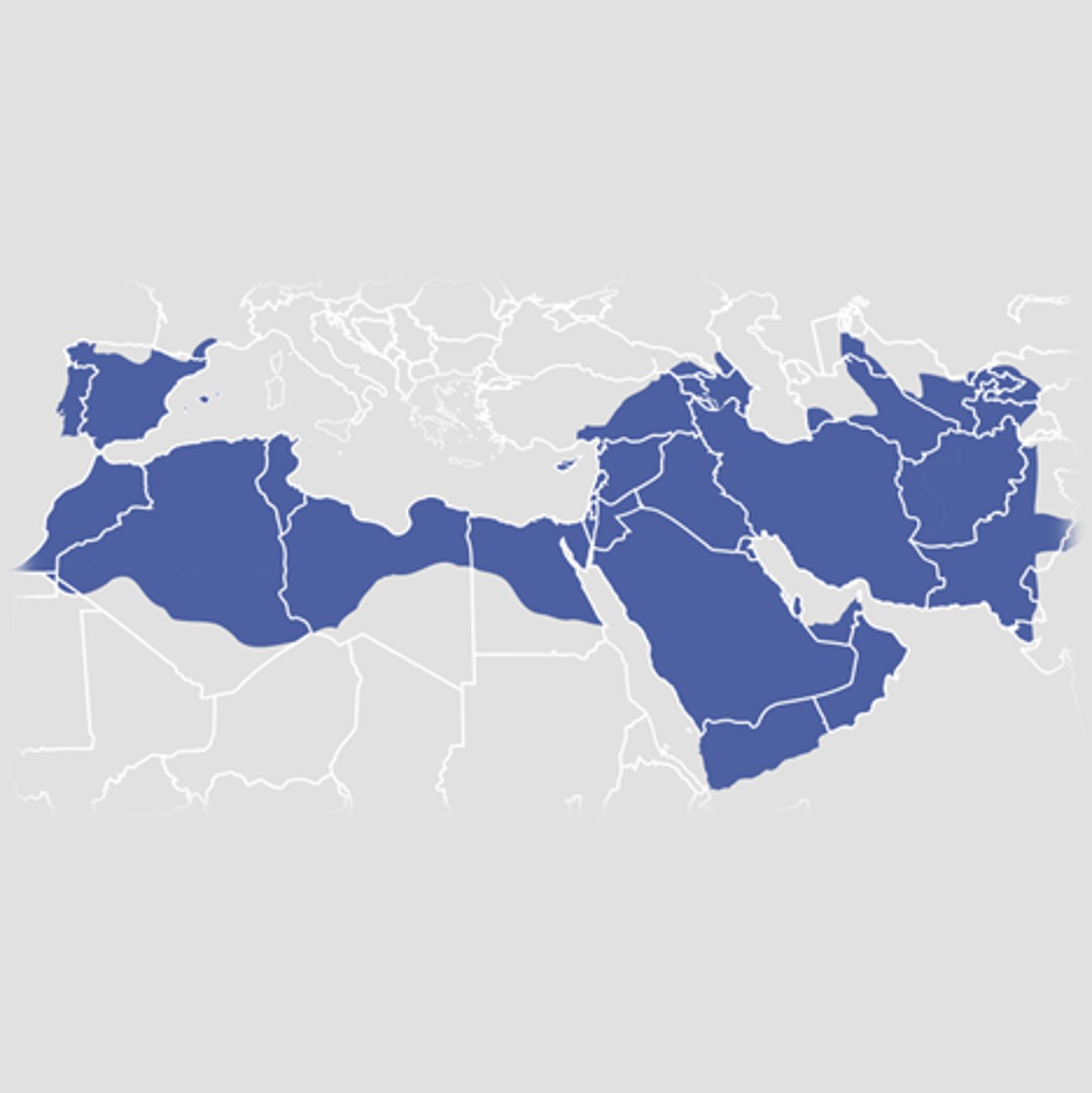
Episode 121: The Umayyad Caliphate
The Umayyad Caliphate, from 661-750, became the largest empire the world had ever known, even as it suffered through two civil wars and significant internal divisions. This episode covers its overall military, political, and cultural history.
| Read Transcription | References and Notes |
| Quiz | |
| Episode on Spotify | Episode on Apple Podcasts |
| Previous Show | Next Show |
Episode 121: The Umayyad Caliphate
Gold Sponsors
David Love
Andy Olson
Andy Qualls
Bill Harris
Christophe Mandy
Jeremy Hanks
John David Giese
KelleyGr
Laurent Callot
Maddao
ml cohen
Nate Stevens
Olga Gologan
Steve baldwin
Silver Sponsors
Lauris van Rijn
Alexander D Silver
Andreu Andreu i Andreu
Basak Balkan
Boaz Munro
Charlie Wilson
David
Devri K Owen
Ellen Ivens
Evasive Species
Hannah
Jennifer Deegan
John Weretka
Jonathan Thomas
Julius Barbanel
Michael Sanchez
Mike Roach
rebye
Top Clean
Sponsors
Katherine Proctor
Carl-Henrik Naucler
Joseph Maltby
Stephen Connelly
Chris Guest
Sander
Matt Edwards
A Chowdhury
A. Jesse Jiryu Davis
Aaron Burda
Abdul the Magnificent
Aksel Gundersen Kolsung
Alex Metricarti
Andrew Dunn
Anthony Tumbarello
Ariela Kilinsky
Arvind Subramanian
Bendta Schroeder
Benjamin Bartemes
Berta Kienle
Brian Conn
Carl Silva
Cat Peterson
Charles Hayes
Chief Brody
Chris Auriemma
Chris Brademeyer
Chris Ritter
Chris Tanzola
Christopher Centamore
Chuck
Cody Moore
Daniel Stipe
David Macher
David Stewart
Denim Wizard
Dominic Klyve
Doug Sovde
Earl Killian
Eliza Turner
Elizabeth Lowe
Eric McDowell
Erik Trewitt
Anonymous
Francine
Friederike Otto
FuzzyKittens
Garlonga
Glenn McQuaig
J.W. Uijting
James McGee
Jason Davidoff
Jay Cassidy
JD Mal
Jillyp
Joan Harrington
joanna jansen
John Barch
John Sanchez
John-Daniel Encel
Jonah Newman
Jonathan Whitmore
Jonathon Lance
Joran Tibor
Joseph Flynn
Joshua Edson
Joshua Hardy
Kathrin Lichtenberg
Kathryn Kane
Kathy Chapman
Kyle Pustola
Lat Resnik
Laura Ormsby
Le Tran-Thi
Leonardo Betzler
Lori Gum
Maria Anna Karga
Mark Griggs
MarkV
Martin Schleuse
Matt Hamblen
Maury K Kemper
Michael
Mike Beard
Mike Sharland
Mike White
Morten Rasmussen
Mr Jim
Nassef Perdomo
Neil Patten
noah brody
Oli Pate
Oliver
Paul Camp
pfschmywngzt
Richard Greydanus
Riley Bahre
Robert Auers
Robert Brucato
De Sulis Minerva
Rosa
Ryan Goodrich
Ryan Shaffer
Ryan Walsh
Ryan Walsh
Shaun
Shaun Walbridge
Sherry B
Sonya Andrews
stacy steiner
Steve Grieder
Steven Laden
Stijn van Dooren
Stuart Sherman
SUSAN ANGLES
susan butterick
Susan Hall
Ted Humphrey
The Curator
Thomas Bergman
Thomas Leech
Thomas Liekens
Thomas Skousen
Thomas Woolverton
Tim Rosolino
Tod Hostetler
Tom Wilson
Torakoro
Trey Allen
Troy
Valentina Tondato Da Ruos
vika
Vincent Vandeven
William Coughlin
Xylem
Zak Gillman
The Umayyad dynasty has a checkered reputation in Islamic history. The geopolitical achievements of the Umayyads are unquestionable. They managed to conquer even more territory than the previous caliphs, including what is today Spain. They built the Dome of the Rock in Jerusalem, and al-Aqsa Mosque next to it, the Great Mosque of Damascus, and they greatly expanded the Prophet’s Mosque in Medina. They were also, however, responsible for keeping Muhammad’s cousin and son-in-law Ali, and his sons, out of power, and killing Ali’s youngest son Husayn. They practiced nepotism on an intercontinental scale, forcing colonized populations to kneel to greedy and often incompetent emirs. And they were, in the end, confronted by so many different groups opposed to them for so many different reasons that their ignominious demise has long been a part of their tarnished legacy.
Following the Rashidun caliphate of 632-661, then, the Umayyad caliphate of 661-750 is a more marbled, intricate era of central Eurasian history. The Umayyad period, governed by 14 caliphs over the course of 89 years, and encompassing a number of succession disputes and civil wars, is not a straightforward epoch of history. Yet the Umayyad empire also laid the groundwork for a lot of what was to come. It was within this period that Shiism solidified, first as a political movement, and increasingly, a theological one. It was within the Umayyad period that the geographical axis of Islam moved northward, to Damascus, and stretched its western and eastern arms to encompass the Iberian Peninsula and the lower Indus. If the Rashidun period was a tidal wave, the Umayyad period was that tidal wave’s end and aftermath, when the water soaked into the ground, and the populations of central Eurasia and North Africa could start to see what the world to come would look like. Controversial, complex, and above all consequential, the Umayyad caliphate is something about which everyone on earth should learn the basics, and over the next two hours, we’re going to do just that. [music]
Background: The Rise of the Umayyads
In order to understand the Umayyad period, we should first learn where the word “Umayyad” comes from. The Umayyads were a group of people. In the Pre-Islamic period, the Umayyads were a clan, and they were a clan within the larger Meccan Quraysh tribe. Their progenitor, Umayya, was roughly of Muhammad’s grandparents’ generation. Over the course of the mid-500s, the Umayyad clan of Mecca had become a powerful branch of the Quraysh tribe, running caravans up and down between Mecca and Syria. Muhammad knew, worked with, and fought with various Umayyads over the course of his life. During the period of Muhammad’s ministry, his older contemporary Abu Sufyan, the grandson of Umayya himself, was for a long time one of the Prophet’s most powerful enemies. After being opposed to the ministry of Muhammad for two decades, however, and facing Muhammad on the battlefield in 625 and 627, in 630, Abu Sufyan, the leader of the Quraysh establishment who had resisted Muhammad for so long, surrendered, and converted to Islam.2The Umayyads, then, in Pre-Islamic Arabian history, were a powerful clan and trade syndicate. Some of their foremost scions tried to stop Muhammad, and Islam, from expanding between 610 and 630. In doing so, the Umayyads were protecting their economic interests. Involved in northern trade, and also, the beneficiaries of profits from the Meccan pilgrimage circuit, the Umayyad clan saw Islam as a threat to business. A new ideology based on monotheism, equality, and the redistribution of wealth imperiled the system on which Umayyad power was based. The Umayyads weren’t the only old guard Meccan elite opposed to Muhammad and Islam. More generally, Mecca’s aristocracy wanted to safeguard their old way of life from the Prophet, and they fought Muhammad and his followers to do so. And after Muhammad conquered Mecca in 630, the ancient clans and tribes of western Arabia, like the Umayyads, did not simply dissolve into an Islamic unity. Blood is thick, and the tribal order of the Peninsula persisted into the first Islamic empire – the Rashidun Caliphate, which we discussed last time.
When we learn about the Rashidun Caliphate – the central events in Islamic history between 632 and 661 – we essentially learn two stories. The first is a story of expansion and triumph. An Arabian power, united under Islam, flared up from the peninsula and defeated two great empires. But there is another story – the story of tensions seething within that Arabian power. Muhammad’s cousin and son-in-law, Ali, first conceded leadership to Abu Bakr in 632, and then to Umar in 634, and then to Uthman in 644, until finally, in 656, Ali was able to assume control of the empire for a fraught and tragically brief four and a half years. It is important to remember that there was never a time, after Muhammad, when the polity of Islam lined up behind a single person. Factions, motivated by clan ties, economic interests, and old vendettas, and a little later, theological discord, and almost always some combination of these, backed one leader or another, because there were great advantages to having someone of one’s own clan on the throne.
The nature of these advantages became clear when the third Rashidun Caliph, Uthman, ruled between 644 and 656. Uthman was of the Umayyad clan. And Uthman used his time in office to reward his fellow Umayyads lavishly, offering them leadership positions throughout the empire. The most consequential promotion of the third caliph Uthman was the promotion of his second cousin, another of the Umayyad clan, to the governorship of Syria. This second cousin was Mu‘awiya, and Mu‘awiya was the son of Muhammad’s old enemy, Abu Sufyan. Mu‘awiya, the first Umayyad emperor, and a main character in our story for today, liked the way that things were going under the reign of the Uthman from 644 to 656. Old Uthman, though a pious Muslim and companion of the Prophet Muhammad, put Umayyads first throughout the growing empire. And when Uthman was assassinated in 656, his second cousin Mu’awiya, the princely heir of a powerful Umayyad family, wanted Umayyads to remain in power. The problem was that Ali, one of Islam’s first ever converts, and the father of Prophet Muhammad’s grandchildren, was long overdue to take over as chief executive of the newborn empire.
Ali, as we learned last time, proved to be the second most pivotal person in Islamic history, after Muhammad himself. During Ali’s life, there were those who believed that he should have immediately succeeded Muhammad after the prophet’s death in 632. Today, Shias believe that Muhammad named Ali as his successor, and that Ahl al-Bayt, or “the people of the house,” in other words, the genetic descendants of Muhammad, are the only ones fit to superintend Islam. When Ali took the throne, finally, in 656, he did so with the intention of making some changes. The previous caliph, the Umayyad Uthman, had put his clan first. Some of the kin whom Uthman had promoted were egregious in the scope of their greed and ineptitude. Muhammad’s cousin and son-in-law Ali, when he became the fourth caliph, distanced himself from the third caliph Uthman’s administration. Ali’s ascension to the throne signaled an economic reform in the empire’s aristocracy. Ali’s ascension meant that the Umayyad clan’s hegemony, entrenched over the previous twelve years of Uthman’s rule, was now no longer secure. And Ali’s most consequential opponent was Mu‘awiya, that Umayyad governor of Syria who was the son of Abu Sufyan, the onetime arch-nemesis of Muhammad himself.
The showdown between Ali and Mu’awiya that ensued has had titanic consequences. To Shias, and the many besides them who revere Ali, Mu’awiya’s seizure of power in Syria in the late 650s was grossly disrespectful to the legacy of the Prophet, and it hobbled what otherwise would have been a spectacular and enlightened reign. Ali faced off against Mu‘awiya over the course of 657, with Mu‘awiya’s power base in Damascus, and Ali’s in Kufa, in what is today Iraq. The end result of their fighting was that the two men drew up negotiations, and it was decided that Ali would continue to hold power in Arabia, Mesopotamia, and Persia, whereas Mu’awiya and his Umayyad allies would rule in Syria. This capitulation on the part of Ali enraged some of Ali’s supporters, who went off on their own and became a group known as the Kharijites. The Kharijite extremists decided that Ali was not staunch and severe enough as a Muslim, and in 661, a Kharijite assassin killed Ali in Kufa, according to tradition, as Ali led prayers there.
The death of the fourth and final Rashidun caliph opened the way for the first Umayyad caliph, Mu’awiya. But there was a problem. That problem was that Ali had two sons, both of them full blooded grandsons of Muhammad himself, and both in their mid-thirties. And where we last left off, Ali’s older son, Hasan, had followed in Ali’s footsteps. Hasan, as of 661, had also capitulated to Mu’awiya, the Umayyad governor of Syria turned self-proclaimed caliph. Hasan, in the capitulation agreement, guaranteed that he would relinquish his claim on the caliphal throne, provided that Mu’awiya would agree to three conditions. First, Mu’awiya promised not to harm Hasan’s followers. Second, Mu’awiya promised to rule according to Qur’anic doctrines, and the customs of the Prophet Muhammad. And third, Mu’awiya promised that his successor would be chosen by a committee. And now, everybody, it’s time to learn the story of the Umayyad caliphate, and whether or not Mu’awiya, the first Umayyad caliph, kept any of his promises to Hasan, the oldest grandson of the Prophet Muhammad. [music]
The Reign of Mu’awiya (661-680)
In early 661, Mu’awiya became the unopposed caliph of the new empire. His chief rival, Muhammad’s eldest grandson Hasan, had retired to Medina. By July of 661, Mu’awiya had earned the sworn allegiance of many emirs and Arab chiefs. Mu’awiya, however, did not rule from the old Rashidun seat of power in Medina. Mu’awiya ruled from Damascus.3Mu’awiya wasn’t the first caliph to move the throne. Just before him, Ali had ruled from Kufa, in Iraq. But with Mu’awiya, the caliphate’s political control room moved west, to Syria. When we say “Syria” today, we think of the modern country. However, the Arabic name Bilad as-Sham, which we might translate as “greater Syria” better describes Syria during the Umayyad period, a region that included modern-day Syria, Lebanon, Jordan, Israel, Palestine, and the southern fringes of Turkey. This was the region that the Romans called Syria. Greater Syria was ecologically richer than western Arabia. It was an area home to agriculture and pastoralism; to port cities and lumberyards; to the Abrahamic epicenter of Jerusalem, and perhaps most pivotally, to a choice swathe of Mediterranean shoreline that quickly became instrumental to Islamic expansion throughout North Africa.
By 661, when he became caliph, Mu’awiya had deep ties to greater Syria, and he had been digging in there for decades. Just as the Umayyads had long been linked with trade to Syria, Mu’awiya had served as a commander during the early Rashidun invasion of Syria in the 630s, holding ever higher military positions under Islam’s first two caliphs between 632 and 644. Mu’awiya married two women from the Kalb Tribe, a powerful Arab dynasty anchored between modern-day Syria and Arabia. When Mu’awiya’s second-cousin Uthman appointed him to the governorship of Syria, Uthman also appointed other Umayyad relatives to various posts. Some of these Umayyad appointees were terrible at their jobs. Uthman’s Umayyad cousin, for instance, had to flee the city of Basrah, and elsewhere, rebels forced Uthman’s foster-brother out of Egypt. Mu’awiya himself, however, was comparably quite competent as the governor of greater Syria, one of his greatest achievements being the construction of the first Islamic navy. As Uthman’s empire shuddered in the early 650s due to the incompetence of various appointees and various uprisings and military stalemates and failures, Mu’awiya’s Syria was the late Rashidun caliphate’s most important military and economic engine.4

The tomb of Mu’awiya ibn Abi Sufyan in the Bab al-Saghir cemetery in Damascus. The resting place of Mu’awiya is regarded far more ambivalently in the Islamic world than those of Ali and Husayn. Photo by محمد اسماعيل كردية.
In the east, the newly minted Umayyad caliphate faced different enemies. When we learn that Mu’awiya’s caliphal predecessors had conquered the Sasanian empire, along with much of the Byzantine empire’s territory, there is a temptation to assume that new Islamic leadership inherited stable regions with orderly bureaucracies that facilitated a new pattern of tax collection. Some provinces that the caliphates conquered were indeed stable and orderly. But constant turmoil in the Sasanian and Byzantine empires, throughout the entire seventh century leading up to the beginning of the Umayyad caliphate in 661, had emboldened a lot of other Sasanian and Byzantine enemies besides the caliphates. The Khazars, headquartered north of the Caucasus Mountains between the Black and Caspian Seas, fought the Byzantines and caliphates alike throughout the seventh, eighth and ninth centuries. Far to the east, in the regions of Khurasan and Sistan, where modern-day Iran meets Turkmenistan and Afghanistan, the Umayyad caliphate fought the Sasanian empire’s old foes along the lower Helmand River and across the Oxus, including a group called the Hephthalites, or White Huns.
As Mu’awiya’s reign lengthened over the course of the 670s, three other things were happening in the Umayyad empire that would have great consequences for the future of the caliphate. First, the Umayyads pushed westward across North Africa. A naval power, now, and capable of rebuffing Byzantine attacks at sea, by 678 the Umayyads had conquered Byzantine north Africa, excepting Carthage and the area around it. Second, Mu’awiya paid very close attention to the governorship of the Hijaz, where the former capital of Medina was seated. For obvious reasons, Medina and Mecca were theologically central to the caliphate, and Mu’awiya was careful to only appoint Umayyad clansmen whom he knew there. Mu’awiya thus put a second cousin, Marwan ibn al-Hakam, in place as governor of Medina for much of Mu’awiya’s time as caliph.
And while Mu’awiya was paying close attention to the leadership of militarily and ideologically important territories in the 670s, he was also paying close attention to his own dynastic legacy. Mu’awiya had decided that his son, Yazid I, would be his heir. The young man, born into the world of the caliphates, had led a military campaign in Anatolia, and had had an important role in directing the pilgrimage to Mecca, roles that his father evidently assumed would make Yazid I eligible for the throne. With Yazid I installed as caliph, Mu’awiya knew that the Umayyad clan would continue to be able to retain and shore up power. And when Mu’awiya died in 680, his son Yazid I took the throne as the second Umayyad ruler, being the first man to assume caliphal leadership by hereditary right. So much, then, for the old world of tribal shuras that had previously decided Arabian leadership. The caliphate was a hereditary monarchy, and Mu’awiya had broken one of the three promises he had made to Muhammad’s oldest grandson Hasan. [music]
The Reign of Yazid I and the Tragedy at Karbala
By the time Yazid I succeeded his father Mu’awiya as the second Umayyad caliph in 680, Muhammad’s oldest grandson Hasan had passed away. Some time between 670 and 680, Hasan died in Medina. His death is most often attributed to a poisoning, with Mu’awiya being the suspected instigator, although sources have never been unanimous. Mu’awiya had promised Hasan in his peace treaty back in 661 that he would not pass power to an heir without some sort of council. Mu’awiya, however, had broken his promise, and so having Hasan poisoned would have been an instrumental step in Mu’awiya’s bid for dynastic power.Although the sources on Hasan’s death are complicated and partisan, if indeed Mu’awiya abetted Hasan’s murder, the first Umayyad caliph committed a horrendous crime in the name of greed and dynastic self-aggrandizement. Ali, and his eldest son Hasan, once the caliphate had grown into an empire, at different moments both swallowed their pride and ambition for the sake of peacemaking, choosing stability within the caliphate over civil war at the cost of their own power. That Mu’awiya would murder Muhammad’s grandson preemptively, merely for the sake of assuring his own son Yazid I’s claim to the throne shows how quickly history changed between the Rashidun and Umayyad caliphates. And six months after the second Umayyad caliph Yazid I took the throne in 680, another great tragedy would befall Islamic history.
Hasan was only one of the Prophet Muhammad’s two grandsons by Ali. The second grandson, Husayn, was 54 years old in 680. He had, like his brother Hasan, lived quietly in Medina during the first decades of the Umayyad caliphate, in spite of perennial efforts of the supporters of Ali to rally around the Prophet’s grandsons and instigate a revolt against the Umayyad regime in Damascus. For decades, Ali and his sons had enjoyed broad support in what is today southeastern Iraq, from the city of Kufa down to Basrah along the prosperous Euphrates floodplain. With Ali gone, and with Hasan gone, support for the younger grandson Husayn still existed in this region. Husayn’s partisans had, for a long time, urged him to rise up and resist the Umayyad power grabs that had mounted since the caliphate of Uthman had begun back in 644.
When Mu’awiya died in 680, his death signaled the end of the Umayyad leadership’s peace treaty with Ali and his sons. And the appointment of Yazid I in 680 to the throne meant that just as this peace treaty expired, the Umayyads had flagrantly broken the terms of those agreements by choosing hereditary succession rather than appointment by committee. After a life spent keeping a low profile, Husayn finally answered the call for revolt in 680. Muhammad’s grandson Husayn sent an emissary up to Kufa to tell supporters in the north to amass. Unfortunately for Husayn, the second Umayyad caliph Yazid I seems to have anticipated the uprising in Iraq.
Yazid I sent his regional governor in to suppress the revolt. This governor, Ubayd Allah ibn Ziyad, would play a central role in Islamic history over the next five years. The Umayyad governor Ubayd Allah ibn Ziyad first put down the Kufan uprising. The governor had intel that Husayn was heading up from the Hijaz to lead the revolt, along with a small retinue of followers, and Ubayd Allah ibn Ziyad sent a larger force to intercept Husayn. The Umayyad forces confronted Husayn and his retinue near Karbala, in present-day Iraq. When no settlement could be reached, a short battle broke out. When it was over, Husayn was dead, along with the members of his household who had accompanied him.

The Imam Husayn Shrine in Karbala during Arba’in of 2019. Photo by J Ansari.
The annual Arba’in pilgrimage to Karbala was prohibited by Saddam Hussein, but today it is actually far larger than the Hajj to Mecca, with 21 million Muslims having participated in 2024, in contrast to the less than two million who embarked on the Hajj. To be clear, the Saudi government, for reasons of safety and logistics, has to limit the number of Hajj participants, as Mecca’s population is less than three million, and Medina’s less than one and a half. But at any rate, for those of us new to Islam, it’s worth remembering that although the Hajj is one of the pillars of Islam, the pilgrimage to Karbala, largely Shiite, is also a central religious rite in the lives of tens of millions of Muslims today.

The Imams regarded as holy by various branches of Shiism. Through Fatima and Ali’s son Husyan (though he was martyred at Karbala in 680), a prophetic line is still believed to have descended, culminating in different Imams for Twelvers, Ismailis, Zaydis, and other, smaller sects.
Abd Allah ibn al-Zubayr was the grandson of Islam’s first caliph, Abu Bakr. A scion of the Quraysh old guard, and with close familial ties to the Prophet Muhammad, Ibn al-Zubayr had considerable support behind him, being a sort of centrist figure around whom Quraysh leadership uncomfortable with Umayyad dominance could rally. Like Husayn, Ibn al-Zubayr refused to pledge allegiance to the new Umayyad caliph Yazid I in 680. With strong support in Mecca and Medina, by 682, Ibn al-Zubayr’s forces had booted the Umayyads out of Medina. In 683, a counterattack ensued, with Yazid I dispatching a Syrian army southward into the Hijaz. The army retook Medina in the late summer of 683, and then turned its attention toward Mecca. After some months of fighting between the Zubayrids defending Mecca, and the Umayyad Syrians attacking Mecca, the war was interrupted by unexpected news from the north. Yazid I, the second Umayyad caliph, had died after only three years on the throne.
The death of Yazid I in 683 marks the beginning of one of the more turbulent periods of early Islamic history, so let’s slow down for a moment, review what we’ve learned so far, and then consider what we’re about to learn. Last time, we went through the relatively straightforward history of the Rashidun caliphate. The Rashidun caliphate exploded in size under the first two caliphs Abu Bakr and Umar. The third caliph Uthman took charge in 644, and though not without achievements, his reign was marked by a problematic degree of nepotism. By the time Uthman died in 656, Uthman’s Umayyad clan had tasted too much unchecked power to relinquish it, and when Ali took the throne in 656, the First Fitna began. As dire as Islam’s initial civil war surely was to live through, it was a relatively simple affair. First, Ali fought off Quraysh opponents, winning the Battle of the Camel 656, at which the Quraysh contenders for the caliphal throne were killed, and after which Ali made peace with Muhammad’s widow Aisha. Then, Ali’s forces fought those of Mu’awiya to a stalemate, signing a treaty that ultimately led Mu’awiya to stay in power until 680. With Ali’s death in 661, the era of the First Fitna ended. Although open hostilities were stalled by Ali’s sons honoring their father’s agreement with Mu’awiya, throughout the reigns of the first two Umayyad caliphs Mu’awiya and Yazid I, tensions still seethed, tensions which led to the Second Fitna, which rocked the Islamic world from 680-692.
With the Second Fitna, and the death of the second Umayyad caliph Yazid I in 683, we come to a more cluttered and challenging period of early Islamic history. Between Yazid I’s death in 683, and the end of the Umayyad caliphate in 750, there were twelve more Umayyad caliphs, meaning that each was on the throne for an average of less than six years. And just as there were many Umayyad caliphs, the caliphate itself became fissured into different power blocs, power blocs which faced off against one another throughout the Second Fitna of 680-692, and the Third Fitna of 744-747, which we’ll discuss later. As of the year 683, again where we are now in our narrative, Muhammad’s grandchildren’s generation were becoming senior citizens, those who had known him were becoming vanishingly few, and the median Muslim believer was as likely to call Syria, Iraq, or Egypt home as western Arabia. In the remainder of this program, then, although we’ll review the full history of the Umayyad caliphate, I’m going to especially concentrate on the Second and Third Fitnas, and several other events that set the stage for the greater medieval world to come. So let’s jump into the Second Fitna, or Islamic civil war, of 680-692. [music]
The Second Fitna: Umayyads, Shi’at Ali, Zubayrids, and Kharijites
Over the twelve years of the Second Fitna of 680-692, four different groups squared off against one another. We have already met all of them. First, there were the Umayyads, that dynasty rooted in Syria that had grown out of a very powerful old Meccan clan. Second, there were the Alids, or Shi’at Ali, who supported Ali and his sons, and were devastated at the death of Husayn near Karbala in late 680. Third, there were the Zubayrids, Quraysh proponents of the first caliph Abu Bakr’s grandson, ‘Abd Allah ibn al-Zubayr. And fourth, there were the Kharijites. The Kharijites, who had emerged as separatists in 657 after Ali first agreed to share power with Mu’awiya, were religious purists who believed that a caliph must have an impeccable character, and the Kharijites became a volatile force in the Umayyad empire after 657, seated in east-central Arabia and what is today the Fars province of Iran. When the second Umayyad caliph Yazid I died in 683 at an unexpectedly young age, further fissures appeared in the empire, with the mighty Umayyad regime in Damascus suddenly lacking a leader.
The power blocs of the Second Fitna in 686. The Umayyad dynasty, under the newly-enthroned Abd al-Malik, was barely hanging on during the second year of the caliph’s reign. Map by Al Ameer son.
Yazid I had a son who ruled for a few months before dying of unknown causes. And with the Umayyad dynasty lacking a clear ruler, suddenly Syria, which had been an Umayyad region since the 650s, showed signs of a split. Some Syrian tribes allied themselves with Ibn al-Zubayr, who, with his Quraysh allies, took control over the Hijaz. Other Syrian tribes sought a new Umayyad figurehead for leadership. And as the Shi’at Ali and Kharijites also shored up their forces during this power vacuum, the peripheries of the Umayyad empire suffered enemy attacks from multiple directions. Byzantine and Berber forces assaulted Arab garrisons in and around what is today Tunisia. In the eastern reaches of the former Sasanian empire, enemies descended on outposts from what is today Afghanistan. In the northern fringes of the Umayyad caliphate, Khazars and Byzantines attacked Muslim forts, having heard of the civil war and interregnum in the Islamic empire.
Within the four main splinter groups of the early Second Fitna, there were more splinters. The 680s saw tribal groups who had given support to Ibn al-Zubayr going their own way. A faction of the Shi’at Ali lined up behind a partisan of another of ‘Ali’s surviving sons, a partisan named al-Mukhtar, between 685 and 687, and al-Mukhtar’s forces tried to take control of the rich floodplains of the middle Euphrates region. Most consequentially, though, the Umayyad clan itself faced a fork in the road.
The clans of Arab tribes were, needless to say, made up of multiple families. In the case of the Umayyad dynasty thus far, imperial power had been in the hands of the descendants of Muhammad’s old foe-turned-friend, Abu Sufyan. In 684, however, a new scion of the Umayyad clan presented himself as eligible for the position of caliph. This scion was the third Umayyad caliph Marwan, the second cousin of Mu’awiya. Well-connected, and about 60 years of age, Marwan was a reasonable choice for Umayyad leadership. Marwan, however, only ruled for about a year between 684 and 685. At the time of his death in 685, Umayyad power in Syria was focused on locking down control of the wealthy territories of Egypt and southern Iraq, the Umayyad’s main foe at that point being the powerful Arabian forces of Ibn al-Zubayr.
In 685, a new Umayyad caliph – the fifth Umayyad caliph, to be precise, ascended to the throne. This caliph will be part of our story for a while, as he ultimately ruled for two decades. His name was Abd al-Malik, and he would prove to be a successful and talented leader. The fifth Umayyad caliph Abd al-Malik did not inherit a very sturdy looking throne. When Abd al-Malik ascended to the throne, many within Umayyad territories understood Ibn al-Zubayr, seated in Islam’s heartland of western Arabia, to be the real caliph, and then there were the Shi’at ‘Ali and Kharijites, who loathed the Umayyads for various reasons, not to mention the numerous dangerous groups on the periphery of the Umayyad empire. Within a year of the fifth Umayyad caliph Abd al-Malik’s reign, the Byzantines were not only attacking Umayyad holdings in the Caucasus, but also sponsoring independent Umayyad foes up north.
Following initial attacks against his main foe in Arabia, the other claimant to the caliphate, Ibn al-Zubayr, Abd al-Malik paused to shore up his power in the rich territories of greater Syria. In the late 680s, Abd al-Malik reached settlements with the Byzantines, and hostilities between the two groups broke off. After fending off a cousin’s bid for the throne, and cordoning off some tribes in Syria that had proved rebellious, the fifth Umayyad caliph Abd al-Malik turned his attention to Ibn al-Zubayr, that grandson of the first caliph Abu Bakr whom, by 690, many considered caliph. By 691, Abd al-Malik had taken back much of the Euphrates floodplain and was ready to march on Ibn al-Zubayr’s power center in Mecca. The following year, in 692, Abd al-Malik’s forces converged in Ta’if, and then Medina. And during the Hajj of 692, in April, Umayyad forces attacked the city of Mecca. Though the fifth Umayyad caliph Abd al-Malik had wanted to avoid attacking the sacred square around the Kaaba, fierce resistance in the city necessitated it, and in the siege that followed, the Kaaba itself was damaged.6 In the end, the fifth Umayyad caliph achieved his objective. The supporters of Ibn al-Zubayr, grandson of Abu Bakr, were defeated, and Ibn al-Zubayr himself was beheaded, his remains displayed in Medina. The Umayyads, then, as of 692, as the Second Fitna reached its bloody terminus, were ascendant once more. [music]
Abd al-Malik and Waleed I (685-715)
With the end of the Second Fitna, the continued reign of the caliph Abd al-Malik marked a new period of Umayyad history, often called the Marwanid period, after Abd al-Malik’s father Marwan. For the long stretch between 684 and 750, Abd al-Malik and his sons and other relatives would hold power in Syria, and while they would not rule unopposed, the dynasty enjoyed peaceful transfers of power up until the 740s.Having vanquished opposition from other Quraysh clans in the early 690s, the caliph Abd al-Malik nonetheless still had a gigantic empire to run. The Umayyad caliphate’s largest revenue sources were the agricultural powerhouses of Egypt and Iraq. Egypt was a smaller source of revenue, but it was also easier for the Umayyad regime to govern. Conquered and run by the Syrian armies, the only threat to Egypt were the Byzantines and Berbers to the west along the North African coast. Iraq, or more properly the Tigris-Euphrates floodplain, yielded much greater wealth in agriculture, but it was also more volatile. For the fifth Umayyad caliph Abd al-Malik, Iraq was so wealthy that any governor stationed there threatened to become powerful enough to threaten the throne in Damascus. Further, the cities of Kufa and Basrah had exploded in size, by the close of the seventh century having populations as high as 200,000.7 The site of the old Shi’at Ali resistance, and also, the front with the restless populations of the former Sasanian empire, Iraq had to be watched very closely by the Umayyad headquarters in Damascus.
The most powerful enemy of Damascus, in the early 690s, was Constantinople. And in the early 690s, we first begin to see political rhetoric deployed that would be used at various junctures throughout the Middle Ages to come. The Byzantine Emperor Justinian II began describing himself as God’s earthly representative, around 690 issuing coins with his portrait and the caption “Christ’s servant.” Within a few years, the caliph Abd al-Malik had begun minting coins that described him as the commander of the faithful, and as God’s deputy. The rhetoric itself was not unprecedented on either side.8 Yet occurring as it did in the early 690s, the theocratic propaganda was part of a mutual saber rattling designed to bolster each ruler’s claims to unlimited executive power. The Umayyad goal was the destruction of Constantinople, but the caliphate, in the 690s, had to fight the Byzantines in numerous places other than Anatolia. With two other major fronts between Muslims and Christians in the Caucasus region, and the central North African coast, Umayyad and Byzantine fighting in the late 690s resulted in modest territorial gains for the caliphate.
As the caliphate fought the Byzantines in the 690s, the fifth Umayyad caliph Abd al-Malik also had to manage the empire’s gargantuan eastern front. Uprisings in Iraq, by slaves and then by Kharijites, had to be subdued. The distant east of what had formerly been the Sasanian empire remained an almost ungovernable frontier, with powerful inhabitants of modern-day Afghanistan and Pakistan taking back Umayyad territory nearly as quickly as the caliphate could conquer it. And Iraq, closer to Damascus though it was, remained a tinderbox throughout the Umayyad period. Between 701 and 704, an Umayyad general rebelled and claimed control of the Tigris-Euphrates region. The rebellion was a significant one, and as a result of the relentless turmoil in Iraq, the fifth Umayyad caliph Abd al-Malik ordered a garrison of Syrian soldiers stationed in between the metropolises of Kufa and Basrah – a garrison that could be mobilized in either direction to squash insurrections. This would be a reality for much of the Umayyad caliphate’s remainder – Syrian military boots on the ground in Iraq, deployed to subdue the diverse and porous breadbasket of the caliphate, and deployed further eastward into Iran, if necessary. The Umayyad governor of Iraq, who ruled there from 694-714, is said to have lamented, “Oh, people of Iraq, people of dissension and hypocrisy and vile character,” in a stinging one liner full of rhymes and assonance in the original Arabic. While pejorative statements against entire regional populations are generally unconscionable, the statement nonetheless captures the central paradox of Mesopotamia during the early caliphates – it was always profitable, and always problematic.

Parts of the Umayyad period Dome of the Rock still survive in the modern building atop Temple Mount in Jerusalem.
While the construction of the Dome of the Rock, completed around 692, aimed to undergird the caliphal conquest of Jerusalem, the Dome of the Rock was also part of a propagandistic building program undertaken by the caliph Abd al-Malik. This building program also included projects in Mecca. The Kaaba, which had been damaged during the recent Second Fitna, saw refurbishments between 692 and 694. By putting his stamp on Temple Mount in Jerusalem, and the Kaaba in Mecca, the Umayyad caliph Abd al-Malik effectively made Jerusalem in greater Syria a part of the pilgrim’s calendar, leading the Hajj himself in person in 695.
The fifth Umayyad caliph Abd al-Malik, having won the first Fitna in 692, fought the Byzantine Empire and enemies from Central Asia in the distant east, and as we just learned, worked to associate himself and his regime with the past and future of Islam. Abd al-Malik died in 705 CE, having been on the Umayyad throne for more than 20 years. He was around 60, and although he and his predecessors have been deeply tarnished in Islamic history for their actions against the descendants of Muhammad, Abd al-Malik’s deeds as caliph were also the ordinary sorts of things that early medieval autocrats did in west Eurasia in the seventh century – associating themselves with God, eradicating opposition, and undertaking projects that publicized their grandeur and fitness to rule. Abd al-Malik’s eldest son, al-Waleed I, became the sixth Umayyad caliph, following his father’s death, generally keeping with the traditions his father had established.
.jpg)
Al-Aqsa Mosque in Jerusalem atop Temple Mount. A major site for Islamic worship in Jerusalem today, the building was originally constructed during the Umayyad caliph al-Waleed I. Photo by Yazan Jwailes.
Just as the sixth Umayyad caliph al-Waleed I commissioned some historically pivotal building projects, under his tenure on the throne, again 705-715, the caliphate became even more militarily successful than it had before. Al-Waleed I had a stable of loyal personnel who were happy enough with the benefits that the Umayyad regime was showering on them. And while the monumental building projects of the Umayyad empire are one of its famous legacies, another is an event that took place in the year 711.
Leading up to 711, Umayyad power had devastated Byzantine North Africa. Caliphal armies captured Carthage around 698, lost it, and then recaptured it again. After a few final Byzantine holdout fortresses fell into Umayyad hands, by the year 710, the profitable territories of North Africa were under the military control of Damascus. It was in the summer of 711 that the Umayyads, who had set up a garrison at Tangier in modern-day Morocco, crossed the Strait of Gibraltar. As luck had it, the Visigothic leaders who ruled the Iberian Peninsula at the time were in disarray, and Umayyad forces were able to defeat the Visigothic king and those trying to usurp him, clearing the way for what would soon be Al-Andalus.
While the Islamic conquest of Spain was a pivotal moment in European history, the caliphate’s eastward expansions resulted in the acquisition of a great deal of territory and riches, as well. Eastern commanders, between 705 and 712, fought on the western outskirts of Transoxiana, or the parts of present-day Uzbekistan and Tajikistan across the Oxus River from Afghanistan. Seizing trade centers linked to China in what’s today western Kyrgyzstan, the Umayyad caliphate dispatched diplomats to Tang Dynasty rulers. The Umayyad caliphate’s eastern commanders also pushed down into the Sindh region of southern and central Pakistan, and the lower Indus Valley, yielding enormous profits for the caliphate.
With the territories under its military control now stretching from Portugal to India, and from Yemen up to Georgia and Azerbaijan, the Umayyad caliphate was, by 715, ascendant. Under Abd al-Malik and his son al-Waleed I, who had ruled for a combined 30 years, the caliphate had managed to expand and consolidate its power in Damascus even in spite of the considerable forces working against it. But when al-Walid passed away in 715, followed by three subsequent caliphs with short reigns, the Umayyad caliphate’s luck began to change. [music]
Military Failures, Demographic Evolutions, and Short-Lived Caliphs: 715-724
The seventh Umayyad caliph ascended to the throne in 715. His name was Sulayman, and he was the son of the fifth caliph and the brother of the sixth, so his qualifications for leadership were impeccable. Sulayman’s name – the Arabic version of Solomon – seemed to harken a providential time to come. The hundred-year anniversary of the Hijra from Mecca to Medina was coming up. A leader with a storied biblical name had come to follow two successful reigns that had led up to his own. The time had come to put an end to Constantinople, and the idolatry of the Christians in their persistent belief in a trinitarian God.
The Umayyad empire at its apex. Note the significant territorial gains that took place between just 661 and the end of al-Waleed’s reign in 715. Map by Cattette.
However, in the summer of 717, the Umayyad military also ran into some problems. First, the propitiously named new caliph Sulayman died of an illness in September of 717. Second, while the Byzantines had suffered from a long series of leadership hiccups leading up to 717, in 717, those leadership hiccups stopped. The emperor Leo III, the founder of the Isaurian Dynasty, came to the throne, where he would remain for the next 24 years. One of Leo III first diplomatic feats was making an agreement with a barbarian population called the Bulgar Khanate. The Bulgars of Thrace, after whom Bulgaria is named, had been harrying the Byzantine northeast for a long time, and after Leo III reached a settlement with them, the Bulgars were happy to attack the Umayyad land army instead. The 717-718 siege, sometimes called the Second Arab Siege of Constantinople, grinded on until August of 718, when the fleeing Umayyad navy was battered by Byzantine pursuers and then mostly sunk by an Aegean storm.
Back in Damascus, fortunately for the caliphate, no succession dispute followed the seventh Umayyad caliph Sulayman’s passing. An eighth caliph lasted only two and a half years, and then a ninth didn’t make it to four years. Sulayman’s two short-lived successors, who ruled from 717-724, came to the throne when the caliphate’s failures at Constantinople still loomed large in the collective memory. And the eighth and ninth caliphs also ruled over a period during which Islamic history was changing so quickly that one generation’s realities were quite different from the next, again and again.
Perhaps the biggest change was the demographic evolution of the caliphate’s population. The amount of money that had gushed into the powerful clans of Arabia and Syria meant that aristocratic men of fighting age didn’t need to fight any more. As a result, there were many denizens of conquered populations who, due to ambition or coercion, made up a large portion of the Umayyad military. Earlier, back in Rashidun days, an Arab-Muslim elite had been a thin layer of military men and administrators ruling from garrisons. By 720, though, cohabitation, collaboration, and intermarriage had created a porous space in between the Umayyad aristocracy and the various groups who served them. These groups were understood as mawali, an Arabic word that, as we learned last time, can be translated as “client,” or “ally,” or “friend.” Freed slaves and mercenaries assumed various client relationships with the Arab elites of various regions, client relationships rooted in military allegiance. As time passed, clientages based on assistance, or a patron converting a client to Islam, or simply friendship, continued to fuel upward mobility for populations living beneath the Arab clans who held the lion’s share of power in the Umayyad empire. There were Arabs, however, who resented the upward mobility of conquered peoples into the ranks of the Arab patricians, and the later Umayyad caliphate would see tensions between indigenous populations and Arab leadership playing out in various problematic ways.
When we consider the client-patron relationships of the later Umayyad empire, it’s important to remember the scale of this empire. A Nestorian Christian sailor from what is today Lebanon, working with a mixed crew, might shake hands with the Arab admiral who commanded a fleet with little reservations. The Arabs were no better or worse than the Byzantines, who had also oppressed the Nestorians, and so having an Arab patron was fine. But the Umayyad empire was absolutely titanic, and it included various militarily competent groups who had other alliances in the outside world that they could make, rather than alliances with the Arab elite. The Visigoths of the recently conquered territory of Al-Andalus, for instance, had Merovingians on the other side of the Pyrenees. Berbers had connections with a whole network rooted in the Sahara. The armies of the Khurasan and Sistan regions in the distant east had partnerships with India and China. The newly won frontiers of the empire, put simply, were not as safe as the interior for Umayyad aristocrats. Indigenous citizens of the frontier zones knew the lay of the land far better than their Arab conquerors, and the aforementioned Visigoths, Berbers, citizens of Transoxiana, and others, could form powerful alliances with groups fully out of the purview of the Umayyad caliphate.
In summation, then, after failing to take Constantinople in 718, and then having two short-lived caliphs rule over the next six years, the Umayyad empire faced the cold, hard reality of now occupying an absurd amount of territory, being surrounded on all sides by capable enemies, and internally, facing evolving challenges with the governance of colonized populations. In 724, however, the caliphate had a stroke of luck. The tenth caliph, Hisham ibn Abd al-Malik, ascended peacefully to the throne, being in his early thirties, competent, and qualified to rule. Unlike his most recent predecessors, the tenth Umayyad caliph Hisham would have a long tenure on the throne. The last caliph whom we’ll consider in detail in this program, Hisham also had a combination of cautiousness, pragmatism, and foresight that managed to hold the Umayyad caliphate together, as well as to spread knowledge and culture throughout the vast empire. [music]
Hisham ibn Abd al-Malik, the Tenth Umayyad Caliph (724-743)
The tenth Umayyad caliph Hisham ibn Abd al-Malik, who ruled from 724-743, continued the policies of his predecessors, and commenced new ones that fit the changing times. Like other Umayyads before him, he patronized the Hajj, leading the pilgrimage in 725, and building infrastructure on the Syrian road to west Arabia to help pilgrims get down to Mecca. He kept up the steady military campaigns against the Byzantines. In order to facilitate these campaigns, and due to his own land holdings, Hisham moved his permanent residence from Damascus 200 miles to the northeast, to the city of Resafa, in the north-central part of modern-day Syria.
Turkic Khaganates thrived in Central Asia from the earliest days of the Islamic caliphates. Half a century into the Abbasid caliphate, Turkic peoples would become a significant influence on the Islamic empire.
The cities of Kufa and Basrah had swelled to a quarter of a million citizens each by the reign of the tenth Umayyad caliph Hisham, and the diverse and energetic populations in these cities became wellsprings for progressive and revolutionary ideas. When the tenth Umayyad caliph Hisham came to the throne in 724, Shi’at Ali, or the party of Ali, still hoped Ali’s descendants would return to power. The partisans of Ali had, of course, not forgotten that the Umayyads had been directly or indirectly responsible for the deaths of Ali, Hasan, and Husayn, and they were thus certainly not supporters of the Umayyad regime.
Another power bloc resident in Iraq and Iran were the Kharijites. The Kharijites not only rejected Umayyad rule. They rejected Quraysh leadership more generally, embracing the Qur’anic doctrine that all Muslims are equal, and thus that in any leader, piety and personal merits were what counted, rather than tribal pedigree. And the Kharijites did not confine their ministry to the central part of the empire. Spreading their message to North Africa and other regions, the Kharijites told any who would listen that the Umayyad dynasty had to go. In general, conquered populations did not need to be told twice that they were being ruled over by a decadent and unrighteous regime, and for non-Arab Muslims in general, some of whom had to pay an extra tax even though they were Muslims, the Kharijite message of equality before God and pious living resonated quite well.
Though Kufa and Basrah generated firebrand ideas like those of the Kharijites, the Mesopotamian cities were also, even in the early 700s, important to the later cultural history of Islam. Intellectual luminaries came into prominence in Kufa in and after the first quarter of the 700s, including the Sunni jurist and historian al-Sha’bi, and Abu Hanifa, the scholar, jurist, and theologian who founded the Hanafi school of Sunni law, today the most prevalent school of Islamic law on Earth.
By the 720s, internal unrest was a given in the Umayyad empire, and the tenth Umayyad caliph Hisham delegated management of this unrest to a large cadre of loyal governors. Hisham also kept up the family tradition of making war on the Byzantines, wanting to be the Umayyad who finally conquered Constantinople and completed the final triumph of Islam over Christianity. Constantinople, however, was now under strong leadership. Its emperor, Leo III, had firm alliances in place with the Khazar Khagnate based in the upper Caucasus, and Khazars raided Umayyad territories in what is today Georgia, Armenia, and Azerbaijan, making a Muslim mobilization into Anatolia in the 720s and 730s tactically unwise. To skip through a great deal of military history pretty quickly, over the course of the 730s, the Umayyad caliphate nearly captured Sicilian Syracuse, and faced the Byzantines in a large land battle in 740, but the Umayyads lost both engagements, suffering further public relations losses within the caliphate as a result.
The Battle of Tours (732): The Big Picture
Perhaps the most famous military debacle of the Umayyad empire, at least in European history, was the Umayyad defeat at the Battle of Tours, in present-day France, in 732. The Umayyad empire had, following its initial invasion of Hispania in 711, locked down control of much of the Iberian Peninsula, seizing territories from the Visigothic crown and nobility during the 710s. Detailed records of the Muslim conquest of Spain, and the early history of Al-Andalus more generally, are notoriously sparse, being restricted to far later Muslim sources, and a single Christian account most often called the Chronicle of 754, an account that is contemporary but nonetheless not very detailed.9 Visigothic Spain, as we learned in a previous episode, had become Catholic back in 587, but the Iberian Peninsula was, even by the early eighth century, still ideologically and demographically diverse, with the Visigothic monarchy ruling over various populations indifferent to, or hostile to, Visigothic rule. The non-Catholic Christians of the peninsula, as well as Jews, when the Umayyad military disembarked in 711, would have felt no special fondness for the Catholic monarchy that ruled over Iberia, which itself suffered from perennial succession disputes and uprisings by the nobles of powerful fiefdoms. Thus, when Umayyad armies conquered Spain in the 710s, they were a militarily proficient empire marching into a feudal world whose internal population was already discordant, and Visigothic Spain did not last long under the assault of the caliphate. Then, the caliphate turned its attention northward, into the heart of western Europe..jpg)
Charles Martel fighting at the Battle of Tours of 732 in a 14th-century French manuscript.
In Francia, at this point, the office of the majordomo, or mayor of the palace, had come to be the real power behind the Merovingian monarchy, and the majordomo Charles Martel, when he assumed his office, would have been well aware of the crisis situation on the southern side of the Pyrenees. Charles Martel ruled Francia from 718-741, and, as students of European history know, he was the father of Pepin the Short, the first Carolingian king, and the grandfather of Charlemagne, the most famous Carolingian king. To turn to the subject of the Battle of Tours of 732, this battle has often been understood as a turning point in European history. The historian Edward Gibbon wrote that:
A victorious line of march had been prolonged above a thousand miles from the rock of Gibraltar to the banks of the Loire; the repetition of an equal space would have carried the Saracens to the confines of Poland and the Highlands of Scotland; the Rhine is not more impassable than the Nile or Euphrates, and the Arabian fleet might have sailed without. . .naval combat into the mouth of the Thames. Perhaps the interpretation of the Koran would now be taught in the schools of Oxford, and her [pupils] might demonstrate to a circumcised people the sanctity and truth of the revelation of Mahomet.10
This is a famous quote about the Battle of Tours of 732, portraying it as the decisive clash between the Umayyad caliphate and the post-Roman monarchies of western Europe. Historians evaluating the Battle of Tours of 732 have run the gamut between deeming it a cataclysmic contest between Christianity and Islam, and deeming it a border skirmish in which a force trying to raid the rich churches of Tours were rebuffed. The real answer probably lies in between these two extremes. Had Umayyad forces, led by their general Abd al-Rahman al-Ghafiqi, prevailed at the Battle of Tours, they might have indeed secured a larger geographical footprint in western Europe. At the same time, though, looking at the greater ebbs and flows of the Umayyad empire, it’s hard to imagine that the caliphate could have somehow persisted infinitely in its military and ideological expansion. Turkic peoples in the east were already retaking stretches of present-day Afghanistan, Pakistan, Tajikistan and Turkmenistan. The Umayyad power centers of northwest Africa, won in a blitzkrieg between 690 and 710, were trembling beneath the pressure of indigenous rebellions. Mesopotamia had never been stable, and there were ineradicable ideological fissures between the Umayyads and their Shiite and Kharijite dissidents. And as always, the caliphate was always one succession dispute away from implosion and fragmentation. So, while it’s possible that the Umayyad caliphate might have carved a swathe of Frankish territory for itself if it had won the Battle of Tours in 732, even a victory at Tours would hardly have guaranteed the Islamization of western Europe.
The Battle of Tours, then, was important, but quite not the civilizational clash it’s sometimes been imagined as. It was followed by a second, and much less often discussed Umayyad invasion of Francia between 735 and 739 – an invasion that managed to capture Arles, Avignon, and much of the southern coast of France. This second invasion was also rebuffed, suggesting that even at maximum size and strength, the Umayyad caliphate had just grown too large too quickly to gobble up any more territory from well-organized defenders.
The Battle of Tours of 732 occurred precisely a hundred years after the death of Muhammad in 632. And as the 730s led into the 740s in the Umayyad empire, and the tenth Umayyad caliph Hisham grew more adept at his role, changes were afoot all over the Islamic world. We have explored, in this program so far, how Umayyad leadership rose out of the bloody and morally murky tumult of the first two Fitnas, how the caliphate continued to stretch to the east and west, how it fought the Byzantines and suppressed internal revolts, and just now, how even in the 730s, it displayed more potential to expand. We have now come to the late afternoon and dusk of the Umayyad empire, and a series of events that brought a new dynasty, soon to be called the Abbasid caliphate, into prominence. [music]
The Qays-Yaman Rivalry
As of the year 740, the Marwanid branch of the Umayyad dynasty had endured for 56 years, through the caliphates of seven different rulers. For more than half a century, in spite of the tribalism of high-level caliphal politics, and the unstable nature of entire time zones of the empire, one subset of one clan of one tribe had held onto power. Within ten years, however, the Umayyads would be finished. What toppled them was a rapid-fire procession of calamities that it’s hard to imagine any imperial regime withstanding.
The Umayyad caliphate and Byzantine empire as of the Third Fitna. Civil wars always meant that the caliphate’s external enemies and internal power blocs would try to divide and conquer the empire. Map by Constantine Plakidas.
Throughout this program, at several junctures we’ve considered some of structural fault lines of Umayyad society. The Umayyad empire was a layer cake, and the layers didn’t always like one another. Autocratic power appointed regional governors with fealty in mind more often than competence. Demographically, Arab Muslims were the gentility, non-Arab Muslims beneath them, and then Christians and Jews, and then others. Throughout these various echelons of society, sometimes, unexpected shared interests begat volatile alliances, and when executive leadership wobbled through succession disputes, or lost clout due to military failures, the strata of entire regions of the caliphate transformed. One of these transformations, by 740, had taken place in the Umayyad power center of Syria, and it would commence the end of the Umayyad caliphate.
We have often, in this season on early Islamic history, learned about the tribal divisions of Arabs and adjacent groups in Late Antiquity. It’s worth repeating, every once in a while, that the Arabian Peninsula is the size of western Europe, and that the tribes and clans of this region had significant cultural and linguistic differences from one another. When the era of the caliphates began, these Arab tribes and groups were thrown into unprecedented proximity together. Living in garrison towns, serving in the military, occupying new bureaucratic positions, and living adjacent to barbarian frontiers, Arab tribes shared homogenizing experiences, including, of course, participation in the egalitarian monotheism of Islam. However, a century of propinquity and shared experience within the novel world of the intercontinental empire could not efface the ancient cultural differences between Arabia’s tribes, nor tribal consortiums.
The latter – tribal consortiums – is an important cultural phenomenon to keep in mind when we consider the twilight of the Umayyad empire in the 740s. Broadly, the inhabitants of Late Antique Arabia understood that Adnani Arabs were northern, and Qahtani Arabs had roots in the southern peninsula. Over the course of the Umayyad caliphate, this north-south polarity became increasingly complicated, as tribes moved around and forged situational partnerships somewhat independently of their ancient heritage. By the year 740, a general fissure existed in Umayyad society that historians call the Qays-Yaman rivalry, with Qays faction being the faction with northern roots, and the Yaman group having southern roots. This fissure’s center was not the Hijaz, nor the Arabian Peninsula itself, nor, certainly, Iran or North Africa, but in Syria, smack dab in the middle of where Umayyad power had always been seated.
Central to the Qays-Yaman rivalry was a tribe called the Kalb. The Kalb tribe, though it had bygone southern roots, was seated in Syria during the time of the caliphates. Kalb women married Umayyad men, and much of the Umayyad dynasty was from the confluence of these two tribes, the Umayyad side part of Muhammad’s own Quraysh tribe, and the Kalb side hailing from the caliphal power center of Syria. This union of clans produced a formidable line of leaders. But it also left others out of power. When the tenth Umayyad caliph Hisham died in 743, another wing of the Umayyad clan saw his passing as a chance to assert their power.
The caliph Hisham’s wish had been that his son would succeed him on the throne. His son represented the established confluence of Umayyad and Kalb power – the primacy of a southern tribal group. However, another wing of the Marwanid family propped up a different heir – the caliph’s brother’s son, who ended up ascending to the throne in 743. This eleventh Umayyad caliph, al-Waleed II, was associated with the Qays, or northern consortium. Al-Walid ruled for less than a year and a half. He began his reign by imprisoning and humiliating his rivals for the throne. The northern-aligned Umayyad caliph declared that he had divine right to rule, and that his sons would rule after him. His cousin, Yazid III, a southern-aligned Umayyad, saw to it that al-Waleed II was besieged and killed. This usurpation, which took place in 744, began what historians call the Third Fitna, and the assassination marked the first time an Umayyad had been killed in office since the death of Uthman, ninety years prior.
The usurper, the son of Hisham and scion of the old Umayyad-Kalb partnership, was again called Yazid III. Yazid III died of an illness in late 744, however, less than six months after being on the throne. His plan was to be succeeded by his son, but the northern-aligned Umayyads still wanted one of their own on the throne, and in 744, the empire descended into civil war.
The Third Fitna of 744-750 was an enormously complicated sequence of events that unfolded across many different time zones. Calling it a civil war is an oversimplification. The Third Fitna immediately began because two branches of the Umayyad clan both sought the caliphal throne for themselves, as we just discussed. But as the Third Fitna expanded into an intercontinental crisis, all of the powder kegs on which the later Umayyad caliphate rested exploded at once, from Egypt, to Syria, to Arabia, to Iraq, to most consequentially of all, Iran. [music]
The Third Fitna’s Beginning
The Third Fitna of 744-750 – to be very clear, the sequence of events that led the Umayyad caliphate to transform into the Abbasid caliphate – the Third Fitna ultimately took place due to broad-based internal dissent against the Umayyad dynasty. The Umayyad dynasty arose in large part because it snatched power from the hands of Muhammad’s family. The first power grab, the First Fitna, from 656-661, was from Muhammad’s cousin and son-in-law ‘Ali. The second power grab, the Second Fitna, from 680-692, began with the murder of Muhammad’s grandson Husayn. By the time of the Third Fitna of 744-750, though two generations had passed, a constellation of different groups had hardened that were opposed to the Umayyads due to the clan’s monopolization of power for the past century. And when the Umayyad clan splintered into northern-aligned Qays Umayyads, and southern-aligned Yaman Umayyads – in other words, when the Umayyads started fighting among themselves, their enemies began fighting them, as well.The last Umayyad caliph – the fourteenth – was Marwan II. Marwan II would rule from 744-750, although the word “rule” should probably be in quote marks next to his name, as the last Umayyad caliph spent most of his reign trying to stop things from exploding. Marwan II was a northern-aligned Qays Umayyad, and he might, ascending to the throne, have expected to fend off rivals from the other side of the family and then proceed over a stable caliphate long afterward. Not knowing just how much chaos the next five years would bring, Marwan II began his reign swatting down rival Umayyad claims to the throne. By the end of 744, Marwan II had managed to fend off his immediate southern-aligned Umayyad rivals, which was a good start.
The problem was, though, that as 744 led into 745, a combination of new and old insurgent groups in the empire were appearing far more quickly than any regime could put them down. An Egyptian governor, in 744, tried to secure new rights for Egyptian Arabs, though he did not succeed.11 An uprising of Shi’at Ali flared to life in Kufa, also in 744, and although it was suppressed, the Alid leader fled to western Iran and secured territories there for much of the next year. Throughout 745, as Shi’at Ali gained ground in western Iran, up in northern Iraq, the purist Kharijite sect instigated a large-scale revolt, naming one of their own as caliph. This Kharijite caliph, by the next year, had raised a large army. Also in 745, down in Yemen, another Umayyad dissident declared himself caliph. The final Umayyad caliph Marwan II could not move quickly enough to put out all of these fires.
Caliph Marwan II did what he could. From 745-6, Marwan II flexed his muscles in the ancestral Umayyad headquarters of greater Syria, seeing the largest threat to his power as the rival southern-aligned Umayyads and wanting to maintain control of the empire’s military seat at all costs. After securing Syria and the Levant in 746, Marwan II hurried to Iraq and fought the Kharijite rebel army there, managing to win and then execute the rival Kharijite caliph late in 746. By 747, after a great deal of effort, Marwan II had reestablished control of Iraq. But that same year, on the other side of the Zagros Mountains, in western Iran, Marwan II faced another rebellion.
This rebellion was made up of a coalition of Shi’at Ali and Kharijites, who at that point had more in common with one another than they did the Umayyad regime. The Shi’at Ali and Kharijites had different ideas about who should rule as caliph. But the Shi’at Ali and Kharijites strongly agreed that the Umayyads should not rule as caliphs. In spite of this partnership, though, in 747 Marwan II defeated the combined forces of the Shi’at Ali and the Kharijites, retaking western Iran for the Umayyads.
From what you’ve heard so far about the Third Fitna, it sounds as though by 747, the final Umayyad caliph Marwan II had things in hand. He had, after all, swatted down sedition throughout the vast reaches of the empire, from Egypt to western Iran. Marwan II, however, ultimately could not overcome the problems that had beset the Umayyad caliphate since its inception. First, many within the empire were furious about Umayyad leadership’s actions against Ali and his sons, most notably the Shi’at Ali, which by the 740s had consolidated into a powerful internal in polity Iraq and Iran, notwithstanding its recent military defeats. Second, there were many working-class Arab Muslims, and various non-Arab Muslims, who had found their treatment at the hands of the Umayyad elite to be unfair, not to mention non-Muslims and slaves who felt the Umayyad yoke especially heavily on their necks. Third, there were purist sects, among them the Kharijites, and more recently, the Ibadis of what is today Yemen and Oman, whose vision of Islam’s future did not include an Umayyad autocracy. By the year 747, these groups, and others, had significant overlapping interests, the most immediate of which was taking advantage of the north-south strife within the Umayyad clan in order to end that clan’s hegemony. And over the course of the 740s, a new group had also come into prominence in the empire that also wanted Umayyad leadership of the caliphate to end. This group was called the Hashimiyya, and would eventually be called the Abbasids. [music]
The Abbasid Revolution (747-750)
The Hashimiyya were so named because they wanted the Hashemites, the clan of Muhammad, to be in power. The Hashimiyya movement, by the year 747, was an anti-establishment coalition that many existing disenfranchised groups could get behind. The Shi’at Ali, who wanted Alid rule, definitely wanted power in the Hashemite clan, because the Hashemite clan was Ali’s clan, as well. The Kharijite purist sect shared the Hashimiyya’s revolutionary agenda, seeing within it the possibility of turning toward a more pious version of Islam and away from the sometimes decadent excesses of Umayyad rulers. What helped make the Hashimiyya an effective resistance bloc in the long term was the group’s caution, and its initial collaboration with other revolutionary groups. Taking advantage of all of the broad-based dislike of Umayyad power, the Hashimiyya sprang into action between 747 and 748, and they did so into the distant territory of Khurasan, where Iran, Afghanistan, Turkmenistan, and Uzbekistan come together today.By the late 740s, the Khurasan province – the caliphate’s extreme northeast – was home to a unique population of commingled Arabs and Persians. Khurasan was less densely populated than other regions conquered by the first two caliphates, and Khurasan had fewer garrisons and garrison towns. Subsequently, the Arab settlers who moved to Khurasan had put roots down alongside Persian neighbors, and throughout the region, colonizers and colonized were culturally hybridizing in a way not very common in the rest of the empire. The result of this cultural synthesis, in the politics of the late 740s, was a progressive new populace for whom the faraway Umayyad autocracy was superfluous.
_from_the_genealogy_(silsilan%C4%81ma),_Cream_of_Histories_(Z%C3%BCbdet-%C3%BCt_Tevarih,_1598).jpg)
An imaginative portrait of Abu Muslim (c. 720s – 755 CE) from an Ottoman genealogical work done during the 1580s.
The disarray in Khurasan had roots in the Umayyad clan’s civil war. In Khurasan, a northern-aligned Umayyad governor had been locked in conflict with a southern-aligned Umayyad governor. The conflict between these two Umayyad governors is itself a long and dramatic story. For our purposes, it will suffice to say that as Umayyad factionalism up in Khurasan grinded on from 743-747, the region ended up being a rallying place for many different groups opposed to Umayyad rule, who temporarily united underneath the Hashimiyya banner long enough to overthrow the regime. To summarize the saga pretty quickly, the Hashimiyya sectarian Abu Muslim set the rival groups of south- and north-aligned Umayyads against one another in 747, and when the dust had settled, by late 748, the two rival Umayyad governors of Khurasan were dead, and Abu Muslim controlled Khurasan. The Hashimiyya then moved quickly for the jugular of the Umayyad caliphate, and the Umayyad caliphate’s terminal battles all took place in Iran. Hashimiyya armies, between 748 and 750, fought and defeated Umayyad armies, until in January of 750, at the Battle of the Zab, the Umayyad military suffered a final and crushing defeat. Marwan II, the last Umayyad caliph, escaped the battlefield, and in August of 750, he was captured and executed, being one of many Umayyads to die in a bloody purge by the new regime that had taken power.
This new regime was the Abbasid dynasty, and the events that I’ve just described to you are often called the Abbasid revolution. While the history of the early Abbasid caliphate will be the subject of our next program, we should still pause for a moment here and get an idea of how the consortium of dissidents that united beneath the Hashimiyya over the late 740s turned into a new full-fledged caliphate. The answer is actually fairly simple. The Hashimiyya’s general mantra was that Muhammad’s Hashemite clan ought to be in charge. The thing was, though, the Hashimiyya had someone very specific in mind, though they did not proclaim him caliph until very late in the game. This someone was Abu al-Abbas as-Saffah, the great-great grandson of the Prophet Muhammad’s uncle al-Abbas. Al-Abbas, then, the patriarch of the Abbas branch of the Hashemite clan, is where the Abbasid caliphate gets its name – descendants of al-Abbas, Abbasids. The first Abbasid caliph Abu al-Abbas as-Saffah, or more commonly, as-Saffah, proclaimed himself caliph in 750, following numerous major victories over Umayyad armies.
This proclamation struck different portions of the Islamic world differently. As you’ve learned throughout this program, by the year 750, the Umayyads were facing opposition from a variety of different groups. Though the family’s decadence and corruption has likely been exaggerated by later Abbasid sources, Umayyad nepotism had had a pernicious effect on the Islamic world for over a century by 750. In spite of the Abbasid revolution having toppled the much-disliked Umayyads, the ascension of as-Saffah to the throne in 750 was a devastating disappointment to one faction of Islamic society in particular. This was Shi’at Ali. The supporters of Ali had understood that the Hashimiyya movement would enable the surviving descendants of Ali to take the caliphate. When the Hashimiyya movement turned into the Abbasid caliphate in the year 750, the party of Ali, or Shi’at Ali, realized that the Hashimiyya movement had always had Abbasid power as its goal.12 And though the Abbasid caliphate’s inauguration in 750 opened up a prosperous and spectacular era of Islamic history, it also swept some sectarian groups under the rug, the most important of which were Shi’at Ali, and the Alid descendants of Muhammad’s Hashemite clan.
As Abbasid history opened in the 750s, Abbasid caliphs dealt with the descendants of Ali in various ways, sometimes honoring them as advisors and giving them imperial posts, and at other junctures, being suspicious of them as potential usurpers of power. As for the Alids, Ali’s descendants also varied in their fealty to the early Abbasid caliphs. And while Alid family members played power politics with Abbasid family members at high levels across the second half of the 700s, by 800, Shi’at ‘Ali had consolidated into the Shiites. Regardless of whether a descendant of Ali was eligible for caliphal power, the Shiites, by 800, were a firm power bloc within the Abbasid empire, a power bloc with their own theological identity, their own regional ties, and their own demographic appeal, frequently drawing the interest of Persian converts not served well by the old Arabian dominance of the Islamic empire.
Although the Abbasids were just another Quraysh clan, now in charge, their ascension signified major changes. The caliphate was no longer a fresh innovation, and its territories had seen several generations of Islamic traditions. When the first Ummayad caliph Mu’awiya seized power back in 661, a brittle grid of Arab garrison towns were staked into a giant new geographical area. Almost a century later, even though 90% of the caliphate was still not Muslim, the populations who would live underneath Islamic regimes to come had become acquainted with one another. The first two caliphates – the Rashidun caliphate, headquartered in Medina, and the Umayyad caliphate, headquartered in Damascus, had more than anything involved militarized expansion. The third caliphate, though, soon to be headquartered in Baghdad, would be characterized by cultural efflorescence rather than conquest. The Islamic golden age, after all, would be golden because of Islam and the Arabs who had brought it into the larger world, but also, because of everyone else who lived in the empire, as well. [music]
Qusayr ‘Amra and the Greco-Syrian Influence on Umayyad Culture
Over the course of these past two programs on the Rashidun and Umayyad caliphates, we’ve watched the world change very quickly. Between 632 and 750, the old Byzantine-Sasanian front became the center of a new empire, and the demographics and economies of an entire supercontinent transformed at a large scale. We have explored the events of the first two caliphates using a common historical methodology – learning about how an unfolding sequence of caliphs came to be, and how executive leadership of the Rashidun and Umayyad caliphates shaped and reshaped central Eurasia and North Africa. We now have a basic grasp of how the first Islamic empires grew from a very small population of believers in early seventh century Mecca. In the next program, we will move forward through the first century of the Abbasid caliphate, and explore how Abbasid cities and institutions set the stage for some of humanity’s finest intellectual and cultural achievements during the early Middle Ages.It’s important to study history in the way that we have in this and the previous program – military expansions, imperial reigns, large factional clashes – in a word, the big stuff that helps us divide history books into chapters. It’s also important, however, to study historical minutiae, and in the closing portion of this program, I’d like to consider the culture of the Umayyad period in a bit more detail. And we will begin by talking about a single, and very important building – a building that I don’t imagine too many people listening have ever heard of.
,_Jordan.jpg)
Qusayr ‘Amra in Jordan. Only part of the original palace complex still survives today. Photo by Paul Mannix.
In the north-central part present-day Jordan, part of an Umayyad palace survives. This palace was complete by 743, and today it’s known by the name Qusayr ‘Amra. The palace was about 115 miles south of the Umayyad capital of Damascus, and it was once part of a 62-acre complex. The palace grew from a garrison which turned into a princely hunting lodge, where Umayyad heirs could relax and seek pleasure away from the bustle of the capital. One of these heirs, al-Waleed II, was briefly caliph from 743-744. Al-Waleed II, according to traditional Islamic history, was overly fond of the perks of royalty, preferring wine, sex, poetry, music, and other pleasures over the rigors of leadership, and the estate at Qusayr ‘Amra was likely expanded and embellished to facilitate the prince’s leisure activities.
The palace of Qusayr ‘Amra was lost to all but local history until European explorers discovered it in 1898, and over the past century, Qusayr ‘Amra has become one of the more famous physical remnants of the Umayyad regime. Only a tiny portion of the original palace complex survives, but archaeologists digging there have found an audience hall, waterworks for moving and heating bathwater, and a large bathhouse, one of the very oldest hammams, or what we English speakers sometimes call Turkish Baths, in the world. Most famously of all, the palace of Qusayr ‘Amra contains frescoes – frescoes that don’t look very Islamic by modern standards.

Caliph al-Waleed II is shown bathing here, with kings from adjacent lands to his left. Photo by Alyssa Bivins.
In the frescoes of Qusayr ‘Amra, again completed by about 743, we see the kings of the world as the Umayyads knew it. The Byzantine emperor is shown there, wearing a crown, as is the king of Persia, and the king of Aksum in modern-day Ethiopia. The final Visigothic king Roderick is depicted in the frescoes, and two other figures – likely the emperor of China, and the king of either India or the Turks. Next to all of them is the figure of victory, a tacit statement that Umayyad kings had triumphed over all of their peers, and then the caliph al-Waleed II’s own portrait, looking gravely at the viewer and framed in deep, rich blue. Elsewhere in the frescoes are vignettes depicting music, dancing, hunting, and the recitation of poetry. As scholar L.E. Goodman puts it,
Just as the Umayyads adopted the plan of the Greek bath, and structured their great mosques after (or out of) the great basilicas (which often themselves stood upon the foundations of pagan temples), so the Umayyads looked to the indigenous sources of Hellenistic thinking for many of the ideas which were to shape their thought and exert a powerful influence upon Islam in the period of its greatest plasticity and most rapid growth.13
The frescoes at Qusayr ‘Amra, in which al-Waleed II looks quite like a Byzantine Christian, were likely painted by Christian artists experienced with ecclesiastical portraiture who spoke enough Arabic to land a deal with the royal family.
Qusayr ‘Amra, then, that palace in the Jordanian desert, was built for the dalliances of an Umayyad prince. To conservative Islamic standards, the palace is the fitting emblem of a decadent regime – one that killed the Prophet’s descendants, and then drank and fraternized when it ought to have been governing. And certainly, the world would be a better place if heads of state, and future heads of state, took their jobs and studies seriously, and dialed back the hedonism. Nonetheless, Qusayr ‘Amra, today, is also an emblem of Umayyad pragmatism. Just as al-Waleed II likely commissioned Christian artisans to lionize him in frescoes, his predecessors also had those of other religions on the payroll. Mu’awiya’s physician was a Christian, and Mu’awiya and his successors widely employed Christians and Jews as administrators, physicians, and tutors. The talent was right there in Syria. The Umayyad caliphate’s bookkeepers did the empire’s accounting work in Greek for the first generation of its existence.14 An Arab bureaucracy and civil service didn’t magically appear that the Umayyad dynasty could use, and so they used a motley assortment of whoever could get the work done.
_Walid_bin_Yazid.jpg)
The Qusayr ‘Amra fresco of Waleed I, a distinctly Byzantine looking image of an Islamic caliph. Photo by Taha Wasiq.
In some ways, it’s easy to be cynical about the cultural interchanges evident at places like Qusayr ‘Amra. Of course the Umayyads hired Christians and Jews to do stuff. Christians and Jews had skills. They needed work. The Umayyads were conquering and overtaxing continents full of people. It was the least they could do to throw a few dirhams to their subjects for services rendered. However, while blunt pragmatism surely governed the Umayyad kings’ attitude toward their non-Muslim subjects, the literary history of the Umayyad period shows a regime surprisingly tolerant of both cultural outsiders as well as the freedom of speech.
For 25 years, the Umayyads had, in effect, a court poet. The poet al-Akhtal lived from about 640-708, and, like so many other writers of Late Antiquity, paid his bills through panegyrics to powerful patrons. He was favored first by Yazid I, the son of Mu’awiya, and then slightly later by Abd al-Malik, on the throne from 685-705. Interestingly, this poet, al-Akhtal, the propagandist and pamphleteer of two generations of Umayyads, was a Christian. He belonged to the Arab Taghlib tribe, who were Christians, and the poet’s religion was no hindrance to his position in a Muslim court. And why would it be? Christianity had been around for a long time among the Arabs. As we learned in our programs on the Qur’an, Islam was a reform movement in Abrahamic religion just as much as it was a brand new ideology, and so when kings like Yazid I and Abd al-Malik listened to their contemporary al-Akhtal advocating for their reigns in pristine Bedouin Arabic, al-Akhtal’s Christianity was nothing to be hung up on.
Living side by side with actual caliphs, al-Akhtal probably did have to be a bit careful with what he said and did. But his two equally famous contemporaries, both poets at work over in present-day Iraq, together with an entire generation of Umayyad writers, seem to have enjoyed the prerogative to write whatever they pleased, from fierce satires of caliphs and governors, to poetry about wine and sex, to lampoons of rivals and political figures that are gross, funny, and often both.
We have visited, here toward the end of this episode, the late Umayyad palace of Qusayr ‘Amra, the beautiful retreat of al-Waleed II, around the year 754. To bring the story of the Umayyad caliphate to a close, let’s take a quick tour of one other location in the empire. In order to get a sense of the masses of the Umayyad period, I want to take you to a different location in the enormous Umayyad empire, about two decades earlier – a city that was one of the most impactful places in early Islamic history. [music]
The Urban Culture of the Umayyad Caliphate
The lower part of Iraq’s alluvial floodplain is a place where two rivers meet. The Tigris and Euphrates come together in a waterway that’s today called the Shatt al-Arab. Near this confluence, the city of Basrah arose over the course of the Umayyad caliphate. Basrah will come up a lot in the remainder of the present season. Before Baghdad was founded in 762, for a time, Basrah was the cultural hub of the central empire. Basrah, at first, was a garrison town. The outpost was positioned where Arabia, Mesopotamia, and Persia all join together; where the shore of the western desert turns to wetlands as you go east, and then not long after, to the hill country of the southern Zagros Mountains. Over the years of the Umayyad caliphate, Basrah exploded in size. From being a garrison, Basrah sprawled into a boomtown full of opportunists and migrants. A logical fulcrum between the Umayyad empire’s east and west, Basrah was a city of mud bricks and hundreds of canals; of theological and artistic restlessness; of a whole new hierarchy of improvised civilization, from Umayyad governors down to a huge slave population from all over the world.Historian Salma Jayyusi calls the Umayyad period “an age of anxiety. . .[of a] wayward, disturbed temper. . .a time of great disruption. With conquests, urbanization, great influx of wealth and a new system of beliefs, the whole picture of the world was changing rapidly.”15 Tension and innovation seethed beneath new regional administrations of the Umayyad empire. In particular, larger cities like Basrah swelled with new Arab settlers and disgruntled indigenous populations; with ambitious immigrants who smelled opportunity, dissenters in search of likeminded enclaves, and dozens of different language groups in diaspora simply seeking people they could understand. There was work to be found in places like Basrah, but there was also solidarity in numbers.

Basra around the beginning of the 20th century. Way back at the beginning of the 700s, Basra was further west than it is today, but it still had irrigation channels and canals like the one shown here, where goods could get over to the Tigris-Euphrates confluence.
This was Umayyad Basrah, and more generally, the urban life of Iraq, which gave rise to multiple new generations of poets. In the gathering places of cities and towns, no system of censors or military police glowered over the populace. As continents of folklore splashed together, with Asian, African, Indian, Persian, and Arabian stories making their way into Arabic, poetry roared into public squares, and satire had a wonderful heyday. Celebrity Umayyad period poets, denied patronage or donatives from aristocrats, could simply satirize the nobility instead, and essentially extract money under threat of public mockery. The public was ready for it. Disenchanted with nouveau-riche patricians puffed up by caliphal bequests, the crowds of Umayyad cities were ready to laugh at rich fops who didn’t work for a living.16 When they weren’t deriding the aristocracy to extort money from them, Umayyad poets were going after each other. We’ve already met al-Akhtal, that Arab Christian spokesman of the middle Umayyad period. The other two most famous poets of the Umayyad period, Jarir ibn Atiyah and al-Farazdaq, shared a rivalry that the entire city of Basrah enjoyed. These two poets met in what their contemporary Anglo-Saxons would call flytings and that we might call rap battles, lampooning one another with gross and hilarious invectives, in which accusations of necrophilia, sodomy, masturbation, and attacks against the chastity of sisters were all on the table.
In a troubled city like Basrah, such ferocious contests could be a public release of energy. Whatever kind of day you’d had working for wages digging canals or firing bricks in the kiln; whatever disenfranchisement and deracination you’d suffered from the past century’s demolition derby, you could listen to two poets tearing each other to pieces, and at least have a good laugh. It wasn’t a free-for-all. The two major poets of the early Islamic period whom we’ll consider later in this season, Ibn al-Muqaffa and Bashshar ibn Burd, were both eventually murdered by caliphal administrations when they took things too far. But the Umayyad and early Abbasid poetry that we still have shows that satirical poets could take it pretty damned far.17 One surviving satire accuses the first Umayyad caliph Mu’awiya’s mother of gross indecency.18 In another poem, an erotic piece, a poet recollects a sex dream he had about the caliph ‘Abd al-Malik’s daughter-in-law.19 Another Umayyad period poet, the Meccan Umar ibn Abi Rabi’ah, wrote flirtatious pieces to female pilgrims arriving in his city during the Hajj. The Arabic poetry that survives from the Umayyad and early Abbasid periods is significant evidence that citizens of the early caliphates enjoyed a remarkable degree of freedom of expression. Kharijites, Shiites, and supporters and dissidents of the Umayyad caliphate’s more transient factions left behind often very powerful political poetry in support of their ideologies and causes.
Arabic poetry, since the Pre-Islamic period, had always been a wild, ungoverned thing. It was how you lampooned another tribe, and how you touted your own. It was how you talked about love, how you trumpeted your virtues, disparaged rivals, praised your sponsors, advertised your faction, and most consistently of all, showed off your skill with words. It was ubiquitous, volatile, and democratic. And when the caliphates came into being, although many Arabic poets were Muslims, they were also working within an artistic tradition that had a very old and colorful past, a past that Islam didn’t suddenly cause to go away.
So, here at the tail end of this program, we’ve considered the Qusayr ‘Amra palace in present-day Jordan, and the Greco-Arab artwork we see therein. And we’ve learned a bit about the rough and tumble world of poetry in Basrah, and more generally large Umayyad cities. What do we make of all of this?
I wanted to tell you about the palace at Qusayr ‘Amra, and about the poetic freedom of the Umayyad empire’s urban centers, for a simple reason. In the English-speaking world, we don’t often imagine colorful frescoes, wine, and music when we imagine the main era of the Islamic conquests. Nor do we imagine satirists ridiculing their contemporaries while onlookers guffaw and applaud. Both with the rise of Christianity and the rise of Islam, I think, we tend to envision the spread of monotheism as a sort of flattening process, and a process of homogenization. To some extent, this is accurate. In greater Syria and elsewhere, pagan temples first became Christian churches. Then Christian churches became mosques. It’s just that cultural evolution, like biological evolution, involves a great deal of mutation, genetic intermixture, and intermediary stages. When religions are young, before the statutes of law definitively issue prohibitions and cultural norms become standardized, religious revolutions can atomize old cultural blocs and put them back together in different ways. The first two caliphates of Islam did just this, erasing the old fissure between Europe and Asia and seating the center of an empire squarely in its place.
In the Rashidun and Umayyad empires, Islam was still a molten, revolutionary movement. The Qur’an was complete. But Islamic law, and the prophetic biographies and hadith collections that are now standard were just being born. Umayyad civilization, then, wasn’t a uniform crucible of Islam as we know it today. Umayyad civilization was a pressure cooker, and within it, strange and incongruent ingredients were unleashing an electrifying new creativity. That creativity, over the coming generations, would not only engender the scientific, philosophical, and literary masterworks of the Islamic Middle Ages. That creativity would also be a large part of Islam itself, as the religion’s all-time most famous jurists and hadith compilers, between 750 and 900 or so, worked overtime to settle Islam’s doctrines and its sacred history.
All told, the Umayyad period was one of astounding contradictions and pressures. The Umayyad regime’s founder usurped power from the second-most beloved figure in all of Islam, and for this, the Umayyads will be forever tarnished. Following this original sin, like all dynasties, the Umayyads had some solid leaders among them, and some pretty poor ones, and thirteen caliphs after Mu’awiya, Marwan II was caught and executed while fleeing through Egypt after failing to regain control of the caliphate. As ignominious as their reputation has traditionally been, the Umayyads also oversaw conquests that created the largest empire Earth had ever known. Muslims though they were, as we learned toward the end of this program, they understood that they ruled over a great big heterodox world, and made practical governing decisions as a result, which included allowing the freewheeling class of poets and sloganeers a surprising degree of freedom throughout the giant empire. In the end, they were ousted because people remembered how they had come to power, and how they’d continued to enrich themselves afterward. Perhaps fewer succession disputes, and fewer unlucky early deaths would have allowed their regime to maintain power for a few decades longer. But all told, in 750 CE, when the final Umayyad caliph breathed his last breath, the die was cast, the period of initial expansion was over, and Islamic culture would begin its long and celebrated centuries of efflorescence over what we English speakers call the Middle Ages. [music]
Moving on to the Abbasid Caliphate
So that, ladies and gentlemen, was an introduction to the history of the Umayyad caliphate from 661-750 CE. In later episodes in this season, we will steer our course back toward literary history, considering some writers who worked during the late Umayyad and early Abbasid period, like Ibn al-Muqaffa and Bashshar ibn Burd. Literature, as always, can give us a sense of the culture and daily life of an empire in a way that military and political history cannot. For the present, though, it’s time to continue onward and learn about the early Abbasid caliphate, and the beginning of the Islamic golden age. Between 750 and 850 CE, the Abbasid caliphate’s most famous leaders undertook the challenging job of managing a humongous empire. Artists and intellectuals from all over the world flocked to its cultural centers. But in spite of the unifying influence of Islam, the Abbasid caliphate, just like the Umayyad caliphate, was just too heterogeneous and intercontinental to hang together, and by the end of its first century, much of it had balkanized into regional kingdoms that made more cultural sense. I have a quiz on this program there in your podcasting app if you want to go over the basics of the Umayyad caliphate. I wanted to say thanks to all of the new Patreon supporters, and as a general announcement, say that Literature and History and its host are doing great. I have a song coming up if you want to hear it, and if not, join me next time to learn about the first century of the mighty Abbasid caliphate.Still listening? So, I got to thinking, and decided that if pious Muslim subjects could satirize Umayyad leadership in their poetry, I could probably do so in a song. I had been delving into Umayyad literary history a bit and realized I hadn’t done any rap or hip-hop numbers for the podcast for a little while. So I wrote this tune called “Umayyad Rap,” which is a quick history of the second caliphate of Islam that treats their deeds with some degree of unsparing honesty. I hope it’s a fun one, and next time, we’re going to settle down in Baghdad and learn all about why the first century of the Abbasid period was so important.
[“Umayyad Rap” Song]
References
2.^ March of 625 is the date commonly given for the Battle of Uhud, and March of 627, for the Battle of the Trench.
3.^ See Marsham, Andrew. The Umayyad Empire. Edinburgh University Press, 2024, p. 91.
4.^ Uthman lost an army to the Khazars in 652, and the Rashidun assault on Constantinople in 654 failed, while garrisons in Iraq had trouble managing the southwestern Caspian shore.
5.^ Historians have placed varying degrees of trust in the account of Theophanes the Confessor, born a century after the siege, and James Howard-Johnston (2010) made the case that Theophanes was projecting the events of the 717 siege back on the events of the military engagement at Constantinople four decades prior.
6.^ See Marsham (2024), p. 114.
7.^ Ibid, p. 121.
8.^ Ibid, pp. 128-9.
9.^ See Collins, Roger. The Arab Conquest of Spain: 710-797. Wiley-Blackwell, 1995, pp. 23-8.
10.^ Gibbon, Edward. The History of the Decline and Fall of the Roman Empire (5.7.2). Delmarva Publications, 2013.
12.^ See Donner, Fred. “Muhammad and the Caliphate.” Printed in The Oxford History of Islam. Ed. John Esposito. Oxford University Press, 1999 p. 24.
13.^ Goodman, L.E. “The Greek Impact on Arabic Literature.” Printed in Arabic literature to the end of the Umayyad period. Ed. A.F.L. Beeston et. al. Cambridge University Press, 1983, p. 473.
14.^ See Beeston et. al. (1983), pp. 474-5.
15.^ Jayyusi, Salma. “Umayyad Poetry.” Printed in Arabic literature to the end of the Umayyad period. Ed. A.F.L. Beeston et. al. Cambridge University Press, 1983, pp. 387, 390, 392.
16.^ Ibid, p. 409.
17.^ See Bashshar ibn Burd, XXV and XXXI in particular in Selections from the Poetry of Baššār. Translated and with an Introduction and Notes by A.F.L. Beeston. Cambridge University Press, 1977.
18.^ That of Hassan ibn Thabit, who, in the midst of a more general satire of the Quraysh, wrote a poem accusing Hind bint ‘Utbah of adultery.
19.^ Al-Ruqayyat’s love poem for Umm al-Banin. See Jayyusi (1983), p. 424.