
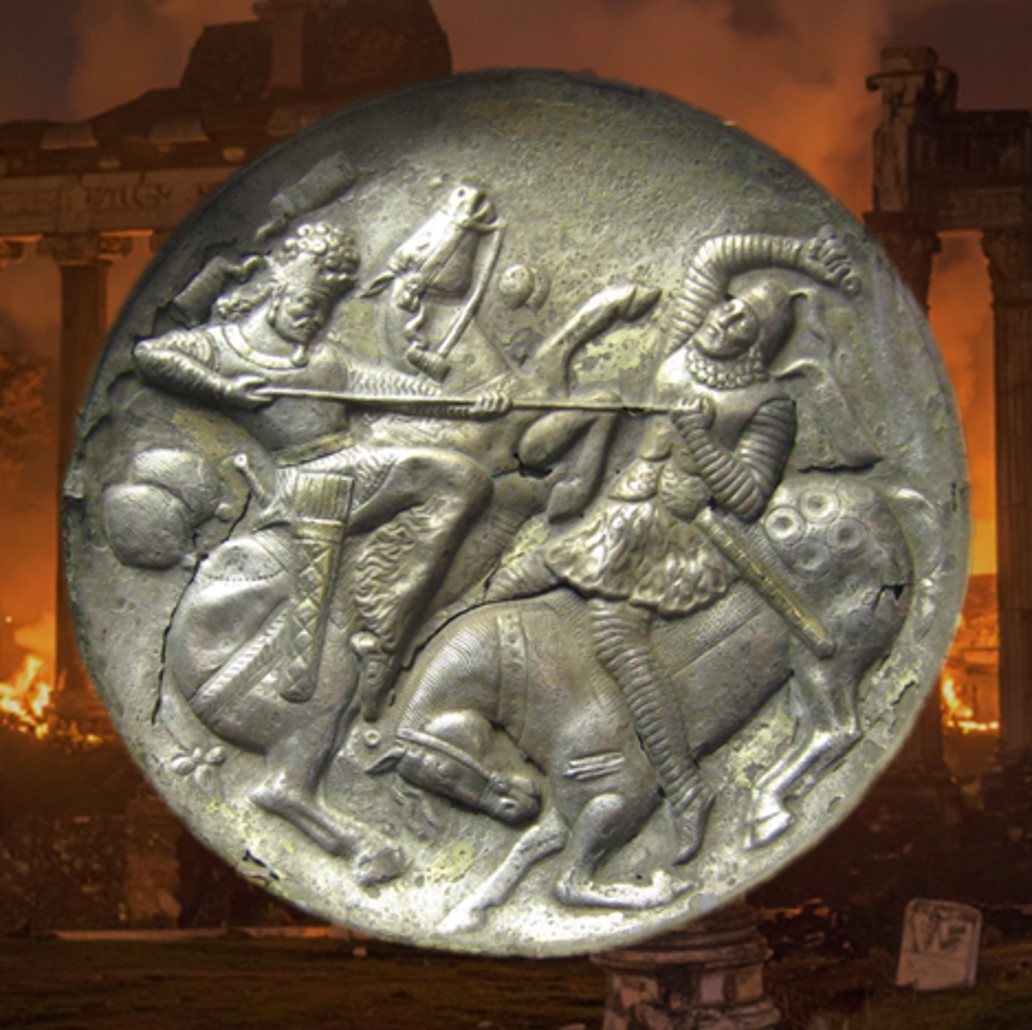
Episode 124: The Last Great War of Antiquity
Between 602 and 628 CE, Rome fought Persia for the very last time. The war marked the end of the ancient world, and the beginning of the Middle Ages.
| Read Transcription | References and Notes |
| Quiz | |
| Episode on Spotify | Episode on Apple Podcasts |
| Previous Show | Next Show |
Episode 124: The Last Great War of Antiquity
Image Credit: Alborz Fallah
Gold Sponsors
David Love
Andy Olson
Andy Qualls
Bill Harris
Christophe Mandy
Jeremy Hanks
John David Giese
KelleyGr
Laurent Callot
Maddao
Mike Roach
ml cohen
Nate Stevens
Olga Gologan
Steve baldwin
Silver Sponsors
Alexander D Silver
Andreu Andreu i Andreu
Basak Balkan
Boaz Munro
Charlie Wilson
David
Devri K Owen
Ellen Ivens
Evasive Species
Hannah
Jennifer Deegan
John Weretka
Jonathan Thomas
Julius Barbanel
Michael Sanchez
rebye
Top Clean
Ukko
Sponsors
Carl-Henrik Naucler
Joseph Maltby
Stephen Connelly
A Chowdhury
A. Jesse Jiryu Davis
Aaron Burda
Abdul the Magnificent
Aksel Gundersen Kolsung
Alex Metricarti
Andrew Dunn
Anthony Tumbarello
Ariela Kilinsky
Arvind Subramanian
Bendta Schroeder
Benjamin Bartemes
Berta Kienle
Brian Conn
Bruce Spencer
Carl Silva
Carolyn Sabol
Cat Peterson
Charles Hayes
Chief Brody
Chris Auriemma
Chris Brademeyer
Chris Tanzola
Christopher Centamore
Chuck
Cody Moore
Daniel Stipe
David Stewart
Denim Wizard
Dominic Klyve
Eliza Turner
Elizabeth Lowe
Eric
Eric McDowell
Erik Trewitt
JK Huysmans
Francine
Friederike Otto
FuzzyKittens
Garlonga
Glenn McQuaig
J.W. Uijting
James McGee
Jason Davidoff
Jay Cassidy
JD Mal
Jillyp
Joan Harrington
joanna jansen
John Barch
John Sanchez
John-Daniel Encel
Jonah Newman
Jonathan Whitmore
Jonathon Lance
Joran Tibor
Joseph Flynn
Joshua Edson
Joshua Hardy
Kathrin Lichtenberg
Kathy Chapman
Kyle Pustola
Lat Resnik
Laura Ormsby
Le Tran-Thi
Leonardo Betzler
Lori Gum
Maria Anna Karga
Mark Griggs
MarkV
Matt Hamblen
Maury K Kemper
Michael
Mike Beard
Mike Sharland
Mike White
Morten Rasmussen
Mr Jim
Nassef Perdomo
noah brody
Oli Pate
Oliver
Paul Camp
Peter Goldstein
pfschmywngzt
purden@verizon.met
Richard Greydanus
Riley Bahre
Robert Auers
Robert Brucato
De Sulis Minerva
Rosa
Ryan Goodrich
Ryan Shaffer
Ryan Walsh
Shaun
Shaun Walbridge
Sherry B
Sonya Andrews
Steve Grieder
Steven Laden
Stijn van Dooren
Stuart Sherman
Sue Nichols
SUSAN ANGLES
susan butterick
Susan Hall
Ted Humphrey
The Curator
Thomas
Thomas Leech
Thomas Skousen
Thomas Woolverton
Tim Rosolino
Tod Hostetler
Tom Wilson
Torakoro
Trey Allen
Troy
Valentina Tondato Da Ruos
vika
Vincent Vandeven
William Coughlin
Zak Gillman
This program will explore the late history of the Persian Sasanian empire, up to and including Byzantine-Sasanian War of 602-628 CE. The war, which took place during the life of the Prophet Muhammad, was a massive, generational conflict – one in which the two most powerful empires in central Eurasia pummeled one another for 26 years, only to result in the status quo ante bellum, or the “state existing before the war.” It’s just that when the smoke cleared, neither empire was the same as it had been before the war. The war’s end, in 628, indeed resulted in the general resumption of territorial boundaries that had been there in the late 500s. But by 628, the Sasanians and the Byzantines were broke and exhausted, and more vulnerable than ever to divisions from within, and military aggressors along their vast borderlands. The most famous of these aggressors were the armies of the Rashidun caliphate, which, between about 630 and 650, reduced the Byzantine empire to a fraction of its former size, and ended the Sasanian Dynasty’s ascendancy for good.
The Byzantine-Sasanian War of 602-628 is often called “The Last Great War of Antiquity,” hence the name of this episode. It was the last time that the Persian east fought the Mediterranean west, and the last time present-day Syria and Iraq lay at the edges between two worlds, before this region became the center of a new world. It was the war that, more than any other war, ended antiquity and heralded the beginning of the Middle Ages. In the Anglophone world, we don’t talk about this war much. We seem to like our Greeks and Persians to be from the 400s BCE, rather than a thousand years later. We seem to like our Romans speaking Latin in Rome during the Julio-Claudian period, and not Greek in Constantinople six hundred years after that. The Byzantine-Sasanian War of 602-628, to medieval histories focused on western Europe, is a far off, nebulous conflict. To Arab-Muslim historians of the Middle Ages, the war was a Jahili prequel to an Islamic blockbuster – the story of two old, blasphemous bullies pummeling each other for so long that a righteous youngster was able to show up and dispatch both of them pretty quickly. When the War of 602-628 is covered in modern academic or popular history, the coverage generally focuses on the Roman side of the story, or, in Islamic Studies departments, how the war’s aftermath enabled the conquests of the Rashidun caliphate.1
And within the already obscure saga of the Byzantine-Sasanian War of 602-628, the Sasanian side of the story is especially obscure, the saga of vast, ancient empire home to regions whose names are only faintly familiar – Sogdiania, Turan, Makran, and Pars. The last Persian empire of antiquity was gigantic. But who were the later Sasanians? Were they a unified, tightly knit empire, like the Romans under Trajan, or something else? What did they believe? What did the immense swathe of territory they inhabited, which stretched from Iraq to Pakistan, look like from region to region? As historian Parvaneh Pourshariati put it in a recent book, “The resultant [story] that we have been left with is one in which the Arabs [who conquered the Sasanian empire] fought a host of ghosts in Iranian territories. And as ghosts cannot be active participants in any history, it is not clear whom precisely the Arabs fought in their war of conquest in the Sasanian territories.”2 In this episode, we will discuss those ghosts, and, focusing on the Sasanian side of antiquity’s last great war, explore the last half century of the Sasanian empire’s history.
If you’ve been listening to this sequence of programs on early Islamic history, you’ll notice that we’re going backwards in time for a moment with this episode. With Muhammad and the Qur’an now covered, why would we now make a hairpin turn to discuss the twilight of a central Eurasian empire that had little to do with Islam? Isn’t it time to talk about the great cultural history of the Abbasid caliphate? Also, when are we going to get to Dante? Let me answer these questions. [music]
Arabs and Persians
Speaking of Dante, the Persian poet Abolqasem Ferdowsi, who has the stature of Dante in much of the world today, wrote an epic called the Shahnameh around 1000 CE – we’ll get to it soon.3 Today, the Shahnameh is the national epic of Iran. Commissioned by the Sultan Mahmud of Ghazni, at a time when a Turkic dynasty of Persian Muslims ruled over Iran, the Shahnameh contains a number of withering remarks about Arabs, such as when a Sasanian general in the epic boasts, “My heart has no fear of Arabs. It hurts the eyes just to look at them, they eat snakes and lizards and they have no skill at fighting.”4 What’s important to remember for those of us new to Arabic and Persian literary history is the Persian perspective that we see in these famous lines of poetry. After the Byzantine-Sasanian War of 602-628, from about 632-651, the Rashidun caliphate conquered the Sasanian Persian empire. Then, for the next two centuries, with varying degrees of success, Arab caliphs and administrators ruled over Persia. Persians, from the Euphrates to the Oxus, in spite of being conquered, still remembered that theirs was a very ancient and advanced civilization, and some of the earliest Persian poetry reflects reservations and condescension toward Arab leaders and settlers, with their sometimes rustic roots and unpolished ways. Islam, following the conquests of the caliphs, sunk in almost everywhere. But in spite of the religion’s emphasis on an umma equal before God, there were still Berbers and Copts, Armenians and Turks, and most importantly of all, at the beginning, at least, Arabs and Persians, and Arabs and Persians, and Arabs and Persians.The Arabs, from the Persian perspective, were militarily indestructible barbarians who had scythed up from the Arabian Peninsula and brought with them an appealing new religion. The Persians, from the Arab perspective, were at once effete and intimidating – the scions of a ridiculously ancient empire whose decadent splendor the Arab invaders disdained even as they speedily emulated it. This story of brawny colonizer and elegant colonized is one we’ve heard before. The Romans, during the republican period back in 146 BCE, had also conquered a vast and ancient civilization to their east. This conquered civilization also remembered its considerable cultural history. Just as the Greeks superciliously served the Romans for centuries, Persians of the defunct Sasanian empire ministered to the needs of an Arab-Islamic regime for two centuries, making themselves indispensable as ethnarchs, bureaucrats, viziers, tax collectors, fixers, and kingmakers, and in particular, taking care of the leaky right side of the empire for caliphs willing to delegate sovereignty of the east.

A 15th-century French manuscript illustration of Heraclius bringing the True Cross back to Jerusalem. The story of the last great war of antiquity, when discussed in European history, has focused on Heraclius and the (alleged) True Cross relic.
The episode that you’re listening to, then, to repeat, is about the final century of the Persian Sasanian empire, and the Byzantine Sasanian War of 602-628, again often called “The Last Great War of Antiquity.”5 The story of this war is operatic in its scope and its reversals of fortune – after centuries of back and forth fisticuffs and tribute payments, suddenly the Sasanian Empire goes or the Byzantine jugular, only, just as the Romans are about to perish forever, they show their ancient teeth, and on the story goes, campaign season after campaign season, in a drama that spans decades and continents. And while we’ll know the main story of the war by this program’s end – the story of how Heraclius fought Khosrow II – again, I hope to focus on the eastern side of the story just a bit more than is usually done in Anglophone works of history.
Due to some very recent scholarship, we know much more about the late Sasanian empire at present than we ever have before. Archaeological survey work on coins and seals and inscriptions, together with studies of surviving literary materials, have begun to paint a picture of the last Persian empire as something far less monolithic than was previously understood. The Sasanian emperor’s title, Shahanshah, or “king of kings,” conjures up the picture of a rigidly hierarchical society in which an autocrat reigns over all. However, an increasing body of evidence suggests that the Sasanian monarchy actually leaned on the consensuses of a cadre of extremely powerful patrician families scattered all over present-day Iran and beyond, families that, following the Islamic conquests, shrugged, dutifully jotted down each new caliph’s name and converted to Islam with varying degrees of devoutness, and continued doing what they had been doing before.
The story of Islam’s roots and its principal text is a west Arabian story, as we’ve learned in this season of the podcast so far. The story of the caliphates, however, is a global one, and it necessarily involves some Persian history. From 602-628, as the Prophet Muhammad went from about age 32 to age 58, north of the sparsely populated Arabian Peninsula, two gigantic empires almost completely destroyed one another. The saga of how they did so is one of the great war stories in human history, and it will also introduce us to many of the key regions and populations relevant to the Islamic golden age to come. [music]
The Sasanian Sixth Century and Rise of Khosrow II

The Sasanian empire in 602, just before the war. Khosrow II had just dissolved the Lakhmid client kingdom (centered in al-Hira, far west-center), and so the empire no longer had a buffer between itself and the Arabian peninsula. Image by Keeby101.
The Byzantine empire, whose inhabitants called themselves Romans, and which is often simply just called “Rome” in contemporary scholarship, had had a taxing, but ultimately very successful sixth century. Under the reign of Justinian I, the Byzantines had nearly succeeded in reconquering the Mediterranean basin. North Africa was theirs once again. Much of Italy was, too, and a stretch of the Spanish coast, and these territories were won in part by the expedient of hasty bargains made with the Sasanian Persians. If wars of conquest were going successfully in the west, then the Byzantine emperor could send some of spoils to the east to pacify its main nemesis. This was the pattern of the middle part of the 500s in central Eurasia. The Byzantines paid gold for peace with the east, and in the east, the Sasanians took the money and, conscious that the Byzantines were doing awfully well over there in the Mediterranean, sometimes made war on them anyway.

The Byzantine empire at the end of the sixth century and the close of the Justinian Dynasty. The Romans had had a fantastic century during the 500s, sweeping up a lot of prime coastal real estate. Here, the Lakhmid kingdom and Persian vassal states on the bottom of the Arabian boot are shown. Notice the Avar Khagnate and Western Turkic Khagnate (northeast), and of course the Quraysh in west Arabia. The whole region was a different place a century later! Map by Getoryk.
The Byzantine and Sasanian empires called themselves the “twin eyes of the world,” and with some justification.6 By 602, their territorial holdings were gargantuan, and each empire had its tendrils into smaller adjacent kingdoms and larger far-off territories, too, from Visigothic Spain to China. But as large as they were, the so-called eyes of the world were also at the center of a tricontinental junction where population migrations and population growth, in spite of the previous century’s Black Plague, were changing the rules of how Eurasia had always worked. The Asian side of Eurasia, decade after decade, had sent hordes of barbarians southwest. The Romans, back in the 300s, had met the Huns, who had galloped down into Europe from the distant steppes of Kazakhstan and Mongolia. The 500s saw Eurasia’s two central empires encountering new invaders from the north and east. Khazars, Avars, and Slavs scourged Constantinople from the 500s onward, just as the Sasanians crossed swords with Hephthalites and Gokturks. Again, and again, during the 300s, 400s, and 500s, barbarian populations mounted on horseback were coming down from the upper right of Eurasia to the lower left, and these migrations drove the motor of the supercontinent’s history toward the end of Late Antiquity. The old central Eurasian hegemony of Romans and Persians, then, by the year 600 when the last great war of antiquity began, was giving way to a new period of history, when a more crowded supercontinent would be ruled more by transient kingdoms than by enduring empires. When the Romans and the Persians unsheathed their swords for a final time in 602, though they couldn’t have known it, empires of their scale were living on borrowed time.
The roots of the Byzantine-Sasanian War of 602-628 lay in earlier wars between the two powers, and political maneuvering at the highest level. In the year 591, a Sasanian emperor named Khosrow II had taken the throne of the empire. Khosrow II, essentially the driving force of the last great war of antiquity, will be one of our two main characters for today. So let’s meet Khosrow II, without whom the last great war of antiquity would never have taken place.
Shrewd, cruel, tactically brilliant, and ambitious beyond belief, Khosrow II rose to power in the murk of his father’s assassination during a coup, taking the Sasanian throne only with the aid of Roman collaboration. The story of Khosrow II’s succession to the throne is at once appalling and ordinary. Reduced to desperation and brutality by the military coup of a general who had served his father and grandfather, Khosrow II was buoyed to power by two uncles. Khosrow II also partnered with the Romans, and he used every tool at his disposal to smash his political foe. In 591, with Roman backing, Khosrow II won a civil war in the Sasanian empire. He would ultimately rule from 591-628. And he remembered the name of the unlikely ally who helped him to power.
The Roman unlikely ally who had brought Khosrow II to power was the Byzantine Emperor Maurice. Maurice, who ruled from 582-602, was a reasonably talented and capable Roman emperor as they came, given the difficult task of holding together a newly ballooned Byzantine empire that seemed plagued with a rolodex of enemies old and new – there were Lombards, Berbers, Avars, Slavs, Khazars, and the usual round of provincial revolts, as well as a treasury exhausted by an overextended military and the Bubonic Plague. When the Byzantine emperor Maurice helped the Sasanian emperor Khosrow II to the throne in 591, Maurice probably saw the young man as an expedient to quiet the eastern front, more than anything else. Facilitating Khosrow II’s rise meant that Maurice’s Persian counterpart was an untested, pasty-faced 20-year-old heir, rather than the crackerjack Persian general who had seized power. Maurice could not have known just how dangerous a threat Khosrow II would ultimately prove.
The unusual partnership between the pair in charge of two enemy empires lasted until the emperor Maurice’s death in 602. Maurice, as I said a moment ago, came to the throne at an unlucky time, inheriting expensive wars in all directions, a citizenry depleted by the Black Plague, and a cadre of armies as experienced as they were fed up with campaigning around the clock and not being very handsomely compensated for it. One of these armies had been left out to pasture between 601 and 602 in the Balkans to fend for itself because Maurice couldn’t scratch together enough money to pay it. And of course, unpaid armies led by ambitious generals are not a good thing to have marching around the interior of your empire.
.jpg)
Phocas (r. 602-610) was a pretty normal usurper emperor as they came, but his reign was cut short by that of Heraclius. Photo by Classical Numismatic Group.
The “all hell” in question would come from Khosrow II. The Sasanian king, who’d spent the first decade of his Roman-backed rule clinging to power with his teeth, shaking off majordomos who tried to control him, and consolidating his rule through a combination of luck and farsighted viciousness, once again remembered who had put him on the throne in the year 591. When, in 602, the usurper Phocas killed Maurice, Khosrow II spoke of the dead Byzantine emperor as his father and benefactor. Khosrow II vowed vengeance against the usurper Phocas. Sasanian emissaries arrived in Constantinople, and they informed the newcomer Phocas that Khosrow II was coming for him – that the blood on Phocas’ hands would only be washed away by the rivers of blood that were to come.7 The colorful rhetoric may be a fiction. The real Khosrow II might have cared very little for parsimonious and unlucky old Maurice, and simply used the emperor’s murder as an excuse to get the ancient Roman and Persian slugfest going again. Whatever Khosrow II’s real motivations were, perhaps no one – neither Byzantines nor Sasanians – could have predicted how far Khosrow II intended to take things. The previous century’s perennial tug-of-war over Syria and Armenia would, as the last great war of antiquity began, turn into something more dire. Because in spite of the fact that it had never been done before, and in spite of the fact that the whole supercontinent was more than ever full of dangerous new tribes and kingdoms, Khosrow II intended to destroy the Byzantine empire and retake the vast western territories once held by the Achaemenid Persian monarchs of old. [music]
602-610: Sasanian Luck and Byzantine Tumult
Khosrow II, as he prepared to avenge his Byzantine benefactor Maurice, had some good fortune, and then more good fortune. The Sasanian Empire’s enormous eastern borderlands were quiet. A group called the Kok Turks had increasingly been harrying the Persians in this region over the course of the previous century, but in the opening months of 602, the Turks were in the middle of a long civil war. Khosrow II thus went westward to make war on the Romans with few reservations. The king of kings also had good luck in that the Byzantines, over the opening years of the war, had to deal with a series of overlapping catastrophes.Just as the Persians invaded their eastern front, an eastern Byzantine general, seated in the upper Syrian city of Edessa, defected to the Persian side. At the same time, the northern Avar barbarians demanded a higher tribute payment from the new emperor Phocas. Though the rebellion in Edessa was put down, by 603, Khosrow II was on the warpath, intending what appeared to be a conquest of Anatolia and a direct attack on Constantinople. The Sasanian emperor, like other Persian kings before him, rode among a unit of battle elephants, which grouped together in a defensive formation and were themselves protected by infantry and cavalry. The Sasanian mixture of elephants, cavalry and infantry wasn’t just for show. When Byzantine cavalrymen squared off against squadrons with elephants, the mounted troops found that their horses weren’t too keen about galloping in to potentially be smooshed by pachyderms ten times their size, and when the Byzantine cavalry faltered, so, too, did the Byzantine army.
The Sasanians, by late 603, were concentrating their efforts on the Roman fortress town of Dara in between the northern Tigris and Euphrates, and they punctured this crucial Byzantine defensive line in the summer of 604. Several campaign seasons deepened the punctures through the Byzantine defensive line in eastern Anatolia, and by 608, the populous flatlands of Asia Minor lay open to further Persian attacks.
This was all grim news for the usurper emperor Phocas, who was six years into his reign, and perhaps wishing that he hadn’t usurped anything. Unfortunately for the soldier-turned-Byzantine-emperor, things were about to go from bad to terrible. Because down in the balmy and generally secure Roman breadbasket of North Africa, a major rebellion rose up. An exarch in Africa, along with his capable son, knowing that their moneymaking province was a lynchpin of the Byzantine economy, decided to remove that lynchpin and attack Constantinople. Just as the North African rebels moved on Constantinople, down closer to the Byzantine-Sasanian hot zone, the Byzantine city of Antioch exploded into anarchy, with the city’s perennially oppressed Jewish population expressing their support of the rampaging Sasanians.
As the North African rebels closed on Constantinople, and the Sasanians seized more Byzantine territory, it was starting to become clear that Khosrow’s military intentions were different than those of his predecessors. The Sasanians, between 602 and 608, were not just intent on smashing and grabbing, nor imposing tribute payments and then carrying the cash back home to Iran after exchanging high fives. They were setting up garrisons. They were corralling Byzantine citizens and deporting them back to the Sasanian heartland to resettle them where they could no longer be a threat. Sometimes, as with deportations and resettlements of Nestorian Christians who’d been oppressed under Byzantine rule, certain Byzantine populations were perfectly happy to be conquered. Khosrow took advantage of all of it. As the Byzantine emperor Phocas turned west to deal with the North African usurpers who had come for his head, Khosrow II assumed control of large swathes of Byzantine Syria, having taken control of the city of Edessa by 609. With this and other victories, the Sasanians held the pivot point between Anatolia and the Levant, and Persia could advance in either direction as needed.
On the Roman side of the war, in 610, things went from worse to positively grim. The usurper emperor Phocas, who had now ruled for eight terrible, catastrophic years, received news that the North African rebels had seized control of Egypt, another lynchpin of the Byzantine economy. The Romans, now in a full-scale civil war, could no longer defend themselves, and Persian armies seized cities along the upper Euphrates like kids in a candy store. They had held northern Syria before. Now they really had hold of it. The question arises, then, that if, in the year 610, the Byzantines were in such a tailspin, and the Sasanians were pummeling them so successfully, why did the war continue for another 18 years? And the answer to this question lies in two main characters we have yet to meet.
Shahrbaraz and Heraclius
We’ve already met Khosrow II, the Sasanian king of kings, who would be the commander-in-chief of the Persian troops for the entire duration of the war. Khosrow II had in his stable of military war chiefs a particularly able general named Shahrbaraz, whose name means “Boar of the Empire.” To Sasanians, his name meant that he smashed through everything, and always won. Shahrbaraz often took point on the Persian side during the Byzantine-Sasanian War of 602-628. Khosrow II, then, and his eminently capable general Shahrbaraz, led the effort to destroy the Byzantine empire for good. And as to the final main character in this great conflict, let’s get acquainted with him.In October of 610, in Constantinople, the usurper emperor Phocas, after a miserable eight years on the throne, was deposed by another usurper emperor. This other usurper emperor was Heraclius. And in spite of the fact that Heraclius ascended to the throne of an empire coming apart at the seams, he would hold those seams together, and rule for the next 31 years. Heraclius, the highborn son of the Exarch of Africa, like so many other Byzantine and Sasanian emperors at the dusk of Late Antiquity, came to the throne at a very difficult time. But over the course of nearly his entire reign, he would prove capable of working under pressure and threat of catastrophe, performing triage after triage of an ailing empire, giving the vaunting Sasanians a run for their money, and ultimately being one of the most talented Roman emperors in history.
In our story for today, the ranks have been formed, with Rome, as always, on the left, and Persia, as always, on the right; with Heraclius in charge of the Byzantines, and Khosrow II leading the Sasanians. What’s perhaps most fascinating to keep in mind as we go through the remainder of this war is that the fate of a lot of the world hung on every battle, every chance barbarian invasion, every siege, and every back-channel negotiation. Because if Khosrow II had won – or if something else had interrupted the war, or if diplomatic settlements had ended the conflict earlier, the Rashidun caliphate, in the 630s CE, would have faced the full might of the Sasanian and Byzantine empires, and would likely not have expanded the way that it did. Had the last great war of antiquity not played out precisely as it did, Islam would not have been the religion of an intercontinental ruling caste of Arabs by the end of the 600s, and the world as we know it would be a very different, and likely far more Zoroastrian place. That makes this story worth knowing. So, moving forward, in 610, settling in in Constantinople, Heraclius decided on a time-tested maneuver with the Persian battle axe now wedged into the Byzantine empire’s east side. Heraclius sent Khosrow II gifts and peace emissaries, proposing an armistice. The Persians didn’t actually want to destroy Rome, did they? They were rivals, but there had been intermittent respect between the two empires from time to time. Wouldn’t Khosrow accept tribute payments, as his predecessors had? Khosrow II said he would not, and he had the Byzantine peace emissaries decapitated. Khosrow II didn’t want Byzantine money. He wanted the Byzantine empire. On this cataclysmic note, the campaign season of 611 began. Khosrow II used his territorial gains and tactical advantages to attack Asia Minor. One general assailed a stronghold in Cappadocia, to the northeast. Another went to Anatolia’s underbelly, digging more deeply into Syria before angling south, toward Palestine. As the Sasanians set their sights on the prized cities of the Levant, finally, the Byzantine emperor Heraclius managed to organize a counterattack, forcing the southern wing of the Sasanian assault out of the Levant and up toward the northern Sasanian faction. This counterattack, by the summer of 612, began the next phase of the war. The Byzantine emperor Heraclius, whose rise to power had been rocky, had no right-hand man in the way that Khosrow II had Shahrbaraz, nor even any set of battle-tested generals with recent experience. Heraclius scraped together what he had – an assortment of the Berber tribesmen who had backed his revolt in North Africa, together a field escort that protected the emperor himself, and units left over from the Byzantine east. And with his motley army, Heraclius did something rather unusual for a Roman emperor. Heraclius led the army himself. A Roman emperor hadn’t done this since 378, way back when the emperor Valens had been killed by Goths at the Battle of Adrianople. With Heraclius at its helm, over the later months of 612, Roman survivors of the Sasanian blitz of Syria and Armenia trickled in to join what was now the main Byzantine army. Heraclius was hardly in advantageous position. His first four years on the throne had been bleak and unpromising, and as he commanded his new slapdash army against the assailing Persians, it could hardly have been with a sense of imminent victory. Still, when the weather grew warm and the campaign season of 613 began, Heraclius had a chance. He had an untested army, a severely wounded empire, and a dearth of qualified senior officers. But again, he had a chance.
613-615: Sasanians Seize More Territory
In the summer of 613, the main Persian and Roman forces converged near Antioch in a battle with heavy losses on both sides. The Persians ultimately defeated Heraclius. It was an inauspicious beginning to the emperor’s already inauspicious career on the throne. Persian control of Antioch completed an important Sasanian strategic maneuver. The Sasanians had encircled Asia Minor from the east, cutting the Byzantine empire in half, and the Sasanians had also secured control of eastern Mediterranean seaports. For the first time in a millennium, in the autumn of 613, the prows of Persian ships cut through the Mediterranean Sea, and in 614, the great Persian general Shahrbaraz tore into the urban centers of present-day Lebanon and Israel, taking Caesarea, the small towns of Galilee, and the highlands of Golan before turning their attention on Jerusalem.The Sasanians knew well enough the significance of Jerusalem for the Romans, and when they appeared at the city’s walls, the citizens surrendered, capitulated, and let the Persians into town, where the Sasanians installed a governor. Within a week, however, rebels within Jerusalem murdered the newly appointed governor, and with help from soldiers stationed along the nearby Roman frontier, the citizens of Jerusalem joined ranks to defend the city. A short, 19-day siege ensued. The Sasanians had siege equipment, and they used it. Once the walls were down, the Persians massacred the city’s citizens, took others captive, and seized a relic known as the True Cross, believed by the Romans to be the very cross on which Jesus had died. The loss of Jerusalem, and the True Cross, was catastrophic for Byzantine morale. The Romans were quickly losing the war, and both sides knew it.
Khosrow II, in 615, decided it was time to finish the job. The Roman east had been shattered. The old Roman sovereignty over the Mediterranean was no longer secure. The Romans could no longer defend Anatolia from the east. Khosrow II ordered his forces into the giant heartland of the Byzantine empire. His goal was Constantinople. Over the campaign season of 615, the Sasanians marched westward across Asia Minor. They reached the Bosporus shore across from Constantinople and made camp. The Roman emperor Heraclius met the Sasanian general in charge of the westward march, once again trying to purchase peace. The Persian general was cordial but firm. The King of Kings Khosrow II was not interested in peace.
The Roman citizens of Constantinople, with Persians visible from the Golden Horn, heard more and more dreadful news over the course of 615 and 616. The Sasanians were seizing Anatolian cities. Smyrna, Pergamum, Ephesus, and Miletus fell. Rivers of money flowed into Sasanian treasure chests. The mid-610s were among the most dire years in all Roman history. But they also marked a turning point.
For the entire duration of the war, the Sasanians had been riding on a cushion of good luck. Their eastern, and northeastern extremities had been quiet for a long time, due to a civil war among their enemies across the border. Around 614 and 615, though, just as the Persians stomped into Anatolia, a rebellion roared to life in Khurasan. The Hepthalites, or the White Huns, were Sasanian subjects ruled over by a king in what is today northern Afghanistan, a group of them having been subjugated the previous century on the south side of the Oxus River. Backed by powerful Turkish allies to the northeast, the Hepthalites began a large assault on the Persian cities of Khurasan, giving Khosrow II a harsh reminder that emperors almost always have to do many things at once. The Sasanians were lucky with the Hepthalite uprising of 615, putting it down relatively quickly even as they chopped deeper into Asia Minor, but the troubles south of the Oxus River reminded the Sasanians that there were other powers out there than the Byzantines that they were going to have to deal with sooner or later.
615-622: Sasanians Take Egypt and Enter the Aegean
Still, in the second half of the 610s, the Byzantine conquest remained Khosrow II’s primary focus. Khosrow II knew that Constantinople, with its giant walls, natural water supply, and tricky ocean currents was a tough nut to crack. And so, rather than going for the head of the Byzantine empire, he made a strategic decision in 618. With the seizure of Syria, Persians had already chopped off the Roman empire’s arm. Now it was time to take one of its legs. Sasanian armies converged in 618 and, rather than hurling themselves against Constantinople, they turned south, toward Egypt. The subsequent conquest was shocking, and swift. Egypt had been under Roman power for more than 600 years. But by the summer of 619, the Persian general Shahrbaraz had conquered Alexandria, the population center and defensive engine of Roman Egypt. As always in ancient history, the lands of the Nile, flat and with a predictable concentration of cities along the river, was a straightforward conquest. In three years, Egypt was under Persian control.And after Egypt fell, the Byzantine territorial and military losses, incredibly, continued to pile up. Anatolia was a large land mass, with plenty of territory and loot to capture, and in the first two years of the 620s, Persian armies took towns and cities of all sizes in Asia Minor, carting off private and ecclesiastical wealth alike to power the Sasanian war machine. In the Aegean, in 622, the Persians disembarked on the island of Rhodes, conquered it, and claimed it as their own. And Persians weren’t the only assailants who’d turned the Byzantine empire into a punching bag. Lombard attackers were chopping away at Byzantine Italy. Avars and Slavs sawed into the Byzantine north, along the old Roman frontier of the Danube. The emperor Heraclius, with his cobbled together army, had lost his only major engagement with the Sasanians ten years earlier, and he must have felt more hopeless than ever after an utterly dismal twelve years on the throne.
622: The Byzantine Empire’s Darkest Hour

Khosrow II seized an enormous amount of Byzantine territory of prime strategic importance in the war’s opening years. Map by Keeby101.
Because speaking of Christian churches, the Byzantine emperor Heraclius was, in 622, scrounging around in what was left of Byzantine Asia Minor for any gold and silver that could be found in order to get an army going. One small benefit the Persians being busy amputating Egypt from the Byzantine empire was that poor Heraclius could at least muster and train troops in Anatolia, and recruit mercenaries from central and western Europe. By 622, he had done this enough to begin some counterstrikes in modern-day Turkey. The first was in the region of Cappadocia, where Heraclius outmaneuvered the Persian general Shahrbaraz. Just as the Byzantines showed a spark of life, however, they were soundly struck again, only this time from another direction.
This strike came from the Avars. The Avars, a group from the northeastern Caucasus region who had been attacking the Byzantine empire for about 50 years, saw that the Romans were vulnerable, and took advantage of it. In June of 623, the emperor Heraclius met with them in person to negotiate, although in disguise. The disguise was fortunate, because when the Avars abruptly attacked Heraclius’ party and attempted to kidnap the emperor, Heraclius was able to escape, leaving the Avars to pillage outlying regions of Constantinople. The Avars, having shown their might, were dutifully paid off – the latest humiliation that the Byzantines had to endure in a long round of them. As with other groups that the Byzantines paid off in the 500s and 600s, the Avars would be back soon.
Heraclius Begins a Counteroffensive
As far as Heraclius was concerned, though, he had more pressing matters to attend to than the northern barbarians, even though the Avars had just tried to abduct him. It was time, the Roman emperor decided, to fight back. Khosrow II, in 624, was surprised to hear that a large Byzantine army was on the loose, and it was smashing through newly built Sasanian defenses – that the Romans were now in control of a major fortress city in Cappadocia, in the Anatolian northeast. Khosrow II amassed his forces in the far northwest of what is today Iran, expecting Heraclius to turn southeast from Cappadocia and fight him there. Instead, Heraclius turned northeast, tearing into the Persians’ newly acquired territories some distance to the north, and ignoring the Persian military.Heraclius’ maneuver in the summer of 625 was as surprising as it was effective. The Persian defenses up north were thin, and the borderlands with Armenia were full of soldiers of fortune happy to join the Byzantine cause for a price. No one had expected an assault up north, and Khosrow II, hearing of the sudden despoliation of Persian Armenia, understood that the swelling Byzantine army might invade Mesopotamia if not stopped. The King of Kings amassed three armies southwest of the Caspian Sea to wall off Persia from any direct Byzantine assault – a force that numbered somewhere between 70,000 and 90,000 troops.8 The plan was simple. Constrict the throat of the Anatolian peninsula, eradicate the Byzantine resurgence, and win the war. This Heraclius fellow, Khosrow II thought, had been floundering for his entire time on the throne, and in spite of whatever he’d been doing up in the Armenian borderlands, Heraclius would soon be put in his place. Heraclius, however, had different ideas. [music]
625-626: The War at its Most Intense
Heraclius thus faced three sizable armies in the spring of 625, and, because he was positioned to do so, he struck fiercely at the northernmost Persian army, gouging and stabbing away at it until the northern army fled to join the central army, which was led by the famous general Shahrbaraz. Shahrbaraz received false intel that the Byzantines were fleeing, and fleeing in a state of disarray. The central Persian army pursued Heraclius, intending to take advantage of the Byzantines’ alleged disorder. Instead, the Persian attack force found the Byzantines ready for them, and when Shahrbaraz attacked, the Byzantines found the Persians hasty and overextended, and were able to fight them off. One of the three Persian generals was severely wounded.
Byzantine and Sasanian campaigns between 611 and 624. These years would be a tough time to be living in central or eastern Anatolia. Map by Mohammad Adil.
When a third Sasanian army arrived to reinforce the other two, the Byzantines, warmed up and in a battle-tested position, defeated this one, as well, looting their supplies and chasing them along a river valley on the border of modern-day Iran and Armenia. Heraclius, then, as the weather cooled and the campaign season of 625 wound down, had used slipperiness and discipline to fend off a huge trio of Persian armies. Heraclius even, once the two sides had gone to their winter camps, blitzed Shahrbaraz’s center of operations, plundering the Persian camp and sending the famous Persian general dashing off to save his skin.
Khosrow II, after the significant and unanticipated losses of 625, spent the winter thinking and planning. Guarding the exit routes of Anatolia to protect Persia had not worked very well. The Byzantine emperor who should have never been a problem was becoming a serious inconvenience. Thus, Khosrow II reverted to a strategy the Sasanians had already attempted. The Persians would defend by attacking, and march for Constantinople.
The Sasanians, at this juncture of the war, continued to have the upper hand. Their numbers were higher, their war chests were battened from a decade and a half of victories, their generals had more experience, and Khosrow II, of course, was still one of the most determined, crafty, relentless, talented adversaries Rome had ever faced. As a case in point, in 626, Khosrow II sent envoys up to the Avars in present-day Hungary. The Avars and Persians struck a bargain. Persians would attack Anatolia. Avars would attack Constantinople. When it was all over, the Avar khagan would rule the European half of what had been the Byzantine empire, and the Persians would rule the Asian half. Rome was in for a very, very hard year.
The Persian military strategy in Asia Minor in 626 was fairly simple. Heraclius’ army was way over on the Armenian borderland, positioned to attack Iran. The Sasanians, attacking Anatolia, would draw Heraclius in and take chunks out of his army as he hurried back to Constantinople to defend it. If the Sasanians succeeded, Heraclius would never get there at all. Heraclius, however, was already on the move before the winter’s end. He went southwest, rather than west, through the mountainous territory of eastern Anatolia, using rivers and crossing points to great strategic advantage, evading Shahrbaraz until the leading Persian general gave up. Shahrbaraz knew where Heraclius was going, and Shahrbaraz planned to intercept Heraclius, using another Persian army, inbound from the north, to smash Heraclius in a pincher attack. Heraclius, however, did not plan on being attacked. He was not dashing toward Constantinople, but instead, hurrying to assail the northern Sasanian army. Over the early summer of 626, Heraclius’ army collided with the northern Persian army, and over the course of two weeks of fighting, the Sasanians suffered a major defeat, retreating eastward, with their general, the second Sasanian war chief, retiring from future war efforts.
Still, Constantinople was in trouble. The Persian general Shahrbaraz moved his army to the east side of the Bosporus, and heard with satisfaction that his new Avar allies had made good on their side of the recent deal. The Avars, joined with Slav auxiliaries, numbered somewhere around 80,000, and were amassed on the west side of Constantinople. On July 31, 626, the Avars assaulted the fortifications of the city’s European side, a 3.7-mile expanse of gigantic triple walls helmed with defenders. Constantinople, famously defensible, was ready for this assault. The initial Avar offensive failed. A naval assault on the part of the Avars the next day also faltered, and during the first week of August of 626, the Avar and Slav confederacy, again and again, by land and sea, broke against the walls of Constantinople. The waters that rush through the Bosporus between the Sea of Marmara and the Black Sea are notoriously swift and difficult to navigate, and Byzantine naval defenders used their knowledge of the unique waterway, together with naval defenses, to Roman advantage again and again over this intense week of fighting. Afterward, the morale of the Avars collapsed. They retreated, burning the siege equipment that they had brought with them. On the other side of the Bosporus, perhaps, the Persians saw the glow of the fires that signaled the Avar defeat. The war which Persia had been winning for more than twenty years – from which an entire generation of Sasanians had enjoyed the spoils – suddenly seemed to be anyone’s game. [music]
627: The Western Turks Enter the War
Between 622 and 626, the Byzantines had gone from hemorrhaging territories to defending territories and occasionally reclaiming them. Anatolia and Constantinople had proved to be far more resilient than the Persians could have imagined. The Persian-Avar alliance had failed, the Sasanians had lost significant regions of Asia Minor, and Heraclius was fast becoming a heroic figure to the beleaguered citizens of the exhausted empire.As the year 627 opened, the war entered its penultimate year, having been raging for a full quarter century. During this quarter century, the Persians had done the unthinkable, seizing Byzantine Syria, the Levant, and Egypt, and other territories besides these. Taking advantage of an uncharacteristically long peace along their eastern front, the Persians had shattered the old homeostasis that had existed between the two regions. What happened over the course of the final two years of the war was that, put briefly, the luck that had helped Khosrow II win so much territory ran out, Heraclius continued to be wily and adaptable, and seemingly every single force that had not been attacking the Sasanian empire for the past 25 years began making up for lost time. The last two years of the Byzantine-Sasanian War of 602-628 are fascinating not only because they held a dramatic reversal of fortune for each side. They’re also fascinating because what happened in 627 and 628 would be more of a rule than an exception for the Central Eurasian Middle Ages, when a constant cataract of outside invaders would deflate novel empires almost as soon as they managed to form. Arab, Persian, Turk, or Caucasian, you could conquer land and cordon off your caliphate or empire, but there were always, seemingly, some new dudes on horseback galloping down from present-day Kazakhstan, Turkmenistan, Xinjiang, Mongolia, or Russia, and the moment that your empire got soft, and your eastern and northern ethnarchs and client kings became opportunistic, your dominion’s days were numbered.
Let’s not jump ahead too far, though. The dudes on horseback in 627 were the Western Turks, a group that had been relatively quiet during the entire Byzantine-Sasanian War of 602-628. The western Turkic khagnate, or Gokturk khagnate, lay above the Sasanian empire, an ocean of steppe land and grass at that point ruled over by a leader known as Tong Yabghu, who had at his command tens of thousands of nomads. In 627, Heraclius contacted the Western Turkic khagnate, at that point centered in present-day Kazakhstan. Byzantine gold and potential military advantage over the Persians convinced the western Turks to get involved in the long war. This alliance changed the entire dynamic of the great war, and changed it very quickly.
The Roman-Turkic alliance was catastrophic news for Khosrow II. Over the course of the entire war, Khosrow II had faced west and fought the Romans, but for a brief Hepthalite uprising in 615. With the new Byzantine-Turkic alliance in place, the Sasanians faced a colossal semicircle of foes to its west and north. And in addition to the sudden and gigantic alliance of enemies suddenly bearing down on them from multiple directions at once, the Sasanians faced another problem.
This problem was essentially a lack of empire-wide unity, coupled with low morale as a result of the war’s extraordinarily long duration. Had Khosrow II actually managed to crack the nut of Constantinople in 626, the coalition of alliances and arrangements that at that point made up the Sasanian empire might have held together. However, with Khosrow’s failure in 626, Sasanian leadership began to appear more like what it actually was – a thin veneer of political conformity that had never been very strong, even in the Persian epicenter of Iran. The Persian empire, as we’ll learn in a moment, was happy enough to follow Khosrow II when he was winning in the west. When his victorious streak started to come to an end, though, old fissures in the empire appeared once more, and an entire generation of soldiers, confronted with the specter of an unending war, no longer drew their swords with very much enthusiasm. The most obvious sign of the Persian empire’s internal divisions was that the leading Sasanian general Shahrbaraz left the hot zone up north and he headed down to Egypt. Shahrbaraz, part of an old Persian dynasty that had never felt much fealty to Sasanian leadership, figured that Khosrow II would blame him for the failed siege of 626, and so the great general went down to Alexandria to hedge his bets.
627: The Battle of Nineveh and the Fall of Khosrow II
And just as Shahrbaraz left the war, in the spring of 627, the Gokturks entered it, fresh from the steppe and not at all enervated by decades of campaigning. The Gokturk leader offered Khosrow II a very clear ultimatum. Give the Byzantine empire back Syria and Egypt, or they were coming for Ctesiphon – both the Gokturks and the Romans. Khosrow II, scratching together what forces he could to defend Mesopotamia, did not comply. The Roman and Gokturk armies, just as they had said they would, marched their way toward the Tigris-Euphrates floodplain and the panicked heart of the Sasanian empire, knowing that if they sacked the capital, there was no need for a decade spent retaking all the Roman regions lost earlier during the war. They were still on the move late in the campaign season of 627, in October, and then November, and still in December, until on December 12, 627, the Romans and their allies met the Persians in a decisive battle on a flatland near the ancient city of Nineveh. Surviving sources describe the morning of the battle as foggy – so much so that it was difficult to spy enemy maneuvers. Once the fog cleared and the battle was over, the Persians had lost. No Sasanian army remained to fight off the enemy forces massed in the empire’s Mesopotamian heart. Khosrow II, the King of Kings, fled to the south.
Piero Della Francesca’s Battle Between Heraclius and Chosroes (c. 1452-66). Khosrow II is the silver-bearded man o the left and Heraclius on the white horse in the foreground to the right.
The Romans attacked Khosrow’s palace and temple complex at Dastagerd, stealing everything they could get from the great king’s winter headquarters. Khosrow II, reeling from the sudden and overwhelming defeats he’d suffered over the past several years, also knew that coalition of Persian power brokers who had supported him during his successful years were no longer behind him. Perhaps even the King of Kings didn’t know how far he’d fallen. Because Khosrow II’s son Kavad II, aided by one of the seven great houses of Iran and the Byzantines, arranged for an insurrection to wrest control of Ctesiphon. Khosrow II fled the city. He was caught, and beheaded, and Kavad II’s lieutenants murdered all of Khosrow II’s 18 brothers. Just as Khosrow II had butchered his father in politically desperate circumstances, so Khosrow II was killed at the behest of his son in politically desperate circumstances. The new Sasanian king Kavad II, following his ignominious rise to power, then reached out to Heraclius in order to end the war. [music]
Heraclius Negotiates with Multiple Sasanian Emperors
Heraclius was as exhausted as everyone else by years of blood and strife. He received Kavad II’s messengers, and the long, bloody clash finally ground to a stop. The peace agreement settled on was fairly simple. The Sasanians would cede all territories taken after 591 back to the Byzantines, and return the True Cross. The two empires would go back to the way they’d been for a long time. The Byzantines and Gokturks would go home. There were just two hiccups with this settlement.First, the new Sasanian king died, likely of the plague, before 628 was out, passing the throne to his son Ardashir III. Second, and more problematically, the great Sasanian general Shahrbaraz was still occupying Egypt. Shahrbaraz was a more formidable negotiator than the cowed Sasanian kings had been, and Shahrbaraz demanded that the new Byzantine-Sasanian border be to the east be the Euphrates. To this new settlement, Heraclius agreed. It wasn’t quite what he had wanted. But considering that just six years before, Heraclius had been running scared and filching gold plate from Byzantine churches to keep the empire on life support, the victory settlement was still a palatable arrangement. To seal the bargain, Heraclius and Shahrbaraz met in the war-torn lands of Cappadocia, and Heraclius’ son married Shahrbaraz’s daughter.
And if it sounds like Shahrbaraz was acting quite a bit like a Persian king during these negotiations of 628, you won’t be surprised to hear that Shahrbaraz thought so, too. The great general seized control of the Persian capital in 630, had the young king Ardashir III killed, and then took control of the empire. Shahrbaraz would rule for the modest duration of about two months before being murdered on June 9th, 630 CE. Over the next year and a half, as the Persian empire rumbled with internal dissent, a stunning number of Sasanian monarchs – more than ten of them – would lay claim to the throne, even as regions and internal polities of the empire proclaimed that they were done with Sasanian leadership altogether. When the slideshow of would-be shahanshahs finally stopped, in 632, a monarch named Yazdegerd III took the throne, in order enjoy the dubious honor of being the very last Persian king of antiquity. Yazdegerd III’s ancestors had crossed swords with Byzantines, Turks, Huns, Bactrians and others. Yazdegerd III, however, from the first year of his rule in 632 to the year of his death in 651, would fight the Arab Muslims, and as you probably know, Yazdegerd III would lose. [music]
Historiography and the Byzantine-Sasanian War of 602-628

Miguel Ximénez’s Saint Helena and Heraclius Taking the Holy Cross to Jerusalem (c. 1483-7). European history, when discussing the Byzantine-Sasanian War of 602-628, has more often focused on Heraclius than on the Sasanian side of the war.
In the pages of modern historians, although the last great war of antiquity is no longer offered up as a tale of righteous west versus orientalized east, the story can still feel strangely artificial. Its ending, as you just heard, is jerky and awkward. How could the Persians win a war for 21 years, only to lose it in five? No, seriously, how could the Byzantine empire lose Syria and Egypt and more, and over the course of the final few years of the war, running on fumes, chase the Persians all the way from Constantinople back to Ctesiphon? We all like dramatic reversals of fortune and underdog victories, but what the Byzantines did in the 620s seems, considering what led up to it, completely crazy.
The answer to this puzzle – why the Byzantines were able to win so suddenly and decisively, ultimately lies neither in the righteousness of Heraclius, nor hauteur of Khosrow II, nor, of course, in anything intrinsic to Christianity or Zoroastrianism, but instead, in the nature of the Sasanian empire itself, and what was happening there over the first quarter of the 600s. First of all, as I have emphasized a couple of times in this program, the Persians were able to blitz the Byzantines because for two decades, the Persian east was unusually calm and quiet. That alone, if you remember nothing else about the Byzantine-Sasanian War of 602-628, is a good takeaway from this story. The cyclones that would drive central Eurasian history during and after the Abbasid caliphate would come from the Iranian plateau and what was to the north and east of it, and when this storm front became quiet due to a civil war between Turkic nomads around 600, Khosrow II, unusually ambitious and aggressive as Sasanian kings went, was able to focus all of his power and will on the Byzantines.
Even victorious wars, however, come with immense costs. And as major Sasanian campaigns stretched into a second decade, and then a third, the fissures that already existed in the Persian empire widened. It is to these fissures that I now want to turn – the political and social structure of the last Persian empire of antiquity. Within the story of the late Sasanian empire’s composition and internal weaknesses are the keys to a lot of subsequent central Eurasian history. [music]
The Power Blocs of the Late Sasanian Empire
The Sasanian empire was the third and final great Persian empire of antiquity, and in the story of its formation in 224 CE lies the ultimate roots of Khosrow II’s military failures exactly 400 years later. Before the Sasanian dynasty controlled Persia, the Parthian dynasty did. The Parthian Persian empire, which endured from 247 BCE to 224 CE, was ruled over by a dynasty called the Arascids. The Arascids, who ruled for than 450 years, actually endured longer than the Achaemenids who had come before them and the Sasanians who came after them, and Romans understood the Parthians and their Arascid rulers as barbarian but equal.The 450-year story of the Arascids is a long one. Initially a military dynasty that wrested control of western Iran from the ailing Seleucids, the Arascids gradually began to claim themselves as the heirs of the long-gone Achaemenids. They likely did so in the face of competing political pressure within the Persian empire. This pressure came from the primacy of seven families, most often called the Seven Great Houses of Iran – the House of Ispahbudhan, the House of Karen, the House of Mihran, the House of Varaz, the House of Suren, the House of Zik, and the House of Spandiyadh. These seven families, in the first century BCE, considered themselves on par with the ruling Arascid dynastry, consenting to Arascid rule as long as it was overall beneficial them. The roots and history of these seven noble houses of Iran are semilegendary, and a lot of the history of the Parthian period was written during the Sasanian period. What’s important for our purposes is simply that the rule of the later Parthian period was both monarchic and oligarchic. Powerful and wealthy houses backed Arascid kings, but they did so conditionally and strategically, such that the Parthian empire was a kingdom made up of smaller kingdoms.

The assassination of Khosrow (left center) in a 16th-century manuscript. The illustration calls to mind the honeycombed and complex nature of the Sasanian empire that Khosrow II actually ruled.
The agnatic families of ancient Persia have some resemblances to the tribes of Arabia during the Parthian and Sasanian periods. Like Arabian tribes, Persian vassal kingdoms were regionally rooted, genetically linked clan groups whose primary fidelity lay in family and kin rather than state or empire. Unlike Arabian tribes, though, Persian vassal kingdoms were property owners who passed estates down through primogeniture and vowed fealty to a central Persian king. Arabs, before the caliphates, at least, elected tribal leaders through councils, but monarchy and vassal kingdoms seem to have been the rule in Persia from the Common Era onward. Thus, and the bottom line here is that Parthian and Sasanian Persia, civilizations which have long been understood as tantamount to the Roman empire to their west, in fact, already resembled the feudal confederations of the European Middle Ages more than they did Rome under, say, the Nerva-Antonine Dynasty. Sasanian Persia was medieval before being medieval was cool.
To turn to historiography for a moment, from ancient times to the present, there has been considerable inertia against acknowledging the pluralistic power of Sasanian leadership. Ever since Herodotus portrayed Achaemenid kings as decadent despots, historians past and present have more often than not imagined ancient Persian empires as “absolutist government[s],” to use the phrase of the influential Danish scholar Arthur Christiansen.10 Political histories written during Sasanian times were equally reluctant to acknowledge the limitations of Sasanian monarchical power. History, up until very recently, has generally understood Sasanian kings as latter-day Xerxeses and Cyruses, and although this was certainly the way that Sasanian kings marketed themselves, the real politics of the late Sasanian empire were far messier and more complex. The evidence for this complexity has always been there. Pliny the Elder, back during the first century, wrote “The kingdoms of Parthia are eighteen in all,” with eleven being in the north, and seven more in the south.11 But in the Anglophone world, we have tended to imagine that Rome fought its own mirror image from the other side of Mesopotamia, when in reality, ancient Persia was something else. [music]
The Complex Politics of Khosrow II’s Rise
In this episode so far, we’ve covered the Byzantine-Sasanian War of 602-628, and then I’ve paused to emphasize that the Sasanians, while this war was being fought, were less of an empire and more of a conglomeration of aristocratic subgroups consensually united under a single commander. Before and after the so-called last great war of antiquity, different groups within the Sasanian empire were struggling for primacy. Getting to know these groups, and the hidden story behind this terminal war, is intrinsically fascinating, as well as excellent preparation for understanding medieval Islamic history. So let’s go back in time one generation, and for a little while, get Late Antique Iran firmly in our minds.
A Sasanian plate depicting the king Khosrow I, the grandfather of Khosrow II. Photo by the Bibliothèque nationale de France.
The rebellion arose in the person of a general named Bahram Chobin. Bahram Chobin was the Sasanian empire’s fixer in the northeast. Among his many achievements was fending off a massive invasion by Turks and White Huns in the late 580s, just before Hormozd IV came to power. To Hormozd IV, as his reign lengthened, everything about Bahram Chobin was dangerous. A celebrity general from an opposing political clan, Bahram Chobin was emblematic of the fragility of Sasanian claims to power. Thus threatened by the general, Hormozd IV had Bahram Chobin demoted from his governorship in the east. And in the year 590, Hormozd IV’s luck ran out.
Khosrow II’s father, memorably, faced two different coups at once, from two of the different noble houses of Iran. I’ve already mentioned Bahram Chobin’s rebellion – the archetypal military coup rebellion that plagued so many ancient empires. But as Bahram Chobin prepared his bid for power, Hormozd IV also faced a palace coup. This palace coup was led by Hormozd IV’s brothers-in-law, men from the Ispahbudhan dynasty, and once these two brothers had done away with Hormozd IV, they put Khosrow II on the throne. Thus, Khosrow II, who would eventually be called “the victorious,” and nearly destroy the entire Byzantine empire, began his reign as a political pawn. His uncles, the Ispahbudhan brothers, saw him as a vehicle for their dynastic ambitions. The problem for these Ispahbudhan brothers was that a general from the House of Mihran, again Bahram Chobin, saw the Sasanian empire as his for the taking after he rebelled in the east in 589. Young Khosrow II and his uncles fled Ctesiphon in 590, and Bahram Chobin took over. Of old Parthian blood, Bahram Chobin, to some Persians, represented the renewal of a Parthian kingdom that should have never been interrupted by Sasanian usurpers in the first place.
The historical events that I’ve just recounted are, at first glance, pretty strange. We can all understand military coups and palace coups, and competing aristocratic dynasties. But weren’t the Parthians left by the wayside way back in 224 CE, when the Sasanian dynasty began? Were there really Parthian dynasts still around in 590, when the Sasanian line of kings was almost 400 years old? And the answer is yes, absolutely. The agnatic family was an incredibly durable institution in Late Antique Persia, just as it would be in medieval Persia. What did it matter if 400 years of Sasanian kings had come and gone, when Parthian houses still flourished in the empire, ready to take up the mantle of leadership in Persia once more and usher the empire into an unprecedented golden age? Zoroastrian prophecies, like their Abrahamic counterparts, were full of legends about coming periods of prosperity, and these religious ideas undergirded the political ambitions of various Parthian clans.
Bahram Chobin, the Parthian who broke the Sasanian line of kings, did not break the Sasanian line of kings for long. There was certainly some momentum in the empire to enthrone a Parthian king. At the same time, the Sasanians had been in charge for a long time, and for many, keeping the Sasanians in charge was easier and simpler than any potential alternative. To return to history we’ve already learned in this program, young Khosrow II, then the pawn of his powerful uncles, also became the pawn of the Byzantine emperor Maurice, who backed Khosrow II’s claims over those of the usurper general Bahram Chobin. Facing the juggernaut of the Byzantine empire, Bahram Chobin understood that he was not the king of kings that many Persians sought, and he fled east, being forced to fight the scions of another of the seven houses of Iran on his way through the empire. Bahram Chobin found temporary solace with the Khagan of the Turks, but, having proven a threat to the Sasanian regime, his days were numbered, and Khosrow II had him assassinated.
This assassination marked the true beginning of the career of Khosrow II. And while Khosrow II was able to eliminate the Parthian usurper, the coup that Bahram Chobin successfully instigated widened a gulf in Iranian civilization. It was an old gulf – the gulf between Parthava, or northeastern Iran, and Persis, or southwestern Iran. These two sectors of the Sasanian empire, and the noble houses based there, had never been a very unified polity. And though they temporarily lined up behind young Khosrow II in 591, the disunity between Persia’s northeast and southwest would prove a critical problem for the empire in decades to come.
Khosrow II’s ascension to power, as I mentioned before, came at the behest of two aristocratic kingmakers – his uncles on his mother’s side who hailed from the Ispahbudhun house. These uncles had probably assassinated Khosrow II’s father Hormozd IV not out of opposition to Sasanian kingship in general, but due to the previous monarch’s volatility. Yet the uncles, if they expected the young king to reward them, received quite the opposite. Khosrow II, like his father Hormozd IV, was suspicious of noblemen who wielded immense political power. Though Khosrow II first rewarded one uncle with a position of royal treasurer, and the other with a major military command to the east, Khosrow II soon turned against both of them. He could not, after all, be too closely associated with relatives who had murdered his father and enabled his rise, however much he himself had countenanced that murder in order to enable that rise. Khosrow II had his treasurer uncle killed. The other uncle rose in rebellion, claiming that, like Bahram Chobin, he was eligible to be king since he was a Parthian. The rebellion was a serious affair, although our historical sources on it are a little thin, though some time in the 590s, Khosrow II was able to have the second uncle murdered, as well.
In spite of the rebellious uncle’s death, Khosrow II saw the rebellion in the north continue – a rebellion in which a northeastern Parthian political coalition fought off Khosrow II’s army, which itself was led by an Armenian prince named Smbat Bagratuni, until as late as 602.12 Smbat Bagratuni, who put down the rebellion, was rewarded handsomely after fighting with the governorship of the northeastern quarter of the Sasanian empire, where both of the Parthian rebellions had originated. Putting an Armenian overlord in charge of the fractious northeast was a stopgap. On the one hand, the Armenian Smbat Bagratuni was loyal to Khosrow II and served him successfully. On the other hand, the appointment of an Armenian governor in the region was Khosrow II’s admission that the Sasanians were no longer willing to let some of the seven noble houses of Iran rule their ancestral territories.
It’s easy to get lost in this period of Persian political history, so let me sum up the implications of what you just heard. The Byzantine Sasanian War of 602-628, when we first read about it, seems to be the story of an eastern horde, united soundly behind a king of kings, bearing down on Rome. But just a few minutes of basic political history from late antique Iran teaches us a very different lesson. Khosrow II, in the 590s, was trying to herd cats, and some of these cats were very old and very dangerous. The first ten years of the shahanshah’s reign were spent in civil wars – wars with the Parthian general Bahram Chobin, and then with Khosrow II’s kingmaker uncle. Khosrow II was able to survive partly by empowering an Armenian military strongman from the north to act on his behalf as an outside agent in the Persian game of thrones. In short, by 602, when Khosrow II appears in European history books as a titan from the east, all was not well in the state of Persia, where seven noble houses were beginning to more openly line up between Sasanian and Parthian leadership, and where an increasing chasm was widening between the northeast and the southwest. All of this took place, again, before the Byzantine-Sasanian War of 602-628, and something else did, as well.
In the year 600, Khosrow II dissolved the Lakhmid client kingdom. This client kingdom, if you’ll remember from earlier episodes, was an Arab client kingdom, based in modern-day Iraq, and anchored there to act as a buffer state between Persia to the east, and then the Arabian interior and Syria to the west. The Lakhmids had served the Sasanians as a buffer state for a long time. When Khosrow II had the last Lakhmid king killed in 600 – allegedly due to a squabble related to a royal marriage, Khosrow II removed a barrier between the Sasanian empire and the marchland to its southwest. This was exactly where Arab-Islamic invasions would come from three decades later, though of course the last successful Persian king of antiquity could never have known this. A nearly exact contemporary of the Prophet Muhammad, Khosrow II was perhaps the second most impactful person of his generation. Had Khosrow II spent his energy from 602-628 on domestic affairs, mending Persia’s divergent tendencies and bringing the seven great houses of Iran into greater accord with one another, the Muslim armies that invaded in the 630s and 640s would have encountered a far stauncher resistance in Iraq and Iran. Instead, though, Khosrow looked west, and made war on the Byzantines for a generation, and the Persian empire quietly hardened into different power blocs ready to go their own way when the time came. [music]
The Political Divisions of the Sasanian Empire During the Late War
All of this late Sasanian history should give you a better sense of what the Rashidun caliphate invaded when they attacked the old Persian empire beginning in the 630s. And I’d like to tell you, here toward the close of this episode, just a bit more about the Persian side of the Last Great War of Antiquity. Between 602 and 628, a devastating war ravaged the Byzantine Empire’s eastern front. Syria, the Levant, Egypt, and Anatolia were the main theaters of this war, and thus histories of the war, like the one I offered earlier in this episode, have traditionally concentrated on battles fought and territory lost and gained. However, behind the Sasanian empire’s formidable front lines, even as it won territory, the empire was seething..jpg#/media/File:NaplesBibVittEmanIIIMS1B18Fol4vLotAndDaughters.jpg)
Heraclius depicted as Job in a Coptic Old Testament fragment from the seventh century. The emperor certainly had it hard, but, as recent history on the Sasanian empire has demonstrated, Khosrow II also had to manage a lot of internal dissension in his empire.
A combination of literary sources, numismatics, and sigillography, or the study of seals, amassed together as evidence, has led some modern scholars to reconsider the war’s final years. In 625, as we heard earlier, Heraclius beat three different Sasanian armies massed against him, and then in 626, the Byzantines fended off a massive siege as Avars and Persians alike fell upon Constantinople. 625 and 626 were certainly years of Byzantine courage and military competence. But this courage and military competence was likely aided by systemic chaos among the Persian leadership. We’ve already learned that, as Khosrow II directed killing blows against Rome, his most decorated general Shahrbaraz abandoned the shahanshah and set up shop in Egypt in 627. Prior to, and contemporary with this high-profile mutiny, however, there may have been similar ones. A mysterious figure named the Prince of the Medes, or Farrukh Hormozd, along with his two sons, in the pages of the Armenian historian Sebeos and the later Persian poet Ferdowsi, is also said to have withdrawn his support for Khosrow II. This second military defection happened not in Egypt, but up north, precisely in the area where Heraclius concentrated military pressure soon thereafter, meaning that the second mutiny in 626 or 627 was likely undertaken in concert with Byzantine help.
Everything about the end of the last great war of antiquity, in fact, points to the political disintegration of the late Sasanian empire. Between 531 and 628, just three Sasanian kings, Khosrow I, Hormozd IV, and Khosrow II, led the empire for nearly an entire century, but increasingly over the course of this final century of effective Sasanian leadership, each king had to reckon with noble houses and entire regions of Iran asserting themselves against the monarchy. By the time our main character for today, Khosrow II, seated himself on a throne already bloodstained with internecine Persian squabbling, the empire’s days were numbered. Though his achievements were enough to make him a folkloric figure in later Persian literature, and though his conquests nearly matched those of the ancient Achaemenids, a maelstrom of political intrigue brought him down in just two years, between 626 and 628. The seven noble houses of Iran, with their ultimately agnatic loyalties to family and clan, together with powerful forces among them seeking to revive the Parthian line of kings set by the wayside four hundred years earlier, did what Byzantines and their allies couldn’t have done alone. In the final phase of the last great war of antiquity, Khosrow II faced truly impossible odds – an ungovernable empire, a talented Byzantine adversary, and a massive and resurgent barbarian menace to the north. When he died, Persia spun like a centrifuge, and although the crippled Sasanian monarchy sputtered onward, there would be no more shahanshahs like those of old. The feudal palaces and estates of Persia’s old landowning families had had various glazes of paint brushed over them, and when the colors of dynasties and empires wore away, this old aristocracy still stood. So, too, would it stand over the next century, as Arabian and Islamic colors joined those painted onto the seven noble houses of Iran. [music]
Captive Persia Takes Her Captor Captive
So now you know the history of the Byzantine-Sasanian War of 602-628, along with a bit about the structure of Persian society during the late pre-Islamic period. In subsequent programs dealing with Islamic caliphates, we’ll remember what we learned in this program – that the Iranian world was vast, deeply rooted, and resilient against change – that although leaders like Khosrow II could conquer walled cities and entire provinces, they still had trouble with the management of Persia itself. Later, when Arab-Islamic armies arrived, they marched into an essentially feudal rather than imperial civilization, brokered agreements piecemeal with various regions of that civilization, and a great deal of Persia’s social and political life continued onward with surprisingly little modification.Earlier, we heard a character in Ferdowsi expressing condescension toward the Arab invaders of Iran. By the time Ferdowsi’s Shahnameh was written – around 1,000 CE, a cultural rivalry between Arabs and Persians had been a part of the Islamic world for 250 years. Out of this rivalry rose the Shu’ubiyyah controversy, essentially a multifaceted debate about the primacy of Arabs and Arabic within Islamic culture. On one side of it, proud Arabs touted the great conquests of their forefathers, and of course, the Arabian origins of Islam and the Arabic language of the Qur’an. They had critics, though. As time passed during the early period of the caliphates, enough Berbers, Copts, Greek speakers, and above all others Persians demonstrated tremendous fluency with the Arabic language. The early Abbasid poet Abu Nuwas, of mixed Persian and Arab heritage, around the year 800, declared that “the Arabs in God’s sight are nothing.”14
While Abu Nuwas’ polemic statement represents an extreme perspective in the long Shu’ubiyya controversy, Arabic literature certainly soaked up a great deal of Persian influence. As historian Robert Irwin writes, “The impact of Persian literature on Arabic prose, non-fiction and fiction, was if anything even more important than that of Greek.”15 Early Arabic prose literature initially developed as something called adab, or what we might call, “literature of refined manners,” and was typically aimed at an addressee – in other words a Caliph or other highborn correspondent, real or imaginary. The Persian author Ibn al-Muqaffa, at work in the second half of the 700s, wrote works we might call “mirrors of princes” – in other words, didactic prose intended to instruct the ruling class on how to be gracious and genteel leaders, and we’ll read one of those soon. While today, the Arabic word adab simply means “literature,” during the late eighth century, under the pens of al-Muqaffa and others, the genre probably evolved out of Persian didactic literature aimed at dihqans, or country gentlemen who were landowners, like the patriarchs of those seven noble houses of Iran. Thus, even with the Sasanian empire gone and the Abbasids in control, old Persian noble families were still arbiters of taste and culture.

Julius Köckert’s Harun al-Rashid Receiving a Delegation of Charlemagne in Baghdad. The Persian Barmakids, in the second half of the eighth century, made themselves indispensible civil servants in the Abbasid court.
As the ancient world of Persian gentility suffused the early caliphates, within the new hybrid aristocracy, the norms of the old Arabic qasida gave way to new ones. Pre-Islamic Arabic poetry had often featured gritty speakers, fresh from melancholy desert sandscapes, praising their camels or horses or tribes or martial prowess. Such grave protagonists, during the 800s, gave way to figures called zarifs – more lighthearted men of taste, culture, and fashion more likely to wield verbal ripostes than spears, and more schooled in wit than war, and yet at the same time not immune to the pangs of unrequited love. As zarifs waltzed through Abbasid poems and stories in the 800s, a literary work was underway that would eventually become the most famous piece of Arabic literature in the west, and this was The Thousand and One Nights, often called The Arabian Nights. This collection, notwithstanding its name, actually came from a Persian miscellany of stories called the Hazar Afsaneh, stories with roots in the sprawling and pluralistic world of the old Sasanian gentility.16
.jpg)
Marie-Éléonore Godefroid’s Scheherazade and Shahryar (c. 1842). The most famous work of Arabic literature in the English-speaking world has Persian roots.
The poet Abu Nuwas, who lived from about 756-814, is among the most famous in all classical Arabic literature, though his heritage was partially Persian. Abu Nuwas wrote many khamriyya poems, or poems that extolled drinking and wine. These wine poems had Persian, rather than Arabian roots. Sasanian courts had long been associated with heavy drinking, and the Pre-Islamic Arabic poems having to do with wine, fittingly, were composed in the Lakhmid court – in other words the court of a Persian client king. Some Abbasid period Muslims found their way around Qur’anic prohibitions of wine, many of them Persians, who had always had a tradition with the beverage. Mocking the dusty old form of the qasida, which traditionally began with a lamentation for an abandoned desert camp, Abu Nuwas wrote a parody that lamented an abandoned tavern. His entire oeuvre, in fact, with its wide-ranging celebrations of wine, women, hunting, boys, and beautiful flowers was in some ways a reaction against the grave, solemn, ponderous genre of the traditional Arabic qasida. In Abu Nuwas, the splendor and libertinism of the old Sasanian aristocracy lived on.
The poets I’ve just named, every single one of them wholly or partly Persian in his extraction, were among the foremost founders of Classical Arabic literature prior to the year 850, and though most of us don’t encounter them in the Anglophone world, Ibn al-Muqaffa, Bashshar ibn Burd, and Abu Nuwas are on bookshelves across a lot of the world today. The last Sasanian shahanshah had perished back in 651. But while some cultures do not survive imperial and military takeovers, others flourish beneath imperial and military takeovers, and this was what Persian culture did after the death of the last King of Kings. Way back in the 30s BCE, the Roman poet Horace, contemplating the profound fascination Romans had with Greek culture, wrote that “Captive Greece took her captor captive.” Something similar happened during the early Islamic caliphates. Just as they occupied nearly every other governmental post, men and women with Persian roots were a formative part of what made the Islamic golden age so golden. Islam was there to stay. Arab culture was, too. But to these, the descendants of the seven noble houses of Iran added the cultural richness of a very old and complex civilization, one that conquered Arab-Islamic leadership even as it had been conquered.
To return to the subject of the Byzantine-Sasanian War of 602-628, the Arab poet al-Buhturi wrote about this war perhaps 250 years later, in a poem that sadly reflected on the bygone empire’s glory days, and pictured it as something beyond the scope and scale of Jahili Arabia. The poet Al-Buhturi wrote about how
[T]he house of Sasan. . .
had ruled recumbent in a towering shade
baffling the eye with its starry hub,
its gateway closed on the distant line
from grand Caucasia to deep Lake Van;
worlds removed from gazelle’s abode
that driving sands obliterate,
ambition beyond the ambition of tribes. . .
manifest still is the glory of men
whose record dispels all shadow of doubt.
At the sight [of Sasanians at war] you would start. . .
as one irrevocably thrusts his lance
and another flashes his shield at the blade,
and alive to the eye indeed they come. . .
[and] enrapt in contemplation I find
my fingers tracing out their forms. . .
[t]o drink on the battle field,
wine like a star that in moonless night
illumines the dark, or a beam of the sun,
that sends a glow through pulsing veins
at every draught, a bringer of peace,
and with a ray from every heart distilled
in the glass unites all men in love,
that I fancied [Khosrow II] himself. . .
keeping me company then. . .
The hall of presence in immensity stands
like a cave high-arched in the face of a cliff.17
In these stunningly beautiful lines, al-Buhturi imagines the bygone world of Persia at its apex, fittingly, under the influence of a little bit of wine. He pictures the Sasanians at high tide, and his assessment is thoroughly reverent. The Persians of yesteryear, al-Buhturi concludes, had ambitions greater than tribes could have had. They were not some Jahili profligates, thwacked to the side by the righteous ascent of Islam. They had been majestic, and they were majestic still, hanging in the imagination of Arab and Persian alike. The last great war of antiquity had been a tragedy. Khosrow II had slammed armies westward and failed due to Byzantine brawn, barbarian attacks, and dissension among his own subjects. And yet those subjects had survived and adapted within subsequent history, and they were flourishing, and if the 700s and 800s were any indication, ancient Persian culture had never lost any wars at all. [music]
Moving onto the Bundahisn
In this program, we’ve learned two overarching lessons. The first is that the Sasanian empire, in 602, was at once mighty and ramshackle – a consortium more than an empire. The second is that the regional dynasties within the Sasanian empire were each distinctive hubs of culture – culture that would survive the Islamic conquests and continue to flourish thereafter. But there is a third overarching lesson, as well, that we can take away, and this third lesson has to do with human migration patterns during the early Middle Ages.The rise and ascendancy of the Islamic caliphates, specifically the Rashidun, Umayyad, and Abbasid caliphates, took place between 632 and 861.18 Headquartered at the seam between Europe and Asia, these three empires, centered in Medina, and then Damascus, and then Baghdad, controlled staggering amounts of territory. But almost as soon as the Umayyad caliphate spread its wings from the Atlantic Spanish coast to the Indus Valley, it began to contract again. After 750, modern-day Andalusia went its own way, and then Morocco, and then Tunisia, and the distant northeastern region known as Khurasan – eastern Iran and western Afghanistan, was volatile for generations. By the mid-800s, various kingdoms more properly called emirates ruled what had been under unified Arab leadership a century before. These kingdoms continued the cultural efflorescence that had begun unfolding under the Abbasid caliphate by 800. But Islamic history, by the 800s, was no longer just Arab history. As the vast population migrations that Romans had weathered during the 300s continued, Muslim populations in modern-day Iraq and Iran, over the 600s, 700s, and 800s, absorbed immigrants from present-day Turkmenistan, Kazakhstan, Russia, Mongolia, China, and more.
From the Huns to the Mongols, a thousand years of Eurasian history saw a general migration pattern of eastward raider and settler groups coming westward. This was the case at the most crucial moment of the last great war of antiquity, in the year 627, when the western Turkic khagnate allied with the Byzantines, and then began chainsawing its way into the Sasanian north and east. The same westward migration was at work on a smaller scale during the twilight of Roman Britannia, as Saxons and other groups crossed the North Sea to settle along the east coast of Britain. At a macro and micro scale, throughout the medieval period, what we can superficially call barbarian population migrations from the north and east to the south and west were immense drivers of history and culture, up until the Mongol invasions of the early 1200s.
The last great war of antiquity broke the might of the ancient world’s left and right fists. For two centuries afterward, the early caliphates were an astounding anachronism, holding sway over a land mass too large, too populous, and too heterogeneous to be ruled by one power. Because beneath the tides of whatever empire or barbarian population showed up to assert control, west Eurasia’s cultural history had become too ingrained and indelible to be effaced by any regime. Persian and Roman kingships, excepting in their heartlands, had always been hubristic affairs. Beneath them, noble houses, businesses, tribes, trade systems, languages, and more weathered the high tides and low tides of various empires. The history of the Middle Ages, then, is the history of a strange tension – on the one hand, tumultuous westward migrations from the Saxons to the Mongols, and on the other hand the emergence of stable and durable vernacular cultures onto the historical record that sprung up from the rubble of old empires.
In some cases, though, culture itself was targeted during a regime change. This was the case with Zoroastrianism during the first three caliphates of Islam, which, in spite of a literary renaissance over the course of the late 800s, was a fading presence in the Islamic east. Zoroastrians still lived and worked throughout Abbasid Iran for a long time. But as generations passed, between genuine conversions, conversions based on pragmatism and ambition, and less often, religious prejudice, Zoroastrians were finding life in certain places within the Islamic world challenging by the year 900. And late Sasanian Zoroastrianism will be the subject of our next show.
Zoroastrianism is a tricky subject for a lot of reasons, not the least of which are the Zoroastrian scriptures. Though the religion was definitely around by the Achaemenid period – the mid-500s BCE, some sources place the birth of the prophet Zarathustra all the way back toward the 1500s BCE. Zoroastrianism, always a silent partner to the Abrahamic religions, was slower to write down and codify a canon, and so although Zoroastrianism is probably about as old as Judaism, astonishingly, many works that are part of Zoroastrian sacred tradition today weren’t written down until after the 800s CE. In the next program, we’re going to look at one of those sacred works. The Bundahisn is the Zoroastrian creation story. While it’s objectively fascinating as a piece of theology, the Bundahisn is also a window into a changing world. Set down during the 800s, the Bundahisn shows a population of Persian traditionalists trying to make sense of an unintelligible present. To Christians living in the Islamic world, a new religion had come into being, but Constantinople still stood strong, and to the west, the papacy in Rome was an outpost for Christendom, too. For Zoroastrians, though, things had fallen apart, and the center had not held. Fire temples were giving way to mosques, and Ahura Mazda, or Ohrmazd, as he was known in later centuries, saw fewer and fewer devotees in his congregations.
So in the next show, we’re going to learn about later Zoroastrian history, building on what we’ve learned about the religion throughout our podcast. And I can tell you ahead of time, that, just as the theology of the Middle Ages often gets really weird, really quickly, the Zoroastrian Bundahisn has some passages, some ideas, and some images that are not for an age, but for all time. Thanks for listening to Literature and History. Please check out my new book on Homer’s Odyssey. I have a quiz on this program in the notes section of your podcasting app, if you want to review all the eventful history we’ve gone through. And for everyone, I have a song, so stick around if you want to hear it.
Still here? So, I got to thinking about that True Cross so central to the Byzantine war efforts during the war story we heard today. It wasn’t the true cross. There are no material remnants of Christianity from the first century. And as people during Late Antiquity and the Middle Ages knew, a lot of relics were fake. Of course, relics that are illegitimate can still be very special and sacred, and there are thousands of legitimate relics from saints and martyrs of the early Christian period that deserve the shrines and pilgrimages devoted to them. However, again, the relic industry was also a thousand-year hustle, in which charlatans and snake oil salesmen of all stamps sold anything under the sun that they could pass of as sacred. So I decided to write a tune about relic sales, in which a friendly salesman offers you a choice of all sorts of wonderful relics from the life of Jesus, all of them entirely genuine. This one’s called “Buy Some Relics.” I hope you like it, and I’ll be back next time with the Zoroastrian Bundahisn.
References
2.^ Ibid, p. 16.
3.^ The comparison is that of Tamim Ansary. See Ansary, Tamim. Destiny Disrupted: A History of the World Through Islamic Eyes. Public Affairs, 2009, p. 180.
4.^ Ferdowsi, Abolqasem. Shahnameh: The Persian Book of Kings. Translated by Dick Davis and with a Foreward by Azar Nafisi. Penguin Classics, 2006, p. 832.
5.^ See Decker (2022), p. 181.
6.^ Printed in Decker, Michael. The Sasanian Empire at War: Persia, Rome, and the Rise of Islam, 224-651. Westholme, 2022, p. 186.
7.^ See Decker (2022), p. 180.
8.^ Decker (2022), p. 196.
9.^ Pourshariati (2022), p. 61.
11.^ Pliny the Elder. Natural History (4.29). Printed in Delphi Complete Works of Pliny the Elder. Delphi Classics, 2015, p. 400.
12.^ See Pourshariati, p. 197.
13.^ Ferdowsi mentions Zad Farrukh as a fellow mutineer.
14.^ Printed in Irwin (1999), p. 70.
15.^ Irwin (1999), p. 75.
16.^ Irwin (1999), p. 115.
17.^ Printed in Irwin (1999), pp. 139-40.
18.^ The assassination of al-Mutawakkil and the subsequent decade of chaos marks the end of the Abbasid ascendancy and rise of the Turkic ghilman as de facto power players in the caliphate.