
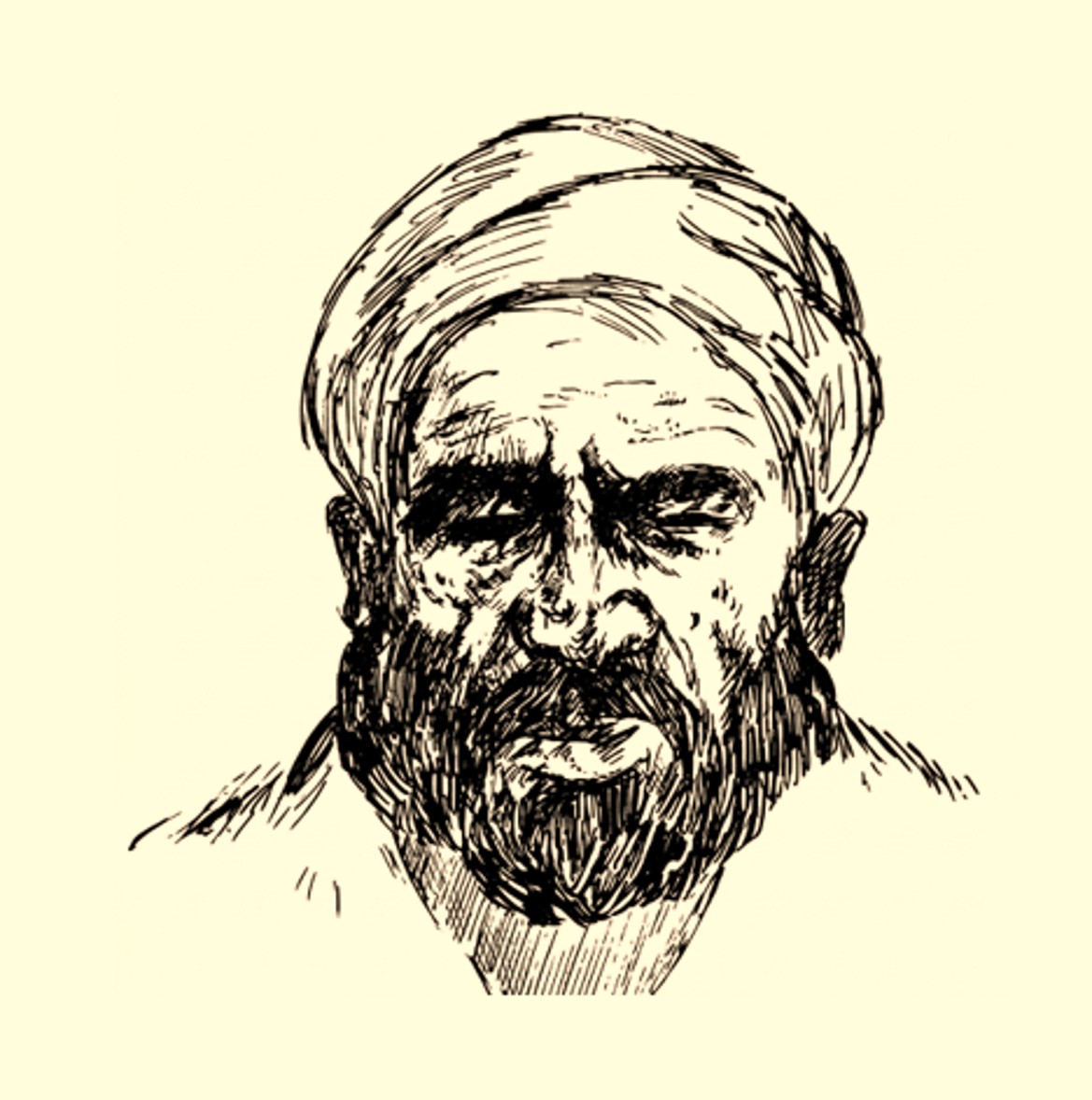
Episode 127: Bashshar ibn Burd
Bashshar ibn Burd, feisty, restless, brilliant, and wise, was one of the founding figures of Classical Arabic poetry. Learn about his wife and works in this episode.
| Read Transcription | References and Notes |
| Quiz | |
| Episode on Spotify | Episode on Apple Podcasts |
| Previous Show | Next Show |
A Foundational Poet in Classical Arabic Literature
Gold Sponsors
David Love
Andy Olson
Andy Qualls
Bill Harris
Christophe Mandy
Jeremy Hanks
John David Giese
KelleyGr
Laurent Callot
Maddao
Mike Roach
ml cohen
Nate Stevens
Olga Gologan
Steve baldwin
Silver Sponsors
Alexander D Silver
Andreu Andreu i Andreu
Boaz Munro
Charlie Wilson
Devri K Owen
Ellen Ivens
Evasive Species
Hannah
Jennifer Deegan
John Weretka
John-Daniel Encel
Jonathan Thomas
Julius Barbanel
Michael Sanchez
rebye
Top Clean
Ukko
Sponsors
Carl-Henrik Naucler
Joseph Maltby
Robert
Stephen Connelly
A Chowdhury
A. Jesse Jiryu Davis
Aaron Burda
Abdul the Magnificent
Aksel Gundersen Kolsung
Alex Metricarti
Andrew Dunn
Anthony Tumbarello
Ariela Kilinsky
Asher DeLarme
Basak Balkan
Bendta Schroeder
Benjamin Bartemes
Brian Conn
Bruce Spencer
Carl Silva
Carolyn Sabol
Cat Peterson
Charles Hayes
Chief Brody
Chris Auriemma
Chris Brademeyer
Chris Tanzola
Christopher Centamore
Chuck
Cody Moore
Daniel Stipe
David
David Stewart
Denim Wizard
Dominic Klyve
Elizabeth Lowe
Elliot Cole
Eric
Eric McDowell
Erik Trewitt
Anonymous
Francine
Friederike Otto
FuzzyKittens
Garlonga
Glenn McQuaig
J.W. Uijting
James McGee
Jason Davidoff
Jay Cassidy
JD Mal
Jillyp
Joan Harrington
joanna jansen
Joe Dudley
John Barch
John Sanchez
Jonathan Whitmore
Joran Tibor
Joseph Flynn
Joshua Edson
Joshua Hardy
Anonymous
Kathrin Lichtenberg
Kathy Chapman
Kyle Pustola
Anonymous
Lat Resnik
Laura Ormsby
Le Tran-Thi
Leonardo Betzler
Lexi Mayhew
Lori Gum
Maria Anna Karga
Mark Griggs
MarkV
Matt Hamblen
Maury K Kemper
Michael
Mike Beard
Mike Sharland
Mike White
Morten Rasmussen
Mr Jim
Nassef Perdomo
Nicholas Stern
noah brody
Oli Pate
Oliver
Paul Camp
Peter Goldstein
purden@verizon.met
Richard Greydanus
Riley Bahre
Robert Auers
Robert Brucato
Rosa
Ryan Booth
Ryan Goodrich
Ryan Shaffer
Ryan Walsh
Shaun
Shaun Walbridge
Sherry B
Sonya Andrews
Steve Grieder
Steven Laden
Stijn van Dooren
Stuart Sherman
Sue Nichols
SUSAN ANGLES
susan butterick
Susan Hall
Ted Humphrey
The Curator
Thomas
Thomas Leech
Thomas Woolverton
Tim Rosolino
Tod Hostetler
Tom Wilson
Torakoro
Trey Allen
Troy
Valentina Tondato Da Ruos
vika
Vincent Vandeven
William Coughlin
Zak Gillman
Zita Farkas
Other Sponsors
too many to list
Persian citizens of the early caliphates, in the 720s, 730s, 740s, 750s, and onward, were a diverse lot. Some had earnestly converted to Islam. Some were still Zoroastrians or Manichaeans, and some were religious skeptics. Some, like Bashshar ibn Burd and Ibn al-Muqaffa, lived in the power centers of the new caliphates, learning the language and culture of the Arabs while at the same time still speaking Persian and remembering the long history of the great Persian empires. Other Persians lived further afield, paying taxes to the new colonial overlords out in the provinces, but otherwise holding to old Sasanian cultural traditions and business operations. The Sasanian empire had officially fallen back in 651, when its final king, Yazdegerd III, was assassinated. But Persia was vast, and even a century later, in 750, when the Umayyad caliphate gave way to the Abbasid caliphate, many provinces to the east were far more Persian than they were anything else.
Over the past few episodes of Literature and History, we have learned a bit about the deep-rootedness and longevity of Persian culture during the early caliphates. The story of the Byzantine-Sasanian War of 602-628 taught us that the Sasanian empire was less of an empire, and more of a confederation of stalwart fiefdoms often called the Seven Noble Houses of Iran. We read the Zoroastrian Bundahisn, and learned that during the 800s, a renaissance in Zoroastrian theology in the Abbasid east produced a number of texts still central to the religion today. We read Ibn al-Muqaffa’s Kalilah and Dimnah, and in doing so, observed that Persian scholarship and translation were essential to bringing knowledge into the caliphates’ capitals in Syria and Mesopotamia. Put briefly, over the past few episodes of our podcast, we’ve learned that although Arab-Muslim leadership conquered Sasanian Persian leadership during the mid-600s, a century later, Persians weren’t all that conquered. By 819 – just 69 years after the beginning of the Abbasid Caliphate, the Persian Samanid Empire became a semiautonomous region in the Islamic east, sponsoring Persian language, literature and culture for generations afterward.
The Shu’ubiyya Movement in the Eighth Century
The Persian pushback against Arabization had many forms, and took place across multiple time zones, but the general name for it in Arabic language history books is Shu’ubiyya. The word simply means “nations” or “peoples,” and it’s drawn from a Qur’anic passage in which God says, “O mankind! Truly We created you from a male and a female, and We made you peoples and tribes that you may come to know one another” (49.13).1 The verse is quite a nice one in the Qur’an, generally interpreted as emphasizing the equality of all human beings regardless of their origins. Where the Qur’an says, “We made you peoples and tribes that you may come to know one another,” the word “peoples” is (شُعُوبًۭا) in the original Arabic, which is where we get the word Shu’ubiyya. To Persian Muslims with Shu’ubiyya sensibilities, bowing down to Arab elites just because they were Arabs didn’t make sense. The Qur’an taught that Muslims were equal. It did not teach that Arab Muslims should live in garrisons and lord themselves over other Muslims in the provinces. The Shu’ubiyya movement was a great equilibration, mainly Persian in origin, but also involving other indigenous cultures, during which various conquered populations of Muslims advocated for equal rights.Our writer for today, again the poet Bashshar ibn Burd, was an early part of the Shu’ubiyya movement in literary history. A Persian schooled in Arabic literary history, Bashshar could imitate the conventions of Arabic literature as it existed around 750 CE. But as an ethnic Persian familiar with the long, cosmopolitan history of the Sasanian empire, Bashshar didn’t just want to write solemn odes about solitary speakers astride camels. Restless and intrepid, Bashshar, over the middle part of the 700s, pushed Arabic literature forward into a new, more sophisticated epoch. He is among the first writers whom Arabic literary anthologists associated with the badee style, or the “new” style, a style that developed during the early Abbasid period that was more elaborate, embellished, and worldly in nature than the more traditional Arabic poetry that was then popular – those pre-Islamic odes on Bedouin themes that we read at the beginning of our podcast’s present season.
Today’s story, generally speaking, will focus on modern-day Iraq, and the middle of the 700s. And although I imagine most of you listening have never heard of Bashshar ibn Burd, over the past seventeen episodes on early Islamic history, you’ve learned everything you need to understand his life, his times, and his work. So let’s begin today’s show by taking a deep breath, and imagining ourselves in the city of Basrah, in the year 750 CE. [music]
Basrah in 750: A Melting Pot and Boomtown
The modern city of Basrah, Iraq is about 25 miles downriver from where the Tigris and Euphrates come together. Originally, the city was 15 miles away from the convergence of the two great rivers, but, past and present, Basrah has always been at the bottom of the Tigris-Euphrates wetlands, near where the two waterways join to make the final leg of their long journey to the Persian Gulf. If we were there back in 750 CE, this aquatic confluence would be a perfect symbol of what the city had become. Basrah, in 750, had swelled to more than 250,000 residents, an assortment of Arabs, Persians, and others. If you sat there among the city’s newfangled watercourses and mud-brick residences, on a summer evening beneath the shade of young trees with the sounds of marsh birds in the air all around you, you could get a sense of how fast history was changing.You would see Bedouins and other tribespeople from the Arabian Peninsula, speaking various pure dialects of Arabic studded with a particularly enormous vocabulary for describing the places, and flora, and fauna of the desert. You’d see different Arabs than these – wellborn Syrian aristocrats enriched by the last century of the Umayyad hegemony headquartered in Damascus, and Arabs who’d already lived on the coast of the Levant for two generations. You’d see Arabs whose grandparents had homesteaded in North Africa, who called the Mediterranean’s southern shore home. And you’d see Arabs from the north and east, as well – Arabs who lived up on the Caspian’s southern shore, and ones whose grandparents had made homes for themselves all over what is today Iran, Turkmenistan, Uzbekistan, and western Afghanistan. And if you sat there in Basrah, at the cusp between the Umayyad and Abbasid caliphates, you would hear many other languages than Arabic.
Most obviously, you’d hear Persian, because Basrah itself, as of 750 CE, had only been under Arab-Muslim control for a century or so. Back during the Hijra of 622, which begins the Islamic calendar, the country around Basrah had been part of the Sasanian empire’s balmy western fringe – a marshy lowland superintended by the Lakhmid client kingdom. The confluence of the Tigris and Euphrates had always been a place where Arabs and Persians mixed and worked together, and though the power balance had decidedly shifted to favor the Arabs as of 750, the two peoples were not strangers to one another. Basrah, in 750, was home to old Iraqi Persian families, together with generations of Persian immigrants who, due to the changing times, had come west over the Zagros Mountains to seek fame and fortune in the power centers of the caliphates.
These Persian immigrants might have been a bit surprised to be in Basrah itself. Because the city was not an old one. By 750, it had ballooned out of a Rashidun garrison staked down in the badlands with a desert on one side and a salt marsh on the other, and it was only after considerable effort building earthworks and irrigation channels that Basrah was able to support a substantial population. If you were there in 750, you would know all of this. Mesopotamia held incredibly ancient cities, among them Ur and Babylon, and it was home to old Persian capitals like Ctesiphon. Compared to these storied places, Basrah was a newfangled boomtown, expanded with the investment money of bigwig city planners and the muscles of slaves and hired laborers.

The Umayyad Caliphate was gigantic by 750. Basra, at the junction of Arabia, Persia, and the areas of the empire further to the west, was a fulcrum of trade and culture. Map by Cattette.
These slaves and hired laborers would have been from all over Eurasia and Africa. The Indian Ocean slave trade was a vast enterprise, and along with the sub-Saharan slave trade, it had brought Africans up into caliphates to serve as forced domestic and commercial laborers. Africans, however, were not the only slaves in Basrah during the late Umayyad and early Abbasid periods. The conquests of the Rashidun caliphate and the continued border wars of the Umayyad empire had brought legions of slaves into the Islamic world, and slaves and freedmen who had liberated themselves from slavery through conversion to Islam or some other means would have made up a sizable swathe of Basrah’s population in the year 750. From these commingled populations, if you were sitting along a Basran street during a summer afternoon, you’d hear Arabic, Persian, Tamazight, Coptic, Armenian, Greek, Bantu languages, and more.
To Meccan or Damascan Arabs, and to wealthy Persians from old cities like Bishapur and Firuzabad, Basrah in 750 might have seemed a bit vulgar – a slapdash sort of place you thumbed your nose at, because it had basically been wrested out of salt marshes in the middle of nowhere in the wild west, or wild east, depending on which side of Mesopotamia you were from. But if you, like our poet for today Bashshar ibn Burd, were from Basrah, the city’s novelty and cultural sponginess were exactly what made it fascinating and full of possibilities.
Basrah, by 750, was more than just a slipshod place where the newborn Islamic world mingled. Basrah was also an epicenter of cultural development. And before we get into the literary history relevant to Bashshar ibn Burd, we should spend just a moment imagining what else was being written there, other than Arabic poetry.
The Islamic world in 750 was a world in transition, and a world that was trying to write its past as well as to plan for its future. In Basrah and other cities throughout the caliphates, hadiths, or narratives about the Prophet Muhammad and his generation, already numbered in the tens of thousands, and works of fiqh, or religious law and jurisprudence, were in development, as well. Two of the four founders of the modern Islamic schools of law were middle aged and productive, including Abu Hanifa (c. 699-767) and Malik ibn Anas (c. 711-795). The teacher of these grandmasters, Ja’far al-Sadiq (c. 702-765), the sixth and final Imam that most Shias concur was a legitimate transmitter of prophetic teachings was about 48 years old. And while these central figures in Islamic theology were hard at work as the Umayyad caliphate gave way to the Abbasid caliphate, works of tafsir, or Qur’anic exegesis, were also underway. Additionally, the earliest biographer of Muhammad, Ibn Ishaq, was around fifty years old, and the second earliest biographer of Muhammad, al-Waqidi, was about three. By the year 750, then, the real Muhammad had been gone for almost a century, and the Muhammad that history would know, through hadiths and prophetic biographies, was being created.
As all of this high-level theological history and jurisprudence unfolded in the middle part of the 700s, Arabic literature was changing, as well. Foreigners – especially Persians – were learning the Arabic language, and the old poetic styles of the Pre-Islamic period were flourishing and changing at the same time, as fresh generations tried their hand at the old genres of the Arabian Peninsula. We discussed these genres toward the beginning of our present season, but since it’s been a while, let’s take a moment to recall what we learned about Pre-Islamic Arabic poetry. [music]
Bashshar and the Qasida: The Poems of the 500s Meet the Culture of the 700s
My two friends, gather around and listen, as I revisit my memories of the past. I used to live here in this camp, long ago, when I was young and full of fire, before the desert swallowed it up. These acacias down in the wadis and the Astragalus shrubs, with their tiny flowers, the Rhanterium with its yellow blooms in spring, and the morning sandgrouse and occasional lark – these were all my home. There I would sit – there where desert erosion has tumbled earth overrun with the tracks of oryxes and quail, and there I knew her. She was as beautiful as the rain, with a long neck like a gazelle’s, with shimmering eyes and a veil that blew in the wind. Once, during a storm, we dallied in her tent. She was soft and firm and lovely, and outside the water awakened the scent of the earth. But she is gone, long gone beneath the sands of time and memory, leaving me to wander.And so I ride. I ride my she-camel beneath the shade of ridges and in the full sun, and her bellow rattles the saddle and sends the hares and jerboas dashing to their dens. Her heavy feet make the earth’s back groan and she is mighty, mighty like the continued pulse of life in my veins. As dry as the land and pasturage of memory have become, her grunts beneath me are new thunder over the landscape, awakening memories of rain even on days ungraced by clouds.
That was a qasida, or a traditional Arabic language ode, that I made up in prose. The qasida was the most influential genre of Jahili poetry, and it contains variations of everything that you just heard. A first-person speaker, generally a middle-aged or older man, greets listeners. The speaker visits an abandoned camp where he used to live. The camp is carefully described, often with details about local flora and fauna, and local place names. The speaker recollects a love affair that came and went. The speaker is melancholy about the irrecoverable past. But as the poem continues, something, whether his own physical hardiness, or the horse or camel beneath him, heartens the speaker. His mood moves from depression to resolution, and he feels better, ending with a philosophical statement, or a praise to a patron, or some other finale appropriate to the poem’s original context.
The pre-Islamic qasida due to its beauty and early provenance was the most influential form of all Arabic poetry. When our poet for today Bashshar ibn Burd was growing up in Basrah – again, he lived from about 713-783, he would have heard and read qasidas like the one you just listened to. Basrah might have been in a wetland, and its streets might have been teeming with people from all over the world, but nonetheless, among the ruling Arab elite, the most esteemed form of poetry was the solemn and reflective ode of a desert Bedouin.
The qasidas of the Pre-Islamic period are, as we observed a number of episodes ago, indeed beautiful. In the 700s, they were celebrated for a reason, just as they still are, today. The qasida, along with the Qur’an itself, came from an earlier period when Arabs predominantly lived in Arabia, and when the Arabic language itself was less diluted by the loanwords, colloquialisms, and portmanteaus of the caliphal period. However, language, inconveniently for those with reactionary sensibilities, evolves through use, and by 750 in Basrah and elsewhere, an old guard already existed that wanted Arabic to sound like it had during the life of the Prophet Muhammad.

A historical photo of Basra from the turn of the previous century. Basra’s bustling boulevards and watercourses were a far cry from the imagined countrysides of pre-Islamic qasidas.
Nonetheless, if Bashshar ibn Burd attended a recitation of traditional qasidas in, say 750, sitting back in a leafy Basran courtyard as a bard recited them to some nouveau-riche Arab landowner and his pampered sons, Bashshar might have scrunched up his lips and rolled his eyes, as well. Traditional Bedouin poetry was in some ways a strange fit for the new Umayyad and Abbasid worlds. Most Arabs, even by 750, were no longer wending their way along lonely desert roads astride camels. As scholar A.F.L. Beeston writes, by the life of Bashshar,
The inescapable fact was that, however much the Umayyad princes in their desert hunting lodges might like to fancy themselves as Arab chieftains of the ancient pattern, the bulk of even the pure Arab population of the Islamic realm was abandoning the desert environment and settling down to an urbanized or at least sedentarized life. On top of this, vast crowds of non-Arab clients were flocking into Islam and building up a culture which, though Arabic speaking, was only to a limited extent Arab in outlook.2
In short, by 750, the old Bedouin world of the qasida was already mostly an imaginative construction. As we learned in past episodes, even during the Pre-Islamic period, when Bedouin bards came to the peninsula’s trade towns and the courts of Arab client kingdoms, the qasida was already a commodity – a romanticized vision of desert life rather different than the hardscrabble pastoral existence that the Arabian Peninsula’s nomads actually led.
For a poet like Bashshar ibn Burd, then, moving in urban aristocratic circles in the mid-700s, the old desert poetry of Arabia was worth knowing, but it was also a relic. And now that we know a bit about Basrah in the year 750, and now that we’ve reviewed the basics of the storied old Bedouin qasida, let’s spend a few minutes learning about the colorful life of Bashshar himself. [music]
The Life of Bashshar ibn Burd
Bashshar ibn Burd, ugly, feisty, restless, and innovative, was born in Basrah in about 713. The Umayyad caliphate, at this juncture, was at the apex of its power, with the sixth Umayyad caliph al-Walid I’s building projects and social welfare programs ushering in a period of domestic prosperity. Abroad, the caliph Al-Walid had managed to expand the caliphate westward along the North African coast and up into the Iberian Peninsula, and eastward to what is today the border of India and Pakistan. Up in Syria, the Great Mosque of Damascus had been built a few years before Bashshar’s birth, along with Al-Aqsa Mosque atop Temple Mount in Jerusalem. Arabic, in less than a century, had become the administrative language and lingua franca of much of the earth.
Tukharistan (also Tokharistan, formerly Bactria) was where Bashshar’s forebears had lived. His father came a long way to raise children in Basra at the turn of the eighth century.
Bashshar had a distinctive combination of good luck and bad luck as he pursued his studies and grew into adulthood. On the plus side, he had a brilliant, acute mind, a strong memory, and a particular talent with language. On the minus side, though, he suffered from disfiguring smallpox at a young age, was blind, and his very large size and unwieldy frame gave him an even more striking appearance. He later proclaimed that being blind helped him write poetry, stating that “lack of sight strengthens the acuteness of the heart and cuts out interference from things which are visible. It intensifies a man’s language and stimulates his genius.”3
The 10th-century Arabic language Book of Songs, which offers us our longest biographical portrait of Bashshar, paints a picture of a genius with a chip on his shoulder – a man who had every confidence in his own poetic ability, but at the same time, who, due to being a Persian and a disabled person to boot, felt like he had something to prove. One of the things that Bashshar had to prove was that he was not an Arab, and not a Bedouin, and that he didn’t care. At one juncture midway through his career, praising all of the eastern Persians who had helped put the Abbasids into power, Bashshar wrote in a satirical piece that his grandfather and father were the noblest of all Persians and the Roman emperor was his uncle, all of them wearing crowns. Bashshar wrote that since his father was dressed in fine Persian ermine drinking from golden cups – and listen close, because this is pretty funny –
never did my father sing a camel-song, trailing along behind a scabby camel,
nor approach the [desert melon], to pierce it for [great] hunger. . .
nor did I dig for and eat the lizard of the stony ground;
nor did my father warm himself standing astraddle to the flame;
no, nor did my father use to ride. . .a camel saddle.
We are kings, who have always been so through long ages past. (XXVI.12-19)4
The lineage that Bashshar describes here is likely fictitious – he probably wasn’t actually the scion of great Persian kings. The satirical meaning of the poem is nonetheless pretty clear. No, Bashshar says, my ancestors didn’t eat lizards in the desolate countryside, and we didn’t lavish praises on our camels. Persia, Bashshar emphasizes, was a civilized place, and everyone knew that, and so the Arabs could keep their worn-out qasidas that romanticized the parched and dreary deserts from which they’d come.
Bashshar’s attitude toward traditional Bedouin poetry was thus playful and irreverent, though his use of Bedouin poetry’s conventions demonstrates that he understood and appreciated it at the same time. He also satirized some of Basrah’s more puritanical religious figures. Courtly life during the early caliphates involved a fair amount of licentiousness. The famous Kitab al-Aghani, or Book of Songs, compiled by the Arab scholar Abu al-Faraj al-Isfahani, demonstrates that eighth- and ninth- century Arabic poetry contained oodles of dirty stuff. A recent anthology of excerpts from the Book of Songs by scholar George Dimitri Sawa has twenty pages alone of Classical Arabic poetry about penises and vaginas, another twelve on sexual acts and positions, and an additional ten pages of funny sexual mishaps, and to be clear, this was all Arabic language poetry written before about 900 CE.5 The point is not that early Arabic poetry is particularly erotic in nature. From the Descent of Inanna to Archilochus to Catullus, we’ve read lots of steamy poetry in our podcast, and writing and giggling about sex and private parts is just something that human beings do. The point is that when Bashshar ibn Burd came of age as a writer in the 700s, one of the things that poets did was to write love poetry and satirical poetry in which sex and private parts were fair game as subject matter. This racy content in Bashshar’s poetry, as you can imagine, was disagreeable to religious teachers and ascetics in Basrah who didn’t think that sex and genitals and that kind of thing were fit for poetry recited in polite society. These pious critics dismissed some of Bashshar’s work as garbage. He satirized them right back.6
While religious conservatives criticized Bashshar and other poets for their prurient material, Bashshar made enemies of a different sort of theologians, as well. Specifically, Bashshar ibn Burd set himself against an influential Basran thinker named Wasil ibn Ata, the most important early thinker in Mu’tazilism. Mu’tazilism was a divisive movement in Islamic history, especially from 750-850. Mu’tazilites advocated for rationalism and the use of reason in interpreting scripture, over and above the inherited traditions of the hadiths. More famously, Mu’tazilites argued that the Qur’an had been created at a finite point in time, rather than existing eternally in God’s mind. For whatever reason, Bashshar ibn Burd found these theological developments displeasing, and he lampooned the Mu’tazilite thinker Wasil ibn Ata in his poetry.7
Bashshar, in spite of his volatile nature and prickly relationship with Basran theologians, flourished in the sprawling new city. While he picked fights with other poets, scoffed at religious conservatives who called him profane, and mocked the progressive theological developments of Basrah too, Bashshar managed to stay on the right side of the truly powerful. He wrote praise poems to the Umayyad governors of Basrah. He eulogized the final Umayyad caliph. The Umayyad dynasty gave way to the Abbasid revolution in 750, helped in no small part, as Bashshar certainly knew, by powerful Persian allies from the caliphate’s extreme northeast. And in 762, when the second Abbasid caliph al-Mansur founded Baghdad, Bashshar moved there. He would have been about 48, and by this time in his career, he was a famous writer. His panegyrics, or praise poems, were highly sought after. His satires were fearsome, and to be avoided at all costs. His love poems were erotic, but they were also incredibly imaginative – full of new ideas and embellished language that seemed to suit the great amalgamation of humanity gathered in the caliphate’s heart.
In Baghdad, Bashshar’s career persisted for another two decades. His most pivotal relationship there was with the prince and caliph al-Mahdi, who ruled from 775-785. Their relationship was prickly. Al-Mahdi, at one point, commanded Bashshar to stop writing love poetry, though Bashshar ignored the command.8 While Bashshar seems to have got away with a surprising amount of irreverence, eventually, he did something that cost him his life. What this something was varies according to the early sources, but all of them agree that Bashshar got in trouble with Abbasid authorities and ended up dead as a result.
To offer just one of those stories, Bashshar may have penned a criticism of the caliph al-Mahdi that was beyond the pale. Al-Mahdi, like other early Abbasid caliphs, relied on Persian bureaucrats called the Barmakids to help him govern. The poet Bashshar, according to the historian al-Tabari, accused al-Mahdi of delegating so many of his responsibilities to Persian bureaucrats that the caliph was no longer in control of his caliphate. Al-Tabari records Bashshar as having written these lines in about 783:
Sons of Umayyah wake up! Your sleep has gone on too long.
[The Persian bureaucrat] Ya‘qūb b. Dāwūd is caliph.
Your caliphate has been ruined, O people! Search
for the caliph of Allāh among the tambourines and lutes.9
In other words, Bashshar dared to say that the Abbasids might productively be replaced by the Umayyads whom they had usurped, since the Abbasid caliphs were no longer doing their jobs. The statement crossed the line from irreverence to sedition. Bashshar was imprisoned, beaten nearly to death, sewn in a sack, and tossed in the Tigris to drown. He was about 70, and in spite of being blind, ethnically Persian, and unenviably homely, this Persian Cyrano had a marvelous career at the center of the newborn Islamic world, and he had been at the vanguard of a new movement in Arabic poetry. And now that we have a sense of Bashshar ibn Burd’s life and times, let’s get a sense of his poetry – what Bashshar wrote, and why it’s so important in literary history. [music]
Bashshar and the Badee Movement in Classical Arabic Poetry
An anecdote about Bashshar in the tenth-century Book of Songs states that:Bashshār took an untraveled road and excelled in it and was unequalled in it; and he is the greater in versatility and in the genres of poetry and has a greater abundance and versatility and in the genres of poetry and has a greater abundance and broader scope of the [new style].10
Bashshar, earlier historians of Arabic literature agreed, after he came of age in the 720s and 730s, began doing things that had not been done before in Arabic poetry. In Arabic literary history, Bashshar is often associated with the beginning of what is called the “modern” period of Classical Arabic poetry. This is a confusing term to English speakers, because when we think “modern,” we do not think about Iraq in 750 CE. “Modern,” in the context of Arabic poetry, means poetry from the more cosmopolitan epoch of the caliphates, rather than poetry from the Pre-Islamic period. Modern Standard Arabic’s foundation is in the language of the amalgamating urban centers of the early Abbasid caliphate, and so it makes sense that what Arabic literary scholarship calls “modern” begins in the decades after 750 CE.11
In Arabic, there’s another word often associated with the work of Bashshar and those who came along just after him, and that word is badee. Badee, in an Arabic-English dictionary, is defined as “Originated; invented; made, done, produced. . .newly, for the first time. . .new, wonderful, unknown before.”12 The poetry of Bashshar and those who followed him, then, prized innovation. And while badee literally means “newly produced,” over time it came to mean “rhetorical embellishment.” Badee poetry prized the use of metaphor and extended similes, puns, parallelism, and antithesis. All of these elements had existed before in Arabic poetry and even the Qur’an itself, but for Bashshar and his successors, adroit and imaginative play with language was given a new centrality and emphasis.
The poetic Arabic that Bashshar learned when he was young was a strange language. Pre-Islamic Arabic odes, as we learned in earlier episodes, are really dense. The poetic language of the Peninsula was a churning patchwork of many dialects, in which regional place names, and local words for flora and fauna made basic comprehension of any given passage difficult, even during the 700s. The word for this special language of Jahili poetry was ghareeb. And on top of its lexicons of obscure proper nouns, Pre-Islamic Arabic poetry is also figuratively sophisticated, its speakers riding through sandscapes that are partly material, and partly metaphorical in their construction. Nonetheless, sometimes because they were not Arabs, and sometimes because they’d simply heard enough talk of camels and wistful introspection among the dunes, by 750, writers of Arabic poetry had begun experimenting with new styles. As one of Bashshar’s poetic successors wrote, “The vicinity of the [Bedouin] ruins and of their people / That long ago was sweet to drink at, now tastes of salt.”13
Part of the modern style of Arabic poetry that emerged in the mid- to late-700s was a focus on contemporary urban audiences. The old qasidas were not only dense, and difficult to understand for those who only knew Arabic as a second language. The old qasidas were full of enigmatic symbols. Their tones were often lofty, and somber, and they expected a rarefied audience. Modern poetry, on the other hand, was written with the idioms of the contemporary Islamic world. It was the verse of the streets, rich with contemporary language, done with wit and spontaneity for popular audiences. It was neither better, nor worse than the old Jahili poetry of Arabia. It was simply new, and different, and that was what made it fun.
In Bashshar’s Basrah, there was a marketplace called Suq al-Mirbad. It was on the west side of the city, at the breakpoint where the desert met the wetlands. Al-Mirbad, in Bashshar’s day, was where you went to hear developments in contemporary poetry. When he was a teenager, Bashshar might have still watched the performances of two of the Umayyad empire’s most famous poets, Jarir ibn Atiyah, and Al-Farazdaq, right there in Basrah. These two poets – Jarir and Al-Farazdaq, often performed publicly in the city’s western marketplace. They had a satirical rivalry that was both fearsome and friendly, and just as Basra was the seam between the desert and the wetlands; between the world of the rural Bedouin and that of the metropolitan Muslim, the poetry that Bashshar heard while growing up was also a fusion of old and new.
Though rather different from one another, Bashshar’s predecessors Jarir and Al-Farazdaq, who both died around 730, both served as a bridge to the newer, more colloquial poetry of the next two generations. They were both Arabs, and they revered the old Bedouin traditions. But they were also both court poets and city folks, and the Arabic that they heard around them was spoken by tens of thousands of new speakers from all over the empire. Ultimately, these predecessors of Bashshar ibn Burd helped popularize Arabic poetry among a broader audience.14 Jarir, in particular, seemed to think that satire ought to be funny, rather than just fearsome, and when Jarir and Al-Farazdaq held their public matchups, in the 710s and 720s when Bashshar was young, in the strange new urban fulcrum between sand and water, a new style of poetry was being born.
The new style was not monolithic. The best generalization that can be made about it is that its early proponents, first Jarir and Al-Farazdaq, then Bashshar himself, and then his younger contemporaries Abu al-Atahiya and Abu Nuwas, were for different reasons searching for novelty. All around the wetland metropolises where they spent their careers, there were rapid intellectual and theological developments going on, and their lives were lived in courts, among a cultured gentility. The centuries-old poetry of Bedouin Arabia, with its impenetrable diction and foreboding landscapes, was wonderful stuff, but it was from a different time. The late Umayyad, and the early Abbasid empires stretched across much of the world, and in the leafy enclosures of Mesopotamian palaces, as they leaned on peristyles and recited to diverse crowds of listeners – as water sparkled in newly made fountains and the sounds of a dozen languages were faintly audible beyond the walls of metropolitan estates, Bashshar and those like him nudged Arabic poetry forward into a new era.
So, I’ve offered you a lot of background on Bashshar. We’ve learned about the Shu’ubiyya movement, that movement, spearheaded by Persians in the early caliphates, against Arab hegemony. We’ve learned just a bit about Basrah, that sprawling boomtown at the bottom of the land between the rivers, and how during Bashshar’s life, it was one of the main hubs of the new Islamic world. We’ve explored the main events of Bashshar’s vigorous, productive life, and just now, we’ve discussed the modern and badee movement in Arabic poetry – generally a movement away from conventional Bedouin pieces and toward verse that celebrated, and riffed on the metropolitan and courtly world in which the caliphate’s professional poets were actually making a living. Let’s go a little bit deeper, now, and turn the sound on, so to speak, and actually hear some of what Bashshar wrote. Unless otherwise noted, quotes from Bashshar in the remainder of this program will come from the A.F.L. Beeston translation, published by Cambridge University Press in 1977.
Bashshar ibn Burd’s Love Poetry
Bashshar ibn Burd, like any professional court poet, wrote pieces with many different styles and themes. By the last decade of his life, however, if his work itself is any authority on the subject, he was particularly well known as a love poet. He reflects in a late piece that “I have lived my life with myrtle, wine and flute, in the comfort of a fine hall; / and I have filled the lands. . .with poetry to which maidens and matrons pray as devoutly as the deluded heathen to their idol.”15 Bashshar, needless to say, did not invent love poetry in Arabic. The Arabic ghazal, or love poem, had roots in the old qasida of the pre-Islamic period. In the qasida’s traditional form, the wandering Bedouin speakers of ancient Arabia’s odes stop at deserted camps and survey the ruins there, and then comes the nasib, or the erotic or amatory recollection, in which the speaker reflects on a bygone love affair. From this convention in the old desert qasida, poets generations before Bashshar ibn Burd were already writing love poems, pure and simple.16Bashshar ibn Burd may have been living in the urban centers of a new empire, but a lot of the sentiments he expresses in his love poetry could have been copied and pasted from Sappho, Catullus, Propertius, Ovid, and Tibullus. The speakers of lyric love poetry are lovesick, enchanted, sleepless, and sometimes moribund, living lives in which time itself has been fractured by passion that is rarely requited. Just as Catullus had his lover Lesbia, and Ovid had his Corinna, Bashshar ibn Burd’s idealized maiden is called Abdah, as when he writes, “Abdah, visit me, and you will be a boon of God [for] me. . .I swear by God – be sure of this – that I long for you but fear you. / Abdah, I perish and am lost if I taste not the cool touch of your lips; / do not reject a lover at death’s door” (IV.1-3). In another poem, Bashshar tells his addressee, “my sorrowing heart is all a-flutter. / Mention is never made of you without tears starting to my eye for love of you” (VII.1-2), and in another still, “I seek dear Abdah as my remedy; she, however I may conceal it, is [a] physician for my sickness” (VII.9). This is all familiar stuff. Love knocks even the best of us off of our feet, and so it’s no surprise that some of the most foundational Arabic love poetry leverages seemingly ubiquitous human metaphors on the subject. The lover is sick, the beloved is the cure. The lover is parched with passion, the beloved is the only thing which will quench his thirst. The lover is tearstained and alone, the beloved is elsewhere and aloof. Even the old qasidas reminisced about the torrid passions and morally murky love affairs of bygone youths, and so when Bashshar began love poems, he was drawing from a lot of very old traditions.
Still, even in amatory poems that are fairly conventional, Bashshar can write absolutely wonderful lines that capture the enchantment of falling in love. One poem begins,
O my night, you grow ever more hateful, because of the love I bear towards a maiden with whom I have become enamoured.
A sparkling-eyed maiden is she; if she glances towards you, she makes you drunk with wine by those two eyes.
The pattern of her discourse seems like meadow plots garbed in flowers,
and as though [a magician] sat breathing spells therein.
You might well imagine the body on which she gathers her garments to be all gold and scent.
It is as though she were the very coolness of drink itself – drink pure and suited to your breaking fast.
Be she a maiden of the jinn, a human girl, or somewhat between, she is a most splendid thing. (V.1-7)
Here, the woman Bashshar envisions is as varied as the power of his imagination. She has sparkling eyes, which intoxicate those who meet her gaze. Her speech is like a pasture full of flowers, where the breath of a secret magician joins the scent of the countless blooms, and, extending this metaphor further, Bashshar writes that his beloved is pure golden fragrance wrapped, only barely, in human garments. She is as elementarily necessary as coolness and water. In these lines, the beloved whom Bashshar imagines is in a constant state of flux as his restive imagination tries to transfix her in poetry.
Before we explore what made Bashshar’s love poetry novel as it emerged in Basrah and Baghdad in the middle part of the 700s, we should take a moment to discuss what makes it Arabic. Though we’re reading an English translation of Bashshar, some of his figurative language is distinct to Arabic love poetry. A moment ago, we heard Bashshar say of his lover, “It is as though she were the very coolness of drink itself.” Arabic love poetry is full of metaphors and similes likening lovers to water, moisture, coolness, and even ice. Bashshar tells his girlfriend in one poem, “I’ll not forget the taste of the moisture of your lips” (VII.25), and in another, “my [love]sickness is thirst, my remedy a drink from a cool moist mouth” (VIII.2). In a later poem, he exclaims to a lover, “Separation has a fire which ravages my heart and breast when you are far away, but the sight of your face is cooling as ice” (XII.3). The figurative language here makes sense in an Arabian context. In poetry with roots in a hot, dry climate, of course moisture, and coolness, and even ice are all imagined as things that heal and pacify the distraught emotions.
Arabic love poetry, written during the early Abbasid period, has some other figurative differences from any other love poetry that we’ve read Literature and History. For one, Classical Arabic poetry tends to focus on the teeth, rather than the lips, of the beloved. One of Bashshar’s poems mentions “maidens with their sparkling teeth” (IX.2), and another says that his mistress “has a smile like the shining petals of the chamomile” (VIII.3), the chamomile flower having very bright white petals. And while the alabaster teeth of the beloved were a feature on which poets fixated, so, too, was the saliva of the beloved. This is a convention unfamiliar to poetry rooted in European traditions, but poets like Bashshar will often emphasize the lush moisture of the beloved’s mouth. Dampness and coolness, then, are consistent properties of addressees and lovers in early Abbasid poetry, as when Bashshar reflects, “She was close to me for a while, like water, but when she had departed [the city] was waterless” (XI.6).
So far in our consideration of Bashshar’s love poetry, we’ve considered how his amatory pieces show verve and freshness, and at the same time, how they often adhere to the conventions of west Eurasian love poetry, albeit with some delightful quirks indigenous to Arabian sensibilities. What I want to do now is to consider what made his love poetry new and distinctive when it emerged in the performances in the middle decades of the 700s.
For one, the poetic speaker in Bashshar’s amatory verses is a distinctive person. Throughout his love poems, Bashshar is himself – blind, bearded, and often feeble and ungainly beneath his clothes. Emphasizing that a blind man can be as lovestruck as anyone else, Bashshar writes, “I am not the first one to be enamoured of a maiden, in whose encounter he encounters only a waft of perfume. / O folk, my ear has fallen in love with a maiden of the tribe, for sometimes the ear falls in love before the eye” (I.2-3). He tells the same lover in another poem, “Grant me some respite, Abdah; and know, Abdah, that I am but flesh and blood. / Beneath my coat there is a wasted body; were you to lean on it, it would collapse” (II.3-4). Bashshar repeatedly emphasizes his physical finitude in his love poems. He is not a generic Casanova riffing on the general truisms of romance and infatuation, but a specific person whose physical limitations are appropriate to the poor luck he’s had with women. He addresses a companion in one of his love poems with the words, “My friend, do not ask of my love for her, but look upon my body and be amazed / at one wasted in frame, were you to measure him, one who made a passing impression on her heart but never entwined herself therein” (XIII.15-16). Here, Bashshar’s physical deficiencies appear tragically connected to his limited success in love. He’s a vigorous man, but not vigorous enough; he has attracted the curiosity of his beloved, but that’s about it. Further, his unrequited crushes don’t play out in a simple world in which there are only a lover and a beloved. Bashshar’s love poetry is cluttered with obstacles – those who criticize the poet for his various passions, those who try to get in the way of love affairs, and those who spread rumors about him and his crushes.17 There were many sharp eyes in caliphal high society, and so Bashshar didn’t depict his love life unfolding in some boundless, idealized landscape.
Love poetry is always personal in subject matter, but in Bashshar’s hands it becomes more personal, and more introspective. Love poetry is often surprisingly dark, and in Bashshar’s hands, part of that darkness is a devastating self-analysis and emotional vulnerability, and a sense of social walls closing in on him. And while Bashshar brought his own body, and his own insecurities into the love poetry he performed, more famously, he wrote with a turbulence, and technical innovativeness which inspired the next generation of poets in the Abbasid empire.
The idealized lovers in Bashshar’s poems are things that seem to always be transforming. He writes in one of his poems, “My love for you, when I would conceal it, seems abyss on abysses, above me and below my feet. . .beauteous, sparkling-eyed, made of scent when she breathes; the room and the whole house have a perfume from her breath” (XII.4,18). Here, in a murky world of pure imagination, his beloved isn’t a person, but instead a vaporous, disembodied thing – a sweetness that begets ardor more than a human whom he wants to hold and kiss. Elsewhere, the figurative language is equally innovative, as when Bashshar writes, “[My] heart is as it were a ball bouncing about, for anxious fear of separation – would that anxiety could be of any use. . .My eye has become a stranger to slumber, so that its eyelids seem too short for it” (IX.3-4, 7). Love, here, is a bouncing ball of useless anxiety, and in a wonderful metaphor, the lover’s eyelids are compared to drapes too short to shut out the daylight. He tells us in a different poem that “The bones of [my beloved] are sugarcane, not bones of camel” (XVII.1-2), referencing a wetland crop more appropriate to Basrah than the dromedaries of Arabia. In another departure from the traditional qasida, when Bashshar reflects on his beloved’s home, he proclaims that “her abode. . .gleam[s] bright as lines of writing” (XIV.1). The beloved, here, is not the long-lost tribal maiden of Jahili poetry, but instead a modern urban woman who, if she is even real at all, is lovely in large part due to the writing that she inspires.
Bashshar, then, wrote more personally and literarily self-conscious love poetry than had been conventional up to the mid-700s, embellishing the old Arabic literary traditions with new filigrees, and making amatory verses more modern, urban, and suited to the cosmopolitan courts of Umayyad and Abbasid cities. And he did something else with his love poetry to set the tone for the next few generations – something that we’ve actually seen before in Literature and History.
If you read enough poems in which tearstained, crestfallen lovers whimper about women who won’t give them the time of day, you start to get a little tired of it. Don’t get me wrong. I can get down with gloomy, unrequited love lyrics, black nail polish, tears in the rain, metaphors about sickness for which love is the only cure, and verses about being so fixated on a new passion that everything else just seems drab and faded by comparison. Falling in love is a wondrous, surreal experience, and we have always written poetry about it, and we always will. However, although we are a passionate, wistful species, humans can also be prudent and hardheaded, and some of the love poetry that we write reflects the sober realism of adulthood, too.
Bashshar comforts himself in one of his more complex love poems, remarking, “It is a light thing, so long as you yourself are safe, to suffer the loss of someone. . .what soul has that which it desires in unmixed measure?” (XI.10), and then later concluding, “with laps of time solace will come to you” (XI.11). These are not the sentiments of someone experiencing love for the first time, but instead, the conclusions of a mature person who knows how to move on. Another love poem begins with a conventional outpouring of passion for a coy mistress, but then takes an unexpected turn. Bashshar writes, in three lines that epitomize his entire corpus of poetry:
[My beloved] made a stealthy sign with her fingertips to me, to tell me of her feelings; and they stirred up my passion, although maybe they lied.
Thus did she act, but then she turned away – just as I called on resolution to aid me, but it turned away. . .
I will leave love’s folly to other eyes; but I will not abandon the quaffing of ruddy wine and the cup. (VI.17-18, 22)
Here, we have a love poem for grownups. A boy sees a girl’s possible signs of affection. He’s excited, but he’s been burned before, and he doesn’t get his hopes up. And indeed, nothing becomes of it, and it’s nobody’s fault, and not the end of the world. We can almost imagine Bashshar, voicing that final line, “I will leave love’s folly to other eyes; but I will not abandon the quaffing of ruddy wine and the cup,” with a tilt of his wine mug to his audience as he recited verses to a sophisticated Baghdadi audience made up of a mélange of aristocrats and courtiers. Just as Ovid, in the capital of the Roman empire, wrote love poetry for adults, seven centuries later, Bashshar, in the capital of the Abbasid empire, was doing the same thing.
And speaking of Ovid, Bashshar’s love poetry invites us to remember something else about eighth-century love poetry in Arabic. In a previous episode, we heard a historian describe the entire Umayyad period as “a time of great disruption. With conquests, urbanization, great influx of wealth and a new system of beliefs, the whole picture of the world was changing rapidly.”18 Love poetry, during such dizzying times, can be a nice form of escapism.
Umayyad love poetry took different forms. Some of it was unrequited and tragic. An entire genre of love poetry, called al-Ghazal al-Udri, flourished during the caliphate’s ascendancy, in which woebegone speakers lamented their distance from unattainable mistresses. Yet a whole different tradition of Umayyad love poetry was completely nothing like this. The Quraysh writer Umar ibn Abi Rabi’a wrote lighthearted love poetry about flirtations and dalliances, mentioning more than forty women in his oeuvre of work.19 Other Umayyad writers were similar, offering chronicles of conquests and flings undertaken for leisure, just as two centuries before, some of the old Jahili poets had written about hanky-panky in Bedouin tents. Umayyad poetry, then, when Bashshar encountered it, was a wide, diverse genre. It could be about longing, or lust; failure, or frolicking, but it was almost always autobiographical in nature, chronicling the experiences of the individual in a giant, bewildering empire. As such, the love poetry that Bashshar read, and later wrote, just like that of Ovid long before him, was a search for agency and individuality in an unstable dictatorship. In the early caliphates, just like the early Roman empire, just like the Hellenistic successor kingdoms, literature about love was a small escape hatch from large, scary worlds, and a place where individual choice and experience was still precious and worth remembering. [music]
Bashshar ibn Burd’s Satirical Poetry
So that should give you an idea of the range and refinement of Bashshar’s love poetry. Love poetry, however, was only one of the things that this influential writer left behind, and while Bashshar was famous for love poetry in his own time, he was just as well known for satire and political lampoons.Satire had old roots in Arabic poetry. In Pre-Islamic times, poetic satire’s main function was to disparage one’s tribe’s enemies, and to promote one’s own tribe. The genre of hija, or satire, then, went hand in hand with the genre of fakhr, or the boast poem. Inhija, you scorned your rivals; in fakhr, you told everyone how great you were. Poets in Jahili society on the peninsula were spokespeople and public relations managers for their clans and tribes, and so it makes sense that as Arabic poetry emerged in the caliphates, one of the dimensions it served was similar – to caricature and discredit rivals, and to showboat and puff up allies.
We’ve read satire in our show before. From Catullus and Horace to Jerome and Augustine, we’ve encountered writers from antiquity who make fun of their rivals with varying degrees of severity and civility. What’s most surprising about Bashshar’s satire is that he seems to have been able to target any members of Abbasid society, including caliphs, and get away with it.
To understand one of Bashshar’s most absolutely remarkable satires, we’ll need just a bit of background. Between 762 and 763, a pair of brothers who were descendants of Muhammad’s daughter Fatima led a rebellion, based out of Medina, against the newly-established Abbasid caliphate. This was one of what historians call the “Alid revolts” that threatened both the Umayyad and Abbasid caliphates, politically dangerous events for either dynasty’s caliphs, because for obvious reasons, the descendants of the Prophet Muhammad had political traction merely by being who they were. And interestingly, during this brief rebellion, Bashshar sided with the rebels against the Abbasid caliph al-Mansur. Bashshar wrote to the caliph al-Mansur,
. . .[the] length of life is not enduring; he who is now safe will soon be safe no more;
Even upon the mighty king will destruction burst, and smite him down in the narrow strait of death. . .
The days ahead may come in lucky guise, or they may appear scowling, with all too manifest hardness.
Over [the final Umayyad caliph] Marwān’s head did the millstone of war pass – and his crimes were petty to those you have committed. . .
You have devoted yourself to Islam – but it was to efface its ways, and to leave its back bare to the fierce lions;
And you did not cease doing so, until Religion sought the aid of its adherents against you. . .
I will say to one who smiles, decked in magnificence, who has become a generous lover of noble deeds,
One of the descendants of Fātima, who sound the clarion summons to Guidance. . .
“You are a lamp for the eye of the seeker of light.” (XXV.1-2,7-8,10-11,14-16)

Al-Mansur, the second Abbasid caliph, seems to have tolerated a considerable degree of criticism from Bashshar ibn Burd.
The relative political freedom of the early Abbasid period is also evident in Bashshar’s pieces dealing with Shu’ubiyyah themes. (Just as a reminder, the Shu’ubiyyah movement, or “people’s movement,” was a Persian led cultural campaign against Arab domination in the early caliphates.) In a poem we heard quoted earlier that mocks some of the conventions of the qasida, Bashshar says that his ancestors were kings, and not Arabs roasting lizards in the desert hinterlands. And just as Bashshar strikes an irreverent attitude toward Pre-Islamic Arabs, he emphasizes that during the Abbasid revolution of 750, Persian armies from the Iranian east led the campaign against the impious Umayyads, bragging that “[W]e [Persians] restored the sovereignty into the family of the Arabian Prophet. . .For the sake of God and of Islam we [Persians] are wrathful with a most noble wrath” (XXVI.26,19). The meaning there is pretty straightforward. Everyone revered Muhammad, and Islam. But a century after the Prophet’s death, in Bashshar’s opinion, at least, Persians were the most powerful torchbearers of Islam.
Bashshar’s satirical poetry thus advanced some extremely contentious statements about Arabs and Persians in the early Abbasid caliphate, and their relations with one another. It is remarkable that such Persian nationalism flourished openly in literary circles. If dissident poetry against Augustus and the Julio-Claudians were written during the first decades of the Roman Empire, none of it survives. But to continue our consideration of Bashshar’s satirical poetry, not all of it was so gutsy that it criticized actual Abbasid caliphs, or denigrated Arabs more generally. In a few pieces (XXVII, XXVIII, XXIX), Bashshar makes fun of specific people who pretend to have impressive Arab lineage that’s just made up. And though he was obviously proud to be Persian, some of Bashshar’s satire sounds like the old hija, or satirical poems of the Pre-Islamic period, when a tribal spokesperson slammed a rival clan. Bashshar satirizes a tribe called the Bani Zayd in one of his poems, writing:
I have tested the Bani Zayd, and there are no traits of good sense among their [tribe’s] elders, nor among their youngsters one who is decent.
Tell the Bani Zayd. . .
“Curses upon you; my odes are thunderbolts smiting highland and lowland alike.”
. . .They gather the children of adultery into their numbers, so that their number exceeds that of all mankind. (XXX.1-3,5)
This sort of satire – again a poetic invective against an entire tribe, was at least 200 years old in Arabic poetry by the time Bashshar disparaged the Zayd tribe.
One of the common structures of eight-century Arabic satirical poetry was something with which you might be familiar. Let’s say you wanted to satirize me. You might say, “Doug, I’m not going to be mean. I’m not going to satirize you. But if I were going to satirize you, I wouldn’t say X, Y, and Z. And if I did satirize you, well, let’s just say you’d be limping for a week afterward.” This is an ironic literary device called apophasis or paralepsis – you say something by saying that you won’t say it. Some paraleptic satire survives from Bashshar, and it’s delightful stuff. Once again striking at perilously high targets, Bashshar advised a member of the Abbasid royal family, “Seek my good pleasure; seek not to embroil yourself with me: the feeble and decrepit cannot bear the loads I impose” (XXXIII.6). A moment later, passive-aggressively, Bashshar tells the recipient of his satire “How noble is [this Abbasid] man of [the Quraysh tribe]! We deny not his claim to kinship with the Prophet, even if he be the son of an ignoble mother. . .[His ancestors are] lion[s] of the tribe, when they return in the evening to a feast, but jackal[s] of the tribe when they face the foe!” (XXXII.12,14). In this poem and other satires like it, Bashshar acknowledges the merits of his satirical targets while at the same time coming down hard with his critique. Although we don’t associate poetry today with political power, in many premodern societies, including Old Irish, Anglo-Saxon, and Norse ones we’ll soon get to know, a stinging couplet, especially if it contained some kernel of truth, could be a devastating weapon once it went into circulation. Bashshar compares his poems, at one point, to cauterizing irons which brand the flesh of his targets (XXXII.15), and it’s thus no surprise that even his paraleptic satires, which hold back and strike surgically, had real power in the 750s, 760s, and 770s.
In summation, then, in his satirical poetry, Bashshar got away with a lot. He made fun of the Bedouin ancestors of the Arab gentility of Basrah and Baghdad. He said Persians were of a truer and more storied nobility, descended as they were from ancient monarchies and noble houses. He mocked Abbasid social climbers for making up impressive Arab genealogies. And most remarkably, he lampooned the caliph al-Mansur, and al-Mansur’s brother, and another Abbasid relative, and when the ever-compelling descendants of Ali ibn Abi Talib rose in rebellion in 762, Bashshar backed the rebels, and he continued to live and work in the caliphate afterward. Eventually, in 783, Bashshar did take it too far. As we learned earlier, as the caliph al-Mahdi delegated his managerial responsibilities to Persian bureaucrats, Bashshar said that Persians were effectively ruling the caliphate, and that the Umayyad caliphs might as well wake up and return to rule the Islamic world. From an old Persian poet already smirched with a long history of political dissent against the Abbasids, this criticism was a bit too much, and it cost Bashshar his life.
Still, though, Bashshar’s long career as a brazen satirist suggests that the early Abbasids permitted a remarkable degree of criticism and nonconformity among the artists and intellectuals of the court. The Islamic Golden Age would not have happened beneath a totalitarian theocracy that micromanaged its scientists and literati. The Islamic Golden Age happened because its urban centers were, like Hellenistic Alexandria and Classical Athens, vortexes of money, opportunity, and very energetic and talented people. The Abbasid empire was a monarchy, certainly, but it was also something new, amorphous, and improvised, and in its first decades, courageous and outspoken writers like Bashshar helped set the stage for the renaissance that would unfold over the next few generations. [music]
The Philosophical Poetry of Bashshar ibn Burd
So, we’ve heard enough to have a sense of Bashshar’s love poetry, and his satire. Let’s spend a bit of time considering what we might call his philosophical poetry. In addition to writing about their love affairs, and broadcasting their various vexations and jealousies in satirical pieces, early Abbasid poets also entertained audiences with poetry that mused on the ups and downs of the human condition. Abbasid civilization was Islamic, and so of course Qur’anic truisms, and more broadly the norms of Muslim society figured into the philosophical poetry of poets like Bashshar.Bashshar evidently had a young son named Muhammad who passed away as a child. And on the subject of his lost boy, he reveals that he “s[u]nk not under grief, but turn[ed] to God for comfort” (XIX.1). A moment later, in the same poem, Bashshar writes, “I seem to be a stranger in life since the death of [my son] Muhammad, and after him death is no stranger among us. / I must endure with longsuffering the loss of the best of youths. . .were it not for my reverence for God, long would have been my lament” (XIX.3-4). These are sad lines, but they’re not complicated. Upon the loss of his little boy, Bashshar was devastated, but faith in the providence of God was a consolation that kept him from losing himself to grief. In a sad, searing metaphor about the loss of his child, Bashshar writes, “A vanguard party of us set forth in the morning, and a late starter traveled in the heat of the day in the tracks of the earlier ones,” but this “late starter,” meaning the child, never got far down the road. Toward the end of his elegy for his son, Bashshar writes, “We are all just like the jostling crowd that has gone before, victims of a fate which sometimes misses the mark and sometimes strikes home” (XIX.16-17).
Those, again, aren’t philosophically complex statements. Grief for the departed is part of life. In another doleful line, Bashshar writes, “Time has swept away necklace and bangles, and my tears have flowed copiously for mortality. / I have lingered on for a day which is fast approaching, while my dear companions have already passed on in death” (XXIII.1-2). And while Bashshar’s poetry looks death very directly in the face, just as he does with love, the poet understands death as something as natural as it is nonnegotiable. Bashshar writes, “If you do not at times drink a bitter cup and endure it, you must go thirsty; what man is there whose drink is always limpid?” (XXI.6). Or, put differently in another poem, “Man’s perishing is one of his plagues: how hard to find would be one untouched by the wretchedness of perishing” (XXIII.14). The transience of mortality has been a subject of poetry ever since Epic of Gilgamesh, also written in present-day Iraq, although eons before the birth of Bashshar ibn Burd. Mortality is rarely given an enthusiastic thumbs up by human critics, and yet each generation copes with it as best we can. In Bashshar’s case, a meditative resignation is most generally the attitude we see toward death, as when he writes in some simple, relatable lines,
I was created with such qualities as I have, given no choice of my passion; had the choice been left to me, a clever fellow would I have been!
I desire, and am not given it; I am given when I did not desire; my wit is too small to fathom the secrets of providence. . .
I sought to ride on fortune’s back, in hopes that it might prove propitious, though [fortune] is so [stubborn] a beast. (XX.1-2, 4)
This is Bashshar ibn Burd’s wisdom poetry at its best. Just like the Roman poet Horace does in his epistles, Bashshar takes a good, long look at himself, doesn’t feel especially impressed, and accepts the unalterable gravity of fate.

Baghdad during its first century or so of existence. Here, poets like Bashshar cozied up to patrons and got paid to satirize and praise the aristocracy, depending on who was signing the checks.
It’s always important to remember the performance context of premodern poetry. Historian Hugh Kennedy writes of Bashshar that “He always prepared for his [public] recitations by clapping his hands, clearing his throat and spitting, first on one hand and then the other. Then he would launch into performances.”22 I’m not sure why he spat into his hands, by the way, though it sounds weirdly formidable – I would probably listen to someone who spat into each palm before speaking – but to not get distracted by that stage move, Bashshar ibn Burd was a serious performer as well as a careful composer of verses. We’ve heard some of his love poetry, and some of his satires, and just now some of his more philosophical poetry, and we can imagine that when he stood up in a posh dining hall, or walled garden, or even throne room, he moved from genre to genre of his own poetry strategically in order to make any given performance the best that it could be. Maybe he’d start with an tender love poem, and then, hearing cynical scoffs in the audience, offer up a less sentimental love piece; and then, with the audience warmed up, launch into a satire, and then another satire; and then, before the mood got too feisty, some mellower philosophical poetry urging humbleness to bring tempers back down, and on and on. And almost any of his performances would have involved a genre of poetry we haven’t yet discussed.
This genre, for thousands of years, across many continents, was literature’s main moneymaker – the cash cow that, no matter what else you wrote, you had to be good at. In this genre, brilliant poets offered florid, hyperbolic praises to rich patrons who were either too stupid to know they were being flattered, or too steeped in court culture to care. This genre is called the panegyric, or praise poem, and although panegyrics to patrons are one of those “same stuff, different century” things in cultural history, they were nonetheless a big part of a professional writer’s life for many centuries, and always worth taking a quick look at. [music]
Bashshar’s Panegyric Poetry

Al-Aqsa Mosque atop Temple Mount in Jerusalem. The monumental construction was finished during Bashshar’s parents’ generation. With so many oddments of daily life captured in Bashshar’s poetry, it’s quite stirring to remember that the poet lived during extremely momentus times! Photo by ImadM.
Bashshar left behind a long panegyric to the caliph al-Mahdi. Al-Mahdi, the third Abbasid caliph, was on the throne between 775 and 785, and he was ultimately the emperor with whom Bashshar had the closest relationship. Bashshar’s praise poem to al-Mahdi is both formulaic and original. The poet tells his patron, “the earth is refulgent with [al-Mahdi’s] excellencies, as though a borrowed light were added to the sun” (XXXIII.29). Telling someone they are as bright as the sun is a stock comparison, but saying that their presence added some ineffable additional brightness to the daylight, as though some secret luminescence had come to earth with them – that is pretty decent poetry. And in a different poem, in lines intended for the caliph Al-Mahdi’s vizier, Bashshar said, “Beneficent [the vizier] is, and spendthrift; in the manner of his wealth, when he goes out at morning or returns at night, is like the ocean’s ebb and flow” (XXXIV.4-5). Bashshar could have just said that the vizier was as generous as the rain, but instead, the poet compares the vizier’s munificence to the continual force of the ocean’s tides, as constant as it was bountiful and natural.
In what is maybe the loveliest flight of poetry in Bashshar’s panegyrics, once again in his praise poem to the caliph al-Mahdi, Bashshar writes a long passage emphasizing just how far off al-Mahdi was from ordinary people. Bashshar tells us,
to reach such a man’s presence I have assaulted the sandhills and plains which separated him from me, urging on my highbred camels
made fit, on barley-mash and green fodder, for a pressing or over-mastering business,
[camels] which tread on sand hot as embers of acacia-wood, when the mirage has begun to flicker and its intensity has veiled the dunes,
facing from every noontide a summer heat, and a flood that you can see boiling,
Emaciated with travel, dropping their pace to a walk when the rider covers his face against the heat of the day,
or swimming through the rain-cloud. . .
until, when they had reached the [camp] in the end, as guests of a protector who dissipates all cares,
I came in the morning at sunrise to him, whose hands rain gold on the visitors to his house. (XXXIII.8-15)
In this long sentence, the traveler Bashshar becomes an everyman figure, slogging through deserts and storms that bring humble all of humanity, until finally, he reaches the caliph al-Mahdi. There is a sense of providence in the long metaphor – Bashar traveled and traveled through life, just as humanity went on and on without Abbasid leadership, until finally, al-Mahdi appeared to offer guidance and succor to the beleaguered travelers of the human race.
The praise poems of Bashshar will probably never be revered as much as his highly figurative love poems, or his brassy, whip cracking satires. Yet they were innovative pieces, written by an ambitious craftsman who never wanted to just dial it in. It is natural to read panegyrics with some skepticism. As our translator for his episode, A.F.L. Beeston, put it wonderfully back in 1977:
[T]here is little reality about the endless and wildly hyperbolical catalogues of bravery and generosity with which Abbasid poets extolled inordinately wealthy noblemen who occasionally took part in the intermittent skirmishing on the Byzantine frontier. Such pieces were for the most part designed simply to extract money from the person praised, and the poet would as readily turn to satire if his piece failed to produce as big a dividend as he had hoped.23
Panegyrics, in any century, are calculated and transactional – meal tickets for otherwise hungry writers. At the same time, though, they can be both genuine in their praise and gratitude as well as virtuoso in their artistry.
Earlier in this episode, we read some of Bashshar’s satires. The biggest takeaway from those satires was that early Abbasid society tolerated a surprising amount of political dissent – even dissent aimed at caliphs and their families. Bashshar’s praise poems can teach us something just as interesting about the Abbasid aristocracy. The Islamic cities up and down the Tigris and Euphrates were full of people who had become very wealthy – most of all the caliphs and their families. These noblemen surely ran the gamut between dull and insipid on one side, and fantastically intelligent on the other; between greedy on one side, and magnanimous on the other. When poets like Bashshar met patrons like al-Mahdi, personal relationships based on the appreciation of art began growing into an intercultural marketplace that would soon become the Islamic Golden Age. Because the Islamic Golden Age did require some literal gold. As cynical as we can be about praise poems and patronage systems, in a monarchical society, poets’ plates are filled with food purchased by patrons. After Bashshar ibn Burd died, the caliph al-Mahdi’s son, al-Rashid, and al-Rashid’s son, al-Ma’mun, were great patrons of the arts and sciences, al-Ma’mun funding a translation movement responsible for preserving many of the texts that we still read today. As florid as they can sometimes be, then, panegyrics in early Islamic society, some of them quite heartfelt, helped bridge the gap between artists and the lavishly wealthy, and create an infrastructure for funding the arts. [music]
Bashshar and the Subsequent Generation of Abbasid Poets
So that takes us through four of the main genres of Bashshar ibn Burd’s poetry – the love poem, the satire, the philosophical or wisdom poem, and the panegyric. Some of his works fit into more than one of these categories, and he wrote different kinds of poems, as well. Today, he is most famous as an early Shu’ubiyya poet, and a founder of a newer, more modern form of Arabic poetry suitable to the sprawling and dynamic world of the caliphates.Our podcast’s first two programs on Classical Arabic literature have both covered works by Persian writers – Ibn al-Muqaffa last time, and this time, Bashshar ibn Burd. Bashshar’s two immediate successors in Arabic poetry were Abu al-Atahiya, born in about 748, and Abu Nuwas, born around 756, both of them thus a generation younger than Bashshar. Of these two second-generation modern, or muhdath Arabic poets, Abu Nuwas is by far the most famous and influential, and he was half Persian on his mother’s side. The literary heavyweights of the early caliphal period were often Persians, or half-Persians, and it’s long been a subject of fascination in Arabic literary history that so much seminal Arabic poetry, during the 700s and 800s, was set down by Persian writers. On this subject, the fourteenth-century Arab historian Ibn Khaldun mused that during the life of Bashshar,
[T]he Arabs, who had recently emerged from nomadic life, found the exercise of military and administrative command too engrossing to give them leisure for literary avocations which have always been disdained by a ruling caste. They left such studies to the Persians and [those of] mixed race. . .They did not entirely look down upon the men of learning but recognized their services – since after all it was Islam and the sciences connected with Islam that profited thereby.24
It’s not a bad analysis, though it’s a bit reductive. Ibn Khaldun tells us that Arabs had the affairs of state to tend to, and so when a couple of generations of Persian writers threw themselves into the production of literature and literary scholarship in Arabic, the Arabs didn’t have any problem with it. That alone is an inspiring fact to remember. Bashshar ibn Burd showed up, pockmarked and homely, but his Persian extraction didn’t bar him from entrance into the very highest echelons of Umayyad society. Bashshar’s poetry doggedly reminded his listeners of the glories of the bygone Persian empire and the grime and hardship of Bedouin life, and Arab aristocrats, all the way up to governors and caliphs, listened to him and invited him back.

A drawing of Abu Nuwas by Kahlil Gibran from 1916. Bashshar’s more famous successors benefited from the daring and courage of his earlier work.
Speaking of Islam, the new religion is palpable in Bashshar’s poetry. Those he criticizes are sometimes vilified as bad Muslims. Those he praises are sometimes depicted good Muslims, stalwart and steady in their beliefs. In one of his saddest poems, he mourns the loss of his young son, but he says that faith in God’s design took the harshest edge off of his grief. It’s certainly no surprise that Islam is a feature in Bashshar’s poetry. The new religion was burning bright in the mid-700s, with some of its all-time most important theological developments underway, and more soon to come. However, while references to Islam show up from time to time in Bashshar’s poetry, they aren’t very widespread. Poetry about love affairs, after all, and the Khamriyyat, or “wine poems” of Abu Nuwas in the next generation – that’s all about worldly experiences.
Islam was an integral part of early Abbasid life. But Islamic law was still a work in progress, and the prophetic biographies of Muhammad, as well as the most important hadith collections, were just starting to come into being. The stirrings of Shi’ism and Sufism were already being felt by the mid-700s, and although the Qur’an was codified by the time the Abbasid caliphate began in 750, exegesis and cultural differences led to the Islamic world having its own regions and divisions. Further, as is always the case in any civilization, in addition to the interplay of majority and minority religions, there were surely those whose dispositions were not very spiritual in nature, and thus an entire spectrum of Abbasid citizens must be imagined who played by the civilizational rules but did not participate in any religious activities with real earnestness.
A few episodes ago, when we discussed the Rashidun Caliphate, I used a map of the Rashidun empire as the episode’s cover graphic. Maps of imperial expansions are a useful way for us to get a sense of the scale of the military activity of several generations. The maroon part of the map showed the bits that the Rashidun caliphate gobbled up; the cream-colored part showed the bits that the first caliphate did not. It’s important, always, to understand history at the continental scale. At the same time, though, it’s important to understand history at the local scale, as we can when we read certain kinds of primary texts, among them the urban poetry of empires.
In the modern Anglophone world, we commonly understand the Romans as a bunch of brutes who killed each other in coliseums in between building aqueducts and enjoying orgies. The poetry of Horace, Propertius and Ovid helps correct this misconception, because it’s a gateway into the complex networks of personal relationships, economic entrepreneurship, and patronage systems that were the real fabric of Augustan Age Rome. In just the same way, if all we know about the early caliphates is that they practiced Islam and fought Frankish armies in 732 at the Battle of Tours, we might misconceive of the entire Umayyad and Abbasid empires as great masses of Muslims, practicing sharia. and speaking a ton of Arabic. Over the past couple of episodes, though, through the fiction of Ibn al-Muqaffa and the poetry of Bashshar ibn Burd, we’ve learned a bit about what the early Islamic empires were actually like.
As scholar Salma Jayyusi writes,
Early Muslim society was full of tensions. A new hierarchy was emerging, different from the old tribal order and quickly acquiring status as the source of power and wealth. Society was moving steadily towards a more urban way of life. . .The sudden thrust of a Bedouin people through conquests into a completely different world. . .also caused a kind of anxiety. It needed more than four generations of Islam and urbanization to obliterate the effect of the pre-Islamic days and ways of the Arabs, and to bring in basically different attitudes, more suited to the spirit of Islam.25
In other words, eighth-century Islamic civilization was uneasy. New power relations, as we’ve discussed throughout this episode, made entire segments of society feel disenfranchised. But in cities like Basra, poetry, and literature more generally, were a pressure release valve. When Bashshar was young, he could watch the poetic celebrities of the previous generation, Jarir and al-Farazdaq, throwing gross and hilarious verses at one another, and laugh his ass off, along with everyone else in the crowd. As Bashshar grew older, he could compose original poetry and find that although some echelons of Arab society were closed off to him, the Arabic language was public property for anyone with talent. As Bashshar came of age and had his share of romantic affairs, consummated and unrequited, he could chronicle them in the escapist stanzas of love poetry, a genre that, in giant empires, is often a place for artists to cherish and contemplate their private and personal worlds when public life feels unjust and incomprehensible. As he wrote his own satires, he put into words what many citizens around him were thinking, and in all of these cases, Arabic literature was a medium that connected the past with the present; the individual with the collective, and helped the regions and cultures of a disoriented new world get acquainted with one another.
In the mid-700s, in freshly constructed megapolises up and down the Tigris and Euphrates, a newfangled composite of humanity came together. They spoke a lot of languages, and they were from all over the world. The caliphate’s heart was a place of injustice and opportunity; of prejudice and equality, in which a thin aristocracy floated on top of a churning sea of slaves, freemen, laborers, artisans, contractors, hustlers, merchants, industrialists, and moguls; and in which in spite of the status quo of Arab-Muslim domination, even thought it was barely a century old, was already being scorched by the brilliance of intellectual bootstrappers like Ibn al-Muqaffa and Bashshar. Through concerted effort, and merely by being themselves, Persians and others brought a wonderland of talent and artistry into Arabic culture, translation after translation, book after book, and performance after performance. [music]
Moving on to Early Sufism
Well, everybody, we are now most of the way through this season on early Islamic history, with just two more programs to go. These past seventeen programs have, over the past forty hours or so, taught us the basics of Jahili history on the peninsula, the life of the Prophet Muhammad and the emergence of the Qur’an, the overall history of the first three caliphates, and most recently, how late Sasanian history, and more generally, Persian people, were central in shaping the early Islamic world.It has been a complex, multipart season, and I’ve intended it to be. The Arabic word sawad was used to describe southern Iraq during the early Islamic period. It literally means “black land,” or “arable land,” and just as the sawad was dark with rich soil, the Abbasid flag was uniform black. Both the blackness of the land between the rivers, as well as that of the Abbasid standard seem appropriate to the world in which Bashshar ibn Burd lived and worked. Black, after all, is all colors swirled together. The Abbasid world was vast. It contained multitudes. All human cultures are mixtures, but early Abbasid Iraq was a mixture of mixtures, just as Islam itself, as the Qur’an tells us, holds the teachings of many different prophets. But from the rich loam of the Abbasid empire, as European vernacular literature slowly began being written down during the 700s and 800s, Arabic and Persian literature was already moving forward at a dead sprint.
Our writers over the past two episodes, Ibn al-Muqaffa and Bashshar ibn Burd, could very well have been nudged into our future season on the Islamic Golden Age. These two writers, along with Bashshar’s immediate successors Abu al-Atahiya and Abu Nuwas, departed from the majestic but static conventions of Pre-Islamic poetry and wrote about life in Abbasid cities. But I didn’t want to end this season on early Islamic history with the ascension of the caliphates. Islam was wildly successful as a movement, but it did not usher in a new monoculture that deleted everything that had come before.
The word for literature in Arabic is al-adab. The word means both literature as well as “good manners.” As scholar Geert Jan Van Gelder explains, “The term al-adab is often applied to literary output that is entertaining and edifying at the same time, based on the notion that ethics and aesthetics should go together.”26 Arabic literature, then, by the very nature of its name, is expected to enrich and teach, as well as entertain, just as the Roman poet Horace once wrote that poetry ought to be “charming and instructing.”27 The notion that literature teaches us stuff, in addition to being fun, is not a sentiment over which Romans or Arabs or anyone else holds a copyright. Of course we learn from literature. That’s part of why we crack open books. What’s exciting for fans of literary history like us is to explore how different civilizations learn from literature, and what they learn.
The Arabic word for literature – again al-adab – inextricably links literature with courtesy and refinement. In Bashshar ibn Burd’s Baghdad, the Qur’an and early hadiths drew out the beginnings and the ends of things. They taught that Muslims needed to believe in God and the coming judgment day, to be kind, optimistic, and forgiving; to fight when they had to, overall to celebrate the boundless miracles of the divine all around them. But al-adab was a part of early Abbasid society, too, supplementing the word of God with the wisdom of man, and although the word of God had come to earth through one west Arabian prophet, the wisdom of man was a giant arena with many different experts. Arabic poetry, in Bashshar ibn Burd’s age and certainly afterward, was an instructive thing, teaching its listeners and readers how to be smart, perceptive, and articulate; how to imagine and reimagine the world around them with figurative language like metaphors and parallelism; how to recognize malarkey and call it out with a memorable witticism; and above all else, how to take the sometimes lonely world of individual consciousness and share one’s tiniest and most nuanced experiences with others through the precise use of language. These were some of literature’s paramount roles in early Abbasid society, because teaching us how to be courteous, discerning, communicative is always something that literature is there to do.
I am absolutely brimming with excitement to get to the Islamic Golden Age with you guys. In just the next generation of writers who followed Bashshar, we have some of the heavyweights of world literature – the aforementioned Abu Nuwas, born around 756, the Basran polymath al-Jahiz, in 776, the Abbasid princess and poet Ulayya bint al-Mahdi, in 777, and the itinerant scholar Abu Tammam, born in about 796. These writers, and their frequently close interplay with key Abbasid caliphs, were the dawn of a long renaissance in Arabic and Persian literary history, and I think that by studying them and their successors in detail, we will familiarize ourselves with literary traditions that are, at the moment, not very well known in the English-speaking world.
For the present, though, it’s time to move forward to the penultimate episode in this season, and that episode will be on the subject of Sufism. Sufism, generally described as “Islamic mysticism,” is a big, and diverse subject. Due to poetry by Rumi and Hafez, and due to the oversimplifications eighteenth- and nineteenth-century orientalists, Sufism has sometimes been understood as a kind of lightweight Islam, more about universal oneness with God and less about Sharia and hadiths. The truth is that Sufism’s roots were very much Islamic, and many of the foundational figures of Sufism were Islamic scholars whose work began a movement more energetic and manifold than anyone could have predicted during the early medieval period. So next time, in Episode 128: Early Sufism, we’re going to learn the basics of Sufism, how it came to be, and why Sufism is so important to artistic and intellectual history in the Islamic world.
Thanks for listening to Literature and History. I have a quiz on Bashshar ibn Burd and his era available there in your podcasting app – give it a try and see what you remember about our first classical Arabic poet. Again, my new book on Homer’s Odyssey is available everywhere, if you want to experience Literature and History’s distinct combination of warmth, humor, and hardcore academic rigor on the printed page. For everybody, I have a song coming up – this is a good one – you might want to listen to it, even if you usually skip them, but, you know, no pressure, and I’ll see you next time, either way.
If you’re still around, by popular demand, I’ve recorded some more of the Odyssey in Homeric Greek, and in a minute, I’m going to sing that to you while playing my lyre. This will be the opening of the Odyssey, and maybe the most famous lines of ancient Greek poetry out there. It was really wonderful to do this. The Greek lyre is a pretty simple instrument, but it has this clear, insistent sound to it – like the voice of a whole civilization saying “Don’t forget about me. You wouldn’t dare forget about me, would you?” Anyway, whether it’s because I’m playing an instrument I haven’t played that much, or singing in a language that’s not my own, when I did this, it felt like the intrinsic cadences of Homeric language just took over, and the melodies and harmonies wrote themselves and the lyrics sang themselves. That was really a cool experience. The reconstructed ancient Greek pronunciation isn’t perfect, and the music is modern western melody and harmony although it’s played on an ancient Greek lyre. But regardless of its imperfections, here it is: Homer’s Odyssey, Book 1, Lines 1-21.
References
2.^ Beeston, A.F.L. “Introduction.” Printed in Selections from the Poetry of Baššār. Cambridge University Press, 1977, p. 3.
3.^ Kitab al-Aghani (3, p. 109). Printed in Kennedy, Hugh. When Baghdad Ruled the Muslim World: The Rise and Fall of Islam’s Greatest Dynasty. Da Capo Press Books, 2004, p. 184.
4.^ Printed in Selections from the Poetry of Baššār. Translated and with an Introduction and Notes by A.F.L. Beeston. Cambridge University Press, 1977, p. 50.
5.^ Sawa, George Dimitri. Erotica, Love and Humor in Arabia: Spicy Stories from the Book of Songs by al-Isfahani. McFarland & Company, 2016.
6.^ See Meisami, Julie Scott and Starkey, Paul. Encyclopedia of Arabic Literature. Volume 1. Routledge, 1998, p. 138.
7.^ Ibid, pp. 138-9.
8.^ The proscription is memorialized in XV and XVI in Beeston (1977), pp. 36-7.
9.^ Al-Tabari (19.508). Printed in The History of Al-Tabari, Volume XXIX. Translated and Annotated by Hugh Kennedy. State University of New York Press, 1990, p. 226.
10.^ Abdul al-Faraj al-Isfahani. Kitab al-Aghani (Vol 3, p. 147). Printed in Stetkevych, Suzanne Pinckney. “Toward a Redefinition of ‘Badī’ Poetry.” Journal of Arabic Literature, Vol. 12 (1991), p. 3.
11.^ See Beeston (1977), p. 4.
12.^ Lane, Edward William. An Arabic-English Lexicon. Libraire du Liban, 1968, pp. 166-7. Printed in Stetkevych (1981), p. 2.
13.^ Abu Tammam. Printed in Stetkevych (1981), p. 2.
14.^ See Jayyusi, Salma. “Umayyad poetry.” Printed in Beeston, A.F.L., et. al., eds. Arabic literature to the end of the Umayyad period. Cambridge University Press, 1983, pp. 410-11.
16.^ ‘Umar ibn Abi Rabi’a’s “I reached for her and she swayed towards me” is given a lovely translation in Music of a Distant Drum. Translated and Introduced by Bernard Lewis. Princeton University Press, 2001, p. 43.
17.^ See Beeston (1977), p. 8.
18.^ See Jayyusi, Salma. “Umayyad poetry.” Printed in Beeston, A.F.L., et. al., eds. Arabic literature to the end of the Umayyad period. Cambridge University Press, 1983, p. 392.
19.^ Ibid, p. 422.
20.^ See Beeston (1977), p. 49n.
21.^ His panegyric to al-Mahdi praises the caliph (perhaps in an idealizing fashion) for the king’s levelheadedness (XXXIII.5).
22.^ Kennedy, Hugh. When Baghdad Ruled the Muslim World. Da Capo Press, 2004, p. 185.
23.^ See Beeston (1977), p. 58.
24.^ Ibn Khaldun, Muqaddima. Printed in Nicholson, Reynold A. A Literary History of the Arabs. Charles Scribner’s Sons, 1907, p. 278.
25.^ Printed in Beeston et. al. (1983), p. 388.
26.^ Jan Van Gelder, Geert. “Introduction.” Printed in Classical Arabic Literature. New York University Press, 2013, p. xiv.
27.^ Horace. Epis 2.3.344-5. Printed in Horace. Satires and Epistles. Translated by John Davie. Oxford: OUP, 2011.