

Episode 129: We Are the Grass
A retrospective on our podcast’s enormous coverage of the Abrahamic religions, an introduction to the new season, and some special announcements.
| Read Transcription | References and Notes |
| No Quiz | |
| Episode on Spotify | Episode on Apple Podcasts |
| Previous Show |
A Conclusion to the Abrahamic Scriptures
Gold Sponsors
David Love
Andy Olson
Andy Qualls
Bill Harris
Christophe Mandy
Jeremy Hanks
John David Giese
KelleyGr
Laurent Callot
Maddao
Mike Roach
ml cohen
Nate Stevens
Olga Gologan
Steve baldwin
Silver Sponsors
Alexander D Silver
Andreu Andreu i Andreu
Boaz Munro
Charlie Wilson
Devri K Owen
Ellen Ivens
Evasive Species
Hannah
Jennifer Deegan
John Weretka
John-Daniel Encel
Jonathan Thomas
Julius Barbanel
Michael Sanchez
rebye
Top Clean
Ukko
Sponsors
Carl-Henrik Naucler
Joseph Maltby
Robert
Stephen Connelly
A Chowdhury
A. Jesse Jiryu Davis
Aaron Burda
Abdul the Magnificent
Aksel Gundersen Kolsung
Alex Metricarti
Andrew Dunn
Ariela Kilinsky
Asher DeLarme
Basak Balkan
Bendta Schroeder
Benjamin Bartemes
Brian Conn
Bruce Spencer
Carl Silva
Carolyn Sabol
Cat Peterson
Charles Hayes
Chief Brody
Chris Auriemma
Chris Brademeyer
Chris Tanzola
Christopher Centamore
Chuck
Cody Moore
Daniel Stipe
David
David Stewart
Denim Wizard
Dominic Klyve
Elizabeth Lowe
Elliot Cole
Eric
Eric McDowell
Erik Trewitt
Anonymous
Francine
Friederike Otto
FuzzyKittens
Garlonga
Glenn McQuaig
J.W. Uijting
James McGee
Jason Davidoff
Jay Cassidy
JD Mal
Jillyp
Joan Harrington
joanna jansen
Joe Dudley
John Barch
John Sanchez
Jonathan B Whitmore
Joran Tibor
Joseph Flynn
Joshua Edson
Joshua Hardy
Anonymous
Kathrin Lichtenberg
Kathy Chapman
Kyle Pustola
Anonymous
Lat Resnik
Laura Ormsby
Le Tran-Thi
Leonardo Betzler
Lexi Mayhew
Lori Gum
Maria Anna Karga
Mark Griggs
MarkV
Matt Hamblen
Maury K Kemper
Michael
Mike Beard
Mike Sharland
Mike White
Morten Rasmussen
Mr Jim
Nassef Perdomo
Nicholas Stern
noah brody
Oli Pate
Oliver
Paul Camp
Peter Goldstein
purden@verizon.met
Richard Greydanus
Riley Bahre
Robert Auers
Rosa
Ryan Booth
Ryan Goodrich
Ryan Shaffer
Ryan Walsh
Shaun
Shaun Walbridge
Sherry B
Sonya Andrews
Starshell
Steve Grieder
Steven Laden
Stijn van Dooren
Stuart Sherman
Sue Nichols
susan butterick
Susan Hall
Ted Humphrey
The Curator
Thomas Bergman
Thomas Leech
Tim Rosolino
Tod Hostetler
Tom Wilson
Torakoro
Troy
Valentina Tondato Da Ruos
vika
Vincent Vandeven
William Coughlin
Zak Gillman
Zita Farkas
Other Sponsors
too many to list
Once upon a time, in the rugged place where Africa collides with Asia and Europe, there were three sisters. The oldest sister was Jewish. The youngest sister was an Arab. The middle sister was also Jewish, although she stopped going to synagogue and eventually, nearly forgot her own roots. Forgetting things, unfortunately, ran in the family, because the three sisters would often forget that they were sisters, in spite of all the evidence around them. When they met, all too often, they tended to argue, even though they were kindred, and had much more in common than not. The oldest sister was intimidating to her younger sisters, because she’d been around the longest. The youngest sister was intimidating, too, because she was strong and practical, and had been successful from a very young age. The middle sister, over her long life, looked at her older sister and her younger sister with exasperation, feeling like no matter how much she had done in the world, a lot of it still just ignored her. Thus, they lived out their lives alternately bickering and trying to ignore one another, and occasionally exchanging polite salutations when the circumstances were just right. But at moments when the tensions between them were severe, even in their conflicts, they displayed their similarities, because again, they were, and always would be family, and their names were Judaism, Christianity, and Islam.
We learned about the older two sisters a while ago. But over these past twenty episodes and forty hours, we learned about the youngest Abrahamic religion – where Islam came from in the greater world of Late Antiquity, its Prophet, its sacred scripture, and the story of how it brought a small band of west Arabian townspeople to control the largest empire Earth had yet known. Let’s take a moment, now, to look back across the blockbuster three centuries of Middle Eastern history that we’ve covered in this past season, and remember how the youngest sister of Abrahamism came into the world and changed it forever. [music]
A Late Antique Eurasian City Where There Were Polytheists and Monotheists
As someone who has taught a lot of religious history, there are sentences I never get tired of saying. One of them is “The Bible is an anthology of documents from different historical periods.” Again, “The Bible is an anthology of documents from different historical periods.” It’s not a critical or incendiary declaration. It’s just crisply accurate – a simple, baseline statement of fact about a book that is too often presented as some monolithic block of ideology, rather than, if you will allow me once again, “an anthology of documents from different historical periods.” And speaking of snappy sentences that sum of a lot of surprisingly seldom understood history, I also have one about Mecca, in the year 570, when the Prophet of Islam was born. That sentence is “Mecca, in the year Muhammad was born there, was a Late Antique Eurasian city where there were polytheists and monotheists.” In our contemporary world, in which Muslims often think of Pre-Islamic Arabia as al-Jahiliya, or the period of ignorance before Islam, and non-Muslims think of Mecca and just vaguely picture a desert somewhere, it’s good to remember, once again, that “Mecca, in the year Muhammad was born there, was a Late Antique Eurasian city where there were polytheists and monotheists.”In the global English-speaking world, and in the contemporary Islamic world, Late Antiquity is a castaway, not Islamic enough in traditional Muslim historiography; and in later academic history, too classical for medievalists, and too medieval for classicists. Those poor unsung centuries from 200-600 or so, the motley orphan of academic history, got a lot of love in our podcast, and the main things we learned about them were, in the end, pretty simple. Between 200 and 600, there were a lot of major population migrations, which led to changes in the balance of power in Europe and the Mediterranean. Between 200 and 600, west Eurasia and North Africa were slowly becoming monotheistic. When the youngest sister of Abrahamism came into the world around 600, much of the supercontinent looked like Mecca – Jewish? Yes. Christian? Yes. Pagan? Oh yeah. Zoroastrian? Yes. Combinations thereof? Yes.
Mecca, as the mottled centuries of Late Antiquity drew toward their end, was a fulcrum. Arabia had sat, massive and durable, beneath the Mediterranean west and the Persian east a thousand years. Alexander of Macedon had planned a conquest there before he kicked the bucket in 323 BCE. The Roman emperor Augustus had flirted with the idea of a conquest of Arabia in 24 BCE, but when his men returned from the failed expedition, they told Augustus that the Arabian Peninsula was really a bit foreboding for a bunch of beardless Europeans who didn’t know their way around a camel and couldn’t find the right wadis, and so Augustus tossed up his hands and let Arabia be Arabia. And so, Arabia was Arabia, even as kings lashed armies over so much of the rest of world. A land mass the size of western Europe was ruled by tribes and traditions rather than faraway emperors. And although Arabia never claimed to be a land of milk and honey, from 200 to 600, it was a place blessedly free of giant civil wars and ideological persecutions, in marked contrast to the great empires around it. As a result, people moved there. The colossal peninsula collected a peppering of various peoples from the Late Antique world. For Jews, persecuted and bullied out of Judea; for various kinds of Christians, persecuted and bullied by other Christians out of Constantinople, and for unremembered thousands of wandering settler families who found work there and didn’t mind the hot summers, Arabia became home. The ingenuity of its indigenous population, together with the knowhow and far-flung connections of immigrant groups had already poised Arabia for a bright future on the world stage, but as the centuries of Late Antiquity hummed along, something else happened that showered the Arabian Peninsula with even more potential.
This something else was a series of partnerships with the Roman and Persian empires. An Arab Ghassanid client kingdom arose to the peninsula’s northwest, headquartered in present-day Syria, that served the Romans. An Arab Lakhmid client kingdom arose to the peninsula’s northeast, headquartered in present-day Iraq, that served the Persians. The Romans and Persians thought of their Arab client kings as barbarian buffers for imperial warmongering. But the Romans and the Persians did not, around about 500 CE, quite remember one of the great rules of history. That rule is that when you make weaponry and advanced military training and experience available to a culture that’s subordinate to your own, that culture will not be subordinate to your own for very much longer.
The Pre-Islamic Arabic literature that we have helps give us a clue of what Arabia was like during the 500s, when Christian Arabs, Jewish Arabs, pagan Arabs, Zoroastrian migrants, and more had all coexisted there for centuries. Jahili Arabic poetry is not a perfect historical source. Much of it was compiled in the 700s and 800s, and those doing the compiling had their own interests. But there’s enough of it, and it’s diverse enough, and some of it is just odd enough in its density and specificity that Pre-Islamic Arabic poetry doesn’t sound like stuff people would make up wholesale to invent a glorious cultural past.
There are some Jahili poetic traditions that sound romantically, archetypally Arabian. The qasida, or ode, begins and often ends with a lone rider on a horse or camel, contemplating stuff among deserted Bedouin camps or in the trackless wilderness of the desert. The sa’alik, or wanderer poem, chronicles the thoughts of the outlaw or castaway, again, wending through arid landscapes in a state of emotive and philosophical contemplation. In the great cities of the Abbasid caliphate, Baghdadi and Damascene and Alexandrian literati of Arabian extraction read these poems and felt romantic connections to their roots. That was what Bedouin life was like, some well-heeled Abbasids probably thought – riding huge camels through moonlit sandscapes and flexing your imagination, and sometimes your biceps, to come up with bottomlessly profound verses about what it was to be a person.
And of course, during the real 500s CE, there were tens of thousands of miles of rocky trails and as many hardy and vigorous Arabs riding along them and thinking private, weighty thoughts. It’s just that other Pre-Islamic poetry points to other dimensions of what was happening on the peninsula just before Muhammad was born. Pre-Islamic Arabic poetry survives written by Arabs of Jewish and Christian tribes. Pre-Islamic Arabic poetry has most of the same genres as post-Islamic Arabic poetry – there are satires, there are boast poems, there are poems about wine, love, and mourning; poems written in the courts of kings and poems written in the middle of nowhere. The body of Pre-Islamic Arabic poetry that has survived is far too large for a proper generalization, but it serves to show that Arabia’s principal population was scattered along many latitudes and longitudes, engaged in a lot of different trades, and – and this really can’t be repeated enough – that many Arabs were Jews and Christians.
Within this great cultural bustle, the city of Mecca was one of the main junctions of Arabia. On the back center of the Arabian boot, Meccans knew Himyarites from present-day Yemen, Axumites from just over the Red Sea, in present-day Ethiopia, Byzantines from the Levant, Persians from Iran and Iraq, and a medley of others. And thus, to return to a very synoptic sentence from earlier, “Mecca, in the year Muhammad was born there, was a Late Antique Eurasian city where there were polytheists and monotheists.” The youngest sister of Abrahamism came into a world that her older two sisters had helped create. [music]
The Cataract of 610-861 CE
In spite of Islamic posterity’s fondness for the idea of al-Jahiliya, or the period of ignorance before Islam, the Qur’an, revealed to Muhammad between 610 and 632, has a fairly neutral attitude toward the people and civilizations who came along before the 600s CE. The world, the Qur’an actually says, actually went through numerous periods of devoutness, heeding the word of different Abrahamic prophets before Muhammad. The Jews and Christians had come pretty close to getting it all right. The world just needed a little nudge. And during his ministry between 610 and 632, Muhammad nudged. After a vigorous, astounding life, he left behind a fledgling theocratic state in 632 CE. A century later, from Spain to the Indus valley, from Azerbaijan to Yemen, the world was a different place.
The expansion of the early caliphates. Map by Cattette.
The literature and theology that we read toward this season’s close was the product of a world in transition. Ibn al-Muqaffa’s Kalilah and Dimnah was originally a collection of beast fables from India. Later, it was translated into Middle Persian; and in the hands of Ibn al-Muqaffa, the wonderful stories of lions and oxen and crows were rendered into Arabic at the dawn of the Abbasid caliphate. This caliphate had manifold leaders and wars, but at its heart were the cities of the sawad, namely Baghdad and Basra, sawad meaning the black, arable lands of the lower fertile crescent. This territory, as always in history, produced culture as well as agriculture. The poet Bashshar ibn Burd, whom we met a couple of episodes ago, wrote poetry about life on the streets of Iraq’s great big new cities, trading the antiquarian vocabulary and romantic themes of Jahili verse for a more modern Arabic that sounded like people actually talked in Abbasid towns. Ibn al-Muqaffa and Bashshar ibn Burd were ethnic Persians in an Arabic-speaking world, and like so many of their contemporaries, they mastered the language of the colonizers and made lives for themselves in an evolving civilization.
Meanwhile, to the faraway east, Zoroastrian holdouts set down their oral traditions in the storied old Sasanian tongue of Middle Persian. Much of what they recorded, fortunately, still survives in what scholars of Iranian history call the “ninth century books,” a collection of tomes that show the continued vitality of traditional Persian religion, deep into the Islamic period.
And through the entire early history of the caliphates, there were also the hadiths. From the 600s to the 900s, short narratives about the Prophet Muhammad flowed among the pious Muslims of three continents, circulating in oral transmission, then informal notebooks, then compilations organized by chains of transmitters, then topically structured compilations, and finally, at the end of the eighth century, six professionally vetted multivolume anthologies that have been at the heart of Sunnism for more than a thousand years. As we learned about this nucleus of Islamic theology, and how it came to be, Islam reminded us of something very important to all three sisters of Abrahamism. In all three religions, after the coming of prophets and the writing of scriptures, the story was not over. Judaism, Christianity, and Islam each emerged as a revolutionary socioeconomic force, and in each case, it took generations for transplantable doctrines to solidify from the more protean period of prophets and revelations. Religion, as we’ve learned in our podcast, is the peanut butter of exegesis and the jelly of tradition spread over the bread of scripture, and while the bread hails from visionary period of prophecy, the peanut butter and jelly that cover it are made of the more happenstance ingredients of later centuries.
As we explored the hadiths in this sequence of the podcast, and then the Zoroastrian Bundahisn, the fables in Ibn al-Muqaffa’s Kalilah and Dimnah, the poetry of Bashshar ibn Burd, and the history of early Sufism, we got a sense of what came next. Islam was not a cultural reset so much as a cultural stimulant. Everything that had been in the supersized Sasanian empire was still there; everything that had been in formerly Byzantine lands was still there; everything that had been in the Caucasus, and the Iberian Peninsula, and Islamic Central Asia, was all still there, from cultures, to languages, to internecine tensions. With imperial conquests came the usual redistributions of wealth and power, and yet in spite of the hurricane of early caliphal history, a century into the Abbasid period, in 850, a lot of western Eurasia and North Africa was once more being ruled by homegrown regimes. To quote a proverb from the early Abbasid writer Ibn al-Muqaffah, “[T]he grass is safe from the gale because it is flexible and bends whichever way the wind turns” (7.23).1 Just so, kings and governors are toppled under the typhoons of war and conquest. Culture, however, is grass, and once a storm has spent itself, grass comes right back up again, vibrant, ineradicable, and unassuming, all at once.
And that is a recap of the past forty hours of Literature and History. Neither any of you out there, nor me, are going to be able to list all of the twenty-eight caliphs, any more than we can rattle off precise dynasties of Roman emperors or biblical kings. I can’t imagine you’ll remember the great many battles that hastened the expansion of the early caliphates, nor the multiple parties involved in each of four fitnas, nor the many events that slowly turned the supporters of Ali ibn Abi Talib into a distinct sect of Islam, nor the intricate processes that led to the hadiths solidifying into a stable canon. Just so, you can’t possibly remember all the material covered in our thirteen hours of programs alone on Muhammad and the Qur’an, from the hagiographic materials on Muhammad’s father and grandfather down to his final moments with his family in Medina; from the Basmala at the outset of Surat al-Fatihah to the final words of the Qur’an’s very last verses. When we take long walks like this one, we don’t remember every rock and shrub; every view of the horizon and bird and turning of the path. But we do remember the walk as a whole – its duration, its size, and the basics of what we saw, and as humans, our capacity to remember the overall scopes and contours of things is as reliable as our ability to forget details. And so I hope that this season has been just such a walk, and that you’ll remember the titanic dimensions and overall impact of early Islamic history, even if you don’t remember everything down to the chapter and verse. Most of all, maybe, I hope you’ll remember that “Mecca, in the year Muhammad was born there, was a Late Antique Eurasian city where there were polytheists and monotheists.”
The Mecca into which Muhammad was born was a place that had an immense amount of history behind it. Let’s talk about that history. In my recording room, right now, on the other side of the wall of my sound booth, there are bookshelves. And on these bookshelves, there are two Bibles, and two Qur’ans. They’re old friends, and they’ve been underlined and dog-eared for years, now. To the left of the Bibles, there are anthologies of Sumerian and Akkadian literature, and what survives from Ugarit and the Hittites, and around the Bibles are half a dozen books about ancient pagan cult and mystery religions, and then the Dead Sea Scrolls and a couple of anthologies of Second Temple apocrypha, and then, the early Christian stuff – second and third-century church fathers, the Nag Hammadi library, more apocrypha, Jerome, two collections of Manichaean scriptures and right next to them, Saint Augustine, just to remind the old grouch of his roots; an anthology of the Talmud and one of the Aggadah, or stories, from the Talmud, and then two good scholarly Qur’ans, then one-volume anthologies of the hadith scholars al-Bukhari and Muslim ibn Hajjaj. The whole stack of books I just described – generally the most important primary texts of the Ancient Near Eastern and Abrahamic religions – is about a meter thick. I like looking at it, sometimes. The story that it tells is all connected. Now, we know that story.

A Late Bronze Age (13th-century BCE) figurine of a Canaanite mother goddess, perhaps Asherah. In Canaanite mythology, she gave birth to the twins (shown in the picture), Shahar and Shalim. Photo by פעמי-עליון.
Hardly any of us have heard the name Shalim. Bronze Age deities of the eastern Mediterranean aren’t exactly common knowledge. But many of us know the word shalom, Hebrew for “peace,” which is used idiomatically for “hello,” and “goodbye.” And many of us know the greeting as-salamu alaykum, the global Arabic and Islamic greeting which means “Peace be upon you.” And just as shalom and as-salamu use the Bronze Age triconsonant SLM, so, too, does the name, Yerushalayim or Jerusalem, either named after the god Shalim, or more simply meaning something like “city of peace.” The Ugaritic god of peaceful dusk, SLM is also behind the words Islam and Muslim, which, as we learned some episodes ago, mean “submission,” and “one who submits.” This is all old news to speakers of Hebrew and Arabic. But those of us outside of Semitic languages, the old god Shalim, son of El, offers a touching lesson. From the earliest verses of the Bible, to the completion of the Qur’an, the Abrahamic scriptures took about 1,300 years to produce. Nevertheless, all three Abrahamic religions, down to the words they use every day, are part of the same cultural thoroughfare. They came from a connected group of speakers of largely Semitic languages who lived on the back and calf of the Arabian boot, who, to this day, greet one another with wishes of peace, using the name of a forgotten god. The story of the sisters of Abrahamism is right there, plain as day, or plain as the peaceful dusk of the god Shalim, in that meter-thick mass of books on my shelves. It’s a long story, but again, we’ve heard the whole thing, now, and although telling it took me ten years and put some new lines around my eyes, I’m damned proud to have gone from Sumer to the surahs with you, with Shalim, the god of twilight and peace, there the whole way.
In our podcast, from the Middle Bronze Age to the Abbasid caliphate, we’ve learned how these religions came to be. And now, finally, I think it’s a good time to ask two simple questions. Why did Abrahamic monotheism win? And, what if it hadn’t? [music]
Strife, Struggle, and the Scriptures
The sisters of Abrahamism were born under surprisingly similar circumstances. All three of them, at the outset, sought a revolutionary upset to an extant socioeconomic order. King Hezekiah of Judah, who was on the throne in Jerusalem around 700 BCE, lived in a time of turmoil. As a Neo-Assyrian invasion pummeled the north of what is today Israel, in Jerusalem, King Hezekiah’s regime saw an influx of northern refugees flooding into Judah. Hezekiah was a monotheist. The religious order with which he was aligned controlled the First Temple on Temple Mount in Jerusalem. And thus, under Hezekiah, church and state locked arms to broadcast a unified message. Do not sacrifice animals on adjacent hilltops and worship sites. Sacrifice them on Temple Mount. Some of the meat and other sacrificial offerings must go to the regime.As a hodgepodge of Samarian refugees sought homes in and around Jerusalem, and more invasions shook the Levant, through the reigns of Hezekiah, and in particular his great-grandson Josiah during the end of the 600s, a nativist core of Judahites in Jerusalem sought to curtail the religious diversity that had characterized Canaan since time immemorial, and enforce a monotheistic monarchy with a central locus for worship and tithe collection. Facing internal dissention from assorted populations of newcomers, the significant inertia of polytheism’s long and embedded history, and most threateningly, the military might of multiple Mesopotamian empires, the Judahite monarchy, with its doughty monotheism, eventually collapsed. When the First Temple was destroyed in 586 BCE, and a generation of Judahite intelligentsia were taken to the Akkadian world of Babylon, they were strangers in a strange land, and, thinking back to what had been in the 700s and 600s before them, they wrote much of the Tanakh as we still have it today. The early books of the Old Testament were magnificent things, alight with the history of multiple ancient near eastern traditions, and composed with the grave earnestness of a people who feared the dissolution of their culture underneath the assaults of diaspora and colonization.
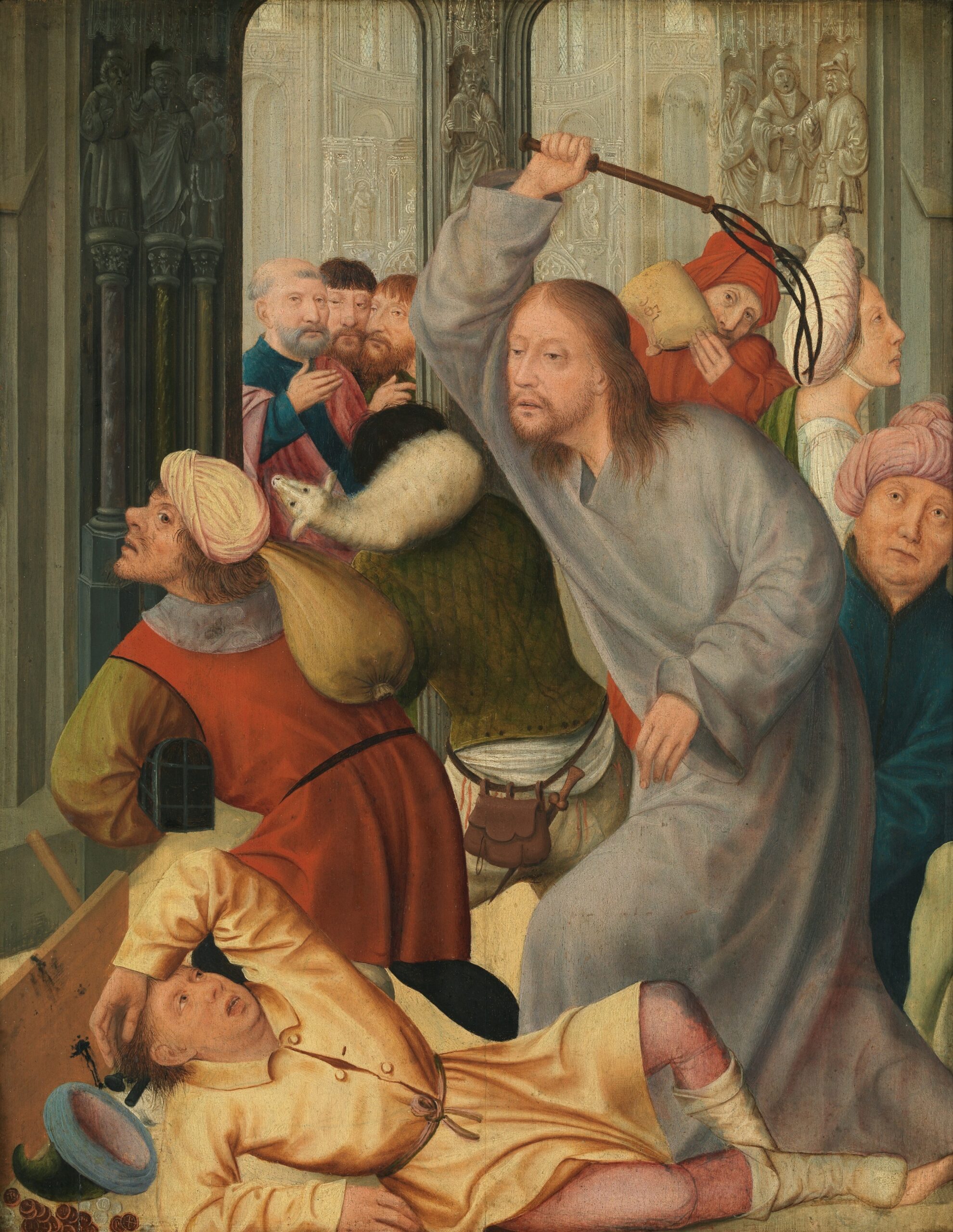
Quinten Massjis’ Christ Driving the Money-changers from the Temple (1520s). The image shows the Book of John’s especially combative version of Jesus.
Six hundred years later, once again, a final Abrahamic prophet threatened a final theological and economic status quo. Much of Muhammad’s biography is the story of his strife with a set of Meccan oligarchs. Mecca had been an Abrahamic pilgrimage site for a long time, and to use a phrase from before, it was “a Late Antique Eurasian city where there were polytheists and monotheists.” When Muhammad came along and began pushing hard for exclusive monotheism, powerful Quraysh leaders pushed back. The pilgrimage, like the first and second temples of Judaism, was a moneymaker, and a new and popular monotheism in town would upset the spiritual business as usual. Over the 620s, the muhajirun and ansar of Medina faced the old guard sheikhs of Mecca, and although our sources on their confrontations are one-sided, one of the many things at stake was the business empire of which Mecca was the nucleus.
Religions were interwoven with regional economies in antiquity, and Judaism in the 600s BCE, and Christianity six centuries later, and Islam six centuries later still all faced opposition and sluggishness to change rooted in entrenched cultural systems, and the greed of the powerful. Each of the three sisters of Abrahamism, in her earliest years, developed through struggle.
The word jihad in Islam is often misunderstood today. It means “struggle.” In the Qur’an, a believer often has to struggle with her own shortcomings in order to be a better Muslim, just as the mu’minun in the Qur’an have to struggle with those who are persecuting them. And what does the word “Israel” mean? The one who struggles with God. From the Tanakh to the Qur’an, jihad has been at the center of Abrahamism. Born under the strife of three different radical ideological movements, the Old Testament, New Testament, and the Qur’an all emerged from periods of revolution and social unrest. Knowing this simple fact is one of the greatest keys to understanding these three books. The many people who set down the Abrahamic scriptures did so under the pressures of class struggle, factional adversity, and anxiety about their own shortcomings as believers. The Abrahamic scriptures, more often than not, were produced within the pressure cookers of cultural conflicts. Their verses, as a result, are often intense, employing hyperbole rather than precise description, using literary figures as often as literal language, and in general, often opting for diction and syntax that is forceful and captivating rather clear and actionable.
I don’t think that very many people have actually read the Bible and Qur’an, not to mention the meter of text that we’ve gone through in our podcast. In my life, I’ve heard too many blanket comparisons between the Old Testament, the New Testament, and the Qur’an, comparisons saying that one of them is X, and the other is Y, comparisons which generally seek to devalue one book at the expense of the other, thereby making some tacit, or not-so tacit point about Jews, Christians, and Muslims. These comparisons are understandable. There are some differences. And we’re humans, and we like recognizing patterns, and categorizing things. But in the main, there are so many more commonalities than differences that the Bible and the Qur’an can very reasonably be described as one connected ideological unit, sprung from the same North Semitic tradition that gave rise to Shalim, Jerusalem, Shalom, as-salamu alaykum, Islam, and Muslims. The latter are acquainted with the Qur’anic phrase ahl al-kitab, or “people of the book,” a concise, inclusive idiom which demonstrates that connectivity.
The Abrahamic scriptures are full of soaring moments of compassion and kindness. Christians often talk about the wrathful and jealous God of the Old Testament, but even among the ireful verses of the Torah, we hear the priestly source in Leviticus saying, “Love your neighbor as yourself” (19:18), and the Deuteronomist in Deuteronomy saying, “Since there will never cease to be some need on the earth, I therefore command you, ‘Open your hand to the poor and needy neighbor in your land’” (15:11).3 These are great verses to have printed in a billion books, and I’m glad they’re there. Not so nice, however, is passage a few pages earlier in Deuteronomy, and one that is in my opinion the single most horrifying string of verses in all of the Abrahamic scriptures – one I don’t think I’ve ever read in our podcast. Here it is – Chapter 13 of Deuteronomy says,
If anyone secretly entices you – even if it is your brother, your father’s son or your mother’s son, or your own son or daughter, or the wife that you embrace, or your most intimate friend – saying, ‘Let us go worship other gods,’ whom neither you nor your ancestors have known. . .you must not yield to or heed any such persons. Show them no pity or compassion. . .But you shall surely kill them; your own hand shall be first against them to execute them. (13:6-9)4
Kill, Deuteronomy says – kill your children. Kill your brother. Kill your wife, all for God. Even for the Tanakh, this is blood-curdling stuff, and the books that make up the Hebrew Bible and the various versions of the Old Testament also include verses that are full of compassion, clemency, history and wisdom. The New Testament and Qur’an have this same duality, sliding back and forth between benevolence and rancor, emerging as they did from such dire periods of history. And in the main, we have neither been as good, nor as evil, as our scriptures have asked us to be.
The Abrahamic scriptures were born during periods of persecution and revolution, and thus, they are variegated with anxiety and optimism, as one would expect. So, now that we’ve considered why all three Abrahamic scriptures are miscellanies of such variant contents, let’s return to that big question: why did the Abrahamic religions triumph in west Eurasia and North Africa? Why did the prophetic tradition of a small Iron Age kingdom in the Levant that grew toward the end of the 600s BCE become the most impactful cultural force in history over a lot of the world today? [music]
Why Did Abrahamism Win?
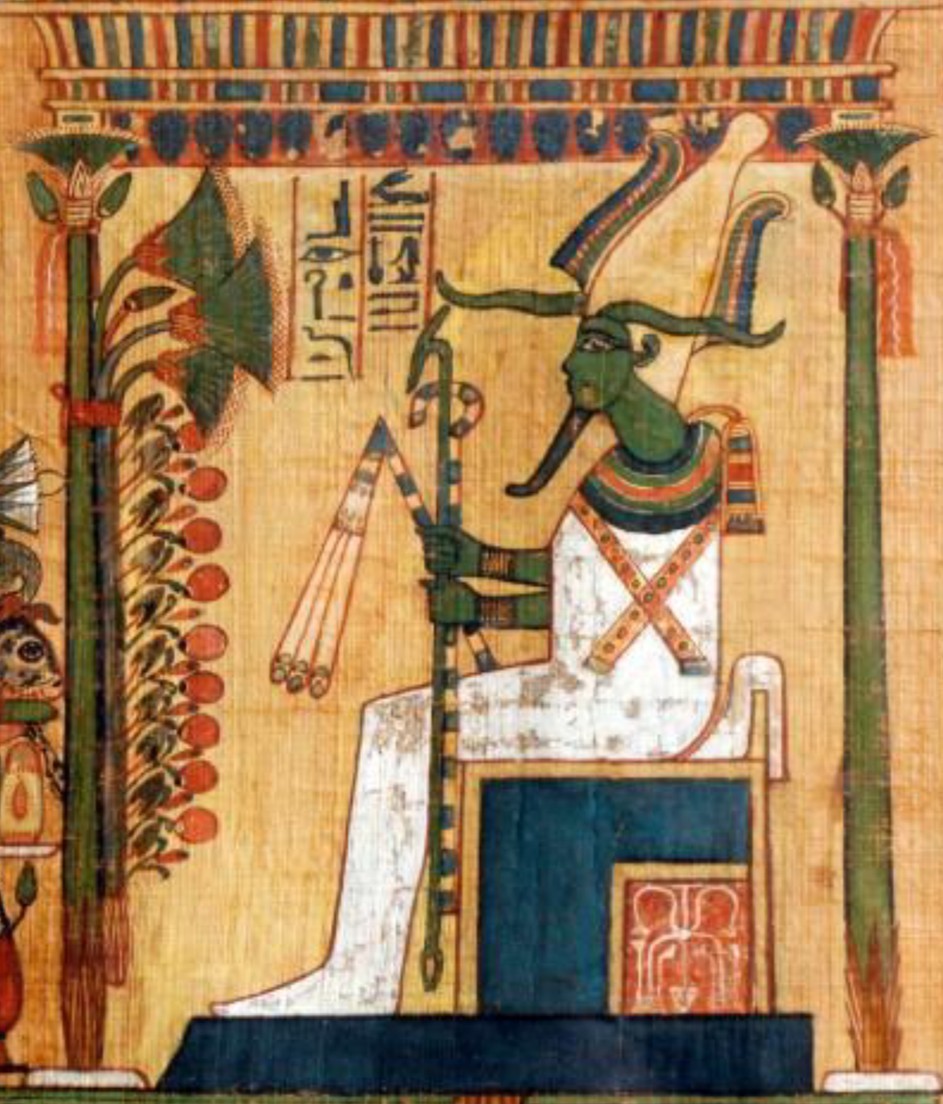
Good old Osiris in Kha’s Book of the Dead. Religions offering posthumous salvation based on worldly actions probably always existed, but the New Kingdom Book of the Dead again and again shows the green-skinned god of the underworld, his wife Isis, and his son Horus as agents of human deliverance.
But the tendency was for more than just adding epithets to single gods, if not exclusively worshipping a single god. From the New Kingdom Book of the Dead onward, a certain genus of deity was gaining ground by the time of the Late Bronze Age. Wonderful old green-skinned Osiris, wearing the bandages of a mummy from the waist downward, and yet eternally verdant and alive from the waist upward, was ancient Egypt’s god of posthumous salvation. From the Iron Age onward, that, increasingly – an emphasis on deliverance after death – became a staple of creeds that grew and thrived.
We’ve talked in many past episodes about the spread of salvific creeds during the Hellenistic and Roman imperial periods. They were everywhere. They resonated with a simple and core human need for reassurance in an unstable world. They offered the same sorts of counsel and encouragement to their adherents. I have occasionally, in Literature and History, submitted a mystery passage for your consideration, and here, at the end of our gargantuan coverage of Abrahamic religious history, I have another one for you. Here it is:
Bear in mind that the present life is just a game, a diversion, an attraction, a cause of boasting among you, of rivalry in wealth and children. It is like plants that spring up after the rain: their growth at first delights the sowers, but then you see them wither away, turn yellow, and become stubble. . .the life of this world is only an illusory pleasure. (57:20)6
So what’s that one from? This one is from Surat al-Hadid, the 57th surah of the Qur’an, but of course, the idea that it expresses is Manichaean, Gnostic, and Platonic; it could have come from the New Testament or the Tanakh; from stoic philosophy or any of the church fathers; it could have come from the Greek Archaic age philosophy of Pythagoras, the folksy truisms of the Panchatantra, or a great many Buddhist texts. The notion that the present world is an illusory prelude to something else is everywhere. From 600-300 BCE, Plato and other Iron Age prophets began promising exclusive access to truth and egress from ignorance. And to this day, if you believe you are a part of a select few with privileged access to the truth who stand above the common masses, then you are the common masses, because this is what most people believe. This was the ideology that won, and its most ascendent versions were the Abrahamic religions.
So far, in our retrospective on why the Abrahamic religions triumphed, we’ve considered a couple of obvious points. First, monotheistic religions in general had gravity, tending to absorb the people and ideologies orbiting around them. Second, they offered clear and consistent messages about the worth of individual believers, and the control of individual believers over their afterlives. If Judaism, Christianity, and Islam had not emerged as ascendant during Late Antiquity, something else very similar likely would have – maybe some Coptic language Ptolemaic scriptures revering the holy trinity of Isis, Horus and Osiris; maybe some sagely hybrid of stoicism and Neoplatonism in which a more numinous and otherworldly Zeus granted posthumous rewards; and maybe a Pahlavi text that revered a Zoroastrian angel as sublime above all other deities. The thing that emerged as dominant, whatever it was, was going to give believers a sense of exclusive exaltation, because a critical mass of ideological traditions were trending toward salvific monotheism. What kind of salvific monotheism was ultimately the question.

The informational placard about the Ketef Hinnom scrolls in the Israel Museum in Jerusalem. Written on tiny silver scrolls around 600 BCE, these contain blessing from Numbers (6.24-6). Photo by McKaby.
The Abrahamic books took the centrifugal force of human spiritual energy and they spun its cyclone around a fixed set of ideas. This harnessing of wild energy took extemporized mythmaking and turned it into exegesis and jurisprudence. Prophecy concretized into doctrine and tradition. There was still continuous creativity within all three religions. Apocryphal and pseudepigraphal texts, together with the caprices of individual theologians, did rattle the foundations of hardening orthodoxies, as Pharisees debated Sadducees, Christological controversies shook the early church, and Mu’tazilites vexed traditionalist hadith scholars. The three religions had dings and dents, as the problem of evil remained a tough cookie, century after century, and monotheism has never quite been a warm enough jacket to keep away all the cold and hard weather of life. But again, the Torah, the New Testament, and the Qur’an remained the solid and stable cores around which all disputations orbited, and theological divisiveness, generation after generation, only made their centrality more and more certain. The Abrahamic scriptures themselves became the nucleation points that changed phases of human history. Since then, we have had wars and plagues and demagogues at regular intervals. But as the proverb from Ibn al-Muqaffa put it, the grass always comes back up after a storm, even though great big things get knocked over, and the three sisters of Abrahamism will always be a part of the grass, and of what we are. [music]
Have the Poets Left a Rip Unsewn?
_-_The_Four_Doctors_of_the_Western_Church,_Saint_Augustine_of_Hippo_(354%E2%80%93430).jpg)
Augustine’s generation, who endured the collapse of the Western Roman empire, passed on the pessimism of the early fifth century. But in general, Abrahamic theology can run the gamut between dour and upbeat.
We’ve heard this same sentiment before, also in poetry from the 500s, only, in Arabic poetry. We heard it forty hours ago, in the very opening sentence of this season. I told you we’d come back to it, once we’d completed the story of how Islam came into the world. And now, here we are, and it’s time to consider the most famous line Antarah ibn Shaddad, roughly contemporary with the world-weary Roman poet Maximianus. Antarah ibn Shaddad wrote, in his most famous qasida’s opening, “هَل غادَرَ الشُعَراءُ مِن مُتَرَدَّمِ” or, “Now, have the poets left a rip unsewn?” or “Have the poets left a single spot for a patch to be sewn?” Antarah’s meaning here is generally understood to be that poetry is old and overcrowded. Everything that could be said has been said. There’s nothing new to add. I wanted that to be the first line in this whole season, because it’s a line that says so much with so little. Antarah’s ode, with its opening line, tells us that Arabic literature was broken in even by the 500s CE. Just as the poet Maximinianus, during the same century over in Ostrogothic Italy, following many Christian churchmen, lamented that the promised bounty of youth yielded no delight or freshness, 2,000 miles to the southeast, the black knight Antarah thought of all the poetry out there as a worn-out cloak with too many pieces sewn onto it.
On one hand, it’s pretty depressing to contemplate the fact that even 1,500 years ago, poets were writing about the world as tattered and threadbare. On the other hand, it’s inspiring to know that bygone generations also found their historical epochs to be tired-out scrapyards. World-weary poetic cynicism, after all, is still poetry, and saying that there’s nothing left to say is still saying something. As the grass of culture springs eternal with each generation, every era produces its own brand of ennui and pessimism, just as optimism and hope are produced, as well. And some generations after Antarah ibn Shaddad asked, “Have the poets left a single spot for a patch to be sewn?” a certain seventh-century book offered a rather emphatic answer to the sixth century’s jadedness. This book did not see the whole world as blasé and dilapidated. It did not think there was nothing left to say. Instead, the Qur’an proclaimed, “If all the trees on earth were pens and all the seas, with seven more seas besides, [were ink,] still God’s words would not run out. God is almighty and all wise.”9
It’s one of the most optimistic verses ever written, in a book that is, in the main, quite optimistic in general. The Qur’an sees earth as infinitely generative, and God as capable of verse after verse, and creation after creation. Of course the world isn’t raggedy and dying, the Qur’an says. Earth is part of the part of limitless fecundity of God, and as such, it is as unbounded as divine imagination. The Qur’an can also, like so many other texts from the ancient world, occasionally decry the earth as a paltry prelude to heaven – we heard a quote earlier in which Surat al-Hadid did just this. But the book is also stocked with wonderful metaphors about the plentitude and loveliness of the earth, having more of the deep hope and optimism of the New Testament Gospels than the jadedness of Ecclesiastes. Outside of Islam, Late Antiquity is often imagined as a time of decline, when the Classical world wheezed out, before the long, dull intermission of the Medieval period. To Muslims, though, the early seventh century was dawn, rather than dusk, and the real instantiation point of history that matters. That perspective – that the 600s, and the 700s were the most mightily important centuries that there ever were – is quite a refreshing one for those of us in the English-speaking world conditioned to think of the Middle Ages as a dreary interlude to supposedly more lucid periods of history. As the Qur’an puts it, the pen of God, and perhaps by extension, the pens of humanity, are tireless, charged with inspiration by the world itself, and there is always, in every generation, something new and important to say.
The long theological story that you’ve heard in this podcast is not a secret. I don’t claim to offer you exclusive access to some esoteric truths. What we’ve done in this show has been characterized by work more than visionary originality. That work was kind of Islamic in nature. The earliest revelation of the Qur’an was a single word imperative from God that is often translated as, “Read.” And so we have. And the large reading venture we’ve undertaken into the primary texts of the Abrahamic religions has been deeply empirically satisfying – to me, at least. I hope most of all that, for you, this journey has made Judaism, Christianity, and Islam, along with the Tanakh, the New Testament, and the Qur’an, all feel ordinary and familiar. They are all part of the same thing, and the unity of their traditions should be better understood than it is today. Fortunately, wiser and more accomplished people than me have tried, and are still trying, to broadcast the message of that ultimate unity.
On March 6th, 2021, Pope Francis went to meet with the Grand Ayatollah Ali al-Sistani, the head Shiite cleric in Iraq. The two revered leaders met in Ali al-Sistani’s home in the historic city of Najaf. Ali al-Sistani, at the time, was 90; Francis was 84, and so needless to say, there was no breakdancing. The two old theologians sat close to one another in al-Sistani’s unadorned living room during a photo session with the press. Then there was a closed-door, 40-minute meeting between the two men. I wonder what they talked about. Leading giant religious organizations? Arthritis? Scripture? Soccer? It could have been anything. The point is, it was the first time that a Pope met with a Grand Ayatollah of Shiism. Afterward, Pope Francis went to speak near the ancient city of Ur, where our podcast began, to emphasize the shared roots of the Abrahamic religions, and to urge religious leaders in Iraq to work together. These events did not result in immediate peace on earth. But the Pope’s visit, and the Grand Ayatollah’s goodwill toward that visit, were both a powerful gesture toward acknowledging a shared religious past that dates back deep into the Bronze Age.
Pope Francis also met with Sheikh Ahmed al-Tayeb, the Grand Imam of Al-Azhar University in Egypt, at the Vatican in 2016. Pope Francis had two other meetings with Sheikh Ahmed al-Tayeb, one of the most eminent authorities of contemporary Sunnism. The second of them, in 2019 in Abu Dhabi, resulted in the signing of a document decreeing the fraternity of all humans, regardless of creed. At their third meeting, in Bahrain in 2022, Pope Francis and Sheikh Ahmed al-Tayeb were no longer strangers to one another, and they spoke on the familiar topics of unity and dialogue. A modern Pope, like a Grand Ayatollah in Shiism, or a Grand Imam in Sunnism, with the credentials that these men share, know the truth about Abrahamic history. They know what the roads of extremism look like, and where they lead. They have hearts and minds large enough to accept a great paradox – that although Christianity and Islam each trumpet global proselytization, neither religion has managed to pull it off. They have the maturity to realize that in spite of their profound and deeply informed spiritual convictions, the world is the way the world always has been, and the motley grass of human culture grows in ways contrary to old prophecies.
I share their hope, and I want to share it with you, too. As rocky as the history we’re living through is, that same rocky history is throwing us more and more often in closer proximity with one another, year after year. It’s hard to believe demagogic malarkey about Muslims, Christians, Jews, or anyone else when you grow up trading peanut butter cups, or halva or whatever with them as kids in a school cafeteria, and some of your friends wear hijabs and others wear kipas and others dastaars, and you don’t care, because it would be pretty boring if all of your friends were the same. Globalization and late-stage capitalism have had some pernicious consequences, but they’ve also tossed us all over our countries and our world, and helped us meet, and draw conclusions directly from cultural others, and this amalgamation is a healthy antidote to misinformation and prejudice. It’s not new. During the Roman empire, during the first three caliphates, in Al-Andalus, and in a dozen central Eurasian empires, humanity did what we are perfectly capable of doing, glomming together into productive civilizations, even though some of us were striped and others spotted. We have always been able to do this, and to do it without losing our stripes and spots, should we decide to retain them; we are as hardwired for cultural interoperability as we are for malignant tribalism, and it is tremendously inspiring to see a Pope, and a Grand Ayatollah, and a Grand Sheikh all standing up on behalf of the solidarity of all humans.

The Pre-Islamic Arabian goddesses Al-Lat, Manat, and Al-Uzza, from Hatra in Iraq, dated from around 1-200 CE. Al-Lat wears the Gorgon breastplate of Athena.
When our parents and grandparents went to bed, my cousins and I would prowl around, playing games, climbing trees, and catching fireflies, creatures as alien to California as they were to Kuwait. Bitten by bugs, knees scraped, itching from poison ivy and chiggers, in the basement or kitchen or covered porch, we’d tell stories. My cousins were more interesting than my sister and I were. They spoke multiple languages and cracked each other up with multilingual puns. They went to Cyprus and Bahrain and other places for vacations that at the age of 10 I couldn’t have found on a map. They knew about things that we didn’t.
One night, my youngest cousin – she’s about my age, told me about jinn. It was a ghost story, really, told as we looked down into an overgrown cattle pasture, about Arabian spirits that were old even in the time of Muhammad. There’s a lot of folklore about the jinn. In the Qur’an, they are a discussed as a second, shadowy sect of created beings, capable of both piety and apostasy. My cousin understood them as something more evil and manipulative than anything else, and she told me about how a few suspicious things had happened to her that just might have been a result of the jinn. She was a good storyteller. The night suddenly grew spooky as she told one tale in particular about maybe even seeing one in her house in Kuwait, and I got a case of the heebie-jeebies – I kept looking behind me toward the back yard of the farmhouse, hearing frogs and cicadas and envisioning scary Arabian spirits in the shadows of the ash and cottonwood trees. Then, the tale was over, and she shrugged. It wasn’t one of those pranks where the storyteller scares you at the end. She asked me if I’d ever seen anything like jinn and I said I was afraid of werewolves, but no, I hadn’t, and I felt pretty boring.
There was something magical to me about that story. I remember appreciating the way that she told it, and thinking about the great big span of the world and how many things I hadn’t heard. As it happened, though, it was just a kid telling a story to another kid. But that old storytelling thing – that was also something that has always been happening, and always will. It’s what I do in Literature and History, and what I’m doing right now. Because like my youngest cousin and I were on some July night decades ago, here we all are, underneath the same wilderness of stars, children of Abrahamism and other creeds, all of us, regardless of what believe. The bad news is, we’ve got this story wrong a bit too often, teaching it as east and west, or a zero-sum game for spiritual victory, and the misconceptions that have resulted are old, crabbed trees with hard wood and deep roots. The good news is that when a Pope can shoot the breeze with a Grand Ayatollah and a Grand Sheikh, we can also decide, in the small things that we do, to try and make things a smidgeon better. The world is never a worn-out lost cause, although occasional generations find it fashionable to write it off as such, and as the Qur’an often puts it, referencing the uncountable miracles of nature, “There are signs in all of these for those who use their minds” (2.164), signs for many of us of the bounteousness of God, and for all of us, signs to make us feel grateful for what we do have.10 We are culture, whether we are esteemed elderly clerics, or ordinary children telling stories. We are the grass, and the grass gets to decide how it grows over the mountains and around the stumps that came along before it. Shalom. Shalom. [music]
Banu Tamim, Banu Kalb, Angles, Saxons
Now then, let’s move on. This past season of Literature and History has been, overall, well-received. The importance of the subject matter is incontestable, so that has helped, and obviously, we are just trying to strike a utilitarian course through religious history, rather than attracting an audience due to divisive claims. I have lost a few people, however, who have essentially said that they’ll be back on board when we reach European literary history, which we’re about to. Not everyone is interested in everything, and that’s all normal. Nonetheless, I did read some courteous emails and Patreon exit surveys with a puzzled eyebrow raised. Is early Islamic history really so different from early Medieval European history? Is it?Over the past year, we’ve heard the story of Arabian tribes moving into the territories of the Byzantine and Sasanian empires. The Romans and the Persians fought the last great war of antiquity, and then in came the Banu Thaqif, the Banu Tamim, the Banu Kalb, and most famously of all, the Quraysh tribe with its many legendary clans. These tribes, whom the Romans and Persians considered barbarians, invaded weakened provinces and brought them under the control of caliphs and emirs, and thus, a lot of territory changed hands, with barbarian immigrants assuming control of what was previously imperial territory.

A map of western Europe in the year 500, according to the influential German scholar Heinz Ritter-Schaumburg.
The 600s, 700s, and 800s saw more than the spread of hopeful Abrahamic religious doctrines. In territories that once been Roman and Persian, after barbarian conquest came internecine squabbling. The clan tensions of the Quraysh tribe led to multiple fitnas. On a smaller scale, in the northwest of Europe, Anglo-Saxon kingdoms fought Brittonic principalities in the Old North, and the brief unity of the Carolingian empire was bookended by more violent and chaotic centuries. But in the east and the west, beneath usurpations and power struggles, there spread Arabic and Latin and their appendant theologies, just as, in the middle, the Byzantine empire steered the course, developing Classical and Christian traditions even during tumultuous phases of early medieval history. It was the same great process of migration and cultural equilibration beneath Abrahamism carried out in different regions.
To consider another appealing example of the cultural continuity of west Eurasia in the early medieval period, an Old Irish poem from around 700 tells the story of how “When Jesus, son of the living God, was a small boy. . .He fashioned twelve small birds. . on the Sabbath day he made them smoothly out of clay. . .Jesus clapped his two hands, his little voice was heard; before their eyes – kingly the grace! – [the birds flew] away.”12 And just so, in the Qur’an, Jesus says, “I will make the shape of a bird for you out of clay, then breathe into it and, with God’s permission, it will become a real bird” (3.73).13 The story of Jesus making birds out of clay is not in the Bible – it’s from a work called the Apocryphal Gospel of Saint Thomas, which, during the 600s, was evidently well known enough to reach Arabia as well as Ireland. And just as many Arabs had long traced their heritage to the biblical Ishmael, some early medieval Irish writers began tracing their roots to the biblical Japheth.14 Later, just as Irish storytellers wrote a number of sagas of fairytale voyages out into the Atlantic that are still beloved today, the great Andalusian Arab geographer Muhammad al-Idrisi wrote of the fantastic voyage of travelers from Lisbon into the Atlantic. The point here is not to stress the specific connections between early medieval Irish culture and the greater Islamic world. The point here, especially as we imagine Andalusian explorers charting the Atlantic, or Irish Christians and Muslim students of the Qur’an reading about Jesus bringing sparrows to life, is that the story of the early medieval period is the story of the world that Abrahamism wrought, a world that was intercontinental in scale, but nonetheless, was all part of the same connected cultural system.
If we don’t understand this basic connectivity, and the ultimate structural similarity of the Christian and Islamic splotches of west Eurasia at the end of Late Antiquity, we’re liable to believe in an evergreen boogeyman called the Dark Ages. This boogeyman serves a lot of agendas, but most often, dismissing the centuries between 500 and 1000 as benighted and debased years has offered a handy excuse to mostly ignore them. In Europe, during this half millennium, I think most of us imagine, the withdrawal of Roman infrastructures led to cultural stagnation and squalor, as men of the cloth coaxed barbarians into churches, and battleaxes were traded in for bibles. What really happened was that Christian holy water met various rich pagan soils, and the things that sprouted up were the beginnings a lot of Europe as we know it today. And to move us toward the subject of early medieval literature, in the 500s, and then in the 600s, as Islam billowed over the center of Eurasia, a lot of formative history was also happening up in the northwestern edge of the supercontinent, as well. [music]
A Tale of Two Seas
Those of us who study literature don’t think often enough about seas. We think about them, maybe, as scenery, or backdrops. Poets might gaze out on crashing waves, or lovers might be separated by cruel saltwater, or adventurers might sail in search of Penelopes and white whales. But to many of us interested in books, seas and oceans are merely empty space – perhaps fodder for a good shipwreck tale, or a poignant part of a longer saga, but not in and of themselves subjects of great interest.Seas, however, were cultural ecosystems in antiquity more than countries were. Sea travel, safer and swifter than horses and mule carts over shoddy roads, was one of the steadiest fixtures of great empires. Ancient Greece was the Aegean basin more than it was the modern-day country of Greece. The Roman empire was the Mediterranean, and not Italy. Just so, when we approach the earliest European vernacular literature that has made it down to us today, we see the products of two different seas at work – the North Sea, and the Celtic Sea – both of them, during Late Antiquity and the early medieval period, connected cultural systems that gave rise to the earliest surviving literature in Old and Middle Irish, Old Welsh, Anglo-Saxon, Old High German, and Old Saxon. Let’s start with the first of the two regions – the North Sea – the one on the right.
The North Sea is the oceanic basin east of Britain, north of the Netherlands and Germany, and west of Denmark and Norway, and of course I know that many of you know that – but we Americans are terrified of geography more than anything else on the earth, so it never hurts to clarify. The North Sea, like the Aegean Sea long before it with Greek literature, was the main engine behind a lot of Anglo-Saxon poetry. Beowulf takes place in what is today Denmark and southern Sweden, and many of the most famous Anglo-Saxon poems concern seafaring and bear the imprint of a greater maritime culture. The Anglo-Saxons who settled in Britain predominantly disembarked, generation after generation, on the eastern and southern coasts of the island, bringing with them the dialects and cultural traces of many different vicinities of the North Sea basin. Anglo-Saxon literature, often called Old English literature, is associated with England, but the languages and peoples that produced it came over from the larger and more globally connected expanses of the North Sea.

A folio from the Book of Leinster, a twelfth century Irish manuscript that is one of our most important sources on early medieval Irish literature.
When we approach the first centuries of the Middle Ages, the temptation is often to imagine Christian missionary operations encountering indigenous populations that were somehow frozen in time and place. Romans and Christians tended to be reductive about so-called barbarians and pagans, caricaturing Germanic speakers and Celts with a few traits, and more or less imagining them as primitive peoples who had never really gone anywhere or done anything. But as we’ve learned in our podcast, especially in this past season, the barbarians of Late Antiquity, or what we might more neutrally call the “non-imperial” populations of Late Antiquity, were never simple, static, or imperceptive. The diverse Arab tribes of the fifth and sixth centuries wrote every genre of poetry under the sun, they worked for monarchies on two different continents, they adopted new technologies and learned new languages, they were economic entrepreneurs, participation in trade and warcraft led them to have an acute sense of unfolding geopolitics, and they were not, in a word, just hanging out in timeless sandscapes, waiting for stuff to happen. Just so, a continent away, in between where the Elbe and the Rhine empty into the North Sea, the southern shore of this basin was humming with droves of Germanic tribes, who, during the 400s and 500s, knew what was going on in the region, knew about Romans and Christians, and had themselves absorbed generations of other barbarian immigrants, just like the Romans had. Equally, out to the far west, the Celtic and Irish Seas, during prior to Christianization, were not preserves of Gaelic and Brittonic culture, hermetically sealed away from the history all around them.
These are simple points, and I don’t mean to belabor them. But they’re also good to keep in mind as we prepare to set anthologies of Germanic and Celtic literature on our desk in the next season. Ten years ago, I began Episode 2 with a quote from T.S. Eliot. Eliot wrote in 1944 that, “The bloodstream of European literature is Latin and Greek – not as two systems of circulation, but one, for it is through Rome that our parentage in Greece must be traced.”16 It’s a familiar idea. English, German, and American academics of the mid-20th century liked imagining themselves as the heirs of the classical period. A decade ago, I pointed out that the statement didn’t really acknowledge that the Bible’s roots are ancient near eastern, rather than Mediterranean. European literature’s bloodstream is also Sumerian, Akkadian, Egyptian, and of course, Hebrew. But coming to the subject of what Eliot calls “the bloodstream of European literature,” in point of fact, the bloodstream of European literature is also European. It is Celtic. It is Germanic. It is Norse. If you have been leagues deep in the ancient world, and in Abrahamic theology, like we have for so long, it is somewhat thrilling to remember that the bloodstream of European literature, whatever the heck that means, after the 800s and 900s, also includes acres of poetry and storytelling that did not come from the balmy old Mediterranean and ancient near east, but instead, from considerably further north.
Nonetheless, the thing that we want the most out of early medieval literature from Europe is sometimes slippery and elusive. We might read, for instance, Anglo-Saxon literature, looking for the raw, undiluted Germanic literary traditions that developed apart from Abrahamic theology. We might read early medieval Irish literature, looking for Celtic gods and goddess as they once were on the island before Christianity. But in all cases, every single piece of the earliest vernacular literature that survives from Europe was written down by Christians, even though they were recording and embellishing their own indigenous cultural traditions in their native languages. Thus, when we read Anglo-Saxon literature, or Old and Middle Irish literature, as we’ll soon do a great deal, we see Germanic and Celtic literary traditions at the end of a Christian corridor. A lot of it, to be sure, is absolutely, authentically pagan storytelling from the continent and northwestern islands before the presence of Christianity in both regions. At the same time, though, the earliest medieval literature from Europe were set down by pens trained in monasteries. All of this is neither good, nor bad – it’s just part of the scrumptious layer cake of the early medieval European literature.

The Nowell Codex, which contains the Anglo-Saxon epic, Beowulf, is generally dated to between 975 and 1025. The epic itself is of an unknown vintage. Photo by Ken Eckert.
There is one element of this period of early medieval history that will need no introduction whatsoever, and that element is Christianity. We have often, due to old schemas of historical periodization, been taught that Christianity made the Middle Ages medieval. And indeed, from the First Crusade in 1096, to the English Edict of Expulsion in 1290, the High Middle Ages were a time when some pretty nasty transgressions were committed in the name of the church. However, it is always terribly important in religious history to separate the natural proclivities of humanity, most of all toward greed and tribalism, from the religious ideologies that flawed people profess. In plainer English, the extreme violence of the First Crusade and other medieval atrocities resulted from people being assholes, not from them being Christians, and no major religion, nor lack thereof, has been fortunate enough to cordon itself off from the indefatigable defects of our species.
As we dig into the history of the very early Middle Ages, I think you’ll find, as I have found over the course of writing the next season, that the centuries between 500 and 1000 were among Christianity’s finest in Europe. In a vibrant network of ecclesiastical and monastic operations that spread through western Europe, Christianity generally helped create more egalitarian, stable societies. Out of the general rule of petty kingdoms in the post-Roman west, Christianity’s commitment to the worth of each individual, to promoting clerical literacy, and to helping the sick and hungry led not only to the early medieval literature that we’re going to spend the next forty hours reading, but also, the countries and cities in which many of us live today.
Whatever your background is, I hope that after all these hours, the Bible, the Qur’an, and the stories behind them now feel familiar – hopefully, as they do to me, like old friends, in a way that a book that you’ve read many times sits especially comfortably in your hands, and you remember the outlay of paragraphs and sentences on specific pages. Ahead of us in European medieval literature lie druids and witches, faeries and sorcerers, dragons and magic rings, and monsters and quests, but old Abraham of Ur, and the narratives that came from him, will continue to be part of our story, too. [music]
The Back to Iraq Bonus Series
Speaking of Ur, guys, I have a confession to make. I always wished that the early podcast had covered more ancient Sumerian and Akkadian literature. We did cover the most famous Mesopotamian stuff in the opening episodes – the Enuma Elish, and Atrahasis, and the Epic of Gilgamesh. But there was a lot that I skipped over, too. I got to thinking more and more about old Ur, and Uruk, and Babylon, and Nineveh, especially during these recent shows on the early literature of Umayyad and Abbasid Iraq. No matter that our show had finally entered the early Middle Ages. No matter that I was working on a book about Homer’s Odyssey. Akkadian literature, and especially Sumerian literature, is really special stuff.As this season of our podcast began drawing to a conclusion, I knew it was time to write and record a new bonus sequence. And for this season’s bonus sequence, I decided, for the first time in the podcast’s history, to go back in time – before any of the sisters of Abrahamism existed – back to the cuneiform tablets that were already ancient and forgotten even in the days of the early caliphates. I decided to go back to what is shared by all of us as our oldest literature – back to Iraq.
Back to Iraq is a new, 5-episode bonus series on ancient Sumerian and Akkadian literature, covering texts from 2300-700 BCE that we never explored in our main series.
Following Back to Iraq’s opening episode on earth’s earliest surviving creation stories, we’ll have two full-length episodes on two epic sagas that survive from Sumer – the first called the Enmerkar Cycle, and the second, the Lugalbanda Cycle. These heroic cycles are tales about the ancient kings of Uruk – things that Enmerkar and Lugalbanda did, and adventures that they had. Just as Sumerian Lugalbanda was the father of Gilgamesh, these Middle Bronze Age adventure stories were precursors to later Akkadian epics. These Sumerian epic cycles are some of the strangest, most beautiful literature I’ve come across, and they’re especially engrossing in the way that they are both similar to, and very different from, the later epic traditions that would emerge during the Iron Age.
In addition to four Sumerian creation stories and two Sumerian epics, the new bonus sequence, Back to Iraq, also covers the two most important pieces of non-narrative Sumerian literature. The first of these is called the Cylinders of Gudea, it’s the longest known Sumerian text on earth, and the second, the “Lament for Ur,” is the most famous lamentation text of the ancient world prior to those in the Bible. And then, at the end of the Back to Iraq bonus sequence, we’ll move on to Akkadian literature.
Akkadian cuneiform was around for about 2,000 years. A lot of it survives, in a lot of different gernes. The end of our new bonus sequence, Back to Iraq, covers a short Akkadian epic called Erra and Ishum before going on to read what are two of the most famous philosophical poems in Akkadian, the first often called “The Babylonian Theodicy,” and the second, “The Poem of the Righteous Sufferer.” These are among the greatest masterpieces of Mesopotamian literature, and the later Akkadian texts with which the new bonus sequence ends will teach you some things about Iron Age Babylonian and Assyrian culture that we never got to in the early Literature and History episodes, some things that are especially interesting within the greater history of monotheism.
Though it’s been a busy year, I had an absolute blast writing and recording this huge new bonus sequence. I figured that since we spent so much time in Basra and Baghdad in this past season, and ancient near eastern literature is something that concerns all of us, you guys might enjoy 10 hours’ worth of brand-new content on ancient Mesopotamia.
Up until recently, I’ve always had trouble making this bonus content available for people to easily listen to. To get my bonus content on your favorite apps, which is what everybody wants, there have been truly punishing barriers to clear. I’ve always felt like 5% or 10% taken out of my paycheck is a reasonable amount to deduct for subscription maintenance and payment processing, and that’s about what Patreon takes, and it’s totally reasonable. But Amazon, Google, and especially Apple have pushed for more like 40 or 50% of the earnings of podcasters, if we want to sell things on their flagship apps.
There’s good news, though. After ten years of podcasting and almost ten years of selling bonus episodes, things have become better for content producers and those who support our work. I’ve just set up a new, really simple system with a company called Supercast that podcasters like me have moved over to. If you want to listen to my bonus episodes on nearly any app, including Apple Podcasts or Spotify, you can just tap the first link in this episode’s description, pay with Apple Pay, Google Wallet, or a credit card, tap another link to get the bonus catalog feed into your favorite app, and then have access to 100 hours of Literature and History bonus episodes. The price in this new system is $9/month, with the first week free so you can try it out and make sure that it works. You can get a cheaper price by paying for twelve months if you want, you can continuously subscribe if you’d like to support the podcast in that way, or you can just subscribe for a couple months and listen to what you want to, and then drop off. For all of you who have bought bonus episodes from me in the past, you can still just buy them on the website as MP3s, and you can still buy them on Patreon, too.
The bonus catalog, at this point, includes a colossal range of listening material, all produced with the academic rigor and sound design of the main show. Some of Literature and History’s very best episodes are in the 100 hours of bonus content. There are about twenty hours on Bronze Age literature, including the new Back to Iraq series, and the older Before Yahweh series. There are thirty hours on lesser-known subjects in Jewish and Christian religious history, including The Astounding Apocrypha, Christianity’s Roots, and the Rejected Scriptures. There are thirty more hours on ancient Greek literature, including More Greek Plays, The Actual First Novels, and Rad Greek Myths. And as a special incentive to subscribe, by popular demand, I’ve packaged all of my Patreon bonus readings – an additional 20 hours of material, onto that same new bonus content channel, too, which include me reading everything from Zoroastrian Gathas to Emily Dickinson to Oscar Wilde, Walt Whitman, the Book of Mark, T.S. Eliot, Edgar Allan Poe, Nathaniel Hawthorne, odes, ballads, sonnets, and on and on and on – this is some of my all-time favorite short fiction and poetry that I’ve taught for a long time. Again, 100 hours total, $9/month, first week free, first link in your episode notes. I could especially use the help right now, for reasons that I will explain. [music]
The Challenge of Covering More Obscure Literary History
Doing a whole season on early medieval literature, as I am about to, is a questionable decision. I know for a fact that most English speakers have not heard of Hrotsvitha, nor the Junius manuscript Exodus, or, even, regrettably, Máel Dúin, or Cú Chulainn, or Queen Mebd of Connacht, though I could be wrong – we’ll see. However it lands, this will be the third season of the podcast in a row – first Late Antiquity, then Early Islamic History, and now this present one, in which I will read and teach wheelbarrows of challenging, multilingual material from an era of history that is perennially ignored in the Anglophone world and likely will not earn me very many new subscribers.In fact, for six out of this show’s ten years, we have been in the late Roman empire, and then Late Antiquity, and then early Islamic history. As of this episode, we begin early medieval European literature, another era that, while it’s important, isn’t full of household names. Let’s talk about this long stretch of the podcast for a moment – the one that we’ve been on for a while, and will be in for another year or so. When I was in college and graduate school, this long period – let’s call it 100-1000 CE – was a sort of cultural badlands. 100 to 1000 CE. Everything about it was off. The Greeks were Romans. The philosophers had become Christians. There were polities with weird names swarming all over the place – Visigoths, Lombards, Avars, Sasanians, Alans, Angles, and more. Islam was important, obviously, but boy, that was a lot to learn about. None of the European monarchical dynasties had really got kicking yet, and the whole continent was a Rorschach inkblot test of dubious shapes that didn’t look like anything classical or modern. The historical period appeared, in my imagination, like a timelapse photo of a Roman temple decaying into a moldy ruin for centuries, and then suddenly sprouting minarets and flying buttresses. I stayed away from 100-1000 CE in college. I stayed mostly away from it in graduate school. But I thought about 100-1000 CE a lot. It was the story of the pepper of paganism meeting the salt of Abrahamism and producing all kinds of new flavors of culture. In 100-1000 CE, as I learned much later, lay the greatest secret in western religious history – that apart from some yowling church fathers and heathen extremists on the other side, Christians and pagans most often just kind of hung out for a long time before Christianity’s fabulous organization and charitable outreach led to its hegemony. As pivotal as they are, and as glittering with seldom-known stories, 100-1000 CE, for a podcast presenter like me, are pretty dangerous years to linger in. People are interested in, for the most part, what they already know about. I’ve always known that, because it’s common sense, but over the past year, it’s become clearer and clearer.
Over the past year, I’ve been working with publishers and agents a bit, on both the books I released earlier this summer as well as some other projects. Mostly, it’s been a treat, and I’ve learned a lot. But working with publishers has also made me appreciate this project. The past six years of our podcast – again, a gigantic plunge into unsung centuries of cultural history – this never would have been greenlit by a publisher. I know the system a little bit more, now. If this show had a board of shareholders, I can only imagine trying to pitch some of the episodes to them. Minor Latin poets of the late Roman empire? Nope. Obscure Greek epics of later centuries? Nah. Hadiths? No thanks. Early Arabic literature that depicts profound and moving similarities between the Christianizing and Islamicizing parts of Eurasia? Of course not. Publishers are smart, and they look for paths toward financial success, and popularity generally comes from publishing on things that are already popular.
Unfortunately, this avalanche effect of popularity, which is amplified by internet algorithms that try to get us hooked on whichever app we’re using, has somewhat of a pernicious effect on the study of cultural history. Just as publishers publish in genres that are already selling, most content creators pay homage to the consumption patterns already resident on gigantic platforms like YouTube and Spotify. The pattern for success generally involves finding something that is already popular and then working an intriguing angle of variation, and thus riding a slipstream of hashtags and trends. For instance, a video about Homeric similes might get a few views. A video claiming that the Trojan Horse was actually a hawk, or that Odysseus was gay, or even more strangely, a reaction video to some pop cultural phenomenon related to ancient Greece – these are the elevators to hundreds of thousands of views.
In this environment of algorithmically primed dogpiles, an academic like me is in an unenviable position. I don’t want to tell people about what they already know about. I don’t want to strike some provocative pose on thoroughly trampled ground. I want to teach people things they do not know about. I think that learning new things – not latching fixed preconceptions onto some trending oddment – but learning new things – is clear water that rinses away the rust and gunk of daily cognitive life. Histories of literature like this one – they should not be greatest hits compilations laying flowers at the overcrowded mausoleums of so-called great books – they should introduce us to fresh new material even as they also celebrate what’s already familiar. But being here as I am, three seasons and six years into some of the dustier bookcases of the library, I’ve been on an uphill climb for a while.
I did a full count of the show’s hours and words last week. With bonus episodes included, we are at 330 hours. The podcast’s word count, which is 2.5 million words, means little to most people, but this will. The average length of books published in the 2020s is about 100,000 words, which means that over the past ten years, I have written and recorded the equivalent of 25 books for this project. When I did the math and figured that out the other day, I felt the funniest combination of surprise, pride, and depression all at once – surprise because it’s a lot, pride because it’s a lot, and depression because, you know, you’d think that with 25-book-length works poured into one story, and an audience of one or two hundred thousand people around the world whom I teach every month, maybe I wouldn’t be still working at the same desk and same job I have been for the past decade.
As I said a moment ago, I am really glad to be able to produce this project as it is. I feel fortunate that you guys have trusted me to take the tour bus offroad and bushwack through some obscure stuff. After all these years of doing this project, though, unfortunately, it still hasn’t turned into a full-time living. Earnings at the moment are actually slightly less than they were at the outset of our season on early Islamic history, which, after the past year of putting my back and shoulders into this project, does sting a bit. 100-1000 CE – these centuries are not popular to study, and thus they’re not particularly helping Literature and History’s circulation. The books I’ve needed for the coming season – Cambridge literary histories and expensive companion books, together with out-of-print translations of Old and Middle Irish and Old High German literature – they’ve been especially costly, and I’ve been paying various specialists to proofread episodes before they’re released for years, and that’s an expense, too. Great research materials and a formal peer review process mean that the end products I release are of good quality, but behind the scenes, this is a labor-intensive, complicated show to produce. Especially in these seasons on obscurer centuries in which we’re dealing with multiple languages and literary traditions, the production difficulty has been turned up to ten, again, and again, and again.
Ten years and hundreds of hours of free content that includes the entire story of the Abrahamic scriptures is no mean feat. But, less than one percent of this podcast’s listeners support the show. If that number were a bit higher, my life would be a lot easier, and I would feel more like a professional, and less like a tour guide driving a bus predominantly filled with passengers who don’t pony up any gas money. This show’s circulation is better than ever, but at the same time, it is getting harder to tell long, inclusive stories over audio in an era during which twelve second videos and partisan fury are the two pillars of the modern internet. I think that’s what makes this podcast, and others like it, special. Longform shows like this take careful human work – always to produce, and often to listen to. But when we finish them, we have something new, and lasting, and that something has more heft and gravity than the ad-splattered endless scrolls or cacophonous comments sections in which so much human consciousness is regrettably expended in modern times.
So if you’ve been listening to this show, especially for a long time, and haven’t ever contributed, for goodness’ sake, help me out, pledge a few bucks a month or subscribe to that bonus catalog for a little while – it’s easy and there’s now a free trial. Help me make this thing high quality, ad-free, and available for any human with a smartphone. Let’s make it easier for people to learn about all this stuff. Let’s make it a bit easier for those of us who are commuting, or exercising, or doing chores, or doing home projects, or putting the little ones to sleep, or working repetitious jobs, or retired in name only but still curious as hell, to learn about the past through primary source texts. Give me a chance, especially through this final leg of the obscurer centuries, and I will carry this thing forward for the next thousand years. [music]
Moving onto Early Medieval Literature
So this completes our seventh season of Literature and History, in which we learned, to quote my coworker one last time, that “Abraham have two sons,” a truism that perhaps sums up the whole thing best of all, voiced by a man both crabby from fasting for Ramadan as well as irate about the broader Abrahamic world’s relentless incomprehension of his religion. It has been my honor to teach you this material, albeit with a lot of help from a very qualified Saudi editor who has since become a friend and trusted colleague. Ahead of us still are the 1001 Nights, the Shahnameh, the Epistle of Forgiveness, and the works of Rumi and Hafez. But first, we’ve got to go north. There are mead halls to visit, and ring forts to see; cold Scandinavian harbors and warm monastery chapels; filis and scops singing sagas and clerics chanting liturgy; and literature that runs the gamut between brooding and bawdy; between familiar, and completely different than anything we’ve heard so far in our show.The European Middle Ages – especially when it comes to the Anglo-Saxon, Middle English, and Old French literature of the medieval period – are the first time and place we’ve come to in Literature and History on which your host actually starts to have a lot formal coursework. This is terribly exciting for me. While I’ll always use the best modern primary and secondary sources available, I’m also looking forward to leafing through my old university and graduate school lecture notes, seeing how faculty presentations twenty years ago line up with modern scholarship, and cracking open some dusty course readers from the oughts once again, because all of that shit sounds like nerd paradise to me.
In our next show, Episode 130: An Introduction to Early Medieval Literature, we will meet the principal regions and main historical groups associated with the production of the earliest European vernacular literature. Christianity wrought many changes to the northwestern continent in the 500s, 600s, 700s, and 800s, and 900s – but the most important of these, for our purposes, is that wherever Christianity showed up, so, too, did literacy, and literacy, as it tends to, changed everything. Thanks for listening to the podcast, now’s a great time to make a donation, a Patreon pledge, or check out some bonus content if you haven’t done so before – first week free, first link in the show notes, a hundred hours of bonus content – and I’ll be back next time with a whole new continental region of literary history.
References
2.^ For the original text, see “The Lovely Gods” 52-9. Printed in Stories from Ancient Canaan. Edited and Translated by Michael Coogan and Mark Smith. Westminster John Knox Press, 1978, pp. 163-4.
3.^ Printed in Coogan, et. al. eds. The New Oxford Annotated Bible. Oxford University Press, 2010, pp. 171, 275.
4.^ Ibid, p. 272.
5.^ See Lings, Martin. Muhammad: His Life Based on the Earliest Sources. Inner Traditions, 1983, pp. 164-6.
6.^ Qur’an (57:20). Printed in The Qur’an. Translated by M.A.S. Abdel Haleem. Oxford World’s Classics, 2004, p. 360.
7.^ Printed in Uden, James and Fielding Ian. “Latin Elegy in the Old Age of the World: The Elegiac Corpus of Maximianus.” Arethusa, Vol. 43, No. 3 (Fall 2010), pp. 445-6.
8.^ Maximinianus (Am 3.7.17-18). Printed in Uden and Fielding (2010), p. 451.
10.^ Haleem (2001), p. 18.
11.^ Juvencus 9.3. Printed in Rodway, Simon. An Old Welsh Reader. Modern Humanities Research Association, 2026, p. 187.
12.^ “Jesus and the Sparrows” (1-2, 5). Printed in Deane, Seamus, et. al. eds. The Field Day Anthology of Irish Writing. Field Day Publications, 1992, p. 41.
13.^ Printed in Haleem (2004), p. 38.
14.^ Macalister, R.A. Stewart. Lebor Gabála Érenn: The Book of the Taking of Ireland. Volume 1. Educational Company of Ireland, 1938.
15.^ Downham, Clare. Medieval Ireland. Cambridge University Press, 2018, p. 9.
16.^ Eliot, T.S. On Poetry and Poets. Faber & Faber, 1957, p. 70.