
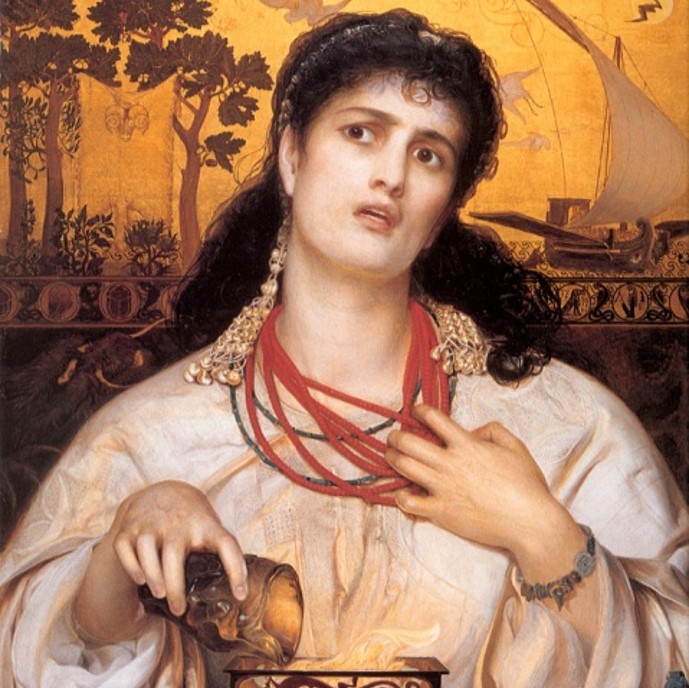
Episode 33: Woman the Barbarian
Euripides’ Medea is Ancient Greece’s most famous play. But what did it mean to the Athenians in 431 BCE who watched it on the Acropolis?
| Read Transcription | References and Notes |
| Episode Quiz | Episode Song |
| Episode on Spotify | Episode on Apple Podcasts |
| Previous Show | Next Show |
The Background of Euripides’ Medea
Hello, and welcome to Literature and History. Episode 33: Woman the Barbarian. This episode will cover the play Medea, written by the ancient Greek tragedian Euripides, and first produced in the city of Athens in the spring of 431 BCE. Medea is the story of a foreign princess, wedded to a Greek hero, and living an alien land. Its plot – a story of love, betrayal, and revenge, has captivated readers for thousands of years. What happens in Medea is so dark, so epic, and so intense that Medea was the most frequently staged work of ancient Greek tragedy in America in the twentieth century.1 In this show, we’ll first some learn some background information essential for understanding this play. Then, I’ll offer you a full summary of the story, with some quotes from the text. And once we’ve explored the contents of Medea, we’ll talk about what it might have meant to its original audience – those Athenians who first watched it in 431 BCE, in late March or early April, on the southeastern slope of the Acropolis.Human women, in ancient Greek and Latin literature, inhabit a dangerous world. Preyed on by lusty gods, widowed and enslaved by wars, and cast down due to the hubris of fathers, husbands, and brothers, human women are vulnerable to both strangers as well as their own families. Andromache and Cassandra are both enslaved to those who have killed their loved ones. Jocasta and Antigone are driven to suicide. Clytemnestra’s husband kills her daughter, and her son murders her. Penelope, faring comparatively better, at the end of the Odyssey, nonetheless gets told by husband to go up to her room and stay there, which is the same thing everyone else has told Penelope for course of the entire epic. Ancient Mediterranean societies were remarkable in their sophistication, but they were also patriarchies, and their literature shows a world in which women, unless they were goddesses, had it tough.
Still, there are ancient Greek plays that show human women as powerful and fearsome. Clytemnestra is swept under the rug at the end of Aeschylus’ Oresteia, but in the first play in the trilogy she is as terrifying as the Furies who later come to avenge her. Antigone’s will is mighty, and even though Creon holds all of the power, Antigone doesn’t bow down to him. Other Clytemnestras and Antigones occasionally stalk the stage in different works of ancient Greek tragedy, from Sophocles’ Electra to Euripides’ Hecuba, stories that show women, abused and compromised, fighting for justice and survival. And out of all of these compromised heroines, Euripides’ Medea stands out. Within a tragic sorority of fictional women who have suffered betrayals, bereavements, and bludgeonings, Medea is the most terrifying heroine in ancient Greek literature.
To begin the story of Medea, I want to take us to a place. That place is the southwestern part of the modern-day country of Georgia, at the eastern end of the Black Sea. Euripides, when he wrote Medea, was thinking about this place, a thousand miles east of the Acropolis of Athens, where his play would be staged. [music]
Medea’s Homeland: Colchis and the Eastern Black Sea
By the year 431 BCE, classical Athens had built a vast maritime empire. If you dropped a gigantic boulder into the Aegean Sea, and tidal swells splashed up over every island, and almost every coastline, up into the Sea of Marmara, all the lands covered in water would form the shape of the Athenian Empire, a confederation of cities and territories along the Aegean rim, and a number of important islands on the west side of the Greek mainland, as well. This was an empire that saw the circulation of many goods, and many ethnicities – a world in which the speed and success of the Athenian navy and trading vessels made the Aegean and Mediterranean worlds seem far smaller than they once had.
The ancient kingdom of Colchis, located in the far southeast of the Black Sea, was Medea’s home.
In the 400s and the century afterwards, as Persian power waxed and waned in the east, Athenians began to spend increasing amounts of time exploring the Black Sea. Far to the east of the Black Sea, again in what’s now western Georgia, there was a kingdom called Colchis. Colchis, in the age of Euripides, was an unimaginably distant place – a realm so far to the east that it was sometimes thought of as the land where the sun rose. Still, by the late 500s, the ever-adventurous Athenians found themselves exploring even in this remote kingdom. Between 401 and 399 BCE, a Greek mercenary leader named Xenophon ventured far into territories seldom explored by Greeks. Xenophon was employed along with ten thousand other soldiers of fortune by a Persian usurper to try and seize the throne of his brother. Their expedition ended up being cancelled militarily, and Xenophon’s Greeks never actually went to battle with any Persians. But Xenophon’s eastward expedition in 400 BCE or so did produce a book called the Anabasis, also known as The March of the Ten Thousand. This book is essentially a military and travel record of a massive Greek force through modern-day Turkey, and Syria, and Iraq, and up through Armenia and Georgia – one of history’s earliest surviving travel narratives. In the Anabasis, Xenophon writes about many far-off places, including the southeastern Black Sea, and the kingdom of Colchis, a land of fortresses and ravines, of wooden towns, narrow descents, plentiful lumber, and strange beehives full of poison honey.
Xenophon describes in the book how upon reaching Colchis, the Greeks saw “Above them, on their right. . .a country of the sternest and ruggedest character, and on their left another river, into which the frontier river discharges itself. . .This was thickly fringed with trees which, though not of any great bulk, were closely packed. . .At this point [the Greeks] were confronted by a great mountain chain, and on it the Colchians were drawn up for battle.”2 Strangers in a strange land, then, Xenophon and his men had to fend for themselves in far-off Colchis, a civilization in a broad valley between the Caucasus and Lesser Caucasus mountains, and a place very different from the dry and sunny Aegean. Even with ten thousand soldiers, the mercenary Xenophon was far from safe there. When the later Greek writer Apollonius of Rhodes wrote about Colchis, he said that when one walked up the embankment from the river, one looked up into the trees and saw human corpses, by the hundreds, suspended from the foliage in strange sacks, because the Colchians, unlike the Greeks, hung their dead in the trees.
So, why are we talking about Colchis, this ancient kingdom at the eastern end of the Black Sea, in the lowlands of modern-day Georgia? We’re talking about Colchis because Colchis was the homeland of Medea, our main character for today. [music]
Medea and Jason
Medea of Colchis was one of ancient Greece’s most iconic characters. She was, like her aunt Circe from Homer’s Odyssey, a witch, adept in potions and spellcasting, and schooled in all sorts of arcane knowledge. And while Medea’s most celebrated appearance in ancient Greek literature is today’s play, Euripides’ Medea, she’s also a major character in another surviving work. This other surviving work is an epic called the Argonautica.
Herbert James Draper’s The Golden Fleece (1904). Euripides’ audience would have known the legend of how before coming to Corinth with Jason, Medea almost singlehandedly enabled him to capture the Golden Fleece and bring it home.
Now, if you were an Athenian, living in the final decades of the 400s BCE, you would very likely know a bit about Jason, the Argonauts, and the quest for the Golden Fleece, and Jason’s unforgettable wife Medea. The earlier Ancient Greek playwright Aeschylus wrote four plays about specific adventures the Argonauts had on their journey.3 Euripides’ contemporary, Sophocles, also wrote four plays on the subject of the myth cycle centered on Jason and Medea.4 Euripides himself wrote two plays on the subject of Jason, the Argonauts, and those associated with them, and the surviving one is what we’re talking about today. So over the course of the mid to late 400s in Athens, at least ten plays related to Jason, Medea, and the Golden Fleece were staged at the city’s main theatrical festival, along with, it is reasonable to suspect, plays written by many more tragedians whose names are lost to history. Jason, Medea, and the Golden Fleece, in Euripides’ day, were a major franchise.
The story of Jason and Medea is older than the 400s BCE, though. All the way back in the 700s, Hesiod included Medea in his Catalog of Women. Fragments from the Archaic Greek poets Ibycus and Simonides tell her story, too. Medea was, like Odysseus, or Achilles, or Heracles, an instantaneously recognizable character – an archetype that the average Greek obviously found vivid and entertaining.
Euripides, in the play we’re about to read, only tells part of Medea’s tale – the end of it. But the Greeks who sat down around the vernal equinox of 331 BCE to watch the play Medea knew a lot about her. That means – unless we want to be totally bewildered as the play opens – that means we should take a moment to learn Medea’s back story. Fortunately, the tale of Medea’s origins is a riveting one.
Medea in Apollonius’ Argonautica
Medea’s lengthiest appearance in ancient Mediterranean literature, apart from our play today, was her lead role in that epic I mentioned a moment ago, the Argonautica, often also called Jason and the Argonauts or Jason and the Golden Fleece. This epic may have gone through many iterations, but the surviving version that we have dates from the mid-200s BCE, and it was written by a scholar and polymath named Apollonius of Rhodes.
John William Waterhouse’s Jason and Medea (1907) shows Medea as a younger woman, when she first met Jason in her homeland of Colchis. Euripides’ Medea is a decade or so older, and has been living abroad with her husband Jason in the Greek city of Corinth.
In the second half of Jason and the Argonauts, Jason and company reach the distant, dark, forested land of Colchis – that Caucasus mountain valley in modern day Georgia. And there, they meet Medea, the princess of Colchis. And from that moment onward, Medea is at the center of the story. Although Jason is, at least on the surface, the hero of Jason and the Argonauts, Medea is the one who does everything heroic. She enables Jason to complete a deadly challenge involving plowing a field with fiery brass oxen and then clobbering an army of men who spring up from dragon’s teeth. Medea enables Jason to do all of this by using herbs and black magic to make Jason invincible. All Jason has to do is show up wearing a bronze helmet and no clothing. He does what his girlfriend tells him to do, and he completes the challenge. Later, when it comes time for Jason to defeat the dragon that guards the Golden Fleece, Medea makes the monster fall asleep, and then her boyfriend heroically hurries forward from where he was cowering behind her, and nabs the famous treasure. Even near the end of the epic, as the Argonauts reach the island of Crete and find that it’s guarded by an enormous metal giant, Medea takes one look at the giant, and essentially tells the Argonauts to hold her beer, and then she proceeds to drop a metal colossus without much difficulty.
This context is really important for understanding Euripides’ tragedy, Medea. The exact narrative that I just described was written two centuries after our play for today Medea was staged for the first time, and so neither Euripides nor his contemporaries could have read it, although Euripides’ Medea mentions these episodes that Apollonius of Rhodes later wrote about in the Argonautica. But whatever exact versions of the story of Jason and the Argonauts were around during the earlier Classical period, Medea was always a heavyweight. She was the priestess of Hecate, the goddess of magic, and crossroads, and the raising of the dead. She was the niece of the witch Circe, and one of the few human women in ancient Greek literature who could crack skulls and slay dragons and not apologize for it.
And there is something else you need to know about Medea before we jump into the Euripides play. Even just hearing a very quick summary of Apollonius’ Jason and the Argonauts, you might be wondering this: if Jason is just kind of an average Joe, and Medea is so powerful, why is she interested in him? Why would Medea join the Argonauts, when she could have continued living in the cold forests of Colchis, brewing drugs, raising skeletons, and listening to early Black Sabbath? And the answer is that Hera, and Athena, and Aphrodite all got together and decided that Medea needed to fall in love with Jason. Medea was hit by an arrow from Cupid – Eros in the Greek tradition, and thereafter, Medea fell deeply, irrecoverably in love with Jason. Medea didn’t want to. Throughout Book 3 of Jason and the Argonauts, the longest psychological portrait of a woman in all ancient Greek literature prior to the Common Era, as far as I know, Medea tries to understand why she’s overcome with such powerful emotions for the Greek stranger.
And so the paramount reason Medea is such a distinctive element in ancient Greek literature is this. She is on one hand an extremely powerful human being – one who knows magic, and pharmacology, who can kill anything on earth and has brains to match her might, like a female Odysseus only with less pathological lying and more black nail polish. But at the same time – and this is the really fascinating part – Medea is still a young woman – a virgin when we first meet her in Jason and the Argonauts, who finds herself overcome with love – and entirely vulnerable to her uncontrollable feelings. This is Medea in a nutshell – part fearless sorceress, and part lovely young damsel.
We’re about to meet her later in her life, once she’s an adult with two children, married to Jason, in the southern Greek city of Corinth. If you and I were Athenians, sitting on the benches at the Theater of Dionysus in 431 BCE and getting ready for the world premiere of Euripides’ play Medea, we would know most of this background. We’d know who she was, and that she was the real reason behind the Argonauts’ success, and what she was capable of.
And while we would understand Medea as a formidable sorceress, we would also think of her as an easterner, and a barbarian. The word “barbarian” actually comes to us from ancient Greek – the ancient Greeks thought that foreigners who were yammering away in foreign languages sounded like they were saying, “bar – bar – bar,” and the name stuck. Medea, we need to remember as the story unfolds and things intensify – Medea, in addition to everything else, was an alien, a foreigner, and a barbarian. Euripides’ audience, the inhabitants of an expanding empire with many new colonies, had a punchy pride in their city and their civilization. Whoever else was out there in the Mediterranean and the Black Sea, in 431 BCE, Athens held all the power, and foreigners knew their places. So Medea’s status as an outlander would have held some significant meaning to more jingoistic swathes of the play’s original audience. Medea was not Greek. Medea was an immigrant.
So now you know about Medea, and have a sense of what she would have meant to the original audience of Euripides’ play. Unless otherwise noted, quotes in the remainder of this program will come from the Philip Vellacott translation, published by Penguin Books in 1963. [music]
The Opening and Exposition of Medea
Some years before, the young hero Jason had, with the aid of his powerful wife, captured the Golden Fleece and returned to his native city of Iolcus. Jason and Medea didn’t settle there, though. Iolcus was a small town, and though its bay was beautiful and its headlands rose strikingly up from the water, a returning hero and his bride needed a more prestigious place to live. And so Jason and Medea chose Corinth, a powerful city on the isthmus between Sparta and Athens, and there, they found a house and started a family. Two sons were born to them – half Greek, and half Colchian, their eastern blood from the far-off mountain kingdom of their mother.For some time, the family had lived happily there, in Corinth, and Medea continued to love her handsome husband as the two babies grew into healthy children. But while Medea’s affection for her husband Jason continued, her husband’s affections began to waver. Just as Jason had once embarked on a 10,000-mile journey for the Golden Fleece, wanderlust, and ambition stayed with him after the birth of his children. This is the situation as the play begins.
On the steps of Jason’s house in the city of Corinth, the family nurse stood, looking downward, numb with shock. The nurse’s voice, when she spoke, sounded haunted. The nurse said, in the opening line of the play, “If only they had never gone! If the Argo’s hull / Never had winged out through the grey-blue jaws of rock / And on towards Colchis!” (17). Everything about Jason’s expedition, the nurse implied, had been a mistake. Medea and Jason should have never met one another. Medea should have never shown her husband such unwavering love and obedience. Because while Medea remained loyal to him, Jason had begun to pursue other women.
There was, in Greece, a hostility toward marrying foreigners. Although Medea had gained the favor of the people of Corinth, she was still an outlander. For Jason, a man with political aspirations, and a desire for a great legacy, his wife’s foreign background was a distinct disadvantage. He had certainly loved the Colchian princess for what she was – a valuable aid in his heroic quest. But, then, Jason was older now. The things that facilitated furthering his reputation, and his wealth, and his legacy – these things were worth holding onto. The things that didn’t – these needed to be cast aside. And so, disregarding his marriage to his first love Medea, Jason had married a Corinthian princess. Her name was Glauce, and she was the daughter of Creon, the King of Corinth, not to be confused with Creon, the king of Thebes, whom we met in previous episodes.
Jason’s remarriage was not only a betrayal of Medea. The hero’s adultery was also a betrayal of their two sons. Because if Jason were to sire fully Greek children with the Corinthian princess, Glauce, it would mean that the children he had with the Colchian princess, Medea, were illegitimate, and dangerous threats.
Jason’s family nurse worriedly described Medea’s reaction to her husband’s treachery. Medea, the nurse said, had gone dead silent. Medea hardly moved, unless, the nurse said, it was to cry out bitter regrets to her homeland and father, whom she had betrayed for Jason’s sake. And the nurse concluded, “I am afraid / Some dreadful purpose is forming in [Medea’s] mind. She is a / frightening woman; no one who makes an enemy / Of her will carry off an easy victory” (18). [music]
Medea Appears Onstage

Evelyn De Morgan’s Medea. In every era that she is painted, Medea appears imperious and confident.
The nurse and the tutor heard Medea speaking inside of the house, and they told the children to be careful. Their mother, the old slaves said, was in a violent mood, and there was no telling what she’d do. Medea’s voice was audible again, and the old slaves winced. The nurse repeated that she was terrified of what Medea might do. Medea was not only powerful, and willful. She was also imperious, and used to giving commands, rather than obeying them.
Following these ominous predictions by the nurse, a group of Corinthian women appeared. These Corinthian women are the chorus of Euripides’ play who, being the chorus, will remark on events and offer expository information about the events of the play from here on out. So a group of Corinthian women appeared – again the chorus of the play Medea, and they remarked that they had heard that Medea was suffering, and wanted to know why. The nurse explained the awful experience Medea was going through, and just then, the chorus heard Medea herself shrieking from indoors, crying that she wished fire would come down from the sky and shatter her skull.
On a side note, the staging here is just visionary, in my opinion. Everyone onstage is Greek. Everyone is talking about the foreigner, who is ranting and raving just out of sight. It’s as though Medea is so overwhelming that she has to be heard before she’s seen.
The chorus of Corinthian women counseled Medea to temper her wrath. They told Medea not to pray for death – after all, husbands losing interest in their wives was quite commonplace. Medea, they said, needed to get her grief, and her passion under control.
Medea did not find their counsel to be relevant to her particular case. Still from behind closed doors, Medea prayed that she would see Jason and his new wife crushed into a pulp within their palace. Medea cursed herself for abandoning her father, and helping Jason kill her brother at a crucial moment during the Argonauts’ journey back to Greece.
The nurse went into Jason and Medea’s house to comfort her furious mistress, and after more dialogue from within, Medea finally appeared onstage. Her eyes were red from crying, but she was calm, and she spoke lengthily to the women of Corinth. Medea said she had tried her best to conform to the ways of Corinth, after immigrating. She had tried to be quiet, and to appear neither proud, nor conspicuous. Only, all of the adjustments that she had made, and the things she’d accepted for Jason’s sake – were for naught. Jason had left her, and she wanted to die. Following these remarks, Medea voiced one of the most famous speeches in classical literature, and again this is from the Philip Vellacott translation, published by Penguin Books. Medea said,
Surely, of all creatures that have life and will, we women
Are the most wretched. When, for an extravagant sum,
We have bought a husband, we must then accept him as
Possessor of our body. This is to aggravate
Wrong with worse wrong. Then the great question: will the man
We get be bad or good? For women, divorce is not
Respectable; to repel the man, not possible.
Still more, a foreign woman, coming among new laws,
New customs, needs the skill of magic, to find out
What her home could not teach her, how to treat the man
Whose bed she shares. And if in this exacting toil
We are successful, and our husband does not struggle
Under the marriage yoke, our life is enviable.
Otherwise, death is better. If a man grows tired
Of the company at home, he can go out, and find
A cure for tediousness. We wives are forced to look
To one man only. And, they tell us, we at home
Live free from danger, they go out to battle: fools!
I’d rather stand three times in the front line [of a war] than bear
One child. (24)
Medea added that she had no family, now – all of Colchis was gone from her. And she said that they had to understand – the chorus had to understand this. Things were going to get very, very bloody. [music]
Medea Makes a Deal with Creon
As Medea wrapped up her grim speech, a new figure approached the entrance of Jason and Medea’s house. It was Creon, the King of Corinth. This, again, is a different King Creon than the one in Sophocles’ Oedipus plays – that guy was the King of Thebes. So King Creon of Corinth appeared and made a proclamation to Medea.Medea, the monarch proclaimed, was henceforth banished from Corinth. Medea demanded to know why. Creon said that he wouldn’t mince his words. He was banishing her because he was terrified of her. Creon admitted that he was afraid that Medea would hurt his daughter, and himself, as well. He had heard threats, and he knew that Medea was smart, and very dangerous.
Medea was not intimidated. Creon, Medea said, was not liked as a king, but Medea added that she herself had no ill will toward him. Of course she understood Creon wanted to marry his daughter Glauce to the prominent hero Jason – Creon believed what he was doing was best for his daughter. Medea said she didn’t begrudge Creon his happiness – her hatred was all toward Jason. Medea asked to remain in Corinth, and said she’d suffer in silence. But Creon said this wouldn’t work. She made his blood run cold, he said, being as quiet and calm as she was. He said an angry and passionate woman was far less dangerous than a quiet and calculating one, such as Medea was.
Creon repeated that Medea had to leave, but, after Medea begged him to let her stay for the remainder of the day, so that she could her affairs, and prepare for her son’s futures, Creon agreed. The king said he wanted Medea out of the city by dawn the next day, and thus, their agreement was reached.
Creon left, and Medea turned to the chorus of Corinthian women. Throughout the play, Medea discloses her plans to them at several key junctures, and she has a special confidentiality with the chorus. Medea told the Corinthian women she had no intention of going out quietly. She said she was going to kill the king, and the princess, and Jason himself, and she mused about whether to burn them alive or stab them in the guts. She had to be cautious, she told the chorus. She would use poison. She would try to poison them, and then would flee to a foreign city for asylum. But if this didn’t work, she’d murder her husband and his new wife with a sword. She told the women of the chorus that women, while widely dismissed as useless, could be practitioners of all sorts of black arts.
The women of the chorus then sung a song about the future of women everywhere. A time would come, the chorus sang, when women weren’t slandered and dishonored – when they weren’t maligned as faithless and deceitful – because these qualities, far more often, were men’s. The chorus agreed that Medea had little choice in seeking revenge at any cost, and just as their song reached its conclusion, Medea’s husband Jason appeared onstage for the first time. [music]
Medea’s First Conversation with Jason
Jason was utterly unapologetic about his choices. He looked at the chorus, and then addressed his wife. And Jason said,I have often noticed – this is not the first occasion –
What fatal results follow from ungoverned rage.
You could have stayed in Corinth, still lived in this house,
If you had quietly accepted the decisions
Of those in power. Instead, you talked like a fool; and now
You are banished. Well, your angry words don’t upset me;
Go on as long as you like reciting Jason’s crimes.
But after your abuse of the King and the princess
Think yourself lucky to be let off with banishment. (30)
Jason said he was still fair minded – he would not desert Medea – in fact, he’d make sure that she and their two sons had some coin in order to ease their path to wherever they ended up going, and he said that he bore her no ill will.
_(14766908825).jpg)
Medea recollects helping Jason recover the Golden Fleece and abet his rise to prominence. Jason is ready to cast her aside.
This is the point at which you would hope Jason might say, “Oh, gosh. Now that you put it like that, I’m – wow – yeah, you know what, I am so, so, sorry, Medea, you know what – I’m going to divorce Creon’s daughter immediately – and we can move back to Colchis, and I can see what it’s like living in a foreign land.” But, sadly, Jason said nothing like this. Instead, Jason denied that she had done anything for him at all. Jason said he owed everything to Aphrodite. Aphrodite, after all, had made the powerful Medea fall in love with him – Medea had just been acting under her helpless passion. In exchange for leaving the barbarous backwater of her homeland, Jason said, Medea had come to Greece, and where justice and law reigned supreme. As for the marriage with Creon’s daughter, said Jason, he had arranged it in everyone’s best interest. Their social position would be consolidated, and Medea could still be his mistress, and all of Jason’s children would be brought up together. Jason closed his speech with these words.
Even you [, Medea,] would approve,
If you could govern your sex-jealousy. But you women
Have reached a state where, if all’s well with your sex life,
You’ve everything you wish for; but when that goes wrong,
At once all that is best and noblest turns to gall.
If only children could be got some other way,
Without the female sex! If women didn’t exist,
Human life would be rid of all its miseries. (34)
The chorus – rather diplomatically – told Jason that whatever truths there had been in his speech, he was nonetheless acting very wrongly. Medea condemned her husband for not being honest from the beginning, and she said she knew what it was about. It was about this. Having a foreign woman for a wife was not considered reputable anymore.
Jason stammered, repeating that all his efforts were to build a respectable foundation and future for their family. He said that he would offer her letters of introduction to friends abroad, and whatever she needed to ease her way into a new place. Medea scorned them, and, after Jason remarked that he had done his utmost to help her and their children, he took his leave.
The chorus sang a song about Medea’s plight, in which they prayed that they would never suffer from a mad desire like the one that had struck Medea from Aphrodite. They prayed that they would not be abandoned and outcast like she was, and that they would never have to miss their homeland. Just as everything seemed unutterably bleak, a new character arrived onstage. His name was Aegeus. And Aegeus was the King of Athens. [music]
Medea Speaks with Aegeus of Athens
Aegeus and Medea knew one another. Aegeus respected the eastern woman’s wisdom. The king had come to Medea to seek advice about a prophecy he’d heard from the Oracle at Delphi. Aegeus, sad to say, found himself unable to have a son with his wife, and he had gone to the Oracle to help. After a short conversation about the prophecy he had heard, King Aegeus of Athens asked Medea why she looked so pale and devastated. Medea told him everything. Jason, she said, was leaving her and their children, for the sake of a more economically advantageous marriage. Aegeus, unlike Jason or the chorus of Corinthian women, immediately took Medea’s side. Aegeus said it was natural for Medea to be upset.Medea saw that she might receive help from Aegeus, the King of Athens. She needed a place to live, she said, and in exchange, if he wanted children with his wife, Medea could make this happen. She was, after all, a sorceress, and exceptionally handy with drugs and potions. Aegeus said that Medea could certainly have sanctuary in Athens – only, Medea had to travel alone, so that it didn’t look like had deliberately set out to give refuge to an outcast of Corinth. Medea made him swear – she very, very deliberately made King Aegeus swear – that no matter what happened, the King of Corinth would take her in, and he made a solemn oath to the gods. They clasped arms in friendship, and Aegeus left.
With the King of Athens gone, Medea turned to the chorus of Corinthian women, and made a long speech. Everything was set, now, she said. She had a plan – a place for refuge. First, she would meet with Jason and pretend to forgive him for everything. She would send, by way of her sons, a dress and golden coronet to the Corinthian princess. But this dress, and this coronet, would be covered with a poison that killed at the touch. Having killed Jason’s new wife, she would then do something so sickening that it would cause anyone who had underestimated her to stop their tongues. She would kill her sons. Looking around at the shocked women of the chorus, Medea said, “Yes, I can endure guilt, however horrible; / The laughter of my enemies I will not endure” (41). Jason, she said, would have no sons with anyone. His rise to prominence, which she had caused, she would now destroy. [music]
Medea’s Second Conversation with Jason
The women of the chorus were distraught. Medea would kill her own children? They asked. She couldn’t possibly do it, they said. If she did – if she killed her sons and fled to Athens – how could she expect to live there? Athens was a peaceful place – a sacred place. The chorus begged her, desperately, not to kill her boys.Just then, Jason arrived. He stiffly asked Medea what she wanted, adding that his offer to ease her banishment still stood. And Medea, gently and conciliatingly, told him exactly what he’d wanted to hear in the first place. Her anger had been unwarranted, she said. He had been perfectly right to seek out a different marriage – it would be the best for both of them, as well as their sons. Why, she should have even offered to help prepare Jason’s new marriage bed and chamber. Her folly had been great.
Jason and Medea’s children came out, and she invited them to revere their father. She told the kids that they had all made up, and, in a moment of breaking character, Medea turned to the side and wept, thinking of what was going to happen to the kids.
Jason said he was pleased, and that his and Medea’s sons, as well as the new sons that he would soon have, would all grow up and become prominent citizens of Corinth. Medea couldn’t hide her tears. She told Jason that she thought it would be better – even through King Creon had said the opposite – that it would be better if her boys stayed in Corinth. Jason was not opposed, but he said King Creon might take objection. And Medea said she had a suggestion. What if their two sons brought a beautiful gown and coronet to Creon’s daughter – and then – Creon’s daughter might be convinced to persuade her father to let the boys stay? Jason gawked a bit, but, under Medea’s steady efforts, agreed that gifts could be brought to his new wife. And so Jason, and the two boys, and their tutor – and the fateful box with the deadly gown and coronet – all exited stage in the direction of the Corinthian palace. [music]
Medea’s Deliberation and the News of Creon and Glauce
The women of the chorus were again aghast. Medea, they realized, was going to go through with everything. The Corinthian princess would die. Only, no news of the princess’ death arrived. Instead, the family tutor returned from the palace with the two boys, and told Medea he had good news. Jason’s new wife, the princess of Corinth, receiving Medea’s gift, had persuaded the king to let Medea’s sons remain in the city of Corinth after all.Medea was not happy about this news. She’d poisoned the dress and coronet, after all, and had been hoping for news of the princess’ bad death. Medea cried and voiced a tragic speech. She said she would never see them grow old, and never see them married. And while she talked, the two little boys blithely played around the house’s steps. As the children played, Medea, in the Penguin Vellacott translation, deliberated about the atrocity she was about to commit. She said,
Dear sons, why are you smiling at me? You smile
At me – your last smile: why?. . .
Oh, what am I to do?
Women, my courage is all gone. Their young, bright faces –
I can’t do it. I’ll think no more of it. I’ll take them
Away from Corinth. Why should I hurt them, to make
Their father suffer, when I shall suffer twice as much
Myself? I won’t do it. I won’t think of it again. . .
What is the matter with me? Are my enemies
To laugh at me? Am I to let them off scot free?
I must steel myself to it. What a coward I am,
Even tempting my own resolution with soft talk.
Boys, go indoors. . .
Oh, my heart, don’t, don’t do it! Oh, miserable heart,
Let them be! Spare your children! We’ll all live together
Safely in Athens; and they will make you happy. . .
No! No! No! In any case there is no escape,
The thing’s done now. . .
Now we must say goodbye. Oh, darling hand,
And darling mouth; your noble, childlike face and body!. . .
How sweet. . .
To hold you! And children’s skin is soft, and their breath pure. . .
I understand
The horror of what I am going to do; but anger,
The spring of all life’s horror, masters my resolve. (49-50)
In the wake of Medea’s long, tortured speech, the chorus sung a song about parenthood – its burdens and its perils, and Medea saw a messenger coming. He was out of breath, and in a state of panic. She had to flee immediately, the messenger said. Medea had to go! The princess was dead, and King Creon had been killed, too – Medea had to flee. Medea made no move to leave, though. She told the messenger, “Your news is excellent. / I count you from today my friend and benefactor” (52). The messenger asked if Medea were insane. She didn’t answer his question. Instead, she asked the messenger to tell her all the details of their deaths, and emphasized that her pleasure would be greater of they’d died in excruciating pain.
The messenger told her the details. The Corinthian princess had been persuaded by Jason to accept his sons into the palace, and to accept Medea’s gift. And the princess had accepted the gifts, and then dressed herself in the gown and coronet, and admired herself in a mirror. Only soon, her skin changed color, and froth oozed from her mouth, and her eyes rolled up. It was an excruciating death. The coronet clung to her skull and dripped droplets of liquid fire onto her face while the dress caused her flesh to melt away like the sap of a pine tree. When she finally died, she was unrecognizably mangled. And when he arrived, King Creon took his daughter’s grisly remains in his arms, wept, and then found he was stuck to them – and the poison from her dress seethed into his skin until he, too, was a mess of molten flesh. In this awful fashion, the messenger said, the King and Princess of Corinth had died. [music]
The Crisis of the Play and Third Confrontation Between Medea and Jason
Having given his news, the messenger left. And after a short speech, Medea stalked into her house to murder her children. The chorus remained onstage and sang a dirge, emphasizing the horror of what was happening. They asked why Medea had come from to Corinth from a far off, barbaric country – and why she was consumed with fury. And then, the chorus heard the screams of children from inside the house – children pleading for their lives, terrified and powerless.
A red figure amphora, discovered in Campania, showing Medea killing one of her sons, from about 330 BCE.
Jason screamed that Medea was an abomination – Medea was a living execration who never should have been brought back to Greece. He told her he knew he couldn’t reason with her, and roared at her to get out of his sight.
Medea told Jason that the gods knew that she had made him a hero, and the gods knew how he had repaid her. Jason growled that she would suffer dreadfully from this murder, and Medea replied, that indeed she would suffer, but she would bear this suffering to ruin his life. Jason told her he would have his sons’ bodies for proper burial, but she said this would never happen. They would be buried elsewhere, she said, and the Corinthians would pray for them every year. As for Jason, Medea voiced a bleak prophecy. Jason would die alone, his head broken from a stray timber, not remembered as a hero. Jason’s desire for his children was meaningless, she said. Jason, just a day before, had been about to send the poor little boys into exile. He would not touch them. She spurred the dragons, and the chariot began to lift.
Jason could do nothing. Brokenly, he said that he would bemoan that day’s events forever. He wished he’d never met her or had children with her. Medea, Jason groaned, was a destroyer. And the chorus, with the chariot now gone from the stage, had little means to make sense of the bloody tragedy. The chorus sang, “Many matters, the gods bring to surprising ends. / The things we thought would happen do not happen; / The unexpected God makes possible; / And such is the conclusion of this story” (61). And that’s the end. [music]
The Ending and Immediate Historical Reception of Medea
That ending – with Jason weeping in futility, with the chorus mumbling a couple of vague lines about unexpected turns of fate, and with Medea taking wing with her dead sons to Athens, where she’ll enjoy the political immunity promised to her by King Aegeus of Athens – that ending is one of theatrical history’s most famous finales – as famous as the corpse heap that closes Hamlet, gunshot at the end of Chekhov’s The Seagull and the slamming door at the end of Ibsen’s A Doll’s House. Medea appears, above the house, probably suspended by what ancient Greek set designers called a mechane, literally “machine,” but in this case meaning “crane,” and then flies off with her dragons. Then, curtain. It’s possible that it was the first time the mechane was used in a theatrical production – that before Superman, and before the divine being at the end of Angels in America, the actor playing Medea was the first human being to fly in front of an audience.5 It is an explosive ending. As I prepared this show, I wanted to quote every single line in the play’s last fifteen pages, because the final conversation Jason and Medea have – the furious insults he hurls at her and the way she boomerangs them back – this is one of antiquity’s greatest scenes of enraged, unmitigated, teeth-gnashing confrontation.6Now, we would think that this walloping, and possibly technically innovative ending would have won Euripides the first prize in that year’s City Dionysia. After all, Medea, as I said before, was the most popular Ancient Greek play in the United States in the twentieth century. Wouldn’t the ancient Athenians find that Medea spoke to them, as well? And the answer is no – evidently they did not.
Euripides didn’t take first prize in the competition of the spring of 431 BCE. He didn’t even take second prize. Euripides finished dead last. There are many reasons why this may have happened, and I think that in exploring these reasons, we can learn both about Euripides as well as Classical Athens.
In considering why one of the contemporary world’s favorite ancient Greek tragedies, Medea, was a critical and popular failure in ancient Greece in 431 BCE, I want to start with some stuff so obvious that it’s actually easy to overlook. The first thing is that Euripides’ Medea wasn’t presented in isolation. It was part of a set of four plays. Tragedians at the Dionysia always presented three tragic works and one satyr play – a lighter production with formulaic elements. Of the set of four plays that Euripides presented in 431, two are entirely lost.7 The third, entitled Philoctetes, which survives in fragments, is a play about a Greek fighter abandoned on an Aegean island who’s suddenly needed during the Trojan War. The Greek heroes Odysseus and Diomedes go and recover him, but the stranded Philoctetes is reluctant to join in their efforts. That’s all we know about the set of four plays, of which Medea was once a part. So maybe Medea, together with its two accompanying tragedies and one comedy – just altogether made for a messy, dissatisfying combination. Euripides was defeated that year by his rival Sophocles, who won second place, and by a playwright named Euphorion, who was the older writer Aeschylus’ son. It goes without saying that Sophocles is quite capable of writing plays, and we can also suppose that Euphorion, who hailed from a proud literary family, was likely no pushover, either. So perhaps competition that year was stiff, and maybe the accompanying plays with which Euripides packaged Medea made for an uneven and awkward set. That seems pretty reasonable. But there’s another possibility. Maybe Euripides’ original audience, watching Medea, found this story about a woman who causes a king and princess to both die gruesome deaths, and then murders her own children – maybe Euripides’ original audience found the play unappealing. Let’s talk about why.
Euripides’ Attitude Toward Women
As you can imagine, a lot of people have responded to Euripides, and his portrayal of Medea over the ages. And probably the most famous response to Euripides was by a man who knew him – the younger comedic playwright, Aristophanes.Aristophanes’ play Thesmophoriazusae is actually about Euripides – it’s a wall-to-wall satire of Euripides, and it’s also a vigorous lampoon of the sexual politics of Classical Athens. In this play, a group of women are angry at the playwright Euripides for his derogatory treatment of women, and they plan to use an annual fertility festival called the Thesmophoria in order to plan their vengeance. The women in this Aristophanes play proclaim:
I’ve been disturbed and annoyed for quite some time now
When I see our reputations getting dirtied
By Euripides, son of a produce-sales girl,
And our ears [get] filled with all sorts of disgusting things!
With what disgusting charges has [Euripides] not smeared us?
Where hasn’t he defamed us?. . .
He’s told slanderous tales, so that no. . . man wants
To try matrimony.8
Now, these lines, with their brazen accusation of misogyny placed on Euripides, are rather startling. Antifeminism is so pervasive in the plays of Classical Athens that it feels odd, at first, anyway, to hear a playwright accusing another playwright of having a pejorative view of women. Was Euripides really so well known for misogyny that he was actually a fitting subject for a full-length satire? Actually, there’s some evidence that he was. Let’s spend a minute talking about Euripides’ historical reputation as a great hater of women.
The Roman writer Aulus Gellius, who lived during the 100s CE – long after Euripides, obviously – but anyway, the later Roman writer Aulus Gellius wrote about the playwright Euripides in his travelogue of Athens – in a book entitled Attic Nights. Gellius wrote that “Euripides is said to have had a strong antipathy toward nearly all women, either shunning their society due to his natural inclination, or because he had two wives simultaneously – since that was legal according to Athenian decree – and they had made marriage abominable to him.”9 So, according to this later Roman historian, and Euripides’ contemporary, Aristophanes, Euripides had a staunch, unapologetic dislike of women. In fact, misogynistic sentiments pervade many of Euripides’ plays. Women are maligned as “devisers of evil” in Medea. They’re called a “source of sorrow” in Euripides’ version of Orestes. Stepmothers are made to look wicked in Euripides’ plays Ion and Alcestis. In his play Hippolytus, the absurd notion is introduced that upper class women invented adultery. And the title character of the Euripides play Hippolytus, a chaste young prince who finds himself the object of his stepmother’s lusts, rails against the female sex. Listen to this quote from Hippolytus – Hippolytus says,
O Zeus, why, as a fraudulent evil for men,
Have you brought women into the light of the sun?
For if you wished to engender the mortal race,
There was no need for women as source of supply,
But in your shrines mortal men could have offered up
Either gold or iron or heavy weight of bronze
To purchase their breed of offspring, each paid in sons
According to his own gift’s worth, and in their homes
They could live without women, entirely free.
Yet now to our homes we bring this primal evil. . .
I hate clever women. . .An untalented woman
Through lack of intelligence stays clear of folly. . .
[W]omen are. . .unceasingly wicked.
Either someone should teach them to be sensible.
Or let me trample them underfoot forever.10
In Hippolytus’ estimation in this other Euripides play then, women are, at best, stupid and silent, and it would be better if they didn’t exist. Throughout the plays of Euripides, and we have more plays by Euripides than any of the other tragedians of classical Greece, by the way – throughout the seventeen surviving plays by Euripides, lustful women, and violent women, and angry harangues against women, are not hard to find. Therefore, it is possible, particularly considering that Aristophanes made fun of him for it, that Euripides, and his play Medea in 431 BCE were just too misogynistic for theatergoing Athenians. [music]
Euripides’ Innovations in Adapting Medea
Is the play Medea misogynistic, though? That’s a good question, and quite obviously, open to interpretation. But one of the things we can do to answer it is to consider how Euripides adapted his version of Medea for the stage. Remember that Euripides’ version of Medea was a single man’s take on an ancestral story – one adaptation of a very old myth. Now, anyone who does remakes, or sequels, or prequels, usually has some innovations of his or her own to add. Euripides had one. And here’s the kicker. Scholarship generally agrees that Euripides invented Medea’s murder of her children. It’s one of the most heinous crimes in Ancient Greek literature – especially since Medea contemplates it, as you saw, and goes back and forth, and steels herself, and then enters her house and slaughters them with a sword. She kills her sons, in other words, in cold blood, and ignores their screams of protest and cries for help. This, evidently, was Euripides’ invention, and if we accept the opinion of Aristophanes, and Aulus Gellius, and consider a sizable quantity of evidence in Euripides’ seventeen surviving plays, Euripides’ portrayal of Medea as a child killer might substantiate the theory that he fiercely, and unequivocally hated women.
A sculpture of Euripides in the Louvre. More of Euripides’ plays have survived from antiquity than have survived from Aeschylus, Sophocles or Aristophanes, and his works had a major influence on the New Comedy that began to flourish about a century after he lived.
When you consider variants on Greek myths, they often take the shape of bundles of sticks, or bundles of ropes held together by a ferrule or rubber band – widely disparate but having some unifying element. The stories about Medea are no exception. But to repeat – the important thing for our purposes is that in writing about a child murdering Medea who burns the skin off her husband’s new wife, as well as the king, Euripides seems to have created a character far more violent, and malevolent, than Medea had traditionally been depicted. In his elaborate deviation from the traditional Medea stories, and in letting Medea get off scot-free in her chariot of dragons, Euripides may have written a play that was too misogynistic, too unorthodox, and too shockingly, unexpectedly violent, even for fifth-century Athens.12
So that’s one take on Medea. We can call it the old-fashioned approach – that Medea, in spite of the fact that wrong is done to her, retaliates with such merciless excess that she ends up being revolting. With this old-fashioned interpretation, Jason ends up seeming almost tolerable in comparison, and the play’s end, which sees Medea flying to safety, shows Medea as more or less the equivalent of a wicked witch hopping on a broomstick and riding off to wreak havoc on a new place. This interpretation of the play – which might well have been the one the classical Athenians had, finds it too grim, and too violent, to be a morally satisfying story. However, there are other interpretations of Medea that we can consider.
The Helpful Foreign Woman
Medea, again, was the most popular Ancient Greek play of the twentieth century in the United States. And obviously, it wouldn’t have been so popular if its main character were nothing more than a heinous villain. Many modern readers of the play find the character Medea’s retaliatory violence, if excessive in its totality, at least justifiable in part. In other words, the innocent boys didn’t deserve slaughter. Nor did the cautious monarch Creon and his daughter. But Jason, who used Medea and then shamelessly, unapologetically ignored his marriage with her, needed to understand that what he did was not fair to the wife who loved him so deeply. Something needed to be done. Medea grossly, atrociously overdid it, but at least she did something – something that wouldn’t ever be forgotten. This interpretation of Medea – of Medea as at least partly heroic, is a more common one today.
Michele Desubleo’s Ulysses and Nausicaa (1654), in which Odysseus asks the Phaecian princess for help.
This is all to say that if we want to interpret Medea’s vengeful desires as at least in part justifiable, there’s plenty of reason to do so. The mediocre pretty boy whom she helped raise to success is suddenly ready to forget the past and secure himself a patrician future in Corinth – and forget the wife who traveled thousands of miles with him, and killed with him, and married him, and bore his children. If a human being ever owed another human being loyalty, Jason owed Medea everything.
So it could be, that for Ancient Greeks, it actually wasn’t any misogyny on the part of Euripides that made Medea unpalatable. Maybe it was something else. Medea’s desire for payback was a stark departure from the customary mytheme about a masculine hero who gets feminine assistance. Because in this mytheme, the female helper gets left behind. Odysseus leaves behind Calypso, and Nausicaa, and Circe, after sleeping with two out of three of them. Theseus abandons Ariadne on an island after she helps him through the labyrinth. Aeneas – though the Classical Greeks couldn’t have known this one, but anyway, Aeneas discards Dido, and she burns herself alive on a pile of all the things that remind her of him. In short, if you were writing a myth in the ancient Mediterranean about a hero and a nice helper woman he encounters on his adventures, the nice helper woman, sooner or later, gets abandoned. It could be that this was another reason why Euripides’ audience didn’t take too kindly to the play Medea. Maybe they would have liked it better if she’d hung herself, or poisoned herself, or stabbed herself, and conveniently paved the way for Jason’s uncluttered future.
But in talking about the play Medea, and its reception with its original audience, we have one final thing to consider. Medea isn’t just a woman. Medea is a foreign woman. And because of specific historical events, and specific legislation that had been passed in Athens in the mid-400s BCE, Medea’s position as a foreigner would have been a special source of attention to Euripides’ audience – maybe even more so than her murderous crimes. So in the last part of our analysis of Medea, I’m going to tell you a bit about marriage and citizenship laws in Athens during the life of Euripides, and why these laws may be the key to understanding the most popular Ancient Greek play of 20th century America. [music]
The Athenian Citizenship Laws of 451 BCE
A few episodes back – in our program about Aeschylus’ play The Libation Bearers, we talked about the lives of women in Classical Athens. We learned that patrician women, in particular, lived confined existences, that they were discouraged from unregulated socialization, and that marriage was vehicle for the generation of offspring and transference of wealth. Marriage, in other words, may have incidentally resulted in love and tenderness between its participants, but its primary and instrumental purpose was a financial one. Thus, in the century after Euripides lived, an orator we call Pseudo-Demosthenes famously attested that as for Athenian men, “We have mistresses for our enjoyment, concubines to serve our person, and wives for the bearing of legitimate offspring.”14 In other words, mistresses are for sex and fun conversation, concubines are for sex, and wives are for sex and procreation, and moving money between generations.Love, in this quote by Pseudo-Demosthenes, is not something that women are for. And the subject of love brings us to one of the things about the play Medea that does not at all stand out for us, but would have been a source of interest to Euripides’ original audience. Medea loves her husband. She passionately, vociferously loves Jason. Medea may love him as a result of the arrow from Eros that struck her when she first saw him in Colchis. But still, Medea adores her husband personally. In an era during which wives were thought of as bedroom fixtures – like nightstands or lamps that occasionally had babies – a loving wife who demanded a monogamous husband might have been a curiosity onstage.
But much more so, as I said a second ago, a foreign wife would have been a particular source of attention. We might see Medea as a loyal wife whose desire for a monogamous marriage is reasonable and justified. But Athenians – Athenians very possibly saw a passionate, hot blooded foreigner whose demands for fidelity are arrogant and misplaced.
_(14779575844).jpg)
Pericles decreed that citizenship could only pass through generations when both parents were Athenian citizens, thus making marriage to a foreigner a huge economic disadvantage.
Athens passed this legislation back in 451 because the city was getting so lavishly wealthy that its leaders wanted to carefully restrict how many new citizens were created, and this was a blunt force approach to doing so. The Athenians said anyone who wasn’t born from two citizens was not a citizen. And though this may have helped cinch up the silver coffers of the city’s patrician class, who all married one another, anyway, many middle-class citizens might have still wanted to marry someone they had met abroad.
And so the plight of Jason might have been the plight faced by men in the audience who had been married to, or were still married to foreign women. In his youth, before he knew any better, Jason had joined himself with a beautiful, passionate foreigner. However, as Jason grew older and times changed, Jason saw that continued marriage to this foreigner would result in immediate and continuing disadvantages for his children and his legacy. And so – as many Athenian men may have, Jason shed aside his alien wife – who was really only for childbearing, anyway, and he found himself a good, native bride.
Euripides: Often Out of Sync with His Contemporaries
I wonder how the vote in the Dionysia contest would have gone down if Euripides had written the following ending. What if Medea protested, but then eloquently backed down and accepted the position of mistress? What if Medea had used her drugs to make Jason’s new wife extra fertile, and the kids all grew up together? We would have found this ending quite dissatisfying. But Athenian men in 431 BCE might have felt rather pleased by it – a didactic tale that taught that it was just fine to have wives and mistresses, that foreign women were somehow naturally subsidiary to Athenian ones, and that Athenian men could have sex with anything that moved, any time, any place, with impunity. That particular play might have gone over swimmingly with a classical Athenian audience.But this isn’t what happens. Medea rips off her rival’s skin like wax, or like tree sap, and burns the princess’ face off with liquid fire. Medea goes into Jason’s house and kills her children, and then steals their bodies. And then – as if in a final, fierce message to the audience, Medea travels to Athens. The message about foreign women in Athens is clear. They’re here. They’ve been here all along. They’re not going anywhere. And we can’t sweep them under the rug with some hemming and hawing about doing what’s best for the kids. If Euripides’ audience sat down in the spring of 431 expecting a version of Medea that gently did away with her, as the earlier legends about Medea seem to have done, they got the opposite. In Medea, the outmoded foreign wife is not something that can be folded up and put into a closet. She is sentient, and expressive, and perceptive, and – even more frighteningly – smarter than kings and princesses, deadlier than epic heroes, and not particularly partial to forgiveness. And at the end of Medea, she’s heading straight to Athens.

Artemisia Gentileschi’s Medea (c. 1620). Medea’s combination of chilly deliberation and violent action made her a unique figure for Euripides’ audience.
In the ending of Medea, then, Euripides committed a mortal sin. Even in the six plays we’ve read so far, you might remember a pattern. Aeschylus’ Oresteia concludes with Orestes happily having found solace, in Athens, the abode of justice and clemency forever after. Sophocles’ Oedipus ends up peacefully buried near the city of Athens, his last moments overseen by the King of Athens. But in Euripides’ Medea, Athens, and everything it stands for, loses. That, I think, more than misogyny, and more than thorny social commentary on marriage legislation, was why the Classical Greeks gave this play that we love so much their thumbs down.
Euripides, evidently, rarely hit the mark with his tragedies – perhaps because he was willing to say things that others weren’t. Out of the fifty years in which Euripides competed in the City Dionysia, he won first place only four or five times. By the time Euripides was old, he was sufficiently unpopular in Athens that he went far north across the mainland, to the court of the King of Macedonia, to spend the last years of his life. There, closer to the threshold between civilized and barbarian, maybe, he found a place that suited him better. [music]
Moving on to the Bacchae
Euripides’ surviving seventeen plays are full of things that we see in Medea – women being done wrong, and women trapped in bad marriages, for instance.16 But I think that another theme in Medea – that dichotomy between cold, civilized rationalism on one hand, and hot-blooded passion on the other – this dichotomy makes its way into what is probably Euripides’ second most famous play, the Bacchae.In the next show, we’re going to talk about the Bacchae, our eighth, and final work of classical Greek tragedy for this podcast, and one that was staged in the last years in the Peloponnesian War. The Bacchae is another dark and violent story, a tale about religious cults that were emerging as the 400s gave way to the 300s. The Bacchae depicts a real historical moment, in which the followers and evangelists of the cult of Dionysus were clashing with rationalists and religious skeptics. And this final work of Ancient Greek tragedy is not only a snapshot of religious extremism stoked by decades of war and chaos. The Bacchae, with its story of murderous cults and blood sacrifices, is a concise introduction to key religious practices and ideologies that began to pervade the world over the course of the rise of Rome, and have continued to do so, ever since. There’s a quiz in the notes section of your podcast app if you’d like to review what you’ve learned in this episode. Stay on if you’d like to hear a song, and otherwise, I’ll be bringing you The Bacchae very soon.
Still here? Okay. So, I got to thinking about what a good song about Medea would be. And I was thinking, what if a Russian rock band – who were good people but whose English wasn’t so good – what if a Russian rock band wrote a really kicking song about Medea? A song with heavy riffs and guitar solos and lots of – uh – grammar problems, too. You know. Some people write songs about break ups and poetic musings on their own lives. And I have written an ESL Russian rock song about a 2,500-year-old play. Anyway, this one is called “She Will Never Backing Down.” I hope it makes you chuckle, and picture Medea on a hard rock album cover, we’ll actually be seeing more of Medea very soon in Apollonius’ Argonautica. Da’svidanya!
References
2.^ Xenophon. Anabasis. Neeland Media LLC. Kindle Edition, pp. 94-6
3.^ These include Argo, Lemnian Women, Phineas, and Hypsipyle. Aeschylus had a particular interest in an early episode in Jason’s travels during which he and his crew encounter an island populated exclusively with women.
4.^ These include Medea, Lemnian Women, Phrixus and Women of Colchis.
5.^ Graham Lev, in A Short Introduction to Ancient Greek Theater (Chicago: University of Chicago Press, 2006) writes that the production of Medea in 431 was the first known use of a mechane.
6.^ Richard Rutherford notes the scene as an example of an agon, or a rhetorical contest or debate such as the sophists taught their pupils, citing other similar confrontations in climactic lines between Theseus and Hippolytus in Hippolytus and Helen and Hecuba in The Trojan Women. See Euripides. The Bacchae and Other Plays. Translated by John Davie, with an Introduction and Notes by Richard Rutherford. Penguin Books, 2011. Kindle Edition, Location 429.
7.^ The tragedy Dictys, probably about Perseus’ adopted father, is no longer extant. Nor is Euripides’ satyr play Theristai, of which we have no records.
8.^ Printed in Pomeroy, Sarah. Goddesses, Whores, Wives, and Slaves: Women in Classical Antiquity. Knopf Doubleday Publishing Group, 1975, pp. 103-4.
10.^ Printed in Pomeroy (1995), p. 106.
11.^ See Pausanias. Description of Greece. Nisyros Publishers. Kindle Edition, Locations 1525-44.
12.^ It’s worth remembering, though, that Euripides’ Heracles also takes on a darker and more cursed persona than in traditional myths. Customarily, it was for murdering his family that Heracles had to complete the seven labors, but in Euripides’ play, Heracles has already completed his labors and happily returned home before he descends into madness and murders them.
13.^ Claude Lévi-Strauss writes that “the very core of our argument” in a 1963 essay is that “the true consistent units of a myth are not the isolated relations but bundles of such relations” (Lévi-Strauss, Claude. “The Structural Study of Myth.” Printed in Theories of Myth. Lancaster: Garland, 1996, p. 121).
14.^ Demosthenes Against Neaira (59.118-22).
15.^ See Thomas R. Martin. Ancient Greece: From Prehistoric to Hellenistic Times. Yale Nota Bene, Kindle Locations 1684-1693.
16.^ Euripides’ surviving plays are full of women who suffer egregiously in marriage, and Euripides, scene after scene, lets women talk about this suffering. In Andromache, the title character has to be married to the son of the man who killed her beloved husband and desecrated his corpse. In The Trojan Women, the Trojan princess Cassandra has to marry the Greek butcher king Agamemnon. In Orestes, Hermione has to marry the volatile man who once threatened to kill her. In Iphigenia in Tauris, we learn that Agamemnon killed Clytemnestra’s first husband and son before marrying her. In Hippolytus, poor Phaedra is married to Theseus, who has conquered her homeland of Crete and seduced and abandoned her sister. In all these extant Euripides plays, women in bad marriages spend plenty of time on camera, plainly suffering from the pangs of unions that they have been forced into, or compelled to remain in. They are not, in other words, the causes of their unhappy marriages – instead greedy, or overweening, or lascivious men have trapped them into sad, stilted lives.